
Let me pre-emptively apologize for the anger a polemical essay of this kind will, no doubt, cause in some readers. For there is no polite way of stating my conviction that a large part of the philosophy profession have misapplied their intellect in pursuits that have tarnished the reputation of our field. But I assure you that I harbour no ill feelings of hatred for my fellow philosophers or the field that we all love. I only feel pity.
I shall thus not apologize for laying a finger in the wound of philosophy’s pitiful state.1
Two years ago, the philosopher and veteran of the blogosphere Eric Schwitzgebel published a lovely book titled The Weirdness of the World — a book aimed at the public to show the mind-bending and strange views that have made it into current debates in philosophy, celebrating “a philosophy that opens” the horizon of our minds. Outsiders of philosophy sometimes look with bewilderment at the weird things that go on in philosophy and come to the conclusion that anything goes. Schwitzgebel wants to affirm that conclusion. We should celebrate philosophy for its wild speculations.
As a fellow philosopher, my view of philosophy could hardly be more opposed to Schwitzgebel’s vision. I think an anything-goes attitude turns philosophy into a circus in pursuit of spectacle. Not a serious academic enterprise in search of truth. With such different views on what philosophy should be, it almost seems like two entirely different creatures roam the floors of the philosophy department.
In a review of Schwitzgebel’s book that surprisingly made it into Science, fellow naturalist philosopher Edouard Machery had this to say:
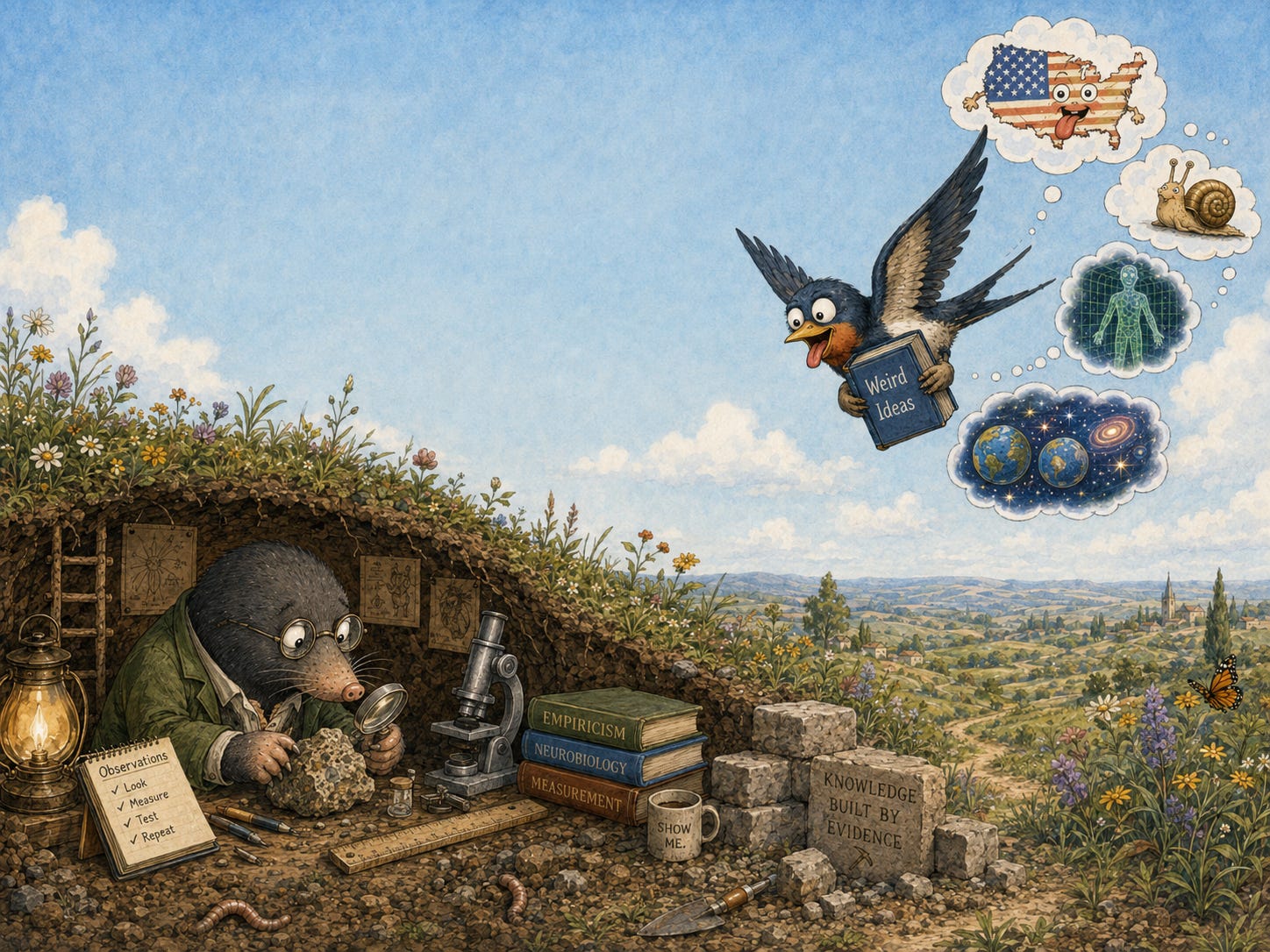
There are two kinds of philosophers: swallows and moles. Swallows love to soar and to entertain philosophical hypotheses at best loosely connected with empirical knowledge. Plato and Gottfried Leibniz are paradigmatic swallows. Moles, on the contrary, rummage through mundane facts about our world and aim at better understanding it. Aristotle, William James, and Hans Reichenbach are paradigmatic moles.
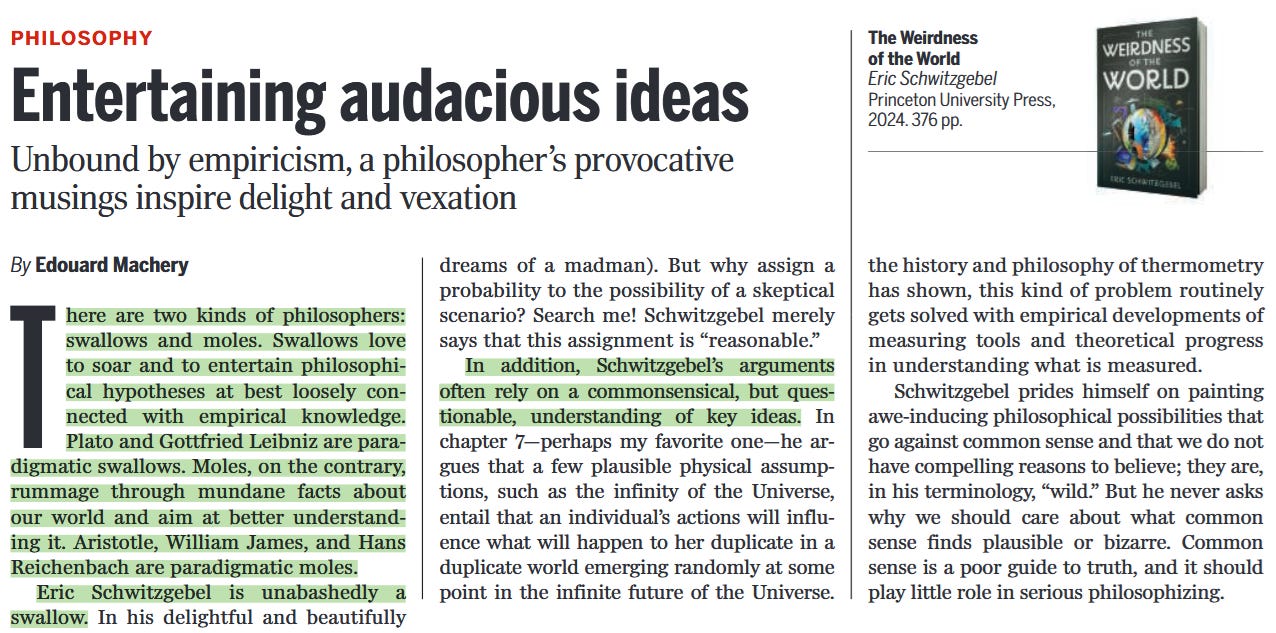
Machery is well-known for his usage of psychological methods to study philosophical intuitions — that have shown armchair theorizing of philosophers to be entirely unreliable — and so it won’t be surprising that he considers himself a mole. He notes that his own writing has been aimed at curtailing “the flights of fancy with which contemporary philosophers are enamored” and accordingly was largely critical in his review. He writes that “Schwitzgebel’s arguments often rely on a commonsensical, but questionable, understanding of key ideas” from science, leading to wild speculation, such as whether the United States of America is conscious.
Machery does not hold back on this point:
Schwitzgebel prides himself on painting awe-inducing philosophical possibilities that go against common sense and that we do not have compelling reasons to believe; they are, in his terminology, “wild.” But he never asks why we should care about what common sense finds plausible or bizarre. Common sense is a poor guide to truth, and it should play little role in serious philosophizing.
Finally, Machery concludes his review with the somewhat barbed compliment that if you enjoyed reading “Philip Goff, then this book is definitely for you,” but warns the moles of the world that the book is not for them:
It is brilliant, thought-provoking, and very enjoyable. But card-carrying moles who want to see philosophy add its stone to the ever-growing edifice of knowledge might be left dissatisfied.
[I have criticized Goff’s speculative views on consciousness elsewhere:]
Even the title of Machery’s review is ambiguous. Describing Schwitzgebel as ‘audacious’ could be read as a compliment for his boldness to go to new places, but also describe a kind of recklessness and a lack of proper respect. Swallows, unfortunately, show little respect for the intellectual achievements of science and even less for its actual outputs, being largely ignorant of what science has to say on the questions they are trying to answer.

While people often think of the history of philosophy as a long series of wild speculation that had little concern for empirical knowledge, that’s not quite right. Moles have always existed.
Aristotle, whom Machery identifies as a mole, spent much of his time observing the natural world and ended up writing some of the first systematization attempts of the living world, which made him the father of biology in the eyes of many — something we have unfortunately largely forgotten.
Hans Reichenbach was an incredibly influential philosopher who published a book in 1951 titled The Rise of Scientific Philosophy, in which he argued that the scientific revolution finally allows us to leave behind the speculative philosophy of the past, which merely asks questions without ultimately answering them. Here is a lovely passage from it that nicely captures the spirit behind much of my recent criticisms of non-naturalistic philosophy:
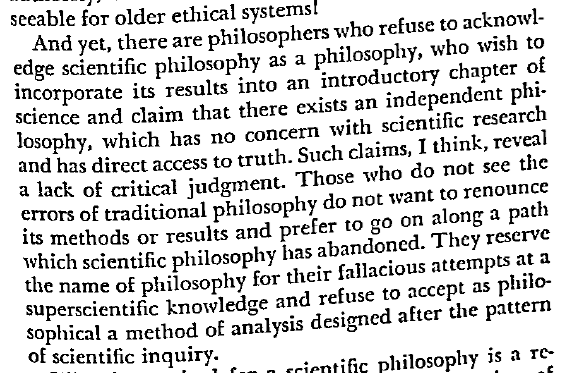
Despite disagreements in the detail, I could hardly agree more with Reichenbach’s general vision for philosophy, which stands in stark contrast to that of Schwitzgebel.
[Ironically, Reichenbach is my academic 3rd great-grandparent (5 generations back through academic supervisors), which I learned when I dug a bit through the history of my lineage:]
Admittedly, Schwitzgebel doesn’t want to “reserve the name of philosophy” for non-naturalistic philosophy. The swallows of philosophy have increasingly given up on that goal. However, the many swallows housed in philosophy departments do want to preserve the label philosophy for all “their fallacious attempts at superscientific knowledge.”
Like Machery, I respect Schwitzgebel, and I, too, agree that his writing is makes for a mind-bending and enjoyable read. But I don’t think it is philosophy. It’s more akin to a science-fiction novel that bends the rules of reality, but shouldn’t be taken seriously as telling us anything about the actual world. Schwitzgebel, of course, is more than competent in doing actual philosophy, masterful even. He has frequently dealt in deeply naturalistic work, even conducting empirical research himself. And so he is a good foil here, since his case shows that swallows can become moles. While I think that philosophy has no need for swallows, indeed, must ‘purge’ itself of swallow-like flights of fancy to become respectable again, no one is prevented from becoming a mole and doing serious work.
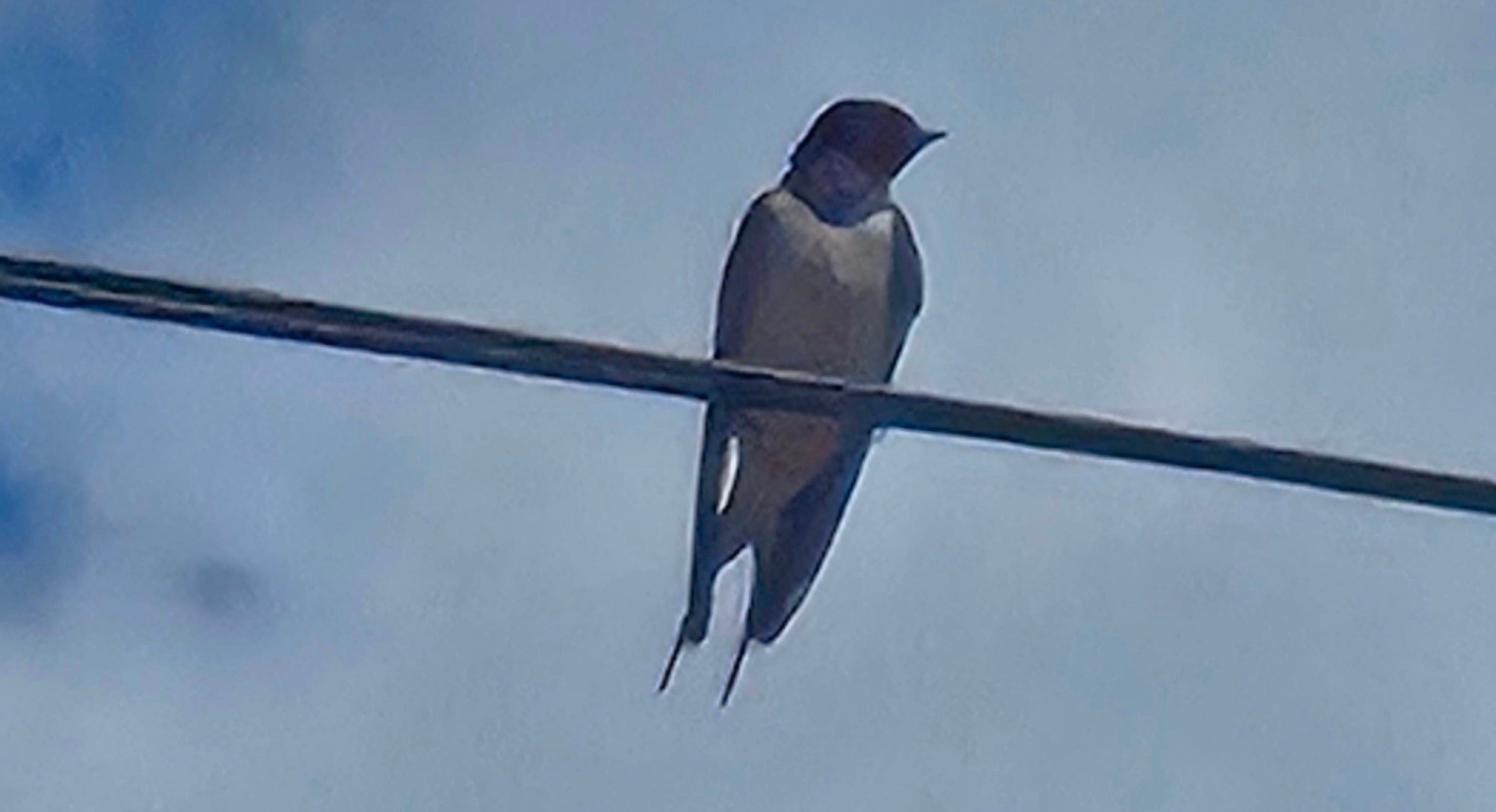
Machery’s metaphor is unfortunate, of course, for a multitude of reasons. After all, animals do not metamorphose into other species. I and many other philosophers are also animal lovers. How could anyone want to get rid of swallows? Don’t we want a diverse ecosystem? Furthermore, given the choice between being a swallow soaring through the skies or a mole burrowing in the dirt, philosophers uninterested in finding themselves constrained by science will feel themselves vindicated. Swallows are free. They can explore the whole world, whereas moles can only ever explore parts of it. Worse, moles have poor vision. So it might be read as a kind of self-own of Machery to describe himself as a mole.
But there is a better way we can think of the difference between moles and swallows here, and it is ironically one provided by Schwitzgebel himself in the final paragraph of his book:
Childlike philosophy toys with wild ideas at the boundaries of our understanding. Are these ideas useful or true? Can we plug them in straightaway into our existing conceptions and put them to work? For me, if I was already sure they were false and useless, that would steal away their charm. But to be in a hurry to judge their merits, to want to expunge doubt and wonder so as to settle on a final view that we can put immediately to work, to want to close rather than open—let’s not be in such a rush to grow up. What’s life for if there’s no time to play and explore? - Eric Schwitzgebel
Rather than thinking about the two kinds of philosophers as swallows and moles, I believe it is more useful to think of them as placed at different stages in the maturity of philosophical development. Children and adults. Child-like and mature philosophy. Or in Reichenbach’s terminology, the ‘speculative philosophy’ of the past and the ‘scientific philosophy’ of the future.
Children engage in wild speculation entirely untethered from the knowledge humanity has accumulated. Even logic is thrown out of the window. As adults we look at their innocence and curiosity with nothing but encouragement and love. But if an adult fails to distinguish imagination from reality the only response left is pity. Child-like philosophy is but one step in one’s development as a philosopher. But eventually it is time to grow up.
Earlier in his book, Schwitzgebel writes: “It would just be too sad if the world had no space for speculation about wild hypotheticals.” Sad that may be. But no one is trying to ban wild speculations. They are just no longer viewed as philosophy and should thus be confined to the fiction sections of book stores. They can still make for an enjoyable read and even hit best-seller lists nonetheless. Mature philosophy is also not against all speculation or diversity either. Science is filled with speculations that are motivated by what we have learned. Science is filled with bizarre and unintuitive conclusions because intuitions and common sense play little to no role in the search for truth. But what would be a truly sad and pitiful state of affairs is if “wild” speculations entirely unconnected from the sciences were continued to be viewed as serious philosophy within the field. For it would justifiably lead to the continued decline in the respect philosophers once held. It would undermine the status of philosophy as a serious academic field in search of truth.
If we are keen to experience the weird, diverse, and wonderful, one has to look no further than to the actual world.
My opening statement is a deliberate homage to that of James Ladyman and Don Ross in their wonderful book Every Thing Must Go: Metaphysics Naturalized. My attack here, however, is broader than theirs, not confined to metaphysics alone.
Please like, share, and subscribe. It helps a lot to reach a wider audience to discuss these ideas, even if you do not agree. Indeed, please leave your thoughts in the comments — regardless of whether you agree or disagree. I try to respond to all.
Comments
Nothing yet. Say the first thing.
Sign in to join the conversation.