
*Edit: I have sent apologies to the two academics who were originally named here as examples. Since my argument here rested on how requests for payments are deceptively framed, rather than monetization in principle, I thought it necessary to use actual quotes, but I now think that was unethical in itself. We don’t know their financial situations and using specific colleagues as examples for what I perceive as unethical behaviour damaging to the profession is itself ethically problematic, even with my disclaimers that I aimed to criticize a general problematic trend and not attack particular individuals. Accordingly, I have removed all names.*
When I started seriously looking into Substack as a platform earlier this year, with the aim of blogging regularly and building a community, I looked at many other academics, especially professors, to see how they ran things and managed to develop successful followings. There were plenty of commonalities, such as posting regularly, sharing things on social media, engaging with their audiences, and so forth. However, I also made two observations that I found quite strange, if not downright unethical:
Academics frequently ask for money in deceptive ways, suggesting that paid subscriptions are “necessary,” “supportive,” “allow them to,” “are helpful,” in order to do public philosophy, despite being in secure tenured positions.
Academics frequently paywall their “public writing.”
I have long pondered whether I should write this post, since criticizing other academics isn’t looked upon too kindly, but the institution of academia ultimately matters more than any individuals. To not call out unethical behaviour in our academic colleagues is going to lead to nothing but a loss of trust in the institution that we all depend on.
After several months of observing and reflecting on this platform, I have come to the conclusion that many academics are using Substack in an unethical way, or at least in a manner that violates the values they profess to hold. Such hypocrisy is dangerous for the public reputation of academia as a whole. This post should therefore be understood as coming from a place of love for academia. I only wish to preserve its reputation. So let’s look at the two cases here.
Case A: Academics frequently ask for money in deceptive ways, suggesting that paid subscriptions are “necessary,” “supportive,” “allow them to,” “are helpful,” in order to do write public philosophy, despite being in secure tenured positions.
That academics ask their readers on Substack to support their work with donations may seem innocent at first. After all, isn’t that the model Substack operates on?
I would have no problem if professors in tenured positions asking for paid subscriptions made plainly clear that they are keen to supplant their university income. At least that would be honest. Alas, many do not, couching their requests for paid subscriptions in language that suggests they’re dependent on this income to write for the public.
But professors are not like most other writers for whom that would be true. Indeed, we are quite dissimilar from freelance journalists, book authors, or the many hobby-writers that use their free time after work to share their ideas and thoughts. For we are already receiving a full-time wage in secure employment. (I am not talking in this blog post about academics in temporary positions.) And unlike employed journalists who may fear for their jobs in today’s volatile market, academic jobs are fairly secure once we get tenure. Essentially, we can write about whatever we like for the rest of our lives, with some time spent on teaching and the administrative tasks academic life brings.
And so I always found the usage of the same language of writers in much more precarious positions that actually depend on the income they earn with writing a bit distasteful. I am not implying that other academics are necessarily malicious. They may be entirely oblivious to their actions being unethical, much like an elderly person who may not even be aware that some racial slur is offensive. So I want to emphasize that I am not attributing any deliberate unethical behaviour to any of the professors.
Now to put my cynical hat on, do academics actually need the help of donations? I don’t know their personal circumstances, which may change things for particular individuals. But the annual salary of university professors is nothing to sneeze at, putting them comfortably in the 10% of highest income earners in the UK and US. But nothing stops academics or other professors from using the time they are paid for to engage the public, so why suggest otherwise?
I could understand why academics would have a greater incentive to spend more of their time on public-facing activities than on, say, writing journal articles aimed at other academics, but it remains unclear why “help” is necessary for them to expand their public work. After all, it would not remove their existing university obligations regarding teaching and administration. And so, such statements seem quite misleading.
Perhaps this is nothing serious worth calling out. But most other writers on Substack actually need help to make a living from writing at all. They cannot use the time spent in their regular jobs to write their newsletters. Using one’s paid university time to write a blog that one then asks others to pay for, therefore, seems like asking to be paid twice over.
But things become much more problematic when we move to Case B.
Case B: Academics frequently paywall their articles.
The pay-walling of academic writing aimed at the public suffers from the same ethical problems identified in Case A and more. Some academics paywall most of their pieces.
Putting everything behind a paywall is no doubt a great strategy for climbing the bestseller list, which counts only paid subscribers. Regardless of how many free subscribers you have, this has no impact on whether you appear in the rankings. To my great dismay, this creates the perverse incentive to make things less accessible to the public in order to appear in those rankings.
I do not believe paywalls for the public writing of professors are ethical. They violate many of the values that most of us academics usually stand up for.
The very point of being a public intellectual in academia, of public philosophy or popular science, is to educate and inform the public. One of the biggest debates in academia concerns the problem of paywalled journals. Almost all of us oppose the profit-driven nature of this enterprise, which prevents the widespread distribution of knowledge, especially in developing countries. Research, academics almost universally agree, should be freely available. For knowledge is a common good that humanity should share.
So why do academics suddenly change their position when they are writing for the public? If it is because they previously had to pay for journal articles or open-access fees, whereas they now stand to profit by hiding their own articles behind a paywall, that seems quite unethical, or at least hypocritical, when it is now them that stand to gain from the arrangement.
If even Ivy League professors feel the need to monetise their writing by placing it behind paywalls, our whole profession starts to look a bit hypocritical. Do we say what we do because it is true? Or could financial interests be at play? Actual intentions barely matter, because they can hardly be proven. What matters is that such behaviour can harm the collective reputation of academia as a whole.
So What Should Academics Do On Substack?
I believe that professors on Substack should neither ask for money, nor have paywalls, unless the following condition is met:
They donate all of their subscription income
This is an easy solution to all these problems, while not disadvantaging professors by the Substack algorithm.
This is how Peter Singer, the most famous ethicist in the world, handles his Substack income. He puts his money where his mouth is. And I think we should all emulate him.
About Paid Subscriptions
I do not need to earn income from Substack, but I’ve decided to offer a paid subscription option in order to support The Life You Can Save. If you wish to support my efforts, consider upgrading your subscription ($70/year), giving someone else a gift subscription, or contributing to The Life You Can Save
In the past, I very much struggled with the idea of introducing paywalled content. But to appear in the philosophy rankings and receive a much larger viewership, one needs paid subscribers, so I found myself in a dilemma.
I found paywalls unethical, but hoped to make it onto the top 100 ranking at some point, which features unfortunately only few actual philosophy professors — a embarrassing state for our discipline, really, given the not too small number of professional philosophers that regularly write excellent essays. The solution I came up with for myself was to put occasionally put a new blog post behind a paywall for a few days before I made them public, and to offer free pdf copies of my books. [That offer still stands by the way:]
I also promised to donate at least half to a charity:
Since I am writing a book on shrimps at the moment, I’ll donate at least half (if not all) to shrimp welfare causes at the end of the year. :)
But I’ll now officially pledge that I will donate all of my subscription income at the end of this year. For maximum transparency, 50% will go to the Shrimp Welfare Project and the other 50% will be donated to FarmKind.
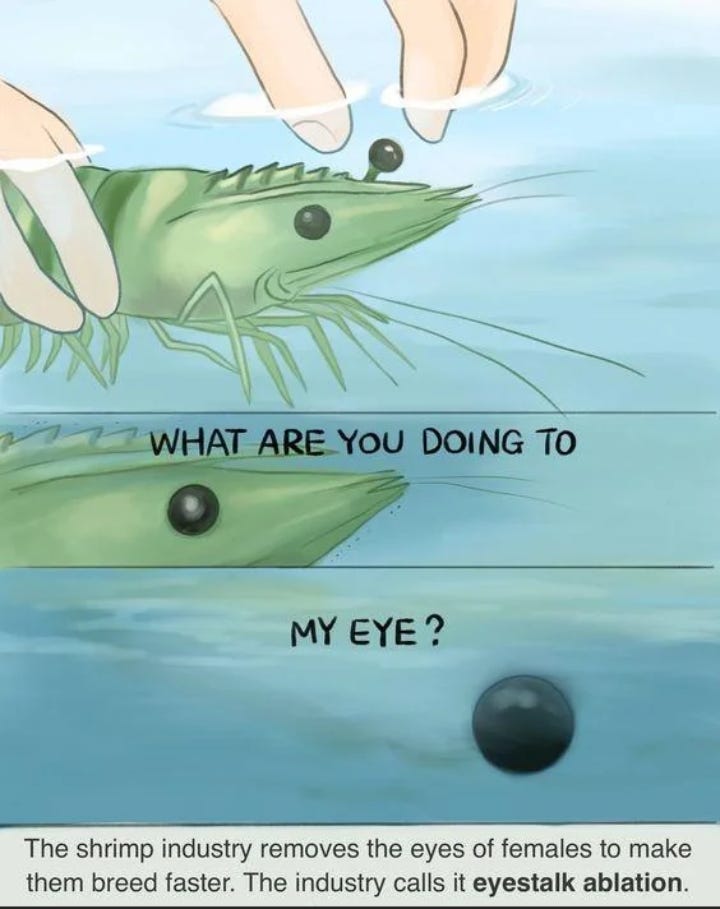
Why shrimp? I admit that it would be easier for me to convince people to become a paid subscriber if I gave all the proceeds to a charity for dogs. But almost all donations to animal welfare already go to dogs and cats. What goes to farm animals, the animals with the worst lives in modern factory farms, is only a tiny proportion. But even here we spend most of our attention to the familiar animals we all know and love (even if purely as food): cows, pigs, and chicken. Almost nothing has gone to shrimp. Indeed, their welfare wasn’t even considered by anyone until very recently. That has led to some horrific practices like eyestalk ablation, which is the removal or crushing of the eyes of females to make them grow faster:
I’m currently writing a book on the mental lives of shrimps, which I hope will turn many readers to rethink their attitudes to these animals, and perhaps even donate themselves. The UK recently announced that they’ll ban the boiling of shrimps, lobsters, and crabs alive — but much more work remains to be done. For financial transparency, the Shrimp Welfare Project has graciously funded a grant to my university that has replaced my teaching and admin tasks for a year to write the book. None of that money adds anything to my income, I should add, it only means I don’t teach for a year.
Nevertheless, if you don’t want to see your money going to shrimp, the other 50% of my subscription income this year will go to FarmKind who try to improve the lives of all farm animals!
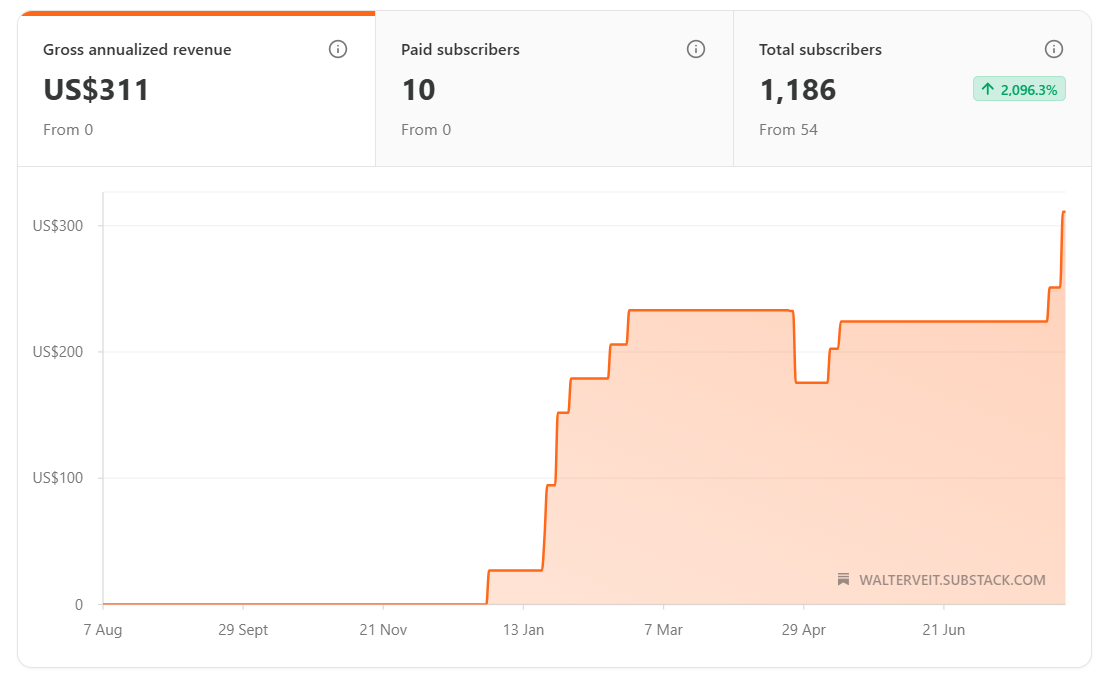
Currently, I have 10 paid subscribers and 311 USD to donate by the end of this year, which I am already proud of since I didn’t really offer much of a benefit to paid subscribers so far. But I hope to make it to reach 1000 USD by the end of December. It’s the season of giving after all.
If you want to support my blog (and irregular podcast) in reaching the philosophy bestseller list, while also seeing your money help animals in need rather than, to put it polemically, simply filling the pockets of academics who are probably already much richer than you, please consider becoming a paid subscriber or gifting a subscription to someone you think might enjoy my posts.
Substack also offers the option of becoming a “Founding Member”, allowing you to contribute any amount above the regular subscription fee. Again, even if you’d donate a million here, I’d donate it all to charity. And so should other academics, who are estimated to earn millions, or at least a good proportion of it. I believe this is necessary in order to preserve the integrity of academia itself.
The ultimate currency of academia is and should remain scholarly reputation, not income. If you want to be rich, I’m tempted to say, choose a different career. That’s not the point of being an academic. Otherwise we all lose our credibility as intellectuals employed in institutions allegedly dedicated to the pursuit of objective truth. Tenure was designed to give us the security to do so, not to serve as the starting point for a second career.
Please like, share, and subscribe. It helps a lot to reach a wider audience to discuss these ideas, even if you do not agree. Indeed, please leave your thoughts in the comments — regardless of whether you agree or disagree. I try to respond to all.
Comments
Nothing yet. Say the first thing.
Sign in to join the conversation.