
Donald Trump has done something truly amazing: he has united pretty much all Canadians — well, all of us except Danielle Smith and her ilk — in an overwhelming desire to retaliate against him despite the (short-term) damage it will also do to us.
Even CPC leader and Prime Minister in wanting, Pierre Poilievre has come out in support of both walking away from negotiations and dollar-for-dollar retaliation, although it is interesting to note that Jamil Javani continues to be a thorn in his side as he continues his own (unofficial) campaign to take over as party leader.
Indeed, the CPC should be supporting retaliation because as pointed out by former Alberta Premier Jason Kenney in a tweet — which I found in David Akin’s latest news roundup — they campaigned on it during the last election:

Jason Kenney 🇨🇦🇺🇦🇮🇱@jkenney
Reminder to Conservative friends who are opposed to retaliatory tariffs: you ran on imposing dollar for dollar retaliatory tariffs on the US in your election platform last year. It’s the commitment you gave to voters.

7:22 PM · Aug 23, 2026 · 96.8K Views
347 Replies · 694 Reposts · 3.49K Likes
Not only that, but the leader of the Parti Québécois has promised to not go through with a separation referendum until after Trump is out of power — which flies in the face of their 50-year assertion that Québec would be better off outside Canada. I guess they are only better off when times are good.
In short, we all recognize the necessary tradeoff of significant short-term pain for even more significant long-term gains, where those gains include protecting our (economic and political) sovereignty and making our economy both more stable and independent of external forces. And while people in the U.S. — including the media — have tended to not show much awareness of Trump’s attacks on us, they are quickly catching up on it now!
Indeed, as reported by Kenn Oliver for the National Post yesterday:
U.S. political leaders, including at least one Republican, are warning that President Donald Trump’s escalating trade feud with Canada will raise costs for U.S. families and businesses, while damaging a longstanding relationship with the nation’s closest ally.
The widespread criticism comes after Canada pulled out of trade talks late Friday night and promised 50 per cent U.S. tariffs on CA$20 billion in Canadian imports kicked in on Saturday.
These politicians are not even limited to those leading border states:
Virginia Governor Abigail Spanberger said Canada is Virginia’s No. 1 export destination and warned that the new tariffs would hurt families, farmers, producers, foresters and businesses “in a matter of days.”
“We have seen time and time again how President Trump’s careless, chaotic tariff policies have direct consequences for Virginians,” she posted on X. “They raise prices and destabilize relationships that our producers and businesses rely on.”
Colorado Democratic Senator Brittany Peterson acknowledged Canada’s decision to impose retaliatory tariffs while warning about the consequences of the trade war.
“It’s hard to imagine the long-term consequences to critical industries in both our countries due to this incompetent and unhinged president,” she wrote on X.
California Governor Gavin Newsom was decidedly more blunt.
“Our closest ally. Our critical trade partner. And Trump is hitting Canada with 50% tariffs,” he wrote. “What the actual f— are we doing?”
Now that most Canadians agree retaliation is necessary, how do we retaliate? I totally agree dollar-for-dollar tariffs is a good approach, particularly when they maximize the impact on the U.S. while minimizing the impact on Canadians. However, there are other options, as well, such as export taxes on Canadian natural resources, which I covered recently here:
There are also import quotas and voluntary export restraints, which I covered here:
But a lot of the talk lately is focused specifically on tariffs, so today I want to go through a theoretical model of tariffs which originally appeared in this newsletter roughly 19 months ago when Trump started his most recent war on humanity. If you are wondering how tariffs will affect different groups of Canadians, as well as how the burdens of these trade barriers could be distributed between countries, keep reading!
Basically, import tariffs generally benefit domestic producers at the expense of our consumers, because they raise the price of the tariffed goods whether the source is domestic or foreign. To further demonstrate the effects of tariffs on both the domestic and foreign economy, please see the graph below where I assume two countries — the U.S. and Canada — and Canada levies a tariff on orange juice coming from the U.S.
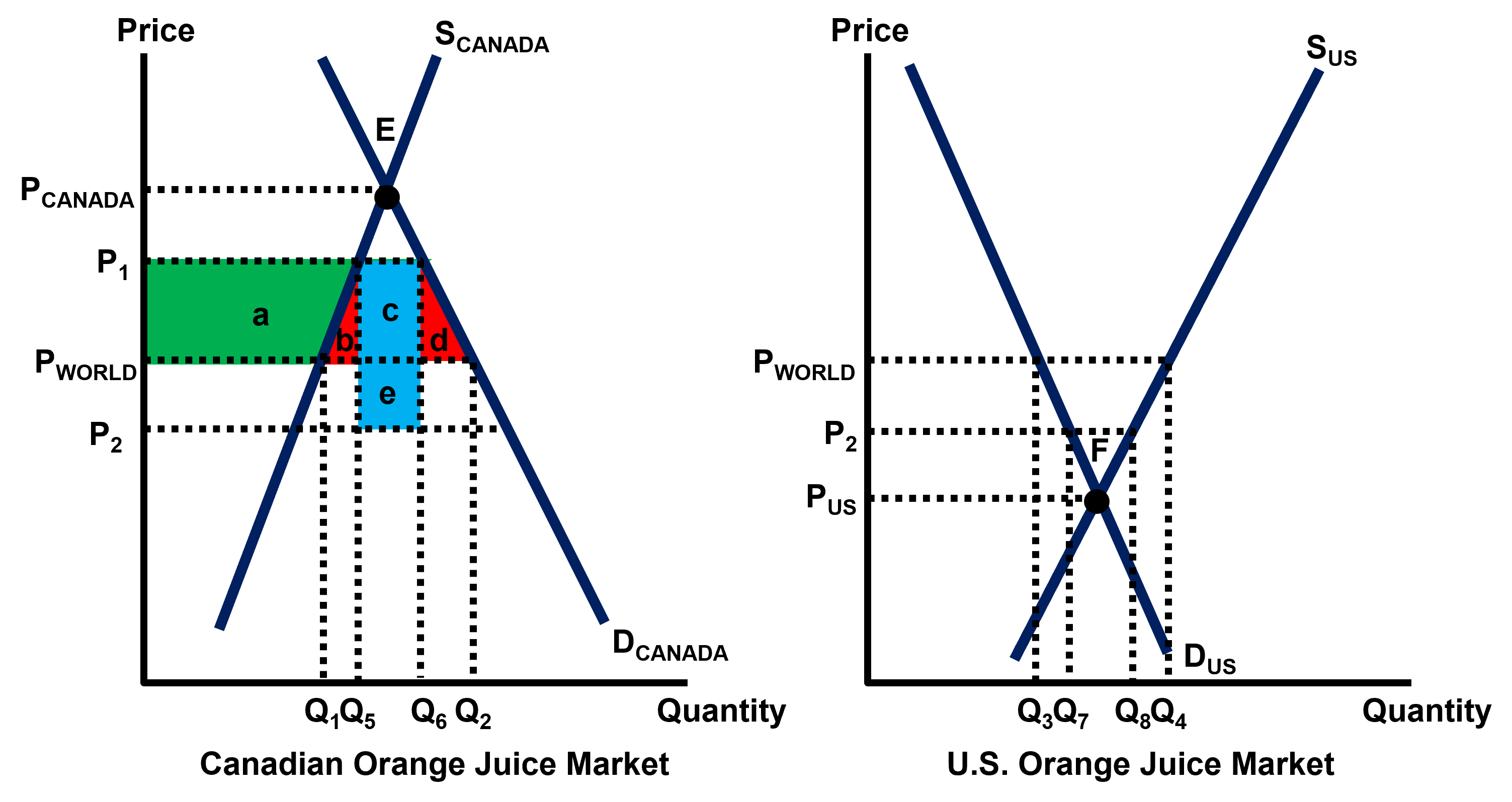
For an explanation of consumer surplus and producer surplus, as well as how the free trade equilibrium is found, see my explanation here. But in short, Canada and the U.S. begin at the autarkic equilibrium where there is no trade at all, and their prices are PCANADA and PUS, respectively. We then trade until the world price is equal across the countries at PWORLD, at which point there are no more gains from trade. At this point, Canadian consumers buy Q2 units of orange juice and Canadian producers sell Q1 units of orange juice, and the difference (Q2 – Q1) is imported from the U.S.
Since there are only two countries, exports from the U.S. (Q4 – Q3) must equal imports to Canada. Of course, there are more than two countries in the real world, but this assumption does not change the qualitative results explained below.
Canada then levies a tariff on imports of orange juice, which raises the Canadian domestic price to P1. I assume it is a per-unit tariff for simplicity, rather than a percentage rate, but the general conclusions that I will explain are unchanged.
Next, the world price will fall to P2, because we are an important customer to the U.S. orange juice producers, meaning they will lower their pre-tariff price of orange juice to keep our demand for it from going down too much.
The more important is Canada’s business to the U.S. orange juice market, the lower the world price will fall. If Canada is really super important to the U.S. market, then the price will fall by the entire amount of the tariff, meaning the U.S. will eat the entire tariff — i.e., it will incur the entire burden of the tariff.
On the other hand, if Canada is entirely meaningless to the U.S. orange juice market, then the world price will not fall at all, and the Canadian price of orange juice will rise by the full amount of the tariff.
Both extremes are unlikely because even though the U.S. is indeed a very important trading partner to Canada, we are still important to them despite what some U.S. politicians — and even some Canadians — are eager to shout from the rooftops. All of their complaints over our retaliations so far — including alcohol boycotts — are proof positive of that fact.
For that reason, I assume the world price only falls by part of the tariff, so the tariff is represented by (P1 – P2). Canada now imports (Q6 – Q5) = (Q8 – Q7) units of orange juice from the U.S.
Thus, U.S. consumers now pay a lower price for their own orange juice (P2), because if U.S. producers try to charge them more, U.S. consumers will want to import orange juice from Canada; on that note, it turns out we can grow oranges in Canada, although it is obviously not a big money-maker for us.
Now, how does the tariff affect Canadian consumers, producers, the government, and the economy as a whole?
Since consumer surplus is represented by the entire area below the demand curve and above the price, it falls by Areas (a+b+c+d). In other words, the tariff harms Canadian consumers because they must pay more for less (Q6) orange juice. However, the more important is Canadian business to U.S. orange juice producers, the less harm will be done to Canadians because the world price will fall more. This is an argument in favour of levying tariffs on stuff that will hurt the U.S. the most: it will hurt them much more than it hurts us.
Since producer surplus is represented by the entire area above the supply curve and below the price, it rises by Area (a). In other words, Canadian orange juice producers benefit from the tariff because they can charge more for more (Q5) units of orange juice. This area also represents a mere transfer of surplus from domestic consumers to domestic producers, since someone still gets the surplus despite the tariff. Furthermore, the more important is Canadian business to U.S. orange juice producers, the less Canadian producers will benefit from the tariff because the world price will fall more.
The Canadian government will also earn revenues on the tariff — although not from anyone in the U.S. because Canadian consumers pay the tariff. Like any other kind of revenue, tariff revenue is calculated as P*Q, so it is Areas (c+e). Area (c) is a transfer of surplus from Canadian consumers to the Canadian government. Area (e) is a terms of trade gain for the Canadian government at the expense of the U.S. market because it represents surplus that went to no one in Canada under free trade. The more important is Canadian business to U.S. orange juice producers, the more the Canadian government will receive in tariff revenues as the world price falls more, and thus the quantity imported will be higher for the same tariff rate. This is another argument in favour of levying tariffs on stuff that will hurt the U.S. the most: the more we hurt them, the more revenues the Canadian government gets.
There are also distortions (deadweight losses) in the economy that amount to losses in consumer surplus which no one in Canada gets: Area (b) is called a production distortion because the tariff encourages Canadian orange juice producers to produce too much for too much. Area (d) is called a consumption distortion because it encourages Canadian orange juice consumers to consume too little for too much. The more important is Canadian business to U.S. orange juice producers, the smaller will be these distortions because the world price will fall more. This is yet another argument in favour of levying tariffs on stuff that will hurt the U.S. the most: we can hurt them with minimal distortions to our own economy.
The more important is Canadian business to the U.S. orange juice producers, the greater will be the terms of trade gain, and the smaller will be the distortions. It is therefore conceivable that Canada could benefit overall from the tariff when the terms of trade gain outweighs both distortions. Therefore, the optimal tariff is the one that maximizes Areas (e - b - d).
I can now hear some of you telling me:
That’s all fine and good, but that assumes the U.S. does not hit back and make the trade war even worse.
And you are right! If the U.S. retaliates against our tariff — for example, with higher tariffs on our steel — then our losses in the steel market will at least partly offset the gains in orange juice. This is something Canadian governments must consider when deciding how to retaliate against the U.S. government for their aggressions against us.
Furthermore, if the product being tariffed by us is an input into something else — like steel and aluminum — then that will cause harm to Canadian markets that use that input to create their outputs.
In summary, in normal circumstances we should never retaliate against another country for their trade barriers because it could begin a trade war which no one wins in the end. In those circumstances, it is wiser to try to reason with them to either eliminate their trade barriers against us, or to at least to minimize the pain they are causing to us while still achieving whatever goals their barriers are meant to reach.
But these are not normal circumstances where the other country is simply trying to do something for their own benefit and we are unintentionally caught in the cross-fire, such as with President Obama’s “Buy American” policy. On the contrary, Trump and his acolytes have always been very open and honest that their primary motivations are to cripple us economically so they can make us the “51st state” and take control of our land and natural resources, including our portion of the Arctic.
We are not being caught in the cross-fire; they are purposely pointing the gun straight at our heads.
Other than to say we should try to hit them where it hurts them most and us the least, I will not get into great detail (right now) on what specific products we should target. But given all of the whining and complaining both Democrats and Republicans alike have been doing over our alcohol boycotts, it is clear those are products where we are harming them much more than ourselves. We do not need their wines and spirits at all, but they obviously need us to buy it.
And as I argued in the past, export taxes on our natural resources would likely be net-beneficial for us in the long run, even when taking into account the possibility of them preventing our own oil and gas from being shipped through Line 5 into Ontario. But as I also conceded in the past, such export taxes are unlikely to happen as long as Alberta Premier Danielle “Unprecedented National Unity Crisis” Smith and Saskatchewan Premier Scott “Whatever Danielle Said” Moe are in power.
Note that another theoretical option for retaliation is an export subsidy, which is a negative tariff because instead of the government charging the importer for whatever is imported, it is paying a domestic business to export more of its product instead of selling it domestically. These subsidies have historically been used to benefit European agricultural producers, and are so distortionary the WTO banned them.
The reason why they are especially distortionary can be explained by referring back to the effects of import tariffs: with tariffs, the larger is the country, the more revenue that government can earn relative to the distortions created by the tariff. But with an export subsidy, the larger is the country, the more the government spends to provide the subsidy. There is no possible way an export subsidy can have a net-benefit for the domestic economy.
Therefore, even if the WTO allowed export subsidies, we should absolutely stay away from them. I recommend sticking with the other options I covered in this article, and perhaps also domestic production subsidies.
Before signing off for today, even if you are not a fan of the industrial metal band Ministry, you might get a kick out of their latest music video. As explained by Fraser Lewry for Metal Hammer:
Ministry have released a video for We Hate, taken from the band’s upcoming final album Hate To Go – Take Out Or Delivery, and it’s accompanied by a video that pulls no punches in its depiction of US President Donald Trump.
“It’s pretty self-evident that Ministry has never been a big fan of ‘Hair Mussolini’,” say the band. “Especially now, as he bombards the American public on a near-daily basis with his self-aggrandising AI slop.
“We just felt it necessary to give ‘Trumplethinskin’ a dose of his own medicine. We present to you the video We Hate.”
The video includes several instances of AI slop being turned against the president, depicting him as a goat-cradling clergyman, sitting on a golden throne drinking “Hate Cola”, engaging in a passionate kiss with an ICE agent, and as fictional serial killer Hannibal Lecter. Amongst others.
The chorus of We Hate is sung in German, but translates as “He is a pig / He is a moron, / He is a thief”, while the female voice on the outro – also in German – paraphrases The Blond Beast – a character who represents the primal, predatory instinct of conquering humans – from philosopher Friedrich Nietzsche’s book On the Genealogy of Morality.
“[It’s] eerily predictive,” say the band. “But it doesn’t take a ‘Nostradumbass’ to know this is not going to end well.”
Even if you do not like the music, it is still fun to watch with the sound off.
In closing, I want to thank all of my paid subscribers for their subscriptions, and to encourage the rest of you to also consider paid subscriptions. I love to do research, but I also enjoy paying my bills, so a paid subscription would be very helpful in ensuring I can accomplish both.
No posts
Comments
Nothing yet. Say the first thing.
Sign in to join the conversation.