

Muses’ War: Fugue of Fire is out in the world, and I’m excited for you to read it. It seems that no launch, especially one where “The Big River Site” (as one of my author friends refers to it) is involved, goes by the numbers. Yes, we know the title has a little “extra” in it. At this point I’m just happy the back and forth didn’t delay the launch.
[Also, my ongoing admiration for She Who Makes Them Wear Pants at Raconteur Press (IYKYK) for her ongoing windmill tilting with The Big River Site to get the title and other things sorted.]
Now that Fugue of Fire has launched, I wanted to take a little time to talk about one of the structural ideas behind the series: the way I’m shaping Muses’ War as something like a literary symphony.
That seems appropriate, given both my background as a musician and the subject matter of the story itself. Muses’ War is, at its heart, a series about art, inspiration, creativity, corruption, and the cost of bringing beauty into the world. So it made sense to me that the structure of the series would draw from music—not just in the titles, but in the way the books are built.
Some of that is obvious. Some of it is less so.
At the broadest level, the series is arranged around musical forms:
Overture of Shadow
Fugue of Fire
Intermezzo
Scherzo of Madness
Finale of Radiance
To be a little more precise, that means four main novels, with Intermezzo planned as a collection of short fiction between Books Two and Three. Taken together, I want them to feel like movements within a larger symphonic work.
A symphony, at least in the way I’m thinking about it here, is a form of musical storytelling. Each movement has its own character, tempo, emotional color, and often its own internal structure. Yet as the movements unfold, they begin to reveal something larger than any single section could express on its own.
One famous example that comes to mind is Hector Berlioz’s Symphonie Fantastique. I am not going to turn this into a full music-history lecture—there are plenty of better places to go for that—but what fascinates me about that piece is the way Berlioz uses recurring musical ideas to tell a story.
The famous idée fixe, the recurring theme associated with the artist’s obsessive, unrequited love, appears across all five movements in different emotional forms. It is not merely repeated. It is transformed. It is made tender, ecstatic, distorted, grotesque. By the time the symphony reaches its nightmare vision of a witches’ sabbath, the theme has become something very different from where it began.
That is the kind of literary approach I’m trying to take with Muses’ War.
The recurring idea is not a single melody, of course. It is a set of questions:
What is the role of art in society? What is the nature of inspiration? How does inspiration shape creativity? How does creativity shape culture? And how do art, beauty, truth, and goodness become things worth defending?
Overture of Shadow is meant to do what an overture does: open the work. An overture sets the stage. It introduces atmosphere, theme, color, and expectation. It prepares the listener—or in this case, the reader—for the world they are about to enter.
So Overture of Shadow establishes the central motifs of the series: Muse-touch, artistic power, corruption, hidden history, love, sacrifice, and the danger of treating inspiration as something to be possessed rather than received.
Fugue of Fire, then, takes those themes and begins to work them contrapuntally.
A fugue is a musical form built around a subject that is introduced and then explored through multiple voices. Those voices may enter at different pitch levels, answer one another, imitate one another, invert the theme, develop variations, create harmony, or create tension. They remain distinct, but they are also part of a larger design.
When I say Fugue of Fire is structured as a fugue, I do not mean it is a literal one-to-one musical diagram. I am not pretending I have written Bach in prose. But the idea of a subject moving through distinct voices and using those voices to transform, challenge, and reveal something different about that subject is very much the principle behind the book.
Fugue of Fire begins in the immediate aftermath of the catastrophe at the end of Overture of Shadow. The veil between worlds has been torn. Eagle’s Wing, the kingdom’s greatest relic, has been sacrificed to bind that wound. What slipped through the breach is now loose in the world.
Breheimen is reacting not only to the catastrophe itself, but also to the hidden actions, old secrets, and institutional failures that made the catastrophe possible.
From there, the novel develops three primary “voices.”
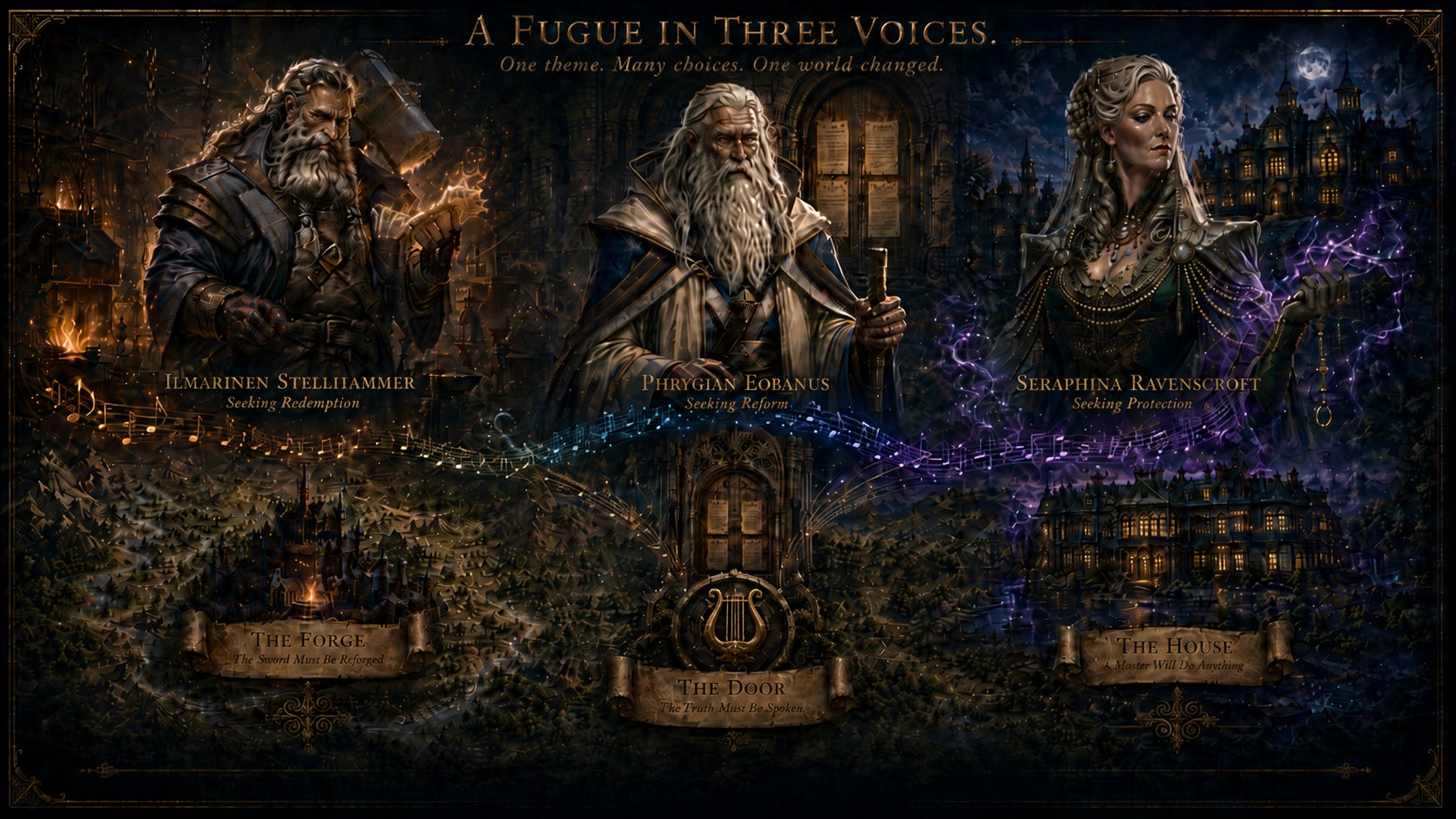
The first belongs to Ilmarinen Steelhammer.
Ilmarinen is looking for redemption. He wants to repair something he feels responsible for breaking, and that desire sends him on the quest to reforge the kingdom’s sword of state. He is supported by Dorian Silversong and Dorian’s new apprentice, Revan, but the central question of Ilmarinen’s arc is this:
When does the search for redemption become something else?
When does noble purpose risk curdling into pride, obsession, or control?
In this world, those distinctions matter. Intention has consequences. Creation has consequences. The question is not only whether Ilmarinen can make the sword, but what kind of spirit is being poured into the making.
The second voice belongs to Phrygian Eobanus.
Phrygian was a supporting and mentor figure in Overture of Shadow, but in Fugue of Fire, he faces his own crisis. He recognizes his complicity in leaving the world exposed to danger. As a senior figure within the Grand University and the Church of the Muse, he understands that the problem is not merely personal. It is institutional, theological, and cultural.
Yes, I am very deliberately drawing on the historical Reformation here, even to the point of Phrygian attaching theses to the doors of the Musae Seminarii.
But I was also careful with this thread, because I did not want the Church of the Muse to become a caricature.
I do not want to write the tired (and frankly, woke) version of “the church is evil.” Human institutions are vulnerable to human corruption, naturally, but people inside those institutions often act from conviction, fear, loyalty, love, duty, pride, and genuine belief in the rightness of their cause.
Phrygian’s story asks: if you know something must change, what are you willing to risk to say so? What does penance look like when the institution you love is also part of what must be reformed?
The third voice belongs to Seraphina Ravenscroft.
Seraphina has always had an agenda. She is accustomed to using wealth, nobility, influence, and power to get what she wants. In Overture of Shadow, she seeks control and fails, and through that failure, she places her daughter at terrible risk. In Fugue of Fire, she moves into full maternal desperation.
Her question is one I find deeply interesting: What is a mother willing to do to save her child?
Raconteur Press explored a version of that question a few years ago in the All Will Burn series of anthologies. I had a story in the first volume of that series, and it is a theme that can go to very powerful (and very dark) places.
Seraphina’s line in the fugue explores that darkness.
What happens when love becomes bargain, sacrifice becomes ambition, and protection becomes something unexpected?
Her story also sets up the continuation of the larger series. By the end of Fugue of Fire, there is a resolution, but there is also a clear sense that the next movement is ready to begin.
There are other voices and ornamentations layered into the fugue as well. King Siegfried has choices to make, and plenty of people in his ear to offer advice. The court has its own intrigues and pressures. William Cantoren, the king’s court bard, has an evolving role as advisor, truth-teller, and moral counterweight. Those threads are not the primary subjects of the fugue, but they add color, tension, and resonance around the main lines.
That, to me, is part of the pleasure and the challenge of writing this book. Multiple storylines have to remain distinct, but they also have to speak to one another. They have to create harmony in some places and dissonance in others. They have to build toward pressure. In musical terms, many fugues build toward moments of stretto, where the subject entries overlap more tightly and create a sense of urgency before resolution. Structurally, that is very much what I wanted the back half of Fugue of Fire to feel like.
The next major novel will be Scherzo of Madness.
A scherzo traditionally carries a sense of speed, contrast, and unpredictability. In practice, that instability can become nervous, volatile, violent, or uncanny, depending on the composer. That makes it the right word for the book where the series’ tension turns furious.
I am not promising guillotines, though Berlioz gives us one memorable musical example of fourth-movement violence in Symphonie fantastique. In that movement, the artist is marched to the scaffold, and just before the fatal blow, the beloved’s theme flashes back one last time and is cut off as the blade falls, complete with a descending arpeggio representing the head rolling into the basket.
What I am promising is that Scherzo of Madness brings the story to a crisis point.
And then comes Finale of Radiance.
A finale is exactly what it sounds like: the movement that brings the whole work to its conclusion. But a strong finale does not merely stop the music. At its best, it gathers what came before and makes the ending feel earned.
That is what I want for Finale of Radiance. The themes return. The conflict resolves. The cost of peace is finally counted. The corruption must be faced, and the world has to arrive at whatever new normal its people have fought, suffered, and sacrificed to achieve.
Before that, though, there will also be Intermezzo.
My current plan is to collect the existing Muses’ War short stories, add a few more, and release them as a collection later this year. The purpose of Intermezzo is to give readers a pause between the larger movements. It lets us change color, explore the edges of the world, catch our breath, and spend time with stories that are not necessarily part of the main symphonic line but still belong to the same musical world.
So that is the architecture I’m working with: a series built like a symphony, with individual books and stories acting as movements, and Fugue of Fire specifically structured as a fugue of three primary voices—redemption, reformation, and maternal sacrifice.
Whether I pulled it off is ultimately for readers to decide.
But I hope this gives you a little more context for how I’m thinking about the series, where these choices come from, and why music is not just decoration in Muses’ War. It is part of the design.
If you’ve read Fugue of Fire, I hope you enjoyed it. If you did, reviews on Amazon and Goodreads are tremendously helpful, and so is sharing the book with friends who might enjoy epic fantasy about music, magic, faith, art, corruption, and the cost of creation.
The Muses’ War continues.
No posts
Comments
Nothing yet. Say the first thing.
Sign in to join the conversation.