

The US and Saudi Arabia have signed what is called a 123 Agreement, facilitating cooperation on civilian nuclear power by providing an exception under the US Atomic Energy Act, alongside a bilateral safeguards agreement. Neither text has been made public, but the former will require Congressional approval, so we may see at least one of the two.
I only know about the safeguards agreement because the US Department of Energy released a press release on the two agreements on 22 July 2026. The press release says that the US is "upholding high standards of nuclear safety, security, and nonproliferation" and that the agreements will "reinforce global nonproliferation standards."
It is part of a broader Trump Administration policy embodied in Executive Order 14299, “Deploying Advanced Nuclear Reactor Technologies for National Security,” dated 23 May 2025. Section 8 of EO14299 requires pusuit of “at least 20 new 123 Agreements by the close of the 120th Congress,” which frankly is a lot. It also requires such cooperation will occur “through the use of safe, secure, and safeguarded nuclear technologies” (Section 1), which is good to hear, and, in Section 10:
This order shall be carried out in a manner which adheres to applicable legal requirements, conforms with nonproliferation obligations, and meets the highest safeguards and safety and security standards.
The agreements are meant to facilitate US investment in and profit from Saudi Arabia’s intentions to expand its civilian nuclear sector as part of a longer-term investment away from fossil fuels. However, Saudi Arabia has made it clear that they also will seek nuclear weapons if Iran builds them, and uranium enrichment and plutonium separation are two quick ways for it to achieve that aim.
Oddly, the DOE statement at the end says:
The agreement will now be transmitted to Congress for review.
So…not both? Only the 123, and not the bilateral safeguards agreement?
Saudi Arabia’s Ministry of Energy also released a three-paragraph statement on the US-Saudi Arabian agreement on 22 July 2026, with only one mention of safeguards (and no mention of the second bilateral safeguard agreement):
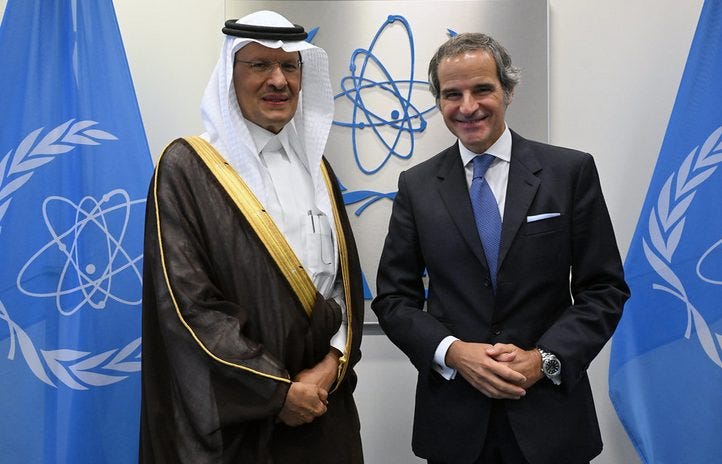
The agreement, signed by Saudi Minister of Energy and Minister of Industry and Mineral Resources Prince Abdulaziz bin Salman bin Abdulaziz and U.S. Secretary of Energy Chris Wright, aims to enhance cooperation between the two countries in the peaceful uses of nuclear energy and to facilitate the exchange of expertise, knowledge, and technologies, contributing to strengthening bilateral cooperation in accordance with the highest international standards of nuclear safety, nuclear security, and non-proliferation. It also reflects the shared vision of both countries to expand cooperation in energy and future technologies while supporting sustainable development.
Enjoying it so far? Why not share it?
My brilliant former colleague Amnah Ibraheem and I in 2023 explored the benefits and risks of the US establishing reinforced safeguards requirements in exchange for deepened civil nuclear cooperation with Saudi Arabia, as well as the Saudi Government statements on their nuclear ambitions. Basically, we laid out in 2023 that the US faced a conundrum: if the US insists on the most stringent safeguards principles for future Saudi Arabian nuclear power, would Saudi Arabia work with the Russians or Chinese who are much less likely to insist on such safeguards arrangements.
On that side of the leger, it is good to see that in the 23 July 2026 New York Times article on US-Saudi Arabia civil nuclear cooperation, journalist Mark Landler seems to understand that if Saudi Arabia pursues enrichment it will not be about the economics of civil nuclear power, but rather as a hedge towards potential future production of nuclear weapons.

William Alberque@walberque
Well, it's good to see more people understanding that if Saudi Arabia pursues enrichment it will not be about the economics of civil nuclear power, but rather as a hedge towards potential future production of nuclear weapons. @MarkLandler @nytimes 1/8
nytimes.com
U.S.-Saudi Deal Prompts Fears of a World With Looser Nuclear Rules

1:56 PM · Jul 23, 2026 · 830 Views
1 Reply · 1 Repost · 2 Likes
I can hold out some hope that the bilateral US-Saudi Arabia Safeguards Agreement will require it to negotiate an Additional Protocol to its Comprehensive Safeguards Agreement with the International Atomic Energy Agency (IAEA), but that is by no means guaranteed. If the US does not, then it will have decided to put commercial interests over longer-term US policy focused on preventing the spread of nuclear weapons and related technology.
Specifically, if Saudi Arabia does not pursue an AP in combination with any move towards enrichment or reprocessing rights, then it will be able to build a nuclear weapon clandestinely, as we have seen tie and time again (e.g., Iran, Syria, Libya, and Iraq). The AP was designed to detect cheating with enough time for the international community to take action.
In 2024, Saudi Arabia rescinded their Small Quantities Protocol (SQP) and activated their CSA, which is good. However, a Congressional Research Service in May 2026 detailed all issues for Congress in negotiating a US-Saudi 123 Agreement, echoing the arguments in our IISS report.
In all of this, Mark Landler's New York Times article omits any mention of the IAEA, safeguards, or the AP in a article that should highlight this topic, instead saying only that the deal limits "the sites that international inspectors could visit to ensure its peaceful intent".
I shall correct this omission!
NPT NNWS must negotiate safeguards with the @iaeaorg based on INFCIRC/153 (Corr.), which was promulgated in GOV/INF/276, but with the original Small Quantities Protocol (which, like the AP, was found to be inadequate). GOV/INF/276/Mod.1 in 2006 provides an enhanced SQP but too late for Saudi Arabia’s CSA.
Saudi Arabia joined the IAEA on 13 December 1962 and deposited the NPT on 3 October 1988, signed its CSA and SQP (INFCIRC 746) on 16 June 2005, implemented from 13 January 2009. Saudi Arabia rescinded the SQP and activated the CSA on 31 December 2024.
However, Saudi Arabia does not have an AP (INFCIRC/540), and has joined with other Arab States in blocking requirements for additional safeguards in IAEA and NPT fora. That does not bode well, especially with future enrichment and reprocessing plans.
The era of controlled proliferation is here. I am not happy with the US supporting the development of enrichment capabilities without an AP and forgoing reprocessing. I think Tom Moore agrees, and based on the New York Times quotes, perhaps Vipin Narang and Gary Samore agree?

Tom Moore, Nuclear-Capable Wonk@PaperMissiles
Because the administration actually favors proliferation among friends. A big policy shift.

Tom Moore, Nuclear-Capable Wonk @PaperMissiles
Here we are, about to bomb a potential Iranian uranium enrichment site deeply buried under Pickaxe Mountain, and celebrating by giving Saudis a green light for uranium enrichment, all in the same weeks or months.
4:02 PM · Jul 22, 2026 · 2.12K Views
3 Replies · 2 Reposts · 14 Likes
No posts
Comments
Nothing yet. Say the first thing.
Sign in to join the conversation.