
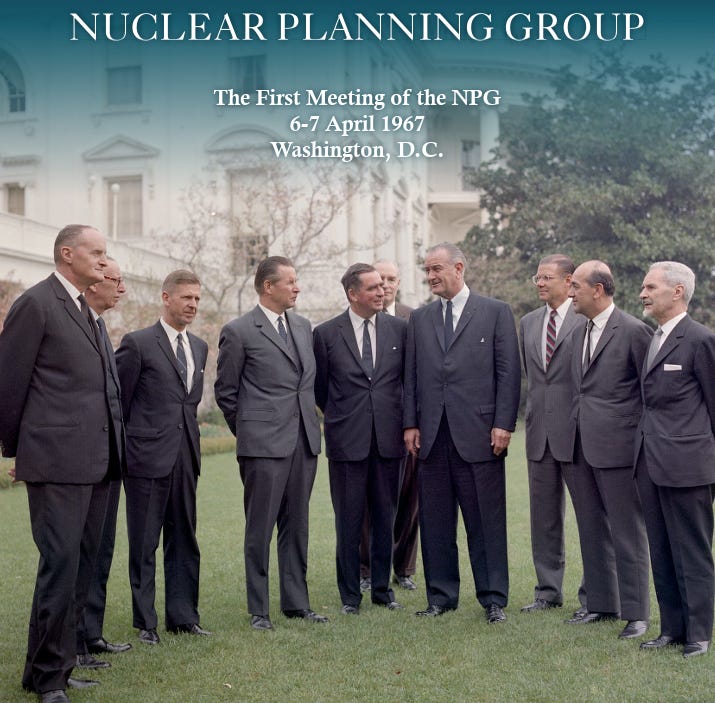
***UPDATE**** In light of our brand new NATO Nuclear Planning Group Communiqué on 18 June 2026, I thought I would also give a bit of a history to this particular form of communication. It’s been 19 years since the last NPG Communiqué, so I’m buzzing.
First, let’s read the text!
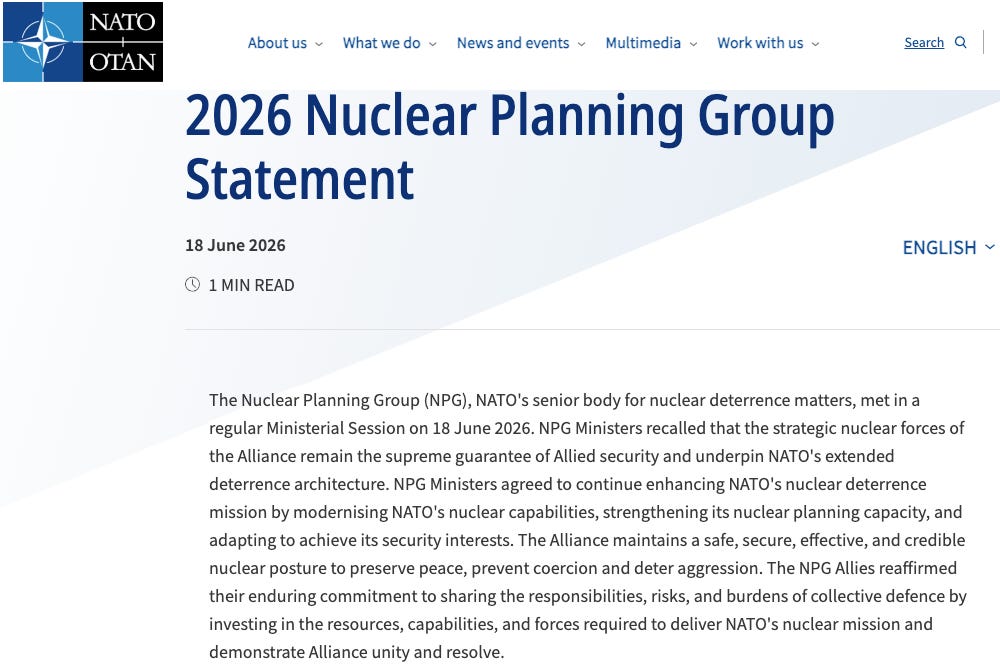
Knowing as well as I do the internal workings of NATO, I can assure you this was fairly hard fought, even though it says relatively little. I will analyze the wording in a bit, but let’s put this importance of this in context.
Now, when the Nuclear Planning Group was agreed by Defense Ministers on 14 December 1966, they announced its formation to the world. There was never any consideration of keeping it secret - it was meant to assure the Allies and tell the Soviets we meant business.
Ministers met as the Defence Planning Committee on 14th December, 1966. As a further step in the process initiated at Athens in 1962, they approved recommendations regarding nuclear planning and consultation, submitted by the Special Committee of Defence Ministers. They agreed to establish in NATO two permanent bodies for nuclear planning--a policy body called the Nuclear Defence Affairs Committee, open to all NATO countries, and, subordinate to it, a Nuclear Planning Group of seven members which will handle the detailed work
Want to read all about the history of the formation of the NPG? I got you covered (the cover of this declassified volume is the header-photo).
The NATO Defence Affairs Committee (NDAC) met a few days later, on 19 December 1966, and decided on the NPG membership. On to the USA! At their first meeting of the NPG on 6-7 April 1967 in Washington, DC, it finished with a communiqué, discussing its work, including developments in missile defense, tactical nuclear weapons studies, NATO nuclear sharing, nuclear planning, and announced their next meeting in Ankara in 1967.
These two issueances, the NDAC of 1966 and the NPG of 1967, set the pattern that continued with NATO Allies agreeing on the wording for a public communiqué after each meeting at the Ministerial level (Ministers of Defense) from the first one on 6 April 1967 right up until 15 June 2007.
Of course, NATO did not publish communiqués for working-level meetings, or even meetings in the format of Ambassadors, but for each Defense Ministerial NPG, there was a communiqué, with each word argued and debated by each of the members, and then published NATO Public Affairs for the world to see.
Key decisions, like atomic demolition munition use, participation in nuclear use planning, the use of tactical nuclear weapons for defence purposes, all in there. Maybe we will return to this level of transparency soon. Maybe not. But the record is not silent on this matter.
Also note that in the early days, there were only seven members of the NPG in order to keep things simple and fast and effective. This ended in 1979, when the NPG was opened to all Allies. This meant that the Nuclear Defence Affairs Committee, which was composed of all Allies and met once a year at Defence Minister level, had to endorse the NPG decisions for them to become official. The NDAC went away in 1979, once the NPG was open to all.
It should go without saying that France did not attend any NPGs or NDACs. Iceland did not start attending NPGs until 1987, when it observed for some meetings, and eventually attended as a full voting member. Invitees with the proper clearances (e.g., Spain) were allowed to observe during their membership finalization. Finally, it is worth noting that Denmark and Greece sometimes had…issues requiring reservations or other notations, as listed.
But the “brain-death” of NATO after the end of the Cold War, particuarly with the monumental folly of the Global War on Terror, resulted in dwindling interest in the NPG, both within NATO and among the publics. Nukes were out, and NATO dumped 98% of its forward-based nuclear weapons assigned to the defense of the Alliance, collapsing from 7,100 non-strategic nuclear weapons down to 100 air-dropped B61 bombs.
The Presidential Nuclear Initiatives of 1991 and 1992 were key to this change, as well as the mis-labelling of Russia as a key partner. The NPG statements from 1990 to 2007 tell the story, as Allies announced the massive reduction NATO had undertaken in light of the new security environment. That brings us to today!
Hard to publish something when you haven’t agreed to language in a while. They would have looked to the last NATO Summit Communiqué for agreed language, but the 2025 Hague Summit did not address nuclear weapons. So we have to go back to 2024 to the Washington Summit or even further to compare language.
the strategic nuclear forces of the Alliance remain the supreme guarantee of Allied security
This is pretty standard, dating back to the 1991 Strategic Concept and the 1999 Strategic Concept, as well as the 2022 version.
The next bit, if I had to guess, is cribbed from the new NATO nuclear policy, but compared to the 2024 Communiqué language and negotiated to bits.
NPG Communiqué (June 2026):
NPG Ministers recalled that the strategic nuclear forces of the Alliance remain the supreme guarantee of Allied security and underpin NATO’s extended deterrence architecture.
NPG Ministers agreed to continue enhancing NATO’s nuclear deterrence mission by modernising NATO’s nuclear capabilities, strengthening its nuclear planning capacity, and adapting to achieve its security interests.
The Alliance maintains a safe, secure, effective, and credible nuclear posture to preserve peace, prevent coercion and deter aggression.
The NPG Allies reaffirmed their enduring commitment to sharing the responsibilities, risks, and burdens of collective defence by investing in the resources, capabilities, and forces required to deliver NATO’s nuclear mission and demonstrate Alliance unity and resolve.
Let’s find where the language comes from. First, the Communiqué:
Washington Communiqué (July 2024):
Nuclear deterrence is the cornerstone of Alliance security.
Allies have reiterated their commitment to continue modernising NATO’s nuclear capabilities, increasing flexibility and adaptability of the Alliance’s nuclear forces, and strengthening NATO’s nuclear planning capability to enhance preparedness, while exercising political control at all times.
NATO remains committed to taking all necessary steps to ensure the credibility, effectiveness, safety, and security of the Alliance’s nuclear deterrence mission,
None
What about the NATO website, updated in May 2026?
Website (20 May 2026):
The strategic nuclear forces of the Alliance, particularly those of the United States, are the supreme guarantee of the security of the Alliance.
At recent summits, Allies have reiterated their commitment tocontinue modernising NATO’s nuclear capabilities, increasing flexibility and adaptability of the Alliance’s nuclear forces, and strengthening NATO’s nuclear planning capability to enhance preparedness, while exercising political control at all times.
NATO will take all necessary steps to ensure the credibility, safety, and security of the nuclear deterrent mission.
The Alliance ensures the broadest possible participation by Allies concerned in NATO’s nuclear deterrence, demonstrating the Alliance’s unity and resolve. For decades, Allies’ commitments and contributions to NATO’s nuclear deterrence have been a central part of NATO’s broader deterrence and defence posture, and a source for security and stability in Europe. These contributions represent an enduring commitment to share both the benefits as well as the risks and costs of nuclear deterrence.
So, you can see, the wording in the Communiqué has its roots in agreed language, but is a pick-and-mix, strengthening some parts and weakening others. Very interesting…I mean, to geeks like me. Non-NATO folks probably are busy yawning into their coffee right now.
So, because the NATO website has some errors in its listings and, frankly makes it hard to find all the NPG Communiqués, I put together a handy table with each and every one of them, including NDAC Communiqués. I also have made a brief summary of the topics for each meeting.
Nuclear Planning Group and Nuclear Defence Affairs Committee Communiqués, 1967-2007 (note the button for Page 2)
Good god, you finished another one of my posts? You must like it. Share it!
No posts
Comments
Nothing yet. Say the first thing.
Sign in to join the conversation.