

With Finland removing its legal barriers to nuclear weapon on its territory as of 1 July 2026, Lithuania is following suit. Lithuania is now deep in the process of amending the constitution, with the proposed change also removing the ban on foreign military basing in Lithuania.
The first stage occured on 3 July 2026, with the requisite number of Seimas (Lithuanian Parliament) members submitting a proposed amendment to the constitution, and the stage of the change occuring on 7 July 2026, with the amendment passing the first of two parliamentary votes. The second vote can only occur after a three month delay, putting it on the calendar in October, and thence to the President for signature.
How did we get here and what does it all mean? Allow me to explain.
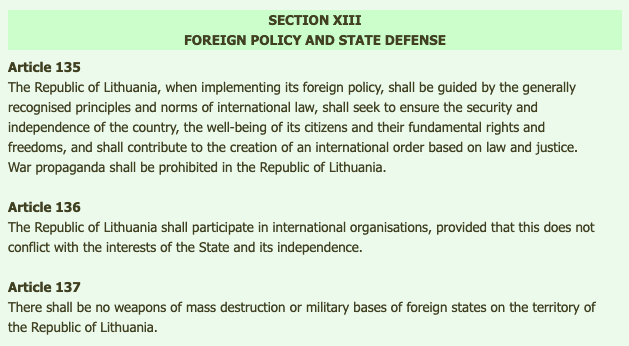
This latest chapter in the longer tale of Lithuania’s relationship with nuclear weapons hit the news on 19 May 2026 when Seimas speaker Juozas Olekas told reporters that it might be the right time to change the Lithuanian Constitution, which bans all weapons of mass destruction (WMD) from Lithuianian territory — as well as all foreign military bases, per Article 137:
Article 137
There shall be no weapons of mass destruction or military bases of foreign states on the territory of the Republic of Lithuania.

Olekas’ quotes in the Lithuanian media are worth reading, as he wants the debate on allowing nuclear weapons in Lithuania as part of a process of understanding what deterrence — and particularly nuclear deterrence — means to Lithuania.
a constitutional-level ban that prevents nuclear weapons from being present on the territory of the Republic of Lithuania in the event of a threat of aggression, in the event of aggression or in the event of collective defense does not correspond to the changed security environment and the national security interests of the Republic of Lithuania
Opponents of the change would prefer holding a referendum, but such a move would open Lithuania up to Russian pressure and disinformation, and is to be avoided. Olekas again:
This issue does not fall into the category that necessarily requires a referendum vote. Therefore, our initiative as responsible political leaders, it seems to me, is important, and knowing what the situation is, we can do it without a referendum
Olekas’ statement on the nuclear basing debate has a context.
First, as I mentioned, is the Finnish change to their laws allowing nuclear weapons to be placed on and travel through Finnish territory as I have described previously.
Previous Defense Minister Dovilė Šakalienė raised the issue on 13 March 2025 at the General Jonas Žemaitis Lithuanian Military Academy (I guest lecture there!), saying the Constitution could be changed to enhance deterrence. Current DM Robertas Kaunas said US nuclear weapons should be allowed in Lithuania in war crises:
"We believe that it is necessary to assess the possibilities for amending Article 137 of the Constitution of the Republic of Lithuania if our allies propose realistic plans for the deployment of nuclear weapons or their components in Lithuania and to review other obligations," she said at a press conference at the Military Academy in Vilnius on Friday.
Second, Russia has ramped up its nuclear signalling, reinforcing a hostile posture towards the West, and stationing nuclear weapons in Belarus. It also has conducted the most astonishingly aggressive nuclear-conventional exercise since the end of the Cold War in May 2026 and under the Union State Treaty and Military Doctrine, poses a direct threat to Lithuania.
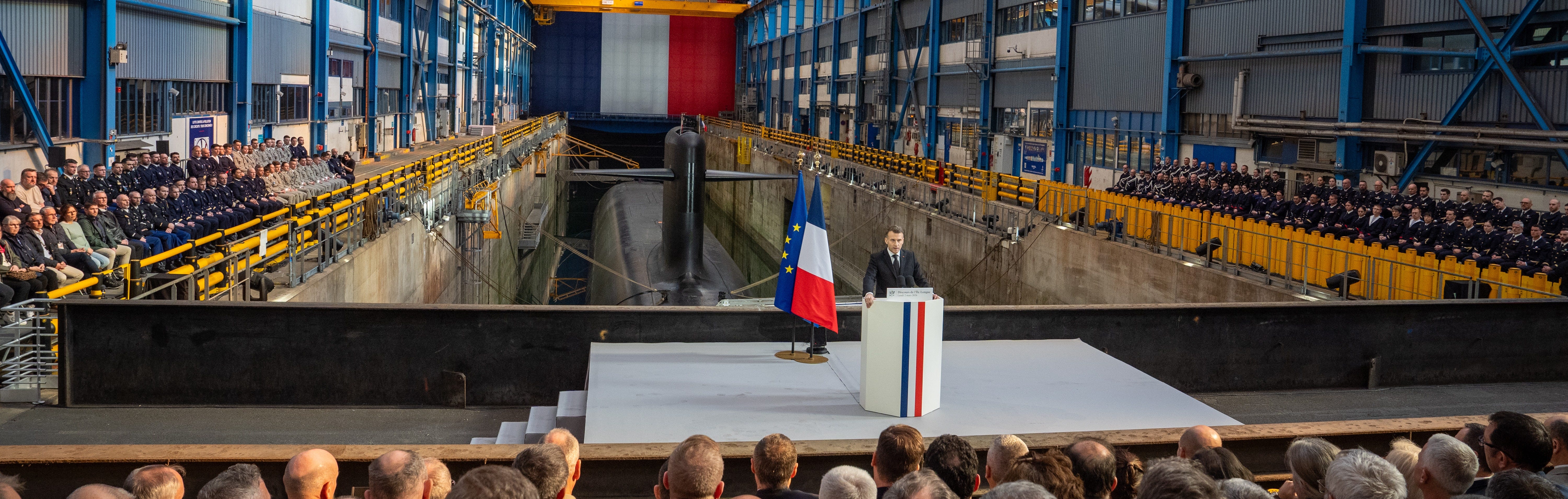
Third, this examination of deterrence comes in the context of NATO‘s nuclear guarantees and Emmanuel Macron’s 2 March 2026 offer of enhanced French deterrence to Europe, made in his speech at L’Ile de Longue submarine base.
It is worth reading the explanatory report submitted with the proposed change to the Constitution submitted by the backers of the change. It states that the 15 March 2011 ruling by the Constitutional Court of Lithuania prohibits military bases owned and controlled by foreign states, but that bases jointly managed by Lithuania and allied states are allowed. This was the necessary wiggle room to later ask for the NATO enhanced Forward Presence on their territory, including the US and German SOFA agreements. The report goes on to note that the Constitutional law included the Act “On the Non-Participation of the Republic of Lithuania in Post-Soviet Eastern Unions,” meaning that the loophole here does not apply to Russia or Belarus.
It goes on to address more fully NATO basing, SOFAs, and nuclear weapons:
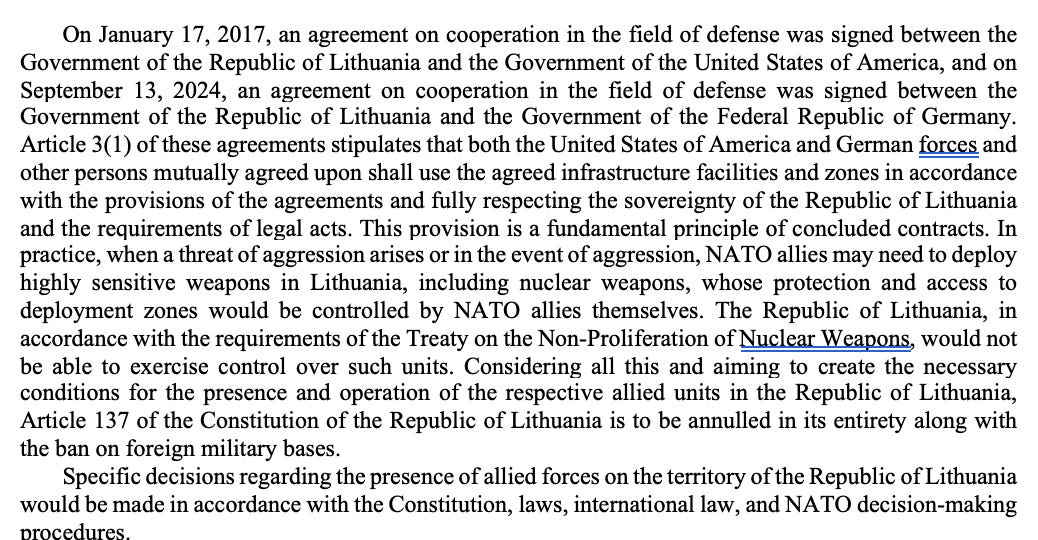
The report acknowledges that NATO may need to station nuclear weapons in Lithuania during aggression or threats of aggression against the state, but emphasizes that consistent with the Treaty on the Non-Proliferation of Nuclear Weapons (NPT), Lithuania would have no ability to control these weapons.
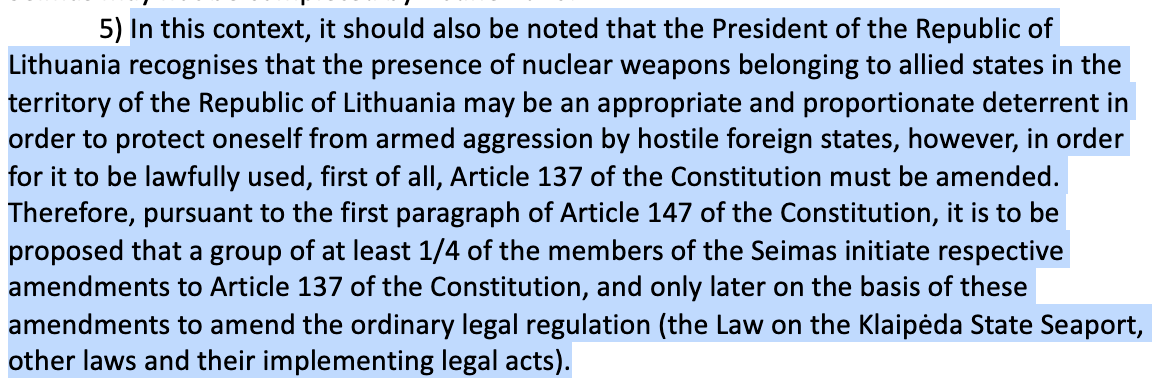
Okay, but why did Olekas raise the matter of changing the Consitution in the first place? Well, blame Klaipėda.
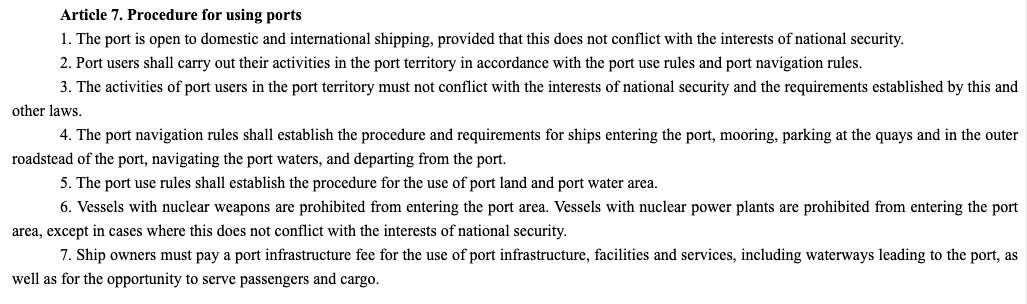
On 7 May 2026, the Seimas sent an amendment to the law governing the use of the port of Klaipėda for President Gitanas Nauseda to sign, providing an exemption for nuclear weapons to enter the port if in the national interest. The current wording of the Klaipėda prohibits nuclear weapons, in line with the Constitution:
Article 8, paragraph 3:
Vessels with nuclear power plants and nuclear weapons are prohibited from entering the port.
President Nauseda wrote a detailed reply, refusing to sign the law on the basis of the Constitutional ban on WMD, and sending it back to the Seimas for reconsideration. In his reply, Nauseda said that they cannot allow nuclear weapons into Klaipėda due to the Article 137 ban. He wrote that Allied nuclear weapons are an "appopriate and propotionate deterrent" for Lithuania, and instead proposed that the Seimas change the law to allow nulcear-powered vessels but to start the process to amend the Constitution.
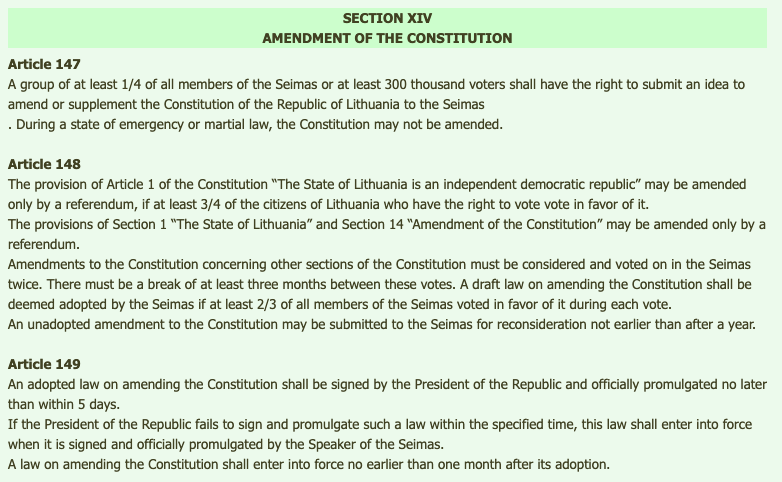
Section XIV of the Constitution, consisting of Articles 147-149, detail the procedure for amending the Constitution.
Article 147 requires 1/4 of the members of the Seimas (36 or more of the 141 members of Parliament) to sign a proposal to amend the Constitution. Only then can Klaipėda's law be so changed.
Article 148 says an amendment can pass if two-thirds of the attending members of the Seimas (which is 95 or more of 141 members with full attendance) vote for it twice, with no less than a three month break between the two votes.
Article 149 then says the President has 5 days to sign the law and it comes into force no earlier than a month later.
In the meantime, the Seimas followed all of Nauseda’s recommendations and amended the Klaipėda Law to allow nuclear-powered ships if it is in the interest of national security, 104-3. One imagines they will revisit this once (and if) the Constitutional change is complete.
Before we get to the hot constitutional action, surely your friends all would want to read this too, right? Right?
On 3 July, 50 Seimas members (34% of the Seimas, exceeding the 25% required) invoked Section XIV, Article 147 of the Lithuanian Constitution to begin the process of invalidating Article 137 and allowing nuclear weapons in Lithuania if and when it is in its national interests. And also to allow the establishment of foreign military bases on Lithuanian territory. It submitted its change to the Constitution:


As well as the explanatory report, as we discussed above. Note that Speaker Olekas, when discussing the amendment, said it should not allow peacetime nuclear stationing in Lithuania, but rather only in crises and wartime.
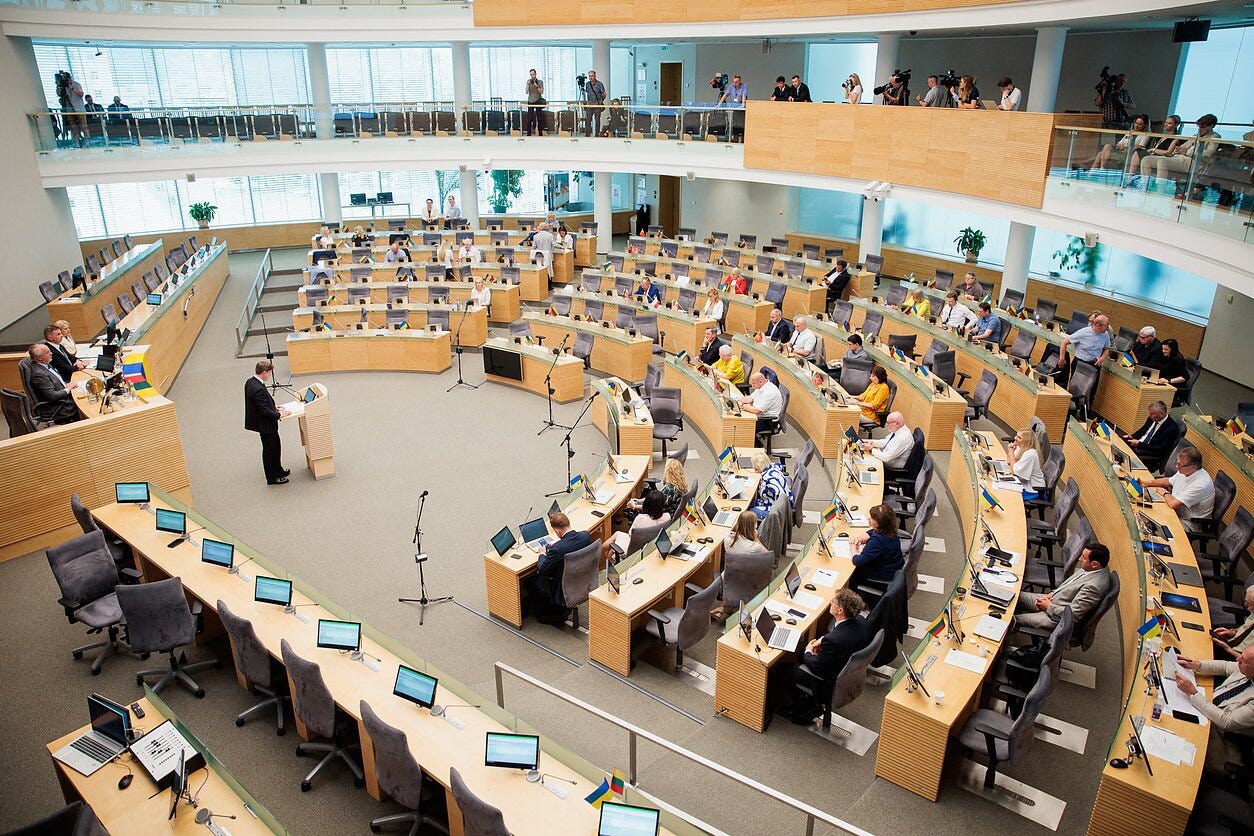
On 7 July Dainius Zebleckis of the Seimas Legal Department submitted his review of the proposed amendment, clearing it hot for a vote. The Seimas voted on the amendment a few hours later at 12:52:20 with 106 members registered as in attendance. This put the 2/3rds threshold at 71 votes: it received 89 votes for, 11 votes against, with 6 abstentions and 35 absentees. This puts the votes for the amendment at 89% (or 83% if you count abstentions), more than enough to proceed to the next stage.
The next sitting (the Fifth regular sitting of the Seimas 2024-2028 term) begins on 10 September 2026. Recall that Article 148 of the Constitution requires that the change also must pass a second vote no sooner than three months after the first, which puts it around 5 October 2026.
If the Constiutional Amendment passes the second vote (again, with 67% of Seimas members registered as in attendance), then it goes to the President for signature 5 days later, and goes into law after a month if unsigned.
Then, Lithuania will be allowed to host nuclear weapons on its territory and to host foreign military bases.
By the way, full credit to LRT for their excellent reporting. Just one thing, guys, some links would be nice. https://www.lrt.lt/en/news-in-english

That leaves only Iceland and Romania with legal bans on nuclear weapons on their territory. Countries like Denmark have politically-binding statements on the topic, but it remains in law in these two countries.
In Romania, I think it’s Law No. 111 on the Safe Deployment of Nuclear Activities of 10 October 1996, which, well, obviously requires all nuclear-related activity in Romania to be peaceful, and governs topics including:
holding, transfer, import and export of unpublished information relating to materials, devices and equipment pertinent for the proliferation of nuclear weapons or of other explosive nuclear devices
It also includes this absolutely wild section:
Article 46
(1) The decommissioning, manufacture, holding, import, export, transit, or detonation of nuclear weapons or of any other nuclear explosive devices shall be punished with imprisonment from 10 years to 25 years and interdiction of some rights.
(2) If the deeds provided under paragraph (1) resulted in the death of one or several persons, or in other particularly severe consequences, the punishment shall be of life imprisonment, or imprisonment from 15 to 25 years and interdictions of some rights.
(3) The attempt shall be punished.
The President of Romania, Nicușor Dan, as recently as March 2026 ruled out Romania hosting nuclear weapons on its territory, again in the context of the Macron speech and French troops taking part in NATO’s Forward Land Forces defending Romanian territory. The Foreign Minister, Oana Țoiu, is in talks with her French counterpart on Macron’s speech, with the Supreme Council of National Defense (CSAT) to make any relevant decisions.
Defense Minister Radu Miruță said the CSAT will analyze the benefits and risks of future deployments or deeper participation in the NATO and French nuclcear deterrent:
A presence of this nature on Romanian territory can also be interpreted as a deterrent measure and as an attraction of the target, because you have such a capacity here. Advantages and disadvantages are being analyzed.
The CSAT last met on 29 June 2026 to prepare for the Ankara Summit, discussing, among other topics:
ensuring a strong deterrence and defense posture and an appropriate military presence in the area and on the territory of Romania.
More as it happens.
For Iceland, it’s the Parliamentary Resolution on a national security policy for Iceland of 2016, amended in 2023, which reads in part:
11. that Iceland and its territorial waters be declared a nuclear weapon-free zone, taking account of international obligations, with a view to contributing to disarmament and peace
This despite the fact that Iceland is defended by the United States by the 1951 Defense Treaty. The latter can be changed by a simple amendment to the policy, but I don’t know if Iceland will do that.
Or maybe. We shall see.
No posts
Comments
Nothing yet. Say the first thing.
Sign in to join the conversation.