
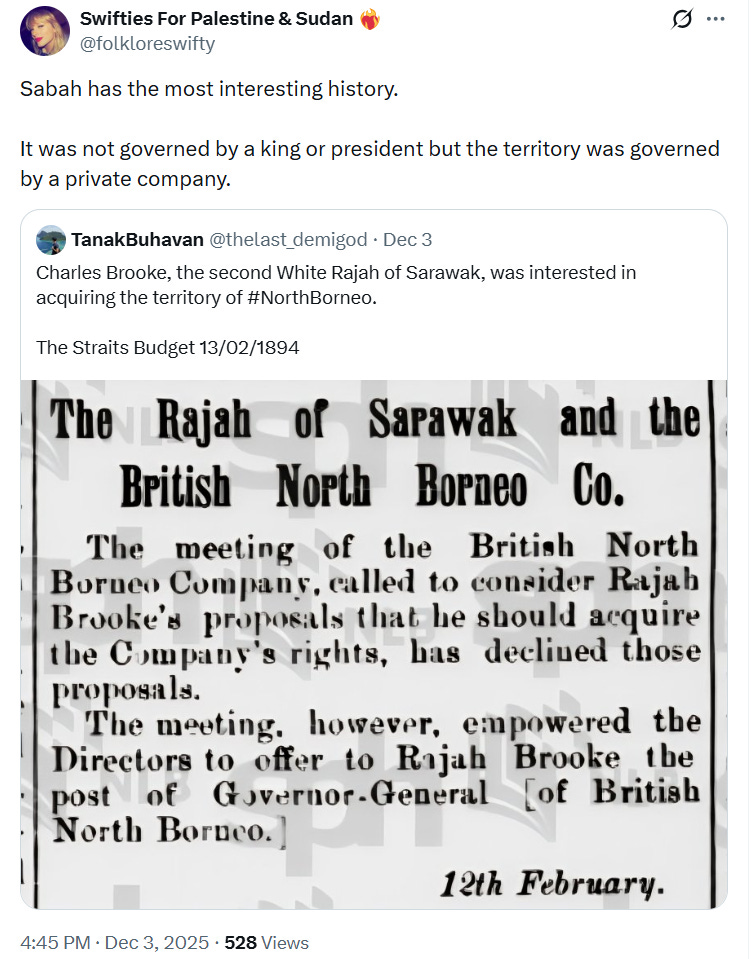
One of the most common misconceptions of the British North Borneo Chartered Company is that it was a “private” company that ruled over the territory that is today known as Sabah. This is misleading for several reasons and this is my attempt to spell out why.
Andrew Phillips and Philip J. Stern are two historians who specialize in the period that was dominated by what is called the company-states. These institutions played a key role in ushering in modernity as we know it and under their framework, the British North Borneo Chartered Company would be classified as one such example of a company-state. Both scholars argue that applying modern categories like “public” and “private” to early modern company-states (such as the VOC, EIC, Hudson’s Bay Company, etc.) fundamentally misdescribes the world in which these entities operated. And when it comes to the British North Borneo Chartered Company, the “public vs private” is an anachronistic frame as any for describing the relationship of the company-state to political authority and the people they governed.
This is largely because the early modern company-state was not yet “public” in the modern sense since modern political thought treats “the state” as a public entity that stands above markets and society. The state qua public entity is supposed to represent a unified sovereign authority—and in this case, sovereignty means that such authority is not rivaled by competing claims—that claims jurisdiction over all aspects within its clearly defined boundaries.
But this flies in the face of the political realities of the 16th–18th centuries when states were dynastic, patrimonial, and composite. In Sabah, political authority had always been fragmented even long before the first Europeans arrived. The Brunei Sultan’s mandala of influence often overlapped with the Sultan of Sulu’s claims over the fringes of Brunei’s reach. Authority was further divided by the various Dusun and Murut chiefs who were able to resist coastal encroachment into the highlands of the interior. “Sovereignty” — if we can even speak of such a thing in a Bornean historical context — was distributed among various rival sultans, wazirs, pengirans, penghulus and native chiefs all vying against each other and the newly arrived authority of the Company with its courts, estates, and administrative officers. Governance was not yet bureaucratic or standardized.
Thus, there was no clear category that corresponded to “public authority” as the modern administrative state defines it. If “the state” itself is not fully “public” yet, one cannot meaningfully call corporations “private.”
This is one of Stern’s key insights in The Company-State.
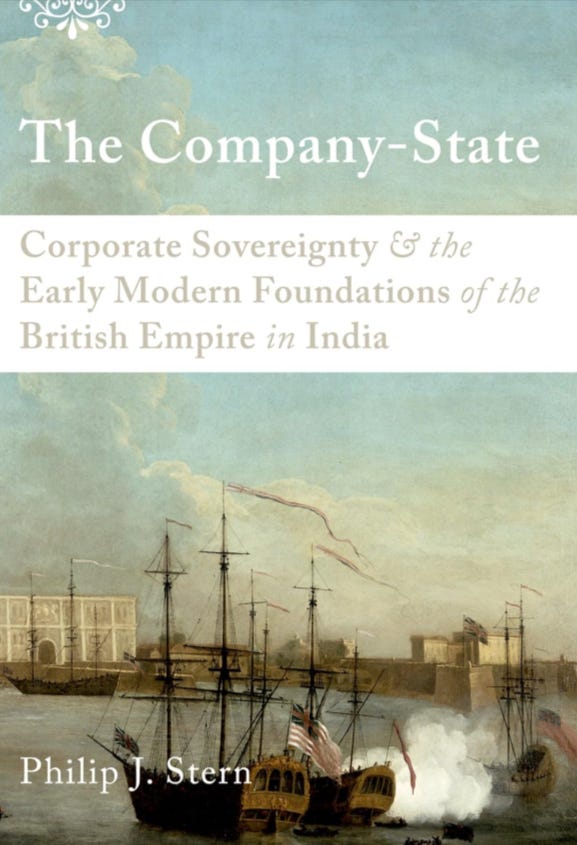
Secondly, we must also consider that chartered companies were part of the machinery of governance not corrosive of it. Companies like the EIC and the BNBCC could exercise judicial authority, taxation, policing, the power to declare war, territorial administration, and diplomatic relations with its neighbours. These powers are today associated with a public state but during the time of BNBCC, the company had assumed all of these powers of a state without acting in the interests of the public.
Th British North Borneo Chartered Company was not “a private actor doing public things.” These powers were inherent to the corporate form of the period. Therefore, it is more accurate to say that it was “a corporate actor doing corporate things.” Early modern corporations were political institutions. Phillips emphasizes this point in War, Religion, and Empire, arguing that companies helped create the international system by acting as “semi-sovereign” polities.
Thus, the modern distinction collapses: the company-states were neither fully public nor fully private since it could exercise powers of a state without being fully sovereign as a public state would normally be.
For a little bit of a historical background, in contrast to the company-state, the precursor to the chartered companies, the corporations such as universities, towns, guilds, and trading companies which were understood in Roman law as fictional persons created for the governance of a community were explicitly regarded as public in the sense of being chartered to govern a collective. But how can non-state actors said to belong to the public sphere? Additionally, calling some of them “private companies” retrofits a capitalist category to a historical context in which it didn’t yet exist. The chartered companies who would go on to become company-states would likewise have to be cut into its procrustean proportions to fit into either a modern understanding of the public or private spheres.
Moreover, the charters did not distinguish public and private powers. A charter to the BNBCC or EIC was not like registering a firm today. It was a delegation of jurisdiction by a monarch, often with:
monopoly rights to trade
authority to make law
authority to wage war
authority to govern subjects
Stern stresses that these grants were not deviations from normal political order instead they were normal ways of governing within a composite monarchy. What is a composite monarchy? A composite monarchy is a political structure in which a single ruler governs multiple distinct territories, each retaining its own laws, institutions, privileges, and political customs; rather than forming a unified state, the monarchy is a layered assemblage of semi-autonomous polities held together by personal union, negotiated authority, and differential arrangements that vary from region to region. What does means in practice is that when the BNBCC dealt with disputes with Dusuns who resided completely within their territory, they would act as a public adjudicator but if a pengiran of Brunei was causing trouble in areas under their jurisdiction, they had to appeal to the sultan as if they were a private entity.
Thus “public vs private sectors” makes no historical sense here. What would instead make sense is to speak of the specific rights that an entity was able to exercise in which territories.
There are also baked-in assumptions when using the terms “public” vs “private” which presupposes that the modern state is the natural end-point of political evolution and that company-states are incomplete or deficient versions of public authority. It paints company-states as though they were “proto-states” or “privatized governance” rather than a form of governance that exists outside of the public-private framework so commonly assumed in modernity. Both Stern and Phillips argue that this reads history backward. These entities were not precursors so much as they were constitutive of early modern governance preceding the split between the public and the private domains.
Thus, the modern public–private dichotomy only fully becomes a stable and widely presupposed structural distinction once a particular set of transformations crystallizes in the long 19th century.
So naturally the question arises: When does the public-private divide first appear? Both Stern and Philips agree that it emerges gradually after the 17th century, but it becomes institutionally real only when multiple processes converge.
Conditions that must be present for a genuine public–private dichotomy
A bureaucratic state with a monopoly on legitimate authority
A bureaucratic state has the ability to claim sole legitimate authority once it develops a centralized, hierarchical administrative apparatus, clear jurisdictional boundaries, and state officials distinct from household servants, retainers, guild officers, or chartered corporate governors as well as codified public law. The BNBCC indeed developed a centralized administrative apparatus but this was not enough to develop clear jurisdictional boundaries and state officials independent from chartered corporate governors.
This is a Weberian criterion. Before this emerges, corporation-states blur into governance that is neither public nor private.
A legally recognized sphere of property rights and private enterprise
The second condition for public-private to emerge requires the foundations of the private sphere to be established. The private sphere presupposes:
• individual property-holding
• contract law
• private firms separate from the state
• markets not regulated through guild-corporate authority or delegated sovereignty
This is solidified only with liberal commercial codes of the 18th–19th c. Since the BNBCC lacked a market that was free from the company’s control, nor was it able to guarantee contract law, the BNBCC cannot be said to be a public body.

The conceptual separation of “society” and “markets” from “the state”
This is the liberal transformation. ”Civil” society and the “free” market become a distinct domain of voluntary association outside the state and simultaneously protected by law. The liberal state is constituted by its recognition of individual rights. Without this conceptual division, nothing can count as “private.” What exists instead are collective rights or common rights that are neither public nor private.
The modern corporation as a private legal person
Building on the liberal revolution, crucial shifts can then occur at the organizational level: The corporation ceases to be a public body chartered for governance and becomes a private, shareholder-governed firm. These are unique legal innovations that were pioneered by the UK and the US:
• general incorporation statutes (U.S. 1811; UK 1844)
• limited liability (UK 1855–56; widespread by 1870s)
• separation of ownership and control
• the decline of “charter” as a political delegation
This is Philip Stern’s main argument: the older corporation belonged to a world where “private corporation” made no sense. Whereas today, corporations belong squarely in the private sphere due to these laws.
A cultural-ideological commitment to state neutrality
And lastly, the “public sphere” (as Habermas writes about) presupposes a neutral state arbitrating between private interests, the end of confessional, patrimonial, or corporate governance, and a notion of “public interest” defined apart from ruler or community.
Only here does “public” mean “acting in the name of the polity as a whole.”
The BNBCC could arbitrate as a neutral state when arbitrating between rival Dusun tribes but not when dealing with the sultan or his retainers. Furthermore, the notion of a public interest was scarcely imaginable when the polity as a whole was not considered to be united.

It is only during the period between the 1880s and 1914 that the dichotomy is fully normalized. This is when Weberian bureaucracy dominates, the difference between public and private law is codified, the private sector becomes the primary economic actor(s), states appear as unified actors in international relations, and privatization becomes thinkable as a transfer between two separate spheres. After this point, the dichotomy obtains as a default assumption.
The modern public–private dichotomy obtains only once the state becomes a centralized bureaucratic institution and the corporation becomes a private, rights-bearing market entity.
This occurs between the late 18th and late 19th centuries, consolidating in the period 1780–1880.
Before that, governance is corporate, patrimonial, and jurisdictionally plural, so the dichotomy simply does not describe reality.
No posts
Comments
Nothing yet. Say the first thing.
Sign in to join the conversation.