
By Harold S. Kudler, M.D.
Americans hearing that sailors aboard an aircraft carrier are in psychological distress will picture something from the movies. Guadalcanal. Dunkirk. Men under fire, and afterward the ones who carry it home. Movies have their place. But it isn’t what’s happening aboard the USS Abraham Lincoln.
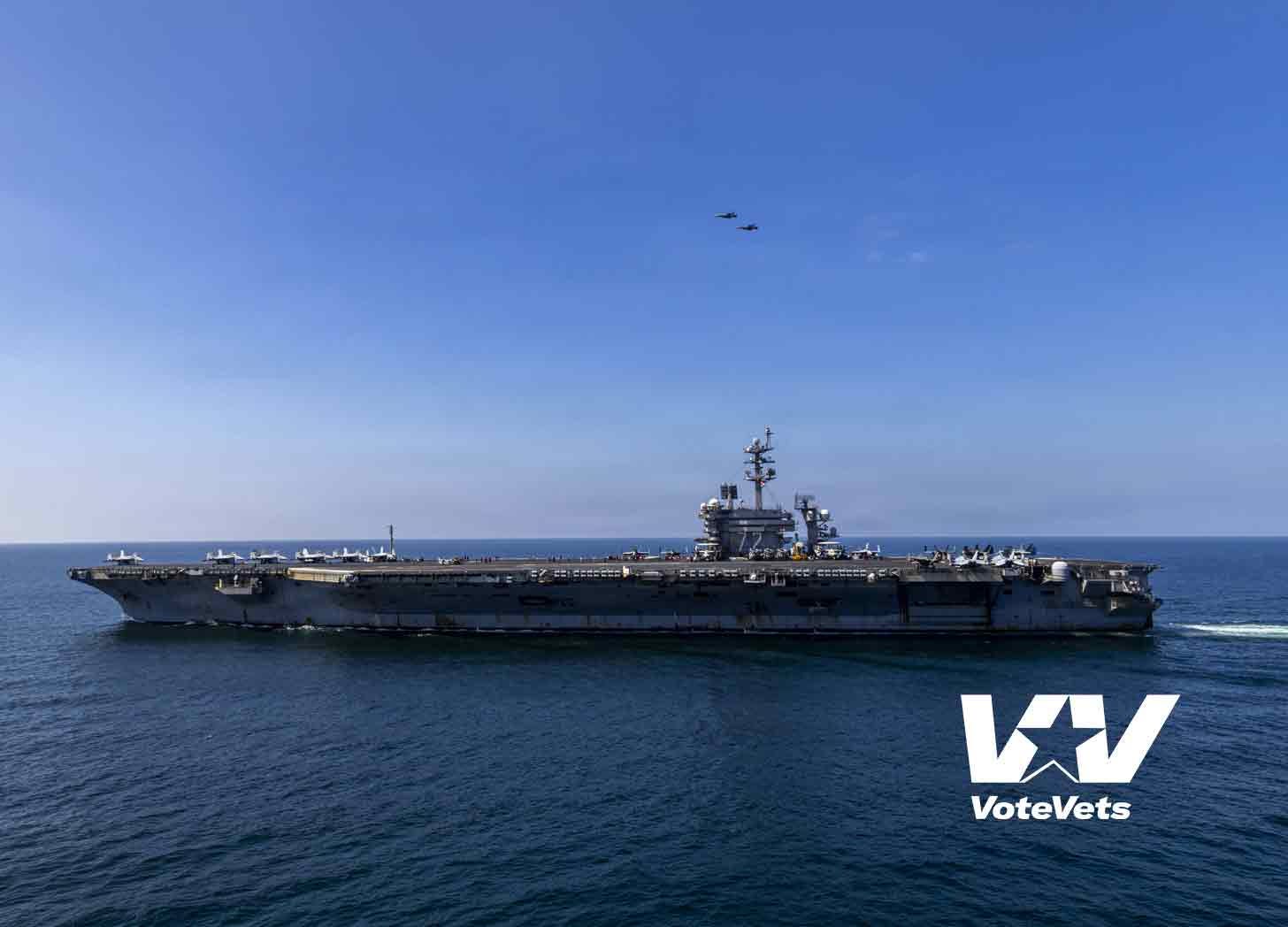
The Lincoln left San Diego in November on a deployment of about seven months. It has been at sea more than 250 days, upwards of 200 of them without a port call, extended twice, with no return date. A sailor went overboard this month and was recovered. Families in San Diego have spent the past week reading Navy leadership the texts they get from their sons and daughters and spouses, which were heartbreaking, and a picture of sailors who’ve reached their breaking points.
I finished my psychiatric training in 1984 and went to work at the VA hospital in Durham, North Carolina, when posttraumatic stress disorder was only a few years old as a diagnosis and so, as young as I was, I quickly became well-versed in it and its effects. Forty years later, I am still at it, a good deal of that time alongside colleagues in Navy and Army medicine.
What is happening on the Lincoln is complex, from a psychological perspective, so it is important we break a few things down.
One of the first things I learned in this field is that combat stress isn’t the only stress. In fact, sometimes it’s not the stress we should be focusing on.
For example, Civil War soldiers didn’t write home much about shell shock. They were writing about nostalgia — an acute and occasionally fatal homesickness. Part of the Army’s answer was baseball. Regiments organized games to fight the boredom, and when the war ended the men took the game home with them. It’s partly why it’s our national pastime today. The Union military understood a hundred and sixty years ago that being deployed is a mental health issue in its own right, quite apart from being shot at.
The second thing to know is that the human brain does not work the way our intuitions insist. What wore out an airplane crew in WWII was often just the hours in the air rather than fire taken, reconnaissance hours included. Vietnam’s fixed 365-day rotation, designed to spare men the open-ended tours of the previous war, produced soldiers who grew more frightened and stressed as their date to go home came closer, rather than less.
The Lincoln is not in a naval battle. The ship has been a target, which is a stress of its own. But it has not been trading fire with an enemy fleet, and what its crew is going through bears little resemblance to what most people mean by combat stress. It is stress all the same, and there is only so much of it any human being can absorb.
A day consists of continued operations. Alarms, with no way to know in the moment whether an alarm is a drill, so the adrenaline arrives either way. A flight deck is among the most dangerous workplaces on earth, where sustained attention is not a virtue but a requirement and a lapse falls on people you know by name.
Then there are the long stretches of boredom in between. Then a message from home. We learned during the Iraq war that better communication carries an injury of its own, because hearing about a problem you can do nothing about, and that may be happening precisely because you are gone, is no comfort.
Worse, there’s no idea when it will end.
With this deployment on the Lincoln, there is no end date or light at the end of the tunnel. During the war in Iraq, stop-loss taught us that the damage was not just the additional months deployed, so much as it was the withdrawal of a date already given. A known ending makes a remarkable amount of hardship survivable. An unknown one turns endurance into something else.
We cannot ignore that much of the uncertainty around the end of the war and deployments stems from the lack of a clear mission or exit plan.
Combat operations against Iran were declared over in the spring. What followed is a standoff that cools and reignites with the news cycle, in which these sailors are instruments of negotiation, with no say in the matter. So, they’re forced to remain in a never-ending aggressive posture, to scare the Iranians into negotiating.
For people trained to be capable and decisive, sitting aboard the most powerful machine this country builds while unable to act, unable to leave, unable to say what they are there for, unable to get the alarms to stop, and unable to get a break from knowing that you make a mistake and your shipmates get hurt, or worse takes a severe toll. And yes the military does its best to help train our troops to withstand that rhythm. But our service members are still only human. And training can only go so far.
It’s not just in the military, by the way. We’ve all heard the stories of hospital staff quarantined during SARS jumping out of windows. We’ve heard of the mental health crises experienced by medical professionals during Katrina who had to decide who lived and who died. Even the best-trained professionals in the world have their limits when there is no clear end date to their isolation and the high-stakes pressure.
Asked about reports of sailors in crisis, the Navy said it has “not identified an increase in reported suicidal ideation or suicide attempts aboard the ship.”
I spent several years at VA Central Office working to make measurement a standard part of mental health care, so it may be surprising to hear me say: I don’t know what that sentence measures.
First, who is that information for? Is that sentence for the sailors to make them feel better? For their families in San Diego? For the public or politicians? I would rather be told than left to guess. In psychiatry, when you put out measurements like these, different people and groups can take them in different ways.
In a culture built on not being the one who breaks, where asking for help can cost you a rating or a flight status, low reporting is what you would predict. It isn’t reassurance. It may be the finding that should worry you most. But by putting it out there that there’s been no “increase,” the message to the sailors isn’t one of reassurance. It’s one that says, “If you feel differently, you’re an outlier.” It discourages sailors from seeking help. For the families, it tells them there is something wrong with their loved one, not the situation we’ve forced them into.
Second, reporting is that the USS George Washington will deploy and relief the Lincoln and its sailors. Good. But what happens in between?
The Navy says it will send more mental health professionals to the ship. That is a good thing to do, and I am glad of it. It will not touch the cause. You can no more staff your way out of this than you could send a therapist to a town after a hurricane and call it a response.
The wellbeing of sailors at sea depends less on the clinician than on the command climate and the wellbeing of people around them. There is a reason why morale is taken so seriously in the military.
For all I know, the officers on the ship are doing the best that they can in a trying situation, so it is premature to point fingers. Responsibility may lie at higher levels of authority. This is something that needs a good examination.
Finally, I share the questions of Senator Blumenthal who asked the Department what the military objectives are for the Lincoln’s continued deployment and what metrics the Navy uses to assess fatigue and morale in a crew. The strongest protection in any deployment is a mission the people carrying it out understand and an ending they can count on. The crew of the Lincoln has neither. Civilian leadership set those conditions, and only civilian leadership can change them.
What we are asking of these people, and why, and for how long, is a question for the country to demand an answer to. It is not an area where we can afford to double down on a mistake. I have seen what happens when we do that. I’ve spent my career treating those who have borne the burden of it.
We as a country owe our service members so much better than what we are seeing unfold from the U.S.S. Lincoln.
If you or someone you know is struggling, the Veterans Crisis Line is available at 988, then press 1, or by text at 838255. You do not need to be enrolled in VA care to use it.
No posts
Comments
Nothing yet. Say the first thing.
Sign in to join the conversation.