
Before reading this, pause for a moment and think about the direction the modern world is moving toward. While many nations focused only on faster growth and larger economies, a few countries quietly began asking a different question
“Can development exist without destroying the future?”
The story of Denmark, Norway, and Sweden is not just about climate policies or green technology. It is about societies that changed the way they build cities, produce energy, manage water, protect forests, design homes, and even think about daily life — all with one goal:
To ensure progress does not come at the cost of nature.
What these Nordic nations achieved over decades is not accidental. It is the result of discipline, long-term vision, innovation, and people who chose responsibility over convenience.
The story of Denmark, Sweden, and Norway is not just about climate policies or green technology. It is about nations that understood early that development without balance would eventually become destruction.
Back in the 1970s, when the world was heavily dependent on oil and fossil fuels, the Nordic nations began seeing warning signs. Energy crises, pollution, and rising environmental concerns pushed them to think differently. While much of the world continued chasing industrial growth at any cost, these countries started asking a more difficult question.
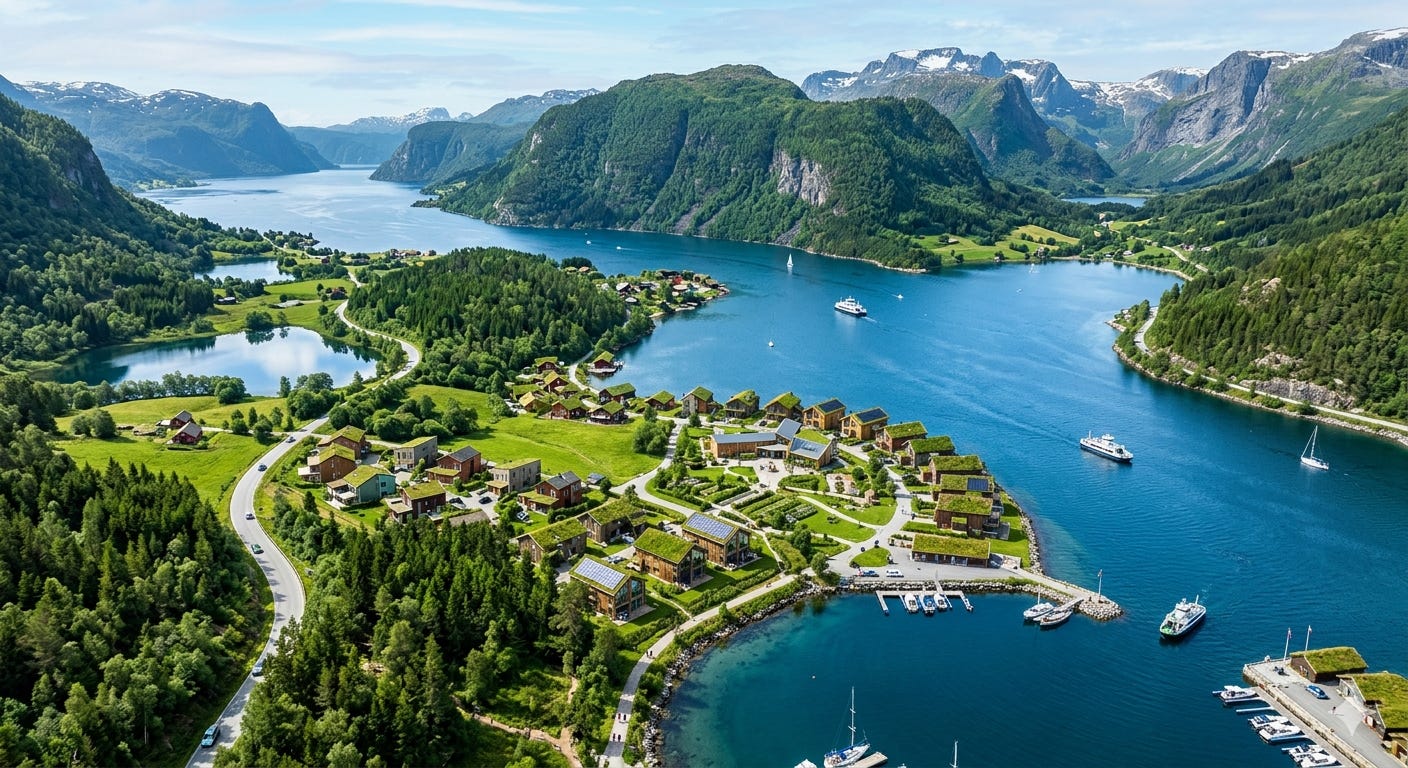
“How can we continue growing without damaging the future?”
That single question changed their direction for decades to come.
Denmark turned toward the wind. What once looked like experimental turbines slowly became one of the world’s strongest renewable energy systems. Today, giant offshore wind farms across the North Sea generate electricity for millions of homes. Wind energy is no longer an alternative there—it is part of the country’s identity. Denmark also became a global exporter of wind turbine technology, renewable energy systems, pharmaceuticals, shipping services, and sustainable food products.
Sweden chose to redesign the meaning of modern living. Instead of allowing waste to pile up in landfills, the country built advanced waste-to-energy systems where garbage is converted into electricity and heating. Cities were redesigned with green spaces, cycling infrastructure, efficient public transport, and energy-efficient buildings. Recycling became part of everyday culture. Sweden today exports advanced machinery, sustainable steel, telecommunications equipment, eco-friendly industrial technology, and forestry products managed under strict environmental regulations.
Norway focused on transforming transportation. Long before electric vehicles became a global trend, Norway began preparing for an electric future. The government reduced taxes on EVs, invested heavily in charging infrastructure, and made electric mobility easier and more affordable than fuel-powered cars. Today, Norway has one of the highest electric vehicle adoption rates in the world. Alongside this, Norway exports seafood, maritime technology, hydropower expertise, and oil and natural gas—while reinvesting much of that revenue into renewable infrastructure and sustainability funds for future generations.
But their transformation did not stop with energy and transportation.
These countries also became pioneers in ocean technology and marine sustainability. Norway and Denmark invested heavily in smart shipping systems, low-emission maritime engines, offshore renewable energy platforms, and sustainable fishing technologies. Their ports operate with strict environmental regulations, while ocean research institutions continuously monitor marine ecosystems to protect biodiversity and reduce pollution. Instead of exploiting oceans endlessly, they began treating the sea as a resource that must survive for future generations too.
Forests were treated with the same long-term thinking. In Sweden especially, forestry is not simply about cutting trees for profit. For every tree removed, multiple trees are replanted under strict environmental policies. Large forest areas are protected to preserve biodiversity, wildlife movement, and ecological balance. Urban planning also ensures that cities grow around nature rather than replacing it entirely.
Even the way homes are built reflects environmental thinking. Nordic homes are designed to conserve energy naturally. Buildings use advanced insulation systems to reduce heating loss during harsh winters. Sustainable wood materials, smart ventilation, natural lighting, solar integration, and low-energy architectural designs became common long before sustainability became a global trend. Entire neighborhoods are planned around walkability, cycling access, public transport, and green open spaces.
Water management became another major focus. These nations invested in advanced water purification systems, wastewater recycling technologies, rainwater management, and hydroelectric infrastructure. Rivers and lakes are monitored carefully to maintain drinking water quality and ecological health. Water is treated not as an unlimited resource, but as something precious that must be protected.
Wildlife conservation also became deeply integrated into national planning. Large protected natural reserves, strict hunting regulations, marine conservation zones, and ecological monitoring systems help preserve species and habitats. Infrastructure projects are often designed around minimizing disruption to animal migration and forest ecosystems.
But what makes these nations truly different is not that they stopped trade or industrial growth.
They simply changed what they prioritized.
Instead of building large pollution-heavy economies, they focused more on:
Innovation
Renewable energy
High-skilled industries
Sustainable manufacturing
Green technology
Research and development
Circular economy systems
At the same time, they import many products that require large-scale low-cost manufacturing, such as:
Consumer electronics
Raw industrial materials
Textiles
Machinery components
Certain food products not locally available
This balance allowed them to reduce environmental pressure within their own countries while focusing domestically on cleaner industries and long-term sustainability planning.
But technology alone did not transform these nations.
The biggest reason the Nordic model works is because the people themselves participate.
Citizens separate waste carefully. Public transportation is widely respected. Energy consumption is monitored responsibly. Environmental awareness begins in schools at a very young age. Sustainability became part of daily culture—not just government policy.
Year after year, these nations kept improving:
1970s: Awareness after global oil crises
1980s: Renewable energy investments expand
1990s: Carbon taxes introduced to reduce emissions
2000s: Sustainable cities and green infrastructure grow
2010s: Electric mobility and circular economy accelerate
2020s: AI-driven energy systems, smart grids, ocean sustainability projects, and carbon neutrality planning dominate national strategy
And perhaps that is the biggest lesson these countries offer the world:
Protecting nature does not mean stopping progress.
It means building progress intelligently—without destroying the air, water, forests, oceans, wildlife, and future that human life ultimately depends on. 🌍
The Nordic nations proved that development does not have to come at the cost of nature. Through discipline, innovation, green technology, and public responsibility, they created a way of life where progress and the environment grow together.
Their greatest achievement is not just cleaner energy or smarter cities — it is building a future where people can still breathe clean air, live peacefully with their families, and remain connected to nature while moving forward as a modern society.
Nordic Energy Research
Renewable Energy in the Nordics
https://www.nordicenergy.org/publications/renewable-energy-in-the-nordics-2021/
👉 Shows how Denmark, Sweden, Norway, and other Nordic countries achieved renewable energy targets ahead of schedule.Nordic Council of Ministers
Tracking Nordic Clean Energy Progress 2025
https://www.norden.org/en/publication/tracking-nordic-clean-energy-progress-2025
👉 Explains Nordic carbon neutrality goals, electrification, smart grids, hydrogen, and renewable transition strategies.
Reuters
Denmark Offshore Wind Expansion
https://www.reuters.com/sustainability/climate-energy/denmark-plans-offshore-wind-tender-with-up-83-bln-subsidy-2025-05-19/
👉 Denmark’s investment into large-scale offshore wind farms powering millions of homes.Axios
Denmark Generated Nearly Half Its Electricity from Wind
https://www.axios.com/2020/01/02/denmark-wind-power-2019-offshore-orsted-vestas
👉 Evidence of Denmark’s long-term transition toward renewable electricity.The Guardian
North Sea Becoming Europe’s Green Power Plant
https://www.theguardian.com/delivering-the-energy-transition/2025/feb/04/denmark-showing-world-possible-north-sea-green-power-plant-europe
👉 Details offshore wind, green hydrogen, and future renewable infrastructure.
Swedish Energy Agency
Sweden Energy Supply Overview
https://www.energimyndigheten.se/en/swedens-energy-system--an-overview/how-the-energy-system-works/supply/
👉 Explains Sweden’s renewable energy mix, biofuels, wind power, and sustainable energy systems.European Environment Agency
Sweden Renewable Energy Progress
https://www.eea.europa.eu/en/europe-environment-2025/countries/sweden/renewable-energy-sources
👉 Sweden’s renewable energy share crossed 66%, supported by wind, biofuels, and heat pumps.
Reuters
Norway Focus on Hydropower & Renewable Expansion
https://www.reuters.com/business/energy/norway-should-not-work-towards-nuclear-power-generation-now-commission-finds-2026-04-08/
👉 Explains Norway’s renewable electricity dominance through hydropower and wind energy.
Nordic Council of Ministers
Waste Incineration in Nordic Countries
https://www.norden.org/en/publication/waste-incineration-nordic-countries
👉 How Nordic nations convert waste into electricity and heating while reducing landfill dependence.
Nordic Energy Research
Energy Efficiency in the Nordics
https://pub.norden.org/nordicenergyresearch2025-01/executive-summary.html
👉 Covers smart grids, building efficiency, industrial sustainability, and carbon neutrality planning.
Sources: Nordic Energy Research, Nordic Council of Ministers, Reuters, Swedish Energy Agency, European Environment Agency, Axios, The Guardian.
No posts
Comments
Nothing yet. Say the first thing.
Sign in to join the conversation.