
Before you read further, pause for a moment and imagine a conversation with your future grandchild—someone who will inherit the world we are shaping today. Imagine them asking simple questions: “Was the air always this hard to breathe? Were rivers always this scarce? Did the Earth always feel this warm?” This article is not just about history, technology, or climate change—it is about responsibility. It is about the choices we made, the progress we celebrated, and the consequences we are only now beginning to understand. More importantly, it is about a question we cannot avoid anymore: what kind of planet are we preparing to hand over to the next generation? 🌍
This image is AI-generated and created for illustrative purposes only.
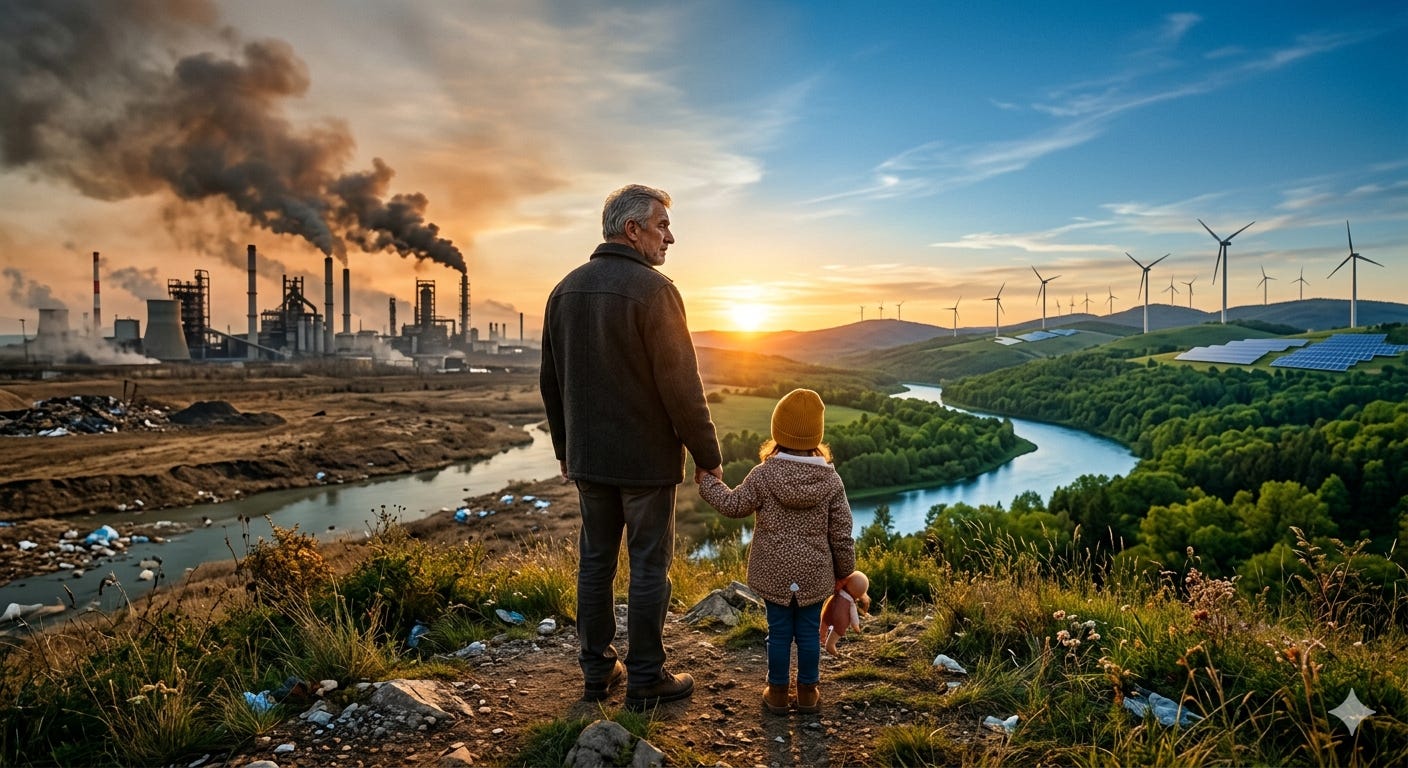
Two hundred years ago, the world changed forever with the rise of the Industrial Revolution. Machines took over human effort, factories replaced open lands, and cities began to shine through the night. Humanity moved faster than ever—building, expanding, achieving. Progress was no longer slow. It became a race.
And today… I stand here wondering—what exactly are we racing towards?
Because every step forward we took came with a cost we didn’t fully understand. The same engines that built our economies slowly filled our skies with heat. The same fuels that powered growth began to choke the air we breathe. Plastics, once a symbol of convenience, are now everywhere—on land, in oceans, even inside our bodies. What we once celebrated as innovation now feels like something we failed to control.
When I look at countries like China, United States, and India, I don’t just see economic powerhouses—I see the weight of responsibility they carry. Growth has lifted millions of lives, yes. But it has also taken something away—clean air, flowing rivers, green spaces. Somewhere along the way, we started believing that nature would adjust to us… instead of the other way around.
And then there is plastic—the quiet invader of our lives. It doesn’t shout, it doesn’t break things instantly, it doesn’t demand attention. It just stays. In the soil where food grows. In the oceans that give life. In the air we breathe. It is a reminder of how easily we chose convenience without thinking about consequences.
But this is not just a story of damage. It is also a story of hope—if we are willing to act.
There are countries like Denmark, Sweden, and Norway showing us that a different path is possible. That growth and responsibility can go hand in hand. That discipline today can protect tomorrow.
Places like Rwanda and Kenya have already taken bold decisions to remove plastic from daily life. Not because it is easy—but because it is necessary.
Across the oceans, efforts like The Ocean Cleanup are trying to undo years of damage. Scientists are working on solutions we once thought impossible. But deep down, we all know one thing—no invention alone can fix what we continue to damage every single day.
And this is where it becomes personal.
Because this is no longer just about governments or industries. This is about us. About the kind of world we are going to leave behind.
One day, our grandchildren will ask us—not with anger, but with innocence—
“What was the Earth like when you were young?”
What will we say?
Will we tell them about clear skies… while they wear masks to breathe?
Will we describe flowing rivers… while they struggle to find clean water?
Will we speak of open spaces… while they grow up surrounded by concrete and heat?
That is the question that stays with me.
The last 200 years were about building without limits.
The next 200 years will depend on whether we learn to live within them.
We don’t need to stop progress.
We need to guide it.
We don’t need to fear the future.
We need to take responsibility for it.
Because at the end of the day, this planet is not something we own.
It is something we are borrowing.
And one day, we will have to hand it back—to our children, and to theirs.
The only question is…
in what condition? 🌍
No posts
Comments
Nothing yet. Say the first thing.
Sign in to join the conversation.