
Last week, GitHub announced that Copilot CLI is now Generally Available.
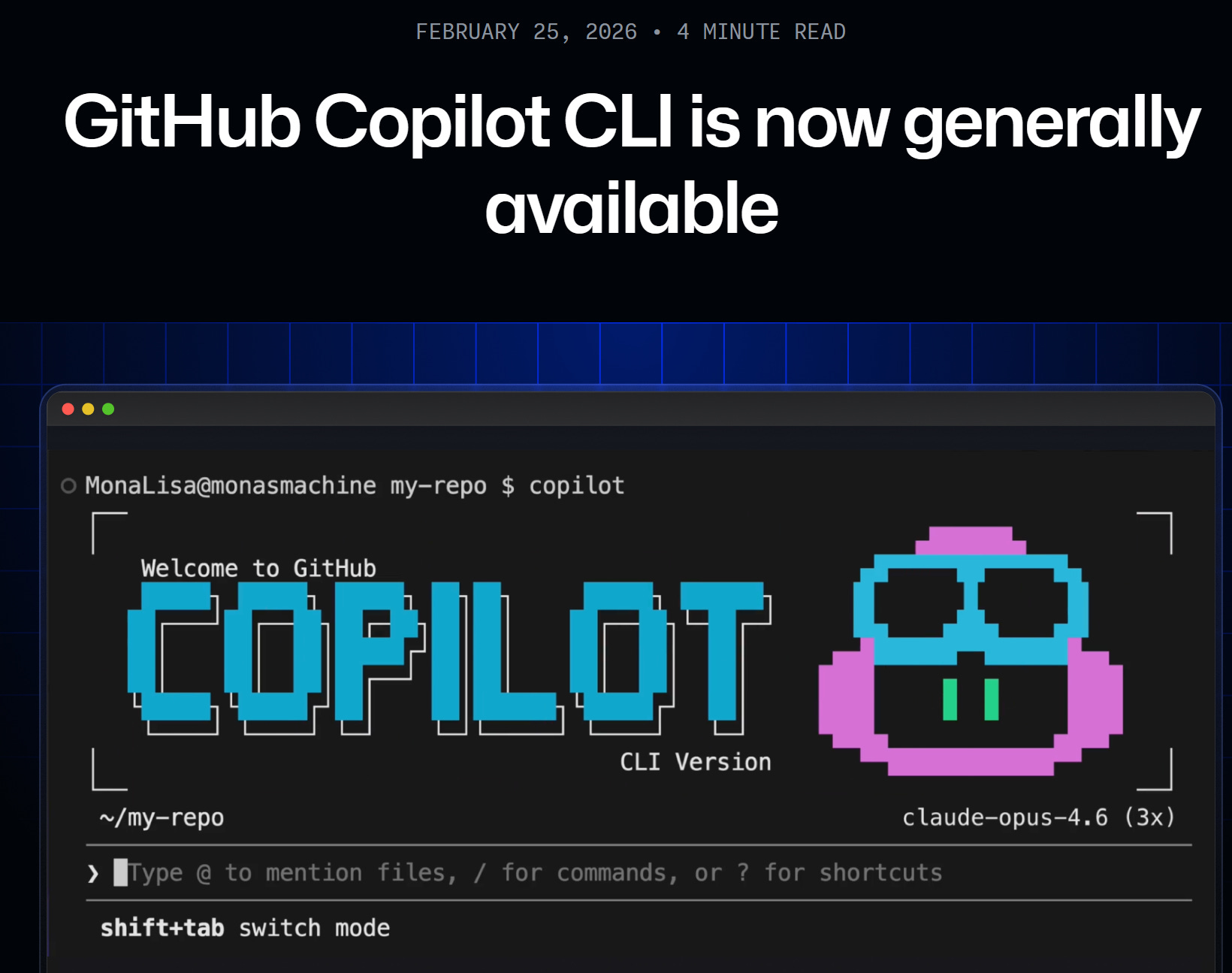
If you saw that headline, you probably thought: “Cool, the terminal thing graduated from preview. Swipe.”
I almost did too.
Then I pulled on the thread — and what fell out wasn’t a CLI story. It was a platform story. One that most IT services companies are going to sleepwalk past while they’re knee-deep in custom agent frameworks.
Let me explain why.
Before this, Github Copilot is already a full-blown agent — planning multi-step tasks, editing files autonomously, running terminal commands, iterating on failures. You could hand it a GitHub issue and walk away.
But it was still trapped. It lived inside your IDE, your CLI, your workflow. A very powerful product — but still a product.
Github recently released another new thing called Copilot SDK (different from the CLI, but still relevant) recently, that freed Copilot from clutches of your IDE.

All those agentic capabilities — planning, tool-calling, multi-step execution, context management — are now exposed as a programmable runtime you can embed into anything. ANYTHING!
You might think this is all fancy developer tooling. You can’t be more wrong.
The SDK supports MCP (Model Context Protocol) servers — an open standard for connecting AI agents to external tools and data sources. Databases, APIs, SaaS platforms, internal enterprise systems. Add custom skills on top, and you can build:
Employee onboarding agents that handle access requests and environment setup
Operational automation with built-in guardrails, dry-run modes, and rollback checklists (Hello, ServiceNow!)
Compliance assistants that scan codebases and generate audit-ready reports
Incident response bots that triage alerts, pull logs, and notify the right people
This isn’t just “autocomplete got smarter.” This is GitHub turning its agent runtime, the one powering the most widely-used AI coding tool on the planet, into embeddable infrastructure.
Why did we talk about Copilot CLI’s GA announcement in the beginning of this article, when the SDK is the core focus?
The Copilot SDK requires Copilot CLI for authentication.
While CLI was in preview, enterprise IT teams wouldn’t touch it. You know how this works — “Our security team won’t approve anything marked ‘preview.’” Hence, by extension, SDK was also out of the reach.
As of February 25th, 2026, that blocker is gone. CLI is GA. Available to all Copilot subscribers — Individual, Business, Enterprise. Flip the switch.
The SDK is now, for the first time, a real option for enterprise deployments.
Most people walked past this gate without realizing what was behind it.
If you’re a services company building AI agents today, your current playbook probably looks like this:
Pick a framework (LangGraph, CrewAI, AutoGen, that thing someone built in-house last Thursday)
Wire up an LLM via API
Build custom tool integrations, orchestration logic, memory, context, state management
Figure out auth, security, guardrails
Deploy, monitor, debug, pray
That’s 60-70% plumbing!
Your client isn’t paying you for plumbing. They don’t care if you used LangGraph or a hand-rolled orchestrator. They care if it works, if it’s secure, and if it plays nice with their stack.
If your client is already on the Microsoft stack— and let’s be real, which big enterprise isn’t? — the Copilot SDK gives you a managed, battle-tested agent runtime that handles all that plumbing.
Agent orchestration. Tool-calling. Context management. Multi-step planning. Already solved. At scale. For millions of developers.
So what should you be building? The last mile.
The last mile could be custom MCP servers, domain-specific skills or the guardrails your client’s compliance team actually cares about. In short, it is “The outcome”.
That’s where your margin is. That’s where your IP lives. Not in the orchestration layer.
Yes. And the pricing model should feel familiar.
Copilot Business: $19/user/month (300 premium requests included)
Copilot Enterprise: $39/user/month (1,000 premium requests included)
Overages: $0.04 per premium request — pure consumption pricing
Sound familiar? It should. You already bundle AWS compute, Atlassian licenses, ServiceNow SKUs, and Salesforce subscriptions into your engagements. Copilot is just another line item in “AI-Powered Agentic Platform.”
The vendor lock-in concern? Real. But let’s be honest — you made peace with AWS lock-in years ago.
A short detour: If you are too much concerned about lock-in, look up Opencode SDK, it can be your hedge.
This IT services strategy works when:
Your clients live in the Microsoft/GitHub ecosystem (so... most enterprise clients)
You’re willing to make an opinionated platform bet instead of being framework-agnostic-but-slow
You want to build reusable IP and accelerators, not bespoke plumbing on every engagement
You see agents beyond just engineering — incident response, compliance, operations, onboarding
This doesn’t work when:
Clients are allergic to vendor lock-in (though the SDK supports BYOK — bring your own API key)
You’re building consumer-facing chatbots (Copilot’s strength is task execution, not conversation)
Strict data residency requirements haven’t been validated against Copilot’s policies
If I were running an AI practice at a services company right now, I’d do three things this quarter:
Build one internal accelerator on Copilot SDK. Something real — not a demo. An incident response agent, a compliance bot, whatever maps to your clients’ biggest pain.
Model the economics. Map Copilot licensing against what you’re currently spending on custom agent infrastructure. I think the numbers will surprise you.
Ship it to a pilot client before your competitor does. Because someone in your space is reading this right now and thinking the same thing.
GitHub’s CLI tool graduated from preview - Small news.
That graduation unlocked enterprise access to an SDK that turns Copilot’s agent runtime into embeddable infrastructure - Big news.
Almost nobody connected the two.
Copilot is no longer just a tool developers use. It’s a runtime anyone can build on. And as of last week, enterprises can actually adopt it.
You can keep spending 70% of your project budget on plumbing that GitHub has already battle-tested at scale. Or you can build on top of the agent runtime that powers the most widely-used AI coding tool on the planet.
The plumbing is done. The gate is open. The question is whether you walk through it — or let your competitor go first.
If this hit a nerve, forward it to your CTO. Or that architect who’s been evaluating agent frameworks for the last six months and feels overwhelmed with options.
Comments
Nothing yet. Say the first thing.
Sign in to join the conversation.