
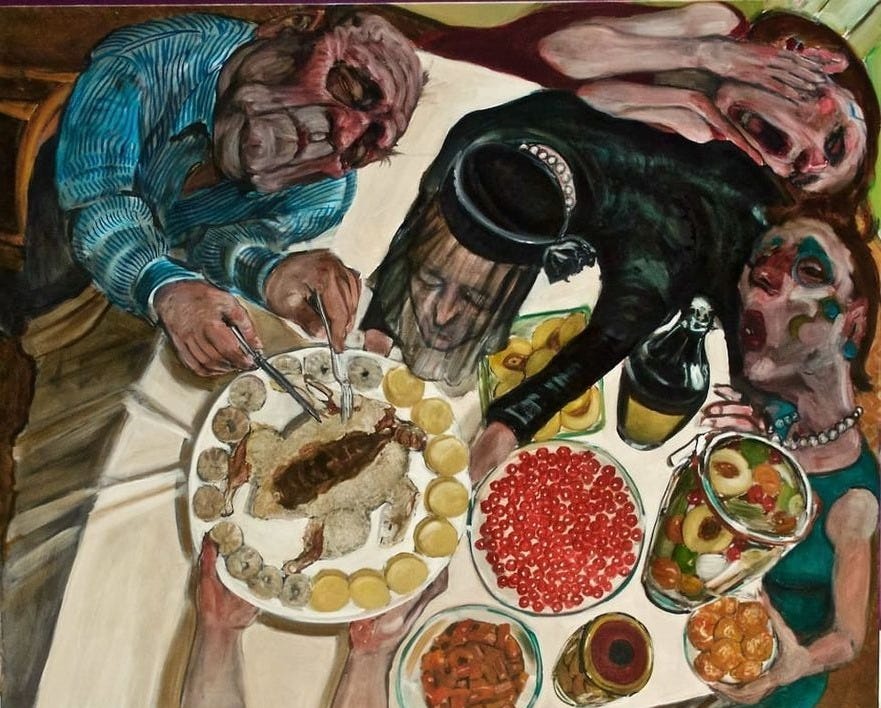
The status quo hums the ominously alluring tune of acquisition, and in a life that centres around acquisition, there is no end to our race for more; bigger, newer, flashier, comfier, stacked and with status, we aim to pad the entire world, to bulldoze the last of our wild nature for a cold palace with corridors that echo of loneliness.
The story of capitalism, of profits over collective personhood, has been grooming me into dissatisfaction since before my memories begin. Despite my best intentions to be less materialistic, simplify my life, and be content and grateful with what I have at any given time, I observe a conditioned tendency within me that is always crawling towards what is more novel, captivating, spacious, and prosperous. Whether we’re talking about renovating ugly kitchen counters, swapping cars, travelling to a bucket-list country or abandoning one modality to train in the next (folding, yet again, to the fluttering whims of shiny-object-syndrome), material or experiential, the essence is the same. More, different, better, “I’ll rest in the joy of what I’ve created when…”
But that when never seems to come, and even if things are going smoothly and I find myself in a place that a younger version of me was dreaming up with pen ink and almost-desperate longing, I still have one greedy eyeball glued to those steps ahead of me. What could be better?
As with everything else, this territory is nuanced. There are indeed elements of greed, skewed societal values and conditioned consumerism at play here, but there is also a quality of innate expansion in the living universe (that includes us humans) which gravitationally pulls us to grow and evolve and creep towards our most aligned visions and fullest potential. As well, our lives are a great work of art, and I think it’s natural to continue building, adding colour, tweaking.
So, how do we discern between all these convoluted variables; the innocent desire to create a better life for ourselves and our families, building comfort and ease while also recognizing a bit of discomfort does us good, evolving as we’re meant to, but not falling victim to marketing ploys that convince us our worth is tied up in what we acquire, both materially and in prestige. How do we paint the canvas of our lives while remembering that what we give matters more than the aesthetics we surround ourselves with, and that the comfort of our nests only serve us to the extent that they continue supporting our growth through life’s hard lessons? How do we discern between natural evolution and conditioned acquisition? How come we can’t leave the succulence of strawberries to June and be happy to welcome apples in the fall? Why is it so hard to simply be content and bask in the splendour of this wild earth?
These are the questions that continue to arise lately, as I consider my next steps in life. So deeply entrenched is the cultural story I was raised within, that I’m driving myself mad trying to dig for the intention behind every decision, like a gardener determined to remove every last root-hair of noxious weed lest it continue to sprawl beneath the surface. The beliefs and values of colonization have tainted my psyche whether I like it or not, and it’s up to me to get the trowel out and disentangle the threads of truth and deception. I think too much, to be fair, but there’s a pattern I see in myself, in most everyone, and the more I look at it, the more its absurdity reveals itself and the harder it becomes to look away.
We all yearn for more leisurely time to take a load off, unzip the civilized human persona, and just be. And we long to feel well, to be well. We know that spontaneous, full-spectrum movement does us good. We know that unprocessed, fresh, whole foods do us good. We know that sunlight regulates our circadian rhythm, allowing deep rest and energized mornings. We know that being in the forest, atop of mountains and by the sea makes us feel both calmer and more alive. Yet here we are, our societies abound with chronic “lifestyle diseases” and mental health crises, while romantic imagery and old cellular memory fill our weary bones with longing.
We yearn, too, to warm our pale skin in the sun like lizards, spend more time holding hands with those we care for, slipping the mittens we knit for them with foraged scraps of yarn over their cold fingers; to wander in the patches of remaining wild, to relax our tense shoulders, to be able to afford an afternoon on the patio untangling our thoughts or listening to birdsong or truly tasting the notes in our cup of tea rather than the usual process of brewing it and letting it go cold while we putter manically and distractedly.
We want to feel bored enough to pick up that dusty guitar on the wall and play it (however poorly), to clamber over beach rocks, freeing our joints from their imprisoned daily range of motion, to find the confidence to turn off our phones and need not be chewing at our fingernails from the anxiety of missing a very important call. We long to feel at peace. We long to give and receive affection. We long for a life that doesn’t feel like an arbitrary drag up a barren mountainside which never rewards one with a view.
Many of us claim some version of this- or are too tunnel-visioned or anesthetized to recognize how badly the animal of our body needs it- while we remain complicit in the complication of our lives. We delay these simple, nourishing moments endlessly, promising ourselves we’ll make time to slow down or pour into our relationships and garden beds and music and selves once we’re less busy. Of course, “less busy” never comes to our rescue, and we carry on, continuing to trade the free production of a joyful existence for the emptiness of passive consumption and acquisition.
We convince ourselves we need to work more or change jobs so we can acquire the better shelter, even though our shelter covers all of our needs and more, rustic and quirky as it may be. We convince ourselves we need to radically change the path we’re on because we’ve projected our internal dissatisfaction on the external circumstances of our lives. And, of course, we simply must move to a different community because that one guy is a little too inflammatory, so we delude ourselves into believing there’s some place on earth without difficult people and conflict that will ask of us to dig deep inside for reluctant compassion and humility. Even to the smallest, seemingly trivial degree, we complicate our lives by insisting to have the expensive, imported fruit for our daily breakfast; those blood oranges that have travelled a few thousand kilometres on train or truck or boat, that we buy across town, while the scraggly old, yet reliable, apple tree in our yard drops its neglected fruit to the ground.
All these small choices, the extra costs for unnecessary luxuries and excessive travelling about and “upgrades”, add up, resulting in a hefty tax on our time, energy and our planet’s vitality (therefore our own vitality, too). In the life of a consumer, the minutes of the day seem to fly away, filled with unmemorable trivialities. Later we find ourselves in the quiet melancholy of dusk wondering, where have the days gone? The more I convince myself I need, the more I am required to spend my time working to buy, build, study or maintain those things, and the less time I spend in the simple, unhurried reverie that truly feeds my soul’s content. It’s a cycle of imprisonment.
Gratitude, contentment and the choice to find beauty in simplicity is the antithesis to this, flipping the cycle in the other direction. Finding ways to meet our real needs- companionship, a safe, warm-enough place to sleep, clean-enough food and water, the freedom to express the truth of who we are- is how we stop chasing empty fillers. Those of us with even an ounce of privilege, with more choice than some, hold this responsibility especially, for our over-consumption is made possible only by the very exploitation that makes it increasingly challenging for so many humans to meet even these most basic of needs.
I am sympathetic to the fact that everything has become expensive, and that many people are hardly covering bills with their low hourly wages. Others are juggling a family and a demanding career, while countless more are weighed down by depression and focused solely on the achievement of getting out of bed in the morning. In these positions, I imagine how it could easily feel as if one is stuck, with little choice, or deprived despite the physical abundance they have because their spirit is cramped and suppressed. I wonder what it would take for people to recover their personal power and relinquish the feeling of being trapped in the claws of capitalism. What would it take for us to start asking, what if…? How do we remind ourselves just how many options we truly have, so long as we’re willing to face something new and unknown, reframing views of success and depravity by the understanding of what truly feeds our soulful nature.
As always, I come to the page not as somebody who has figured out all the answers to the questions I pose, nor claiming to be immune to the seductive draw of luxury and indulgent delights, or unaffected by capitalisms boot. Not even close. This is an exploration, and the subject in question is less about living our best lives, which is a healthy desire, and more about where we place our value and the driving forces behind our expansion. Maybe we’ve got it all backwards.
It’s not wrong to desire, to expand, to build ourselves a cozy nest, and certainly not wrong to want to improve conditions that undermine the wellbeing of our selves and our families. However, the more I examine the true needs of us human animals, the more I arrive at the conclusion that we need very little indeed, and have only been brainwashed into believing otherwise. But why not have more if more is offered to us on a silver platter? This seems to be the thinking these days, and even though most people now know that much of this “more” isn’t actually doing us good, we can hardly keep our hands out of the cookie jar. We’re trapped in a dizzying cycle, spinning in circles. Unfulfilling jobs, superficial relationships and meaningless consumption only breed more pseudo-desires that attempt to fill in for what we really need (sometimes as simple as a long hug or more magnesium or hearing something genuine from someone for once).
I encourage you, myself, all of us, to ask the hard questions and be radically honest with ourselves. What do I really need? What will genuinely improve the quality of my life measured by how it effects my health and my ability to show up and contribute meaningful work in my community? If the answer is rest or play or companionship or time in the woods or to fall asleep face down on the lawn for an afternoon- well, we don’t need to buy anything or uproot our life. We need to prioritize ease. To put the demanding projects on a shelf for a little while. Try going without something for a time. Cancel media subscriptions. Melt into the infinity of a clock-less afternoon without the pressure to trudge forward.
If we want more time for leisure, then we have to be honest about all the ways we’re willingly trading it away. If it’s what we honestly need or want, then we have to stop seeking the more that steals away our time and peace. We need to lean into gratitude and be present with reality’s imperfect perfection. Imagine how many global crises based on over-extraction could be solved by contentment alone.
Again, I recognize how many people have dependants and limited vacation days and that grocery prices are whack, but how many of those same people convinced themselves they needed a new car they couldn’t afford, decided to spend their summer renovating bathrooms that were perfectly fine, or continue to pay hundreds of dollars a month on subscriptions and a continuous supply of red wine. Five less hours of work a week could result in a vibrant backyard veggie bed, something so simple that holds the power to feed us, reduce our grocery bill, get us outside, reconnect us to living systems, and offer a quality family bonding experience.
“Don’t own so much clutter that you will be relieved to see your house catch fire.”
― Wendell Berry, Farming: A Hand Book
The imprint of colonialist attitude, which seeks to colonize, control and acquire, shows up in a myriad of sneaky ways, not only in cultural extremes. Seemingly positive and benign things can become more harmful than helpful if what one really needs is to empty, slow down and appreciate the moment. I notice the ways I busy myself and fill my days with more. I hoard books that offer to fill downtime. I go to workshops about pretty well anything. I comb the free store for more craft material while my half finished or entirely untouched projects at home stare me in the face with a judging frown. Even my thoughts can tend towards an insidious story of lack if I am not watchful, and from a place of lack, the question that follows is always, what more can I get or do? Now, I find myself asking something else…
Have I suppressed the very freedom I claim to value above all else by chasing the next thing rather than choosing to rejoice in this moment in time which I will one day look back on with a strong sense of nostalgia?
What are minor inconveniences, really, in the grand scheme of things. I will not rest on my death bed thinking of the certificates I collected or the cedar siding I installed or that time I got the doorknob fixed so I didn’t have to wriggle it to get in; I won’t be sad to say goodbye to my car or my to-do list or some cranky old boss. I’d rather like to remember the exact melody of the river in each of four seasons, ingrained into my memory from years of visiting her banks, crouched, listening and observing.
How much of this precious existence will I spend trying to tweak every external aspect of my life, wasting my power on the endless task of padding for maximum comfort and ease, not realizing that, to a large extent, ease is a cultivated internal state, a state of energetic flow that comes when one stops contracting against life and allows the path of least resistance. It’s a peace that permeates us when we accept reality as it is, without craving or aversion.
At the expense of keeping this essay concise, I want to follow a few more branches, for there are many implications and nuances that stem from this subject.
Firstly, it’s worth noting that youthful people have an inborn drive to be challenged, keep busy and contribute to society. It’s a part of our natural development and social role. I don’t want to pathologize ambition or a full schedule, and I’m not suggesting we be idle at all times. However, in western over-culture, most of this potent energy is misdirected into meaningless pursuits, guided by the empire’s agenda. Regaining personal agency and sovereignty as beings who have broken free from consumerism’s spell, we win back the ability to be intentional about where we place our time and energy. We can choose to contribute to a culture that is rooted in honourable values and mutual care, and we can choose to contribute directly to our personal or communal survival in a way that feels tangible and satisfying. We can reclaim meaning and purpose in our lives.
Ambition isn’t the issue, it’s what drives it. There are questions missing alongside our decisions to expand. Is this added comfort actually good for me? Am I acquiring at the expense of somebody or something else? And if so, is the negative impact of my decision truly worth it? Is this desire actually masking a deeper need that it can’t fulfill? Why do I want to forcefully alter the external circumstances of my life; what is this action in service to? It’s amazing how quickly a flimsy idea based in fear, control or greed can be yanked out in the light of discernment.
Another way to organize our lives which orients away from the creep of acquisition is to focus on how we want to feel and make decisions from that centre. For example, if we want to feel peace, we may filter our decisions based on the question, will this change sacrifice my peace? And because disruption is at times worthwhile and necessary, is this cause worth sacrificing my peace for? Asking these questions, it won’t be hard to decipher which motivations are superficial and which are rooted in purpose.
The final implication I want to address is our societal aversion towards stillness. Slowing down is uncomfortable, I get it. Those quiet pauses, when we return to body, can bring up so much; the pain of our tightly held muscles, all the emotions that have been left unprocessed rising like molten lava, the irritating and incessant chatter of our minds. It is, in many ways, easier to fill our days to the point of exhaustion and continue complaining about our busyness, than to face all that arises when we put a halt to our locomotion.
Even if we feel emotionally sound, it’s quite the challenge, biologically speaking, for our nervous systems to shift into a relaxed state if we’re chronically hyper-aroused. Melting into a moment joyously and playfully might not even be an option for us, if we’re used to operating in a state of chronic stress. True stillness has become near impossible for the average over-stimulated and listless westerner. So- and I know this from personal experience- sometimes, despite our longing for a simpler, more present and spacious life, the reality of it is foreign to the body, and sometimes impossible without first taking the time to heal and recalibrate. Like anything, it takes time and commitment to adapt and ground the energy of chaos that we’ve grown accustomed to.
At first, the thought of a simpler, more rustic life, may seem entirely unappealing to some- especially if they involve compost toilets and offer no proximity to a nail salon. I like to hope, however naively, that the Wild (in both the literal and symbolic sense of the word) holds the ability to woo even the most domesticated human with its fire-sky sunsets, serene mountain lakes with leisurely circling beavers and the orgasmic taste of real food. I choose to believe this because no matter how far removed we’ve become from our true nature, at the end of the day, we’re still a part of all this. The moments that are captured in a wild life, the ones that are too exquisite for even the single-minded atheist to go on denying divinity, water that seed of wild that’s still within each and every one of us, however buried.
To dance around a pulsing, popping fire, obeying the impulse to move in free, unrehearsed patterns to the twangy tune of a self-taught musician; to learn even two local plants by name, to greet them, know how to harvest and brew them right, and sip them knowing your every tissue is thankful for their medicine; to hear birdsong rather than traffic and be met eye-to-eye with the wise, crows-foot smile faces of townsfolk you know by name; to don a sweater that was made instead of bought, wool dyed by mushroom and bartered from the local weaver; to dig for clams alongside friends and braise them over flames with yard-squash and broth from bones personally de-fleshed and simmered over 48 hours… these are the slow pleasures, the undeniable satisfactions of a life that takes truth and patience to weave. This is the embodiment of unity and reverence for the sacred.
Romantic notions aside, I know it’s not possible for billions of people to feed themselves by hunting and gathering alone, and that what I described above is not the reality for most. That’s okay. Here lies the beauty of humanity- we are adaptable creatures with imaginative capacity and huge creative potential. I like the term “hunter, gatherer, gardener”. It symbolizes the ability to take the best of our undomesticated roots and merge them with our current reality. Following this example, that means accepting the need for some agriculture, while supporting alternatives that take pressure off that system. It doesn’t have to be black or white. We do what we can and refuse to fall into the fallacy and irresponsibility of the belief that our personal choices hold no sway.
Like Michael Pollan’s simplified dietary mantra, “Eat food. Not too much. Mostly plants,” I’m trying to guide my days by, “As little as possible, be with shoes and electronics; as much as possible, be moving, outside, and aware of my breath”. This alone orients me away from distractions and the draw of acquisition and redirects my awareness towards reality, and all the wonder, healthy challenges and simple pleasures that comes with raw, direct communion with life.
I’ll end on a personal note. Last year, I made half the income of the official rural poverty threshold (which is 10k lower than the urban threshold). I only worked a paying job two days a week (maximum four hours) for six months of the year. I also lived more abundantly than I have in my entire life. I have access to more quality food than I could possibly eat. I live in a spacious cabin that I share with no roommates, and most days, I gather around the larger, farmhouse table to share fresh meals with a lively, motley crew. I’m surrounded by lakes, forest trails, bluffs and a diversity of medicinal plants. Of course, I do offer some of my time and energy in exchange for this, and the lifestyle keeps me busy, but the work I do no longer feels meaningless. It’s all tangible, rewarding, real and direct.
The way I’ve structured my life is not for everyone, of course, and my circumstances rely heavily on the web of people who each offer something to make this reality possible. I’ve shared this last piece not to gloat or say it’s what everyone should do, but to show that there are inconceivable possibilities for those that act with stubborn faith and ruthless devotion to what their souls hold true. And this reality, it was inconceivable to me. A few years ago, I would have never imagined I could live so rich, and in a way so aligned with my deepest longings, while putting so little of my time into earning money. Though believe me, I dreamt of it.
Well, I began this essay based on a feeling and a question, and managed somehow to dip into my usual cultural criticism, ask far too many questions, meander off into some poetic daydreams and end with a personal bit that may have tangented (new word) off of one too many tangents. Hopefully, there’s at least one bit in this ranting essay that serves as a chew toy for a contemplative mind, or sows a new seed in an unkempt crevice of the psyche. I’ll finish off with a quote…
“Love the quick profit, the annual raise,
vacation with pay. Want more
of everything ready-made. Be afraid
to know your neighbors and to die.And you will have a window in your head.
Not even your future will be a mystery
any more. Your mind will be punched in a card
and shut away in a little drawer.When they want you to buy something
they will call you. When they want you
to die for profit they will let you know.
So, friends, every day do something
that won’t compute. Love the Lord.
Love the world. Work for nothing.
Take all that you have and be poor.
Love someone who does not deserve it.Denounce the government and embrace
the flag. Hope to live in that free
republic for which it stands.
Give your approval to all you cannot
understand. Praise ignorance, for what man
has not encountered he has not destroyed.Ask the questions that have no answers.
Invest in the millenium. Plant sequoias.
Say that your main crop is the forest
that you did not plant,
that you will not live to harvest.Say that the leaves are harvested
when they have rotted into the mold.
Call that profit. Prophesy such returns.
Put your faith in the two inches of humus
that will build under the trees
every thousand years.Listen to carrion — put your ear
close, and hear the faint chattering
of the songs that are to come.
Expect the end of the world. Laugh.
Laughter is immeasurable. Be joyful
though you have considered all the facts.
So long as women do not go cheap
for power, please women more than men.Ask yourself: Will this satisfy
a woman satisfied to bear a child?
Will this disturb the sleep
of a woman near to giving birth?Go with your love to the fields.
Lie down in the shade. Rest your head
in her lap. Swear allegiance
to what is nighest your thoughts.As soon as the generals and the politicos
can predict the motions of your mind,
lose it. Leave it as a sign
to mark the false trail, the way
you didn’t go.Be like the fox
who makes more tracks than necessary,
some in the wrong direction.
Practice resurrection.”
― Wendell Berry
“May all beings have happiness and the causes of happiness;
May all be free from sorrow and the causes of sorrow;
May all never be separated from the sacred happiness which is sorrowless;
And may all live in equanimity, without too much attachment and too much aversion,
And live believing in the equality of all that lives.”
No posts
Comments
Nothing yet. Say the first thing.
Sign in to join the conversation.