
Somewhere between Cole Hutson’s late-season sizzle reel and Washington’s splashy summer (coaxing Alex Ovechkin back for one last ride, acquiring Jordan Kyrou for Connor McMichael + futures, signing Alex Tuch, Boone Jenner and Vincent Desharnais), the Ilya Protas hype train lost an ounce of its shine.
Make no mistake: He’s more than a younger, lesser version of his big brother. Dismiss his four-game teaser (4 points) if you like. His track record remains miles ahead of where Aliaksei’s stood at the same age:
It follows that he arrived to the NHL sooner, and he’s primed to hit the ground running. Here’s why.
While short on world-class talent, Spencer Carbery’s roster is now teeming with top-six candidates. The competition for minutes will be fierce and the leashes will be short. It’s especially important for Protas to meet his coach’s expectations because he’s a rookie and his broad-strokes make-up (lumbering offensive center) doesn’t scream utility/checking role.
He likely needs to cement an everyday partnership with Aliaksei and Tom Wilson.
Thankfully, these mobile and responsible behemoths are equipped to insulate the 20-year-old from the flanks. The trio’s early returns seemed to corroborate this notion. At 5-on-5, they owned:
55.9% of the shot attempts.
51.8% of the expected goals.
66.7% of the actual goals.
As you might imagine for a unit that measures in at 6’6”, 250 pounds (Aliaksei), 6’6”, 225 pounds (Ilya) and 6’4”, 225 pounds (Wilson), range is the lifeblood of its success. In a small sample, the league’s largest line tormented the opposition by covering an obscene amount of territory.
Even Protas, for whom cracking the 20 mph threshold was a grueling proposition last year, carries so much length into his engagements that he was able to disrupt multiple retrievals and exit attempts. Would you like more physicality from these titans? Sure, but Wilson is intimidating enough for the three of them. What truly matters is their potential to form an efficient forechecking crew:
The first-year pro displays a keen sense of his surroundings in chip-and-chase scenarios, taking disciplined F1 angles to squeeze the life out of opponents’ breakout possibilities. He charts his routes from the inside out, and although he doesn’t always reach his spot in time to kill touches outright, at worst he handcuffs D-men while flushing the action to his linemates. This makes progress up the middle or strong-side wall an uphill battle. No easy outlets permitted.
Understanding his place within the bigger picture and positioning himself accordingly is huge—ha—for a forward whose point-of-attack presence can feel inescapable. When he extends, he can strangle your puck-handling leeway. When you have the misfortune of going shoulder to shoulder with him, his sheer mass can erase your range of motion.
Protas flustered blueliners despite ranking among the slowest forwards in the sport in 2025-26. Considering Aliaksei’s vast skating improvements after similar early-career issues (89th percentile in top speed last season), there may be another level to unlock in puck pursuit.
Alongside his brother and Wilson’s wheels (78th percentile), simply attaining league-average pace would wreak havoc on D-men.
Naturally, upgrading his speed would benefit his in-possession arsenal too. For such a massive specimen, he boasts soft hands and a fast processor that should serve him well in transition. Watch him toy with the Blue Jackets on entry:
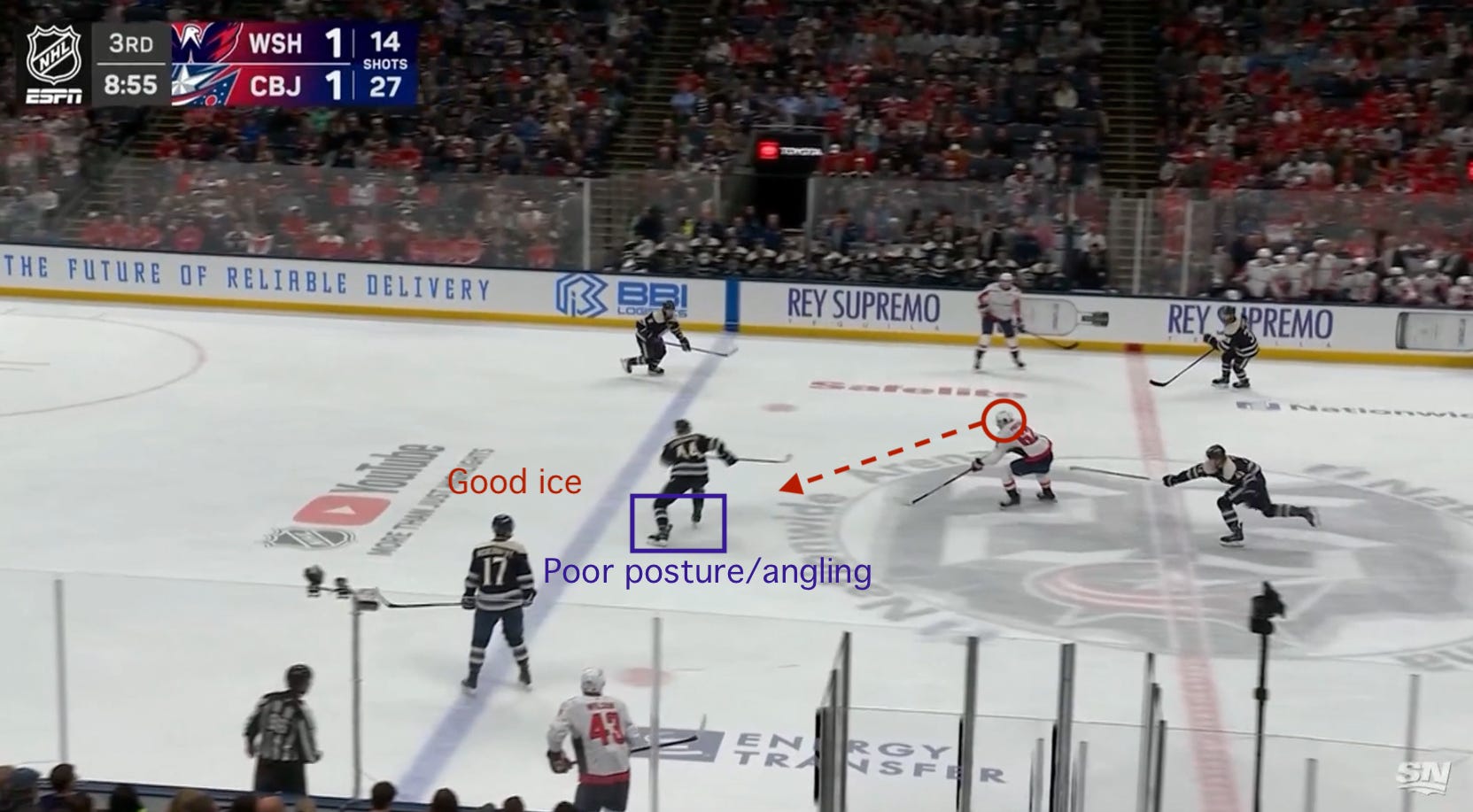
As he scans upon collecting a link-up from Aliaksei, he notices perhaps the worst surfing attempt of the year courtesy of Erik Gudbranson (CBJ 44). From his body orientation to his angling, I don’t know what the veteran D-man is doing here. Protas rides his forehand catch into the good ice his counterpart vacates and plots his next move from a deeper berth:
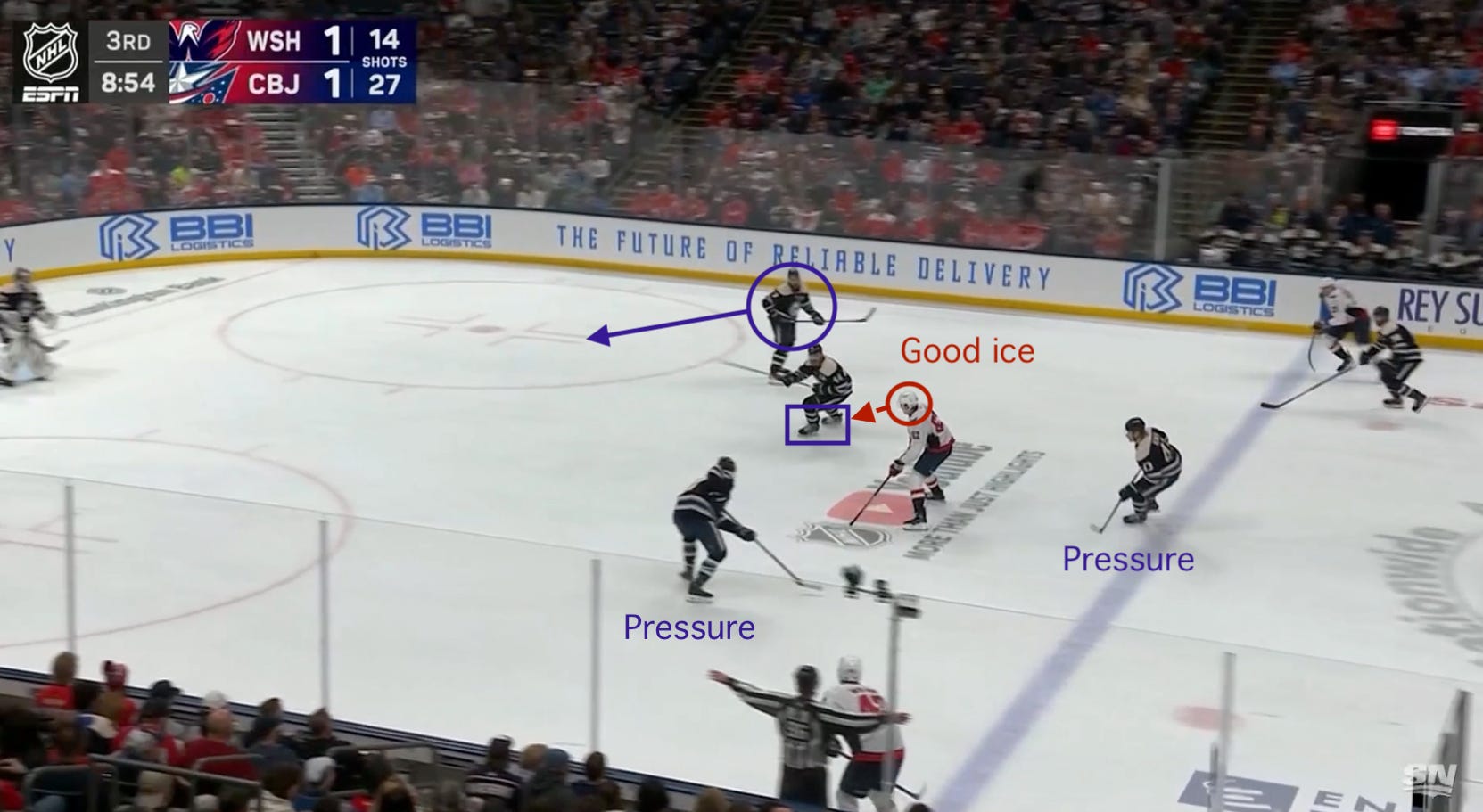
The ice has shrunk and he’s flanked by pressure on his back (Danton Heinen, CBJ 43) and to his left (Mason Marchment, CBJ 17). Meanwhile, his lone outlet (Wilson, WSH 43) is stationary. Dishing to the wall would just sic two defenders on the RW without granting him middle-lane tempo to play off.
Gudbranson is still curling back to the heart of the DZ, though. Protas has no trouble crossing his face once more. To the backhand—and away from the Jackets’ snare—we go:
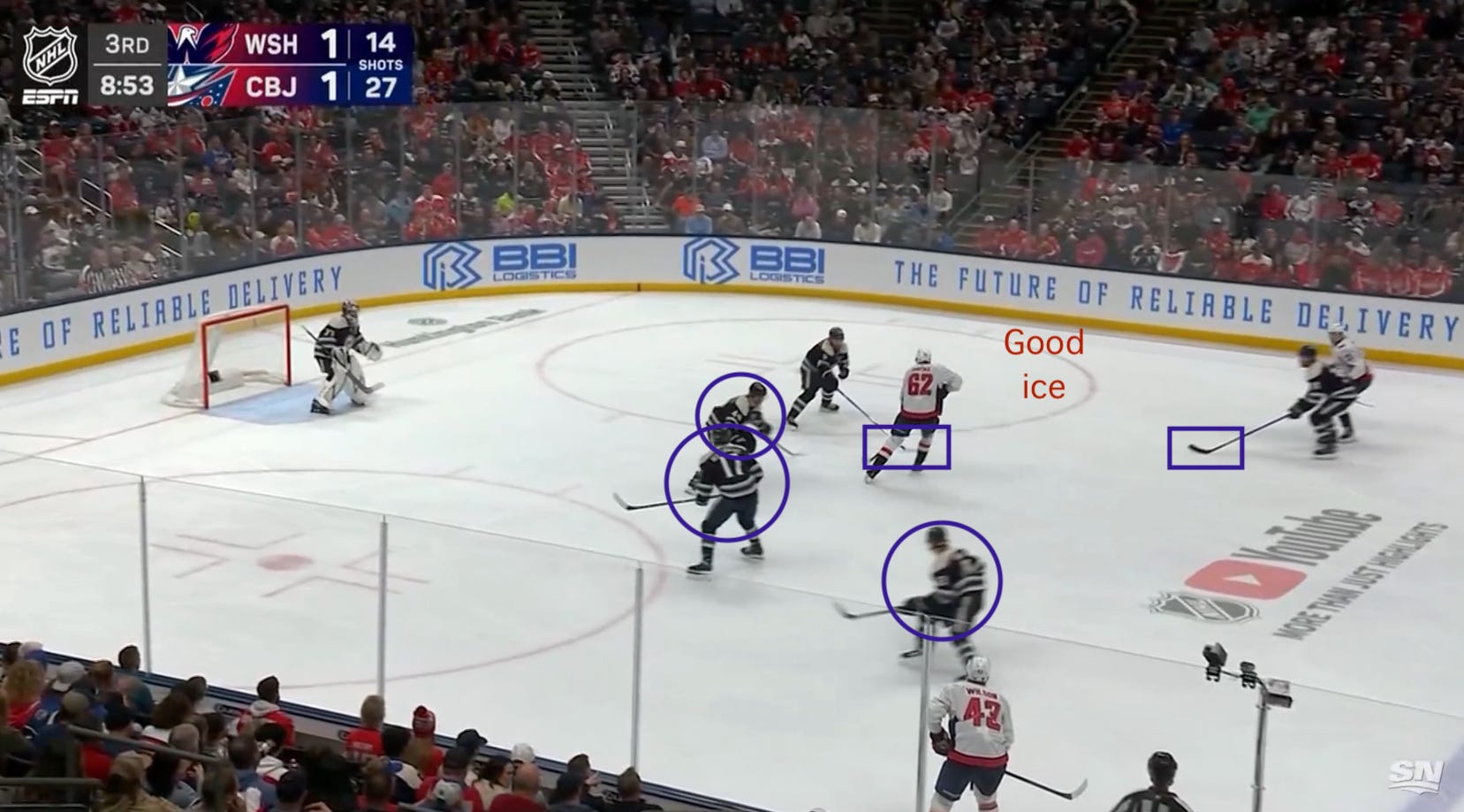
This is nifty stuff, but with all due respect, putting Gudbranson in a blender isn’t worth highlighting. How Protas converts this depth into a plus touch for his teammates is. After shaking the RD, he now faces puck pressure from Ivan Provorov (CBJ 9) and Boone Jenner (CBJ 38). Anticipating the defenseman’s fishing expedition, he slips the puck through his triangle, pulls forehand in a flash to dodge Jenner’s stick and resets from the right wall…with Columbus’ entire defense fixated on the Belarusian.
Look at what Jakob Chychrun (WSH 6) is working with on reception:
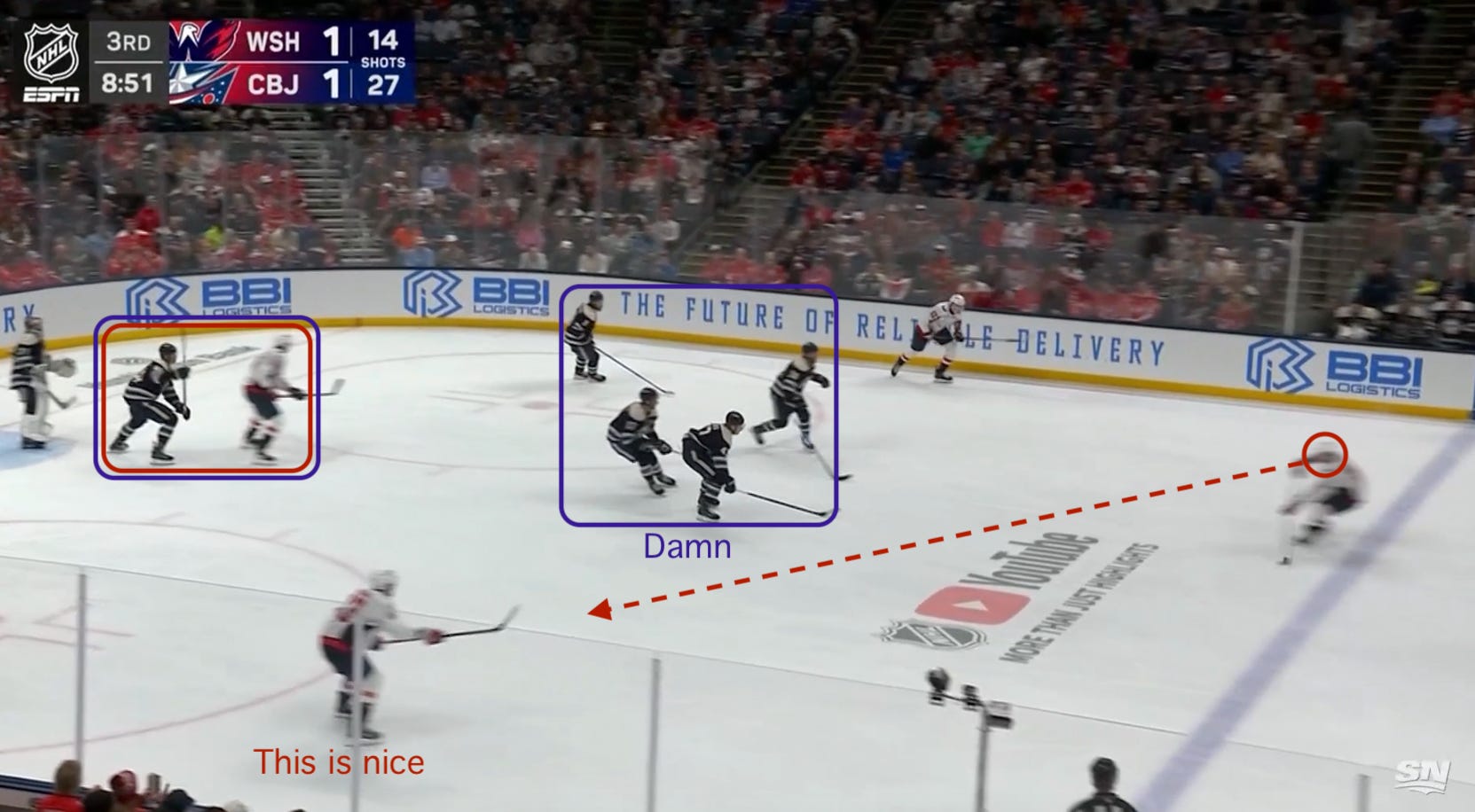
Protas’ quick mitts and sharp reads turn a rather slow, outnumbered scenario into a wide-open bid from the left faceoff dot:
On the back of his wheels, Aliaksei did the NZ heavy lifting for their line last season. Ilya bringing a tick more speed to the party would amplify his impact inside the dot lane (i.e. where you want to be in transition), ushering him in as a viable transporter and introducing different points of entry and attack.
In addition to this multiplicity in space, it would establish a firmer “power” dynamic.
I don’t recall a single hit from Protas in his four late-season contests. Don’t let that fool you into believing defenders were comfortable around him. When he hauled any semblance of momentum into his catch, his eyes lit the path of least resistance and defenders who would normally find themselves on a forward’s hip couldn’t steal a glimpse of the puck:
That first touch is gold. He gains the initial edge and never relinquishes it. Imagine the extent to which he could bully opponents by stacking serviceable pace on top of his skill set.
Protas’ knack for quietly outwitting opponents defines his offense—and this trait is apparent in his playmaking as well.
Unlike Aliaksei, who leans on his north-south tools to muscle attractive lanes into existence, Ilya is a cagey distributor. Vision takes precedence over velocity. He beats opponents to the punch not by leaving them in the dust but identifying where the chess pieces are, where they’re headed and which crack is ripe for the picking. He demonstrated an impressive feel for the flow of traffic this April.
Furthermore, he always sets his sights on the guts of the ice first instead of accepting idle time on the fringes. Few high-danger targets elude him, and in their absence, his eyes on the slot force defenses to collapse and thereby free point men to claim valuable real estate.
He aims to guide teammates into space rather than storming the front gates at every turn. Consequently, he projects as a less direct yet more incisive passer than his brother:
Here’s an example of his brains vs. the Pens:
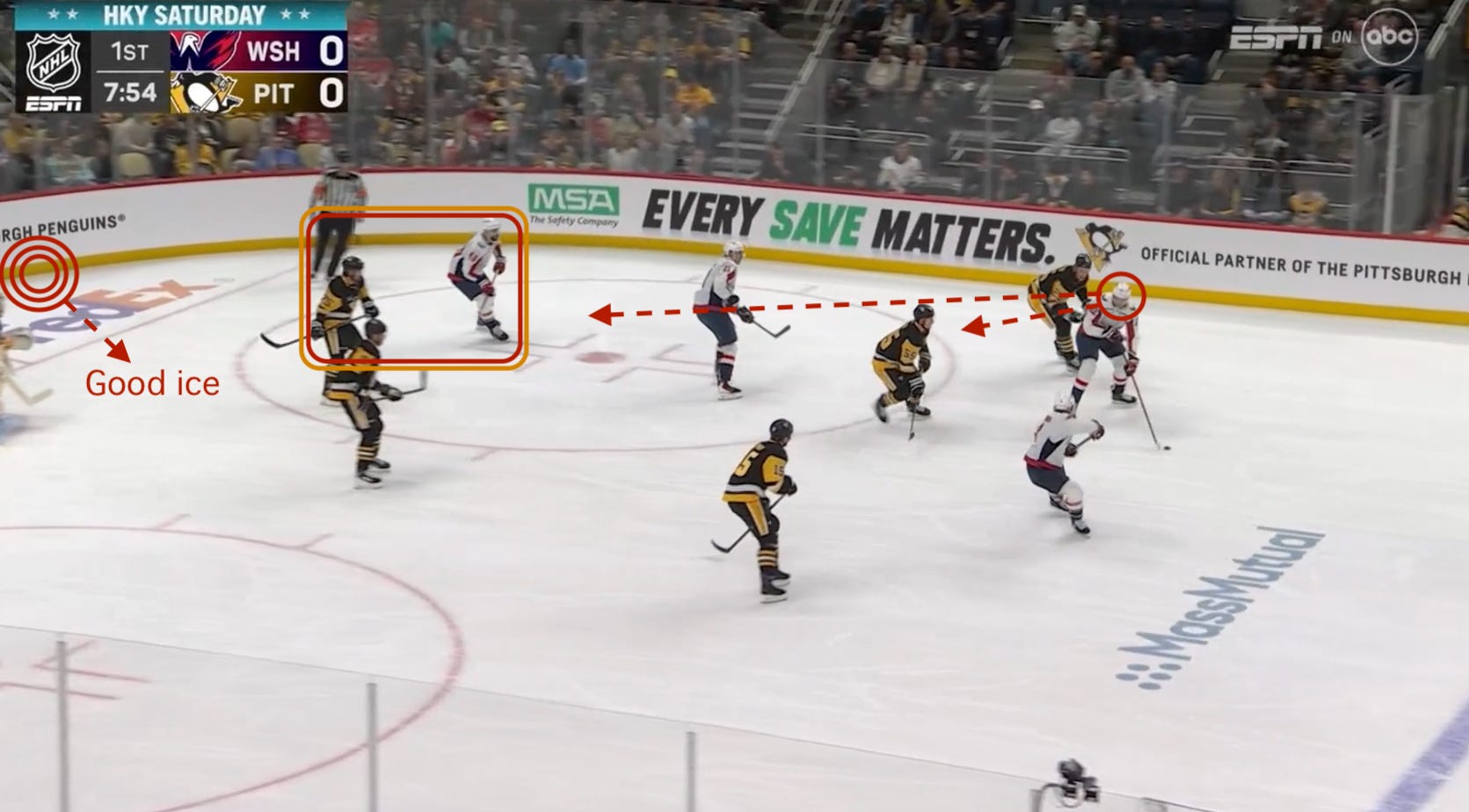
Protas peeks into the heart of the rink while he recovers a loose puck near the point. There’s immediate pressure from Noel Acciari (PIT 55) and Elmer Soderblom (PIT 25), whereas LD Chychrun is covered by Joona Koppanen (PIT 15). Attempting to thread a pass to Aliaksei in this location would be risky. The RD is there (out of frame), but feeding him with 6’8”, 252-pound Soderblom in the vicinity wouldn’t exactly improve his team’s attacking conditions.
Pittsburgh would be in great shape…were it not for the kid’s ability to both pass to open teammates and pass players open. He sees Connor Clifton (PIT 75) roughly level with Wilson, believes his RW can win the race to the goalmouth and calculates a bank pass off the end boards:
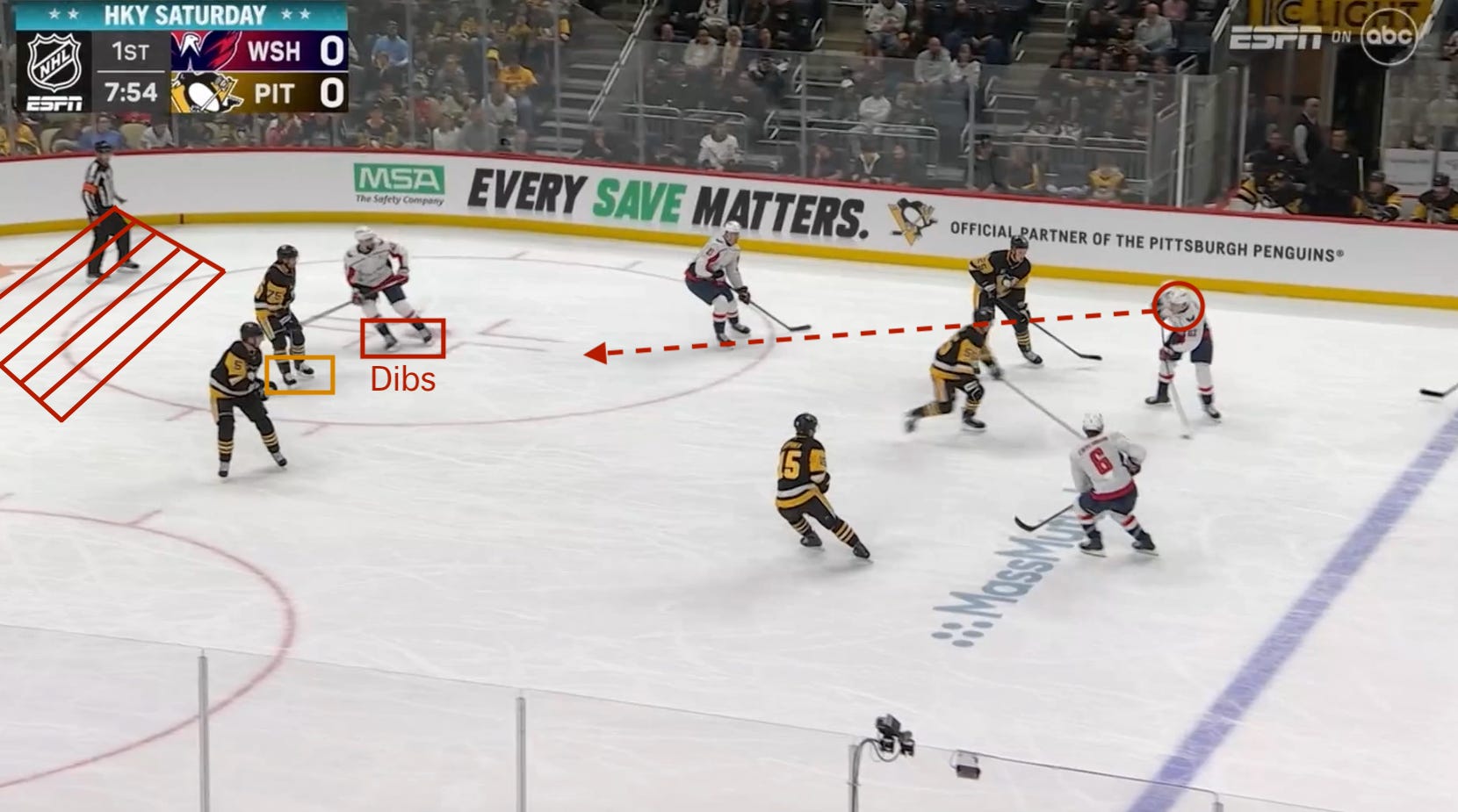
Look at Clifton and Wilson’s feet. One pair is roaming higher in the DZ. The other is poised to zip below the dots. In the time Protas spends corralling the puck and scanning inside, the RD has only skated further from the cage. Should the center’s indirect dish climb back above the goal line anywhere in Clifton’s zone, Wilson will claim it first.
In one fell swoop, the Caps shift from staring the D-corps in the face to slipping behind it altogether:
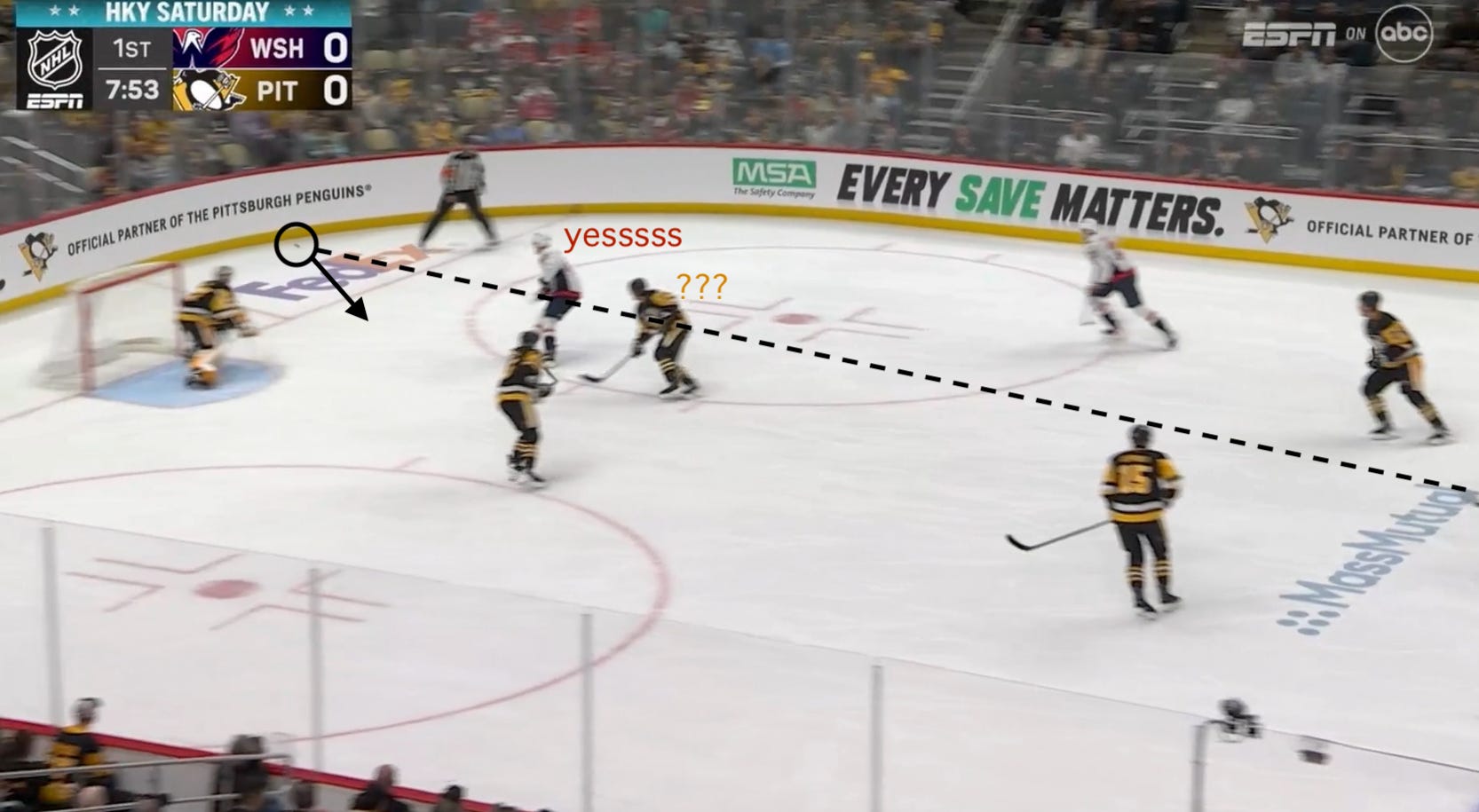
Not many forwards—let alone rookies with a week of NHL experience—would summon the IQ and initiative to complete a slot bank pass under pressure from the point:
There is indeed no doubting Protas’ playmaking upside. He can conceive of and complete dishes that many players can’t.
With that said, his decision-making requires a coat of polish and a wider color palette. While a pass-first identity is fine, you have to pick your spots. Pulling the trigger is necessary on occasion. Don’t shoot exclusively when it’s your only option. Limiting our scope to the recent lineage of Caps setup men, Nicklas Backstrom ripped his wrister from medium range and Evgeny Kuznetsov unleashed a stream of sharp-angle bids in order to sow confusion and keep defenses/goaltenders honest.
Ilya, for his part, didn’t glance at the net unless he had no other choice or the puck found his blade in A+ territory. Sometimes, he passed out of there too. He’d rumble to within arm’s reach of the netminder and force the puck into sagging defenders:
If this pattern holds, it will simplify defensive reads and thus leave goals on the table. Coupling his accuracy and creativity with deception, on the other hand, would unlock a new offensive layer—particularly next to underrated passers.
The bones are there for a more balanced offensive player. At his best, Protas exhibits clever spacing in transition, often timing his trailing arcs with such precision that his 6’6” build steers clear of the opposition’s view. He also senses chances to sink down as the F3 on changes of possession:
To be fair, he did mount a serious scoring threat on the PP. Washington assigned him net-front duty in hopes of extracting all the juice it could from his frame, and PP1 repeatedly drove pucks in his direction:
No Capitals forward registered a higher HD chance rate on the man advantage last year. No one was in the same ballpark. Again, small sample, but it speaks to the coaching staff’s intentions and how difficult it can be to wrangle him down low. I suspect he may be best deployed as a hybrid net-front/goal-line guy rather than a traditional crease-disturber. A quick thinker of his stature would be one hell of an asset to park near the cage.
Remember, tracking Wilson’s whereabouts was already painful enough in 2025-26. Imagine he and Protas swapping posts, bouncing to and from the bumper, the lip of the crease, the strong-side goal line, the back door, etc. while Hutson and/or Chychrun do their thing. There’s always Ovechkin’s generational one-timer to account for as well. PK nightmare fuel.
Given his…lackluster shot, securing a close-range role on the PP and honing his spacing at EV are the keys to developing a dual-threat dimension. There’s room for a high-IQ yet low-key—if it’s possible to consider a mountain of a man low-key—pivot to capitalize on Aliaksei and Wilson’s “noisier” efforts.
What about his defense? Well, there’s no getting around his physical advantages on this side of the ledger either:
Beyond his anticipation and willingness to track back, his length can consume daylight in the most prized areas of the rink (e.g. middle ice in the NZ or home plate). He does have a habit of waving at pucks one-handed, which could cause problems in the DZ when you factor in his poor mobility, but his size usually shields him from peril once more. He attacks puck-carriers from such unconventional angles/unexpected distances that his stick muddies their possession before they can prepare a counter.
It wasn’t all pretty, though:
The first clip reveals how much scarier it is to reach out in space with little speed behind you. As F3, it’d behoove Protas to play the long game, take less aggressive routes and live to fight another day. Aliaksei and Wilson will soon catch up to square the numbers.
His DZ puck management is another concern. His choices bordered on lazy at times, attempting finesse plays through obstacles where firmness was in order. With his positional burden and inadequate recovery speed, he can’t afford to surrender pucks cheaply. Moreover, there’s a decent chance that Protas-Protas-Wilson will absorb tough minutes after the wingers faced stiff competition last season.
Fortunately, he’s a 20-year-old 6’6” rookie. His physical and mental games are still growing. Film room sessions, along with more reps at NHL pace, should correct this fault to some degree.
All in all, the promise is clear: good vision, deft hands, ridiculous size.
Protas has the makings of a monster when the play enters his orbit. The question is how often that monster will rear its head. If he can add a dash of propulsion to his smooth processor and towering mass, the Caps will discover a top-six center who can bolster their title chase this season and eventually anchor their post-Ovechkin forward corps.
Comments
Nothing yet. Say the first thing.
Sign in to join the conversation.