
A new party is a better way to bring change than an internal movement in countries where new parties are viable.
Abundance is the new name of the moderate Democrat movement to make building and producing good things easier. I'm a big fan of this goal. Abundant housing is cheap housing. Abundant clean energy is cheap clean energy is effective climate change mitigation. Stagnation, obstruction, and many veto powers is not a uniquely American problem. The Abundance discourse is seeping into existing European parties, but that won't be enough. Yes, many of the issues also affect Europe severely, but the EU is significantly different from the US. That means that the different problems need different policy solutions. But in this post, I want to focus not on the solutions, but on the question: what is the appropriate vehicle for delivering abundance in the EU?
In Europe, a new party is more effective than a movement inside an old one
The critical difference between the US and European democracies is that the continental¹ European democracies are far more competitive. New parties have a much bigger chance in countries like the Netherlands, Spain, Italy. In the Netherlands, we even have a tradition of a new (often far-right) party surging out of nowhere to compete with the biggest.² Even Germany (5 parties, electoral threshold of 5%) and France (3 party groups) have more opportunities for new political parties than the US.
It is a fact of life that existing organisations are much harder to reform than new organisations can arise that are built to purpose. Because new parties have such abysmal chances in the US, new ideas rely on persuasion and inter-factional competition to get the right candidate on the ballot. The average voter then needs to do a lot of work to figure out which politician's name means which policies.
In Europe, you can just start the Abundance Party. Or, because you want to distance somewhat from the left-coded abundance movement, call it the Build Party or Growth Party. You can include only candidates who are fully on board. You can keep cultural issues fully off the agenda. You can build a highly identifiable brand. You don't need to appeal to existing party elites. You can appeal to the right wing as well as the left wing. You can much more credibly distance yourself from the establishment. You can, like Milei in Argentina, adopt a populist anti-institutional framing.
Most importantly, you can establish issue ownership. That is, you're the issue owner if voters associate your party/name with having the best solutions for that specific issue. Issue ownership is very important, because elections are generally decided by a few salient issues. Be the issue owner of a salient issue, and you can count on a significant vote share.
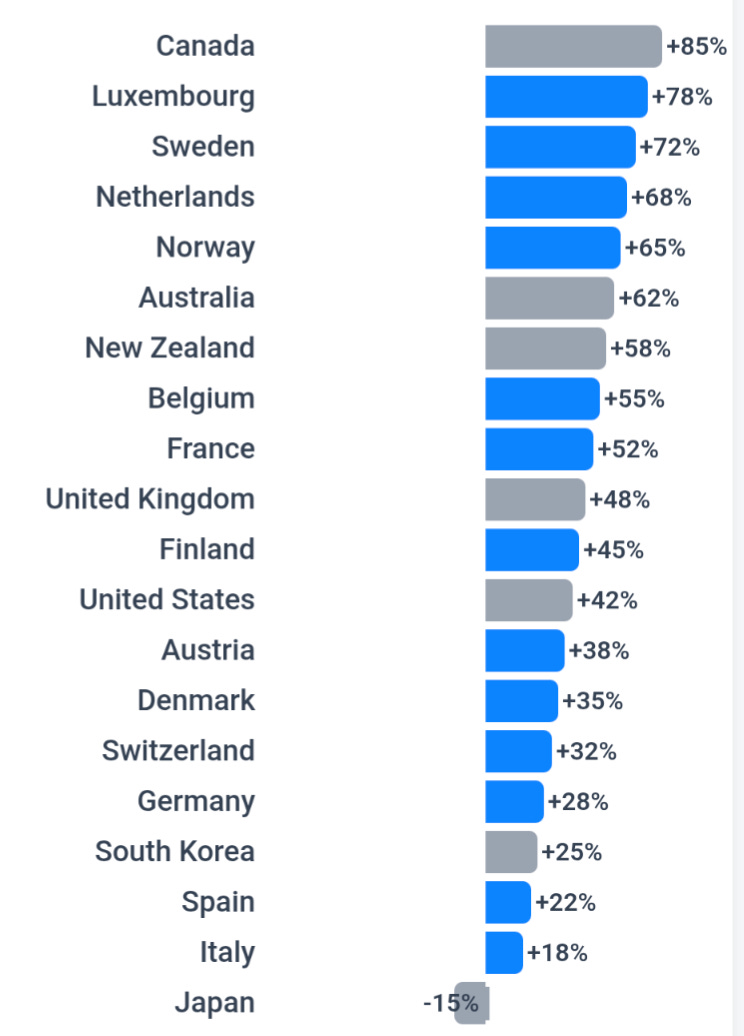
House price changes from 2005 to 2024. Data compiled by Claude Sonnet 4 from Dallas Fed International House Price Database, OECD Housing Data, and other sources. Continental European countries highlighted in blue.
Not all countries have a housing shortage. Nonetheless, energy costs are high across the continent and would benefit from permitting reform to build more clean energy plants (solar, nuclear etc.). And all countries would benefit from reforms that allow Europe to compete in global industries like AI, batteries and electric vehicles, and pharmaceuticals. Still, the Build Party would likely be more popular in some countries than others. Maybe it shouldn't even be called the Build Party.
No parties have so far succeeded in obtaining issue ownership over the housing crisis (or the energy crisis), even though voters rank housing as one of the most important electoral issues. Hence, voters haven't been deciding elections based on housing policies, and little has changed. A Build Party could credibly establish issue ownership. It could avoid other contentious topics like immigration, trans rights, and other culture war stuff that distracts from the important topics and defines the issue ownership of other parties. It also doesn't bear the blame that any party with a governing history has. Any such party gets the obvious and very valid response "well you didn't fix this the last time around, why should we expect you to fix it this time?"
A European Superparty with national chapters
When I say that Europe needs a Build Party, I don't exactly mean a single party. The EU doesn't work that way; there is no single list to vote in during European Parliament elections. But neither do I think abundance believers should focus only on their own country. There should be a European Build Party with national party chapters, each which pays a share of fundraising to the European party. That then funds chapters in countries that don't yet have a Build Party, as well as other activities such as power brokering in Brussels, formulating a European agenda, and disciplining any chapters that betray the party’s principles and damage the brand.
Most importantly, regional chapters within countries need to enter city, municipal, and provincial governments. This will build the necessary governance experience to grow a talent pool and test out which policies work, which are most politically tractable, etc. Furthermore, this will create an evidence base for voters to point to and say: ‘look, the Build Party came into power in these cities, housing supply surged, and prices dropped!’ Again, this is much clearer for voters to evaluate than “Democrat politician Joe Smith applied similar policies on his state”, which would require voters to assess whether Joe Smith did implement those policies, whether those policies are pro-abundance, and which of their local Democrat politicians are proposing similar pro-abundance policies.
So, who’s going to start it?³
¹ Not sure what the best move is for the UK. But given that it's currently facing the threat of a great electoral upset by the far-right Reform UK, and suffering from even worse levels of stagnation than the US, a Build Party might be appropriate.
² These parties rarely succeed, because they run on ineffective policy platforms, have leadership crises, or their issue is no longer highly salient. It's also just difficult and takes time to build a party from nothing.
³ If I were able to work, I would seriously consider it. I could use the platform to get society on the ball with AI. Alas, I'm pretty severely disabled (moderate-severe ME/CFS including cognitive impairment).
No posts
Comments
Nothing yet. Say the first thing.
Sign in to join the conversation.