
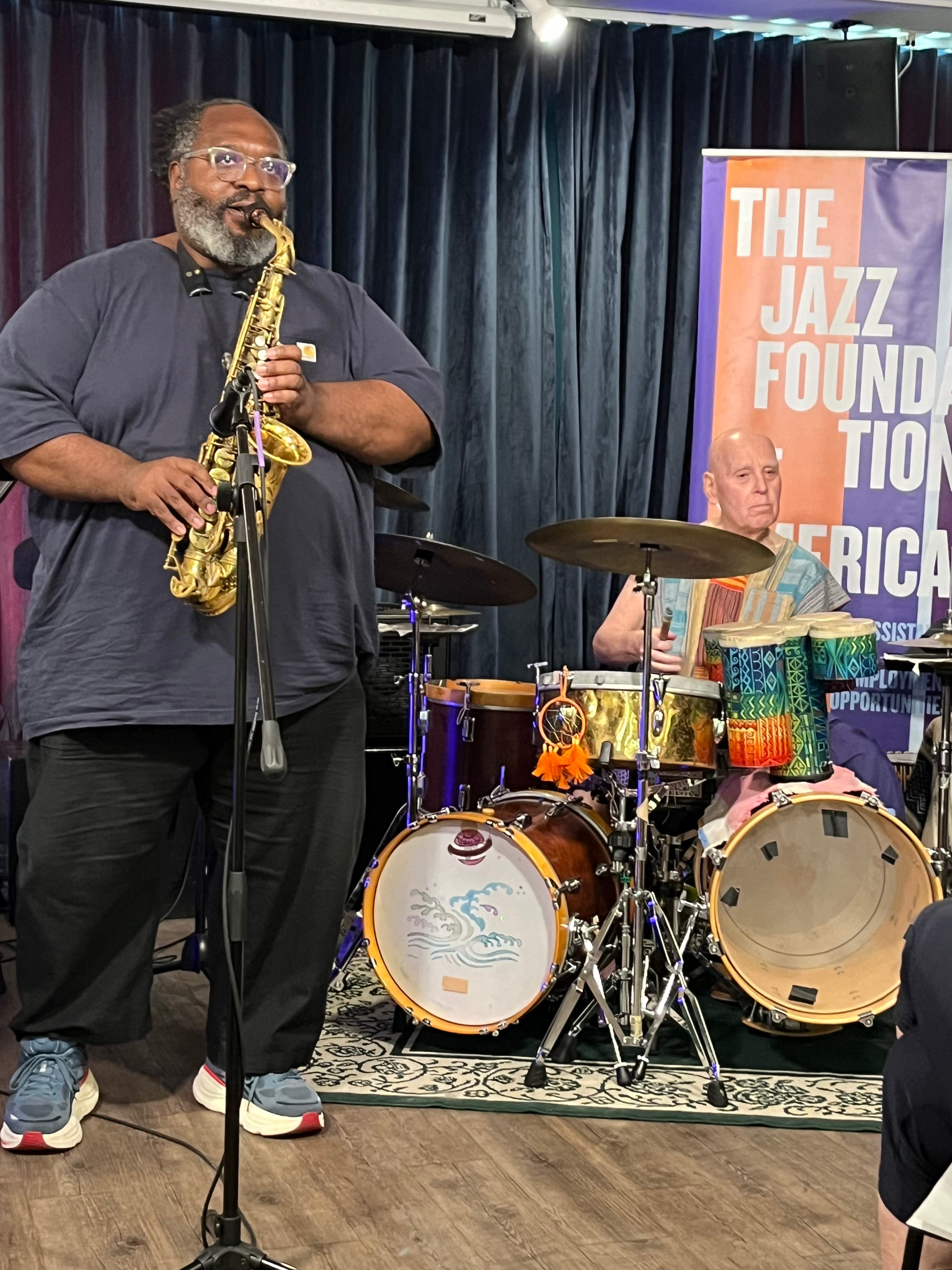
Drummer Bob Moses does not often perform in New York City. But last Thursday, Moses, now living in Memphis, TN, was briefly in town, en route to Kingston to participate in the Jack DeJohnette memorial show on Sunday, August 11th.
Ra-Kalam Bob Moses delayed his trip to Kingston just enough to play a beautiful concert in duet1 with alto saxophonist Darius Jones at the National Jazz Museum in Harlem.
Like many, I first heard Moses on Pat Metheny’s Bright Size Life (ECM, 1975), on which Bob is nothing short of masterful. Moses is fully inhabiting Metheny’s music, supporting Pat’s ideas and direction, but doing so with a sound and vocabulary totally unique to him. Bright Size Life is a Bob Moses tour-de-force, almost a better showcase for Bob than it is for either Metheny or Jaco Pastorius!
Now 78 years old and mindful of his health— he gave heartfelt thanks to the Jazz Foundation of America for help with recent medical woes— Bob’s genial, peaceful air and long relationship with Darius Jones underscored the duo’s melodic and to-the-point improvisations.
While Darius patiently followed each phrase to the conclusion, Moses, on a kit with two small bass drums and two hi-hats, plus something like a snare drum, a tomtom, something like a floor tom, a set of bongos, a few cymbals, and a table of miscellany, played a beautiful traditional grip and inhabited a sound world of his own design. Every sound and rhythm was fully and finally his own, yet his connection to backbeats and ding-ding-a-ding was easy to hear.
I was most grateful that Moses, who has often distanced himself from convention of any kind, shared his beautiful, old-school technique with us. He has a gorgeous sound; now I know a little more about how he makes that sound.
After Darius spoke movingly and off-the-cuff about his decades-long connection to Bob, as both a mentor and friend, the music got louder, more urgent. Now with the stakes just so slightly raised, and a sense of purpose clearly discernible, Darius and Ra-Kalam swept us up into their reality. When the man came out to thank us for coming, I couldn’t believe 60 minutes had passed.
As often happens when musicians play so nakedly, the audience was, for the moment, a like-minded community. We greeted each other as new best friends, while Mr. Moses greeted his family, including his brand-new granddaughter.
I inched towards Bob to pay my respects, while my friend Laurence Donohue-Greene, holding a stack of LPs and CDs, including the first LP by Compost, Bob’s co-op band, with Jack DeJohnette on keyboards, eagerly approached a happy-to-help Bob Moses.
Laurence handed Bob the Compost LP, Bob reminisced, and I briefly made eye contact with him. Bob then took the opportunity to sing and mime the beat for Compost’s “Take Off Your Body”, exactly as my father (or any drummer my father’s age) might have done, a reminder of just how exciting the new, full-bodied rock rhythms really were. Bob’s micro-performance gave me a flash of understanding of 1969, and of the performance I just heard.
Moments later, thanks to a kind introduction by my friend, the wonderful drummer Jason Nazary, I was honored to shake Bob’s hand. He told me I “felt like a drummer”, and I felt lucky beyond words.
As I walked to the train with my friend George Korval (my secret source for all that is good; it was George who told me about the concert in the first place— thank you George!), I started to sense just how once-in-a-lifetime that concert might have been.
Bob Moses was really doing his thing, in a room full of intense listeners, on a weekday afternoon, in the dog days of summer, in Manhattan. This is not the kind of thing that comes up very often.
Many thanks to National Jazz Museum in Harlem, to George Korval, to Darius Jones, and to Ra-Kalam Bob Moses, truly one of a kind. Here’s hoping that I couldn’t have been more wrong about how rare this was.
Amazingly, the concert was streamed. You can watch it in full right here.
Like Bob Moses, drummer Barry Altschul is a native New Yorker with much name recognition, yet whose contribution is still unsorted.
Altschul, born in 1943 (five years before Bob Moses), has an unmatched resume. In the Seventies, Altschul was, in essence, the music’s premier avant-garde drumset stylist. Just look at this:
Altschul is on the bulk of Paul Bley’s recordings from 1965 to 1968, plus significant reunions in the Seventies and Eighties; Sam Rivers built his ensembles around the team Dave Holland and Altschul (one of the classic bass-and-drum teams) from ’73 to ’78, which is the same period in which Altschul was working with Anthony Braxton, appearing on Braxton’s well-regarded Arista records from ’75 to ’76.
Tying this together, is Altschul’s close association with Chick Corea. In Corea’s final pre-Return To Forever guise, Altschul was, with Dave Holland, one-third of Circle, first a trio of Corea, Altschul, and Dave Holland, then a quartet with Anthony Braxton.
Paul Bley, Chick Corea, Sam Rivers, and Anthony Braxton: four of the most progressive musicians of the Seventies, all working with Barry Altschul.
Altschul’s slighty-ahead-of-the-beat ride cymbal (not so different from Bob Moses’s!) rogue left hand, and readiness to abandon timekeeping for waves of energy and counterpoint, creates enormous drama and excitement. I love Barry’s playing on Dave Holland’s Conference of the Birds (ECM, 1973) and Anthony Braxton’s Five Pieces 1975 (Arista, 1975); but I have much to learn about Barry Altschul.
At Smalls last week, Barry seemed right at home with tenor saxophonist Ricky Ford’s group. On a slow-medium “Perdido”, Altschul swung out, bearing down on the time with bassist Jerome Harris, engaging in some nice trades, and generally having a ball. Even in the relatively straight-ahead setting of Ricky Ford’s group, Altschul created his drama, seeking and finding places to smear the time: sometimes when soloing, sometimes at the end of tunes, and at least once, right in the middle of the tenor solo.
The guy I was sitting next to said he first heard Barry with Sam Rivers at Studio Rivbea in 1974, and I was, as always, struck by music’s timelessness. The brief chat helped me listen a little deeper, and for a moment I really heard Altschul’s progressive, still-unfinished conception and living, urgent beat. I got a little closer.
One major difference between me and my cohort and Barry Altschul, Bob Moses, Billy Hart, and all the drummers born in the 1940s and earlier: they never went to school for this. They never even thought of going to school for this.
Though both Bob Moses and Altschul did receive some formal drum and music instruction, neither had the benefit and burden of institutional, academic, sanctioned, accredited jazz learning of the kind that I and my colleagues all received as a matter of course. Everything they do is theirs.
When I hear this community, I am hearing something rare and untamed. Their music has an obvious and enchanting wildness that is sometimes submerged on recordings but clear as day when in heard in person. Like Bob singing “Take Off Your Body” and Barry Altschul exulting in the possibilities of going outside the lines on “Perdido”, the whole thing continues to be more complex, more free, and more real than I initially thought.
Thank you all, and bravo Bob Moses and Barry Altschul!
Jones and Moses were supposed to be joined by bassist Don Pate, who was too ill to participate.
Comments
Nothing yet. Say the first thing.
Sign in to join the conversation.