
PROLOGUE: UNITED STATES, 1920— THE WHITE BANDLEADERS
By 1920, the nation’s infatuation with brassy, small, hot jazz bands, a la The Original Dixieland Jazz Band and similar white groups1 which had begun torridly in 1917, was rapidly cooling off.
Instead of the exuberant, almost naive inventiveness of the five-piece ODJB, featuring drummer Tony Sbarbaro, large orchestras— featuring a relaxed, stately two-beat, a hint of syncopation, swooning saxophones, and a smiling bandleader in front of the band, waving a baton, greeting the audience— were now the thing. An update on the society orchestras of the previous century, the new orchestras were found in the ballrooms of downtown hotels in seemingly every American city.
The most famous bandleaders of the Twenties— Paul Whiteman, Art Hickman, Isham Jones, Guy Lombardo, Vincent Lopez, Jan Garber, Sam Lanin, Hal Kemp, Jean Goldkette, and many more— presented music that was well-played, soothing, reassuring, and professional. 2 To most listeners at the time, this was jazz.
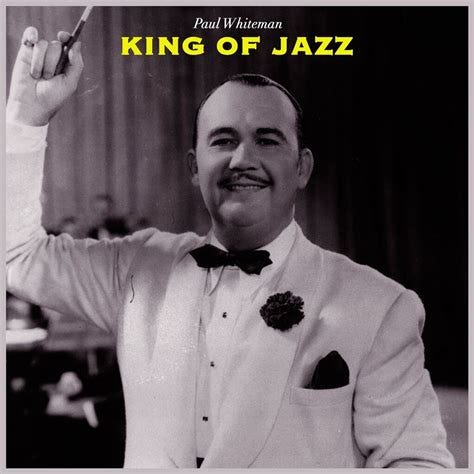
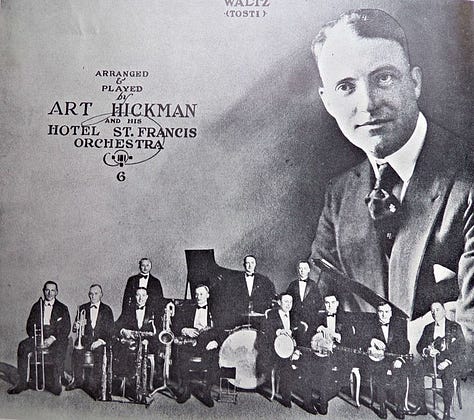
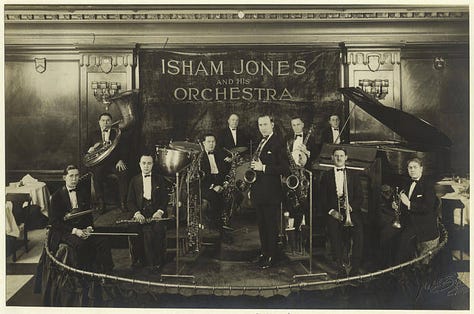
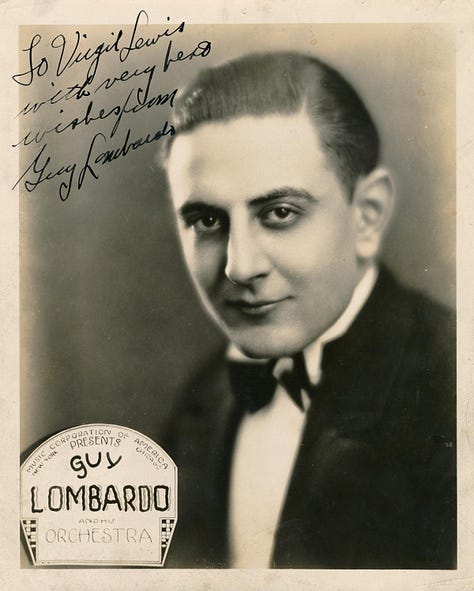
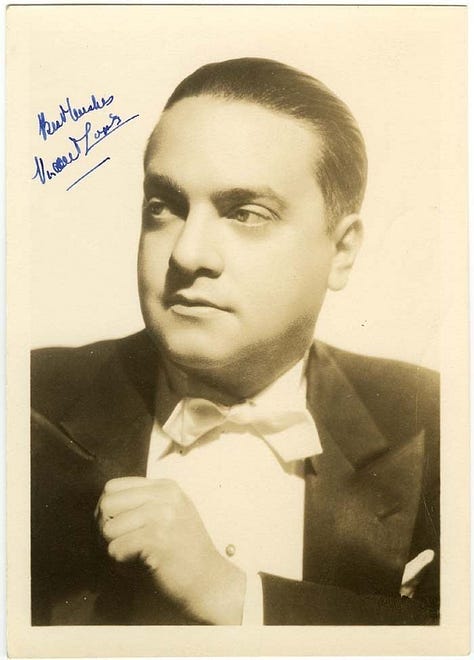
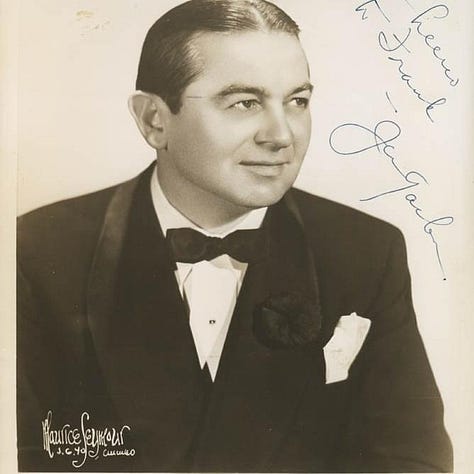
Paul Whiteman, born in Denver, CO in 1890 and crowned “The King of Jazz” by the Buescher Band Instrument Company in 1923, is the most well-known of this crowd. Whiteman dominated American popular music in the Twenties; his recording of “Whispering” from 1920 seems to set the decade’s tone3 .
Of course, Whiteman wearing the crown as Louis Armstrong, King Oliver, and Jelly Roll Morton were making their first recordings is appallingly wrong, though, interestingly, Louis Armstrong’s fondness for Guy Lombardo was lifelong and well-known, and Duke Ellington spoke highly of Paul Whiteman on several occasions, even praising him in his autobiography, Music Is My Mistress.
For it was only a matter of time before Louis Armstrong, Duke Ellington and their followers left the Paul Whitemans of the world in the dust, both musically and culturally. Without needlessly disparaging or dismissing the graceful, professional, and popular music of the white bandleaders, after Louis Armstrong, never again could this music confidently call itself jazz. Although the sound itself did not disappear overnight, never again would it command a wide audience.
Above all, after Louis Armstrong, for music to catch on, it had to have more rhythm4.
BUT THERE’S NO DRUMS ON THE RECORDS!
In 1923, against the backdrop of the clear diction, wide vibrato, and two-beat of the society jazz bandleaders, the nascent American record industry began recording Black artists en masse, spurred in part by the success of vocalist Mamie Smith’s recording of “Crazy Blues” in 1920.5 Once Black Americans began making records in earnest, there was no looking back, and the world has never been the same.
Finally, after two chapters of pre-history, of the drumset being assembled, of vaudeville, minstrelsy, the Victor Military Band, the Original Dixieland Jazz Band, and the white bandleaders of the Twenties, this is our beginning.
After 1923, we can hear the music of Jelly Roll Morton, King Oliver, and Louis Armstrong, the most concrete and direct roots of the music we know and love, and study Warren “Baby” Dodds, the most well-known of the early jazz drummers, with whom Morton, Oliver, and Armstrong all recorded important work.
But we can’t hear what Baby Dodds was actually doing, for there are no drums on the records!
Or rather, there’s not enough drums on the records. On King Oliver’s “Dippermouth Blues”6 from 1923, Baby Dodds plays woodblock. On Armstrong’s Hot Sevens from 1927, Dodds has but a single cymbal, though the eight tunes Dodds recorded with Jelly Roll Morton that same year are a little better, featuring bass drum, toms, cymbals, and brushes.
But this seems thin. How then can we talk about jazz drumming, especially as jazz was emerging, if the drums were not recorded?
A good question, and I have a few answers:
First of all, though Dodds’s earliest recordings— especially with King Oliver— are not what we hope for, they are what we have.7 More importantly, Baby Dodds simply sounds great, even on a woodblock or single cymbal. His choices are utterly perfect.
Besides which, Dodds was active into the postwar era and recorded frequently, both solo and as accompanist. There are plenty of recordings of Baby Dodds in full effect, just not from the Twenties. Also, Baby Dodds was interviewed extensively, explaining his music to the first generation of jazz researchers8 leaving us with all the testimony and context needed to understand his earliest recordings.
Ultimately, it is wrong to dismiss Dodds’s contribution to these seminal records just because I wish Dodds had recorded with a full kit. Above all, I should not let my disappointment at what is not on the recordings keep me from hearing what the recordings do capture.
For Baby Dodds’s earliest recordings capture a great deal.
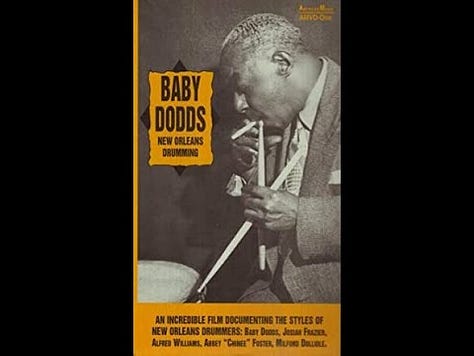
DIPPERMOUTH BLUES: BABY DODDS
Though many drummers were experimenting with the template first recorded by Tony Sbarbaro9, it is with Baby Dodds that our story begins, for Baby Dodds is the drummer most associated with Louis Armstrong in the Twenties, when Armstrong was re-making American music in real time, changing forever what American music could be.
Baby Dodds is unusual in our pantheon. Though an early architect of jazz drumming and an innovator who proposed a cohesive and fresh drum vocabulary, Dodds was also a staunch traditionalist. He seems to have played exclusively with small groups (there is no Baby Dodds big band recording) and only seldom with a dedicated vocalist, one who did not also play an instrument.
Nor did Dodds ever accept the hi-hat10, refusing to add one to his drumset. Likewise, wire brushes were a source of consternation for Dodds; though he played them beautifully, in his autobiography, he declares brushes to be “of no serious use.”
Yet, as jazz( as we know it) emerges, everywhere we look, Baby Dodds is there, with shocking consistency: Dodds is in New Orleans in the Nineteen Teens, where he meets Armstrong, Joe Oliver, and every New Orleanian of note; he’s with Armstrong on the Streckfus riverboats, with King Oliver, at both the Lincoln Gardens and at the Richmond, Indiana recording studio for Armstrong’s first record date; Baby is the first drummer to meet Armstrong’s fabled Hot Seven in the recording studio.
Baby Dodds was named by no less than Gene Krupa as his most formative, primary influence:11
“But there was only one Baby Dodds. He was at Kelly’s Stables [ca. 1926-7] with his brother Johnny, cornetist Natty Dominique, and a piano player. Baby taught me more than all the others— not only drum playing, but drum philosophy.
He did all that the others did, and more. He was the first great drum soloist. His concept went on from keeping time to making the drums a melodic part of jazz. It was partly the way he tuned his drums— the intervals he used. I got that from him.
And it was partly his concept of tone. Baby could play a tune on the drums, and if you listened carefully, you could tell the melody!
I kept going back to hear Baby— though sometimes it was a hassle getting into the place because I was underage12. Not only was he a great showman, the man played with fantastic drive. Those press rolls! He could really get things moving.
It soon became clear how much I admired him, and we struck a friendship that was only broken by his death in 1959. Until I got to New York a bit later and heard Chick Webb at the Dunbar Palace, a ballroom in Harlem, Baby was my biggest influence.”
— Gene Krupa, in conversation with Burt Korall, 1972.
Innovative, influential, and ubiquitous, Baby Dodds also had an eye to posterity. Dodds documented his ideas about drums and drumming, in a book, studio recording, and short film, preserving his legacy for future generations and ensuring his contribution would be remembered.
This combination of willful individualism, right time-right place historical importance, deep popularity, and a sense of jazz history is why Baby Dodds’s name has a luster all its own, why he stands out among the many excellent drummers from the era. Dodds’s luminosity is based on the esteem in which he was held by his community. From the beginning, Baby Dodds was very special.
Warren “Baby” Dodds was born in New Orleans, with a birthdate usually given as December 24, 189813 into a musical family14, with brother Johnny (born 1892) an accomplished clarinetist, and their father an amateur singer and guitarist. “Baby” emerged early as a family nickname, distinguishing the younger Warren from their father, also named Warren.
A fully-trained and musically literate professional who named New Orleans masters Dave Perkins and Walter Brundy (born ca. 1883)15 as formal teachers, and credited local legends Henry Zeno (born ca. 1880), Tubby Hall (born 1895), and Louis Cottrell (born ca. 1878) as inspirations, Dodds, in his early teens learned rudiments16 and sight-reading. He was readying himself to play anything, as he put it, “from street work, to pit work…to show work, to concerts”.
Dodds’s first gig of note was under the leadership of Fate Marable on the Streckfus steam boats in 1918 and 1919. Joining a band that included Louis Armstrong and Pops Foster, the Streckfus job was a prestigious and challenging gig, requiring Dodds, depending on the situation, to both sight-read and improvise.
In 1921, Dodds was reunited with brother Johnny Dodds in Joe “King” Oliver’s band. Oliver brought his group to San Francisco for a long-term gig later that year, and in 1922, the group traveled to Chicago to open at the Lincoln Gardens, where Louis Armstrong joined the group on Saturday, July 8, 1922.
Dodds’s 1923 recordings with King Oliver and Armstrong, a spurt of sessions for Gennett, Paramount, and Okeh, are foundational. Though Dodds is restricted to a woodblock and occasional cymbal, with a core vocabulary based (though Dodds never described it as such) on clavè and habanera, filtered through his knowledge of ragtime and rudiments, he exudes confidence and authority. We are on our way.
On “Dippermouth Blues”, from April 1923, and on the majority of the Oliver sides, Dodds, on a simple woodblock, plays variations on a two-bar pattern: one hand plays a continuous pulse, the other plays around a loose rendition of the 2-3 or 3-2 sòn clave, tying the earliest jazz to the wider African diaspora.
Though Dodds mixes and matches 2-3 and 3-2 at will, clavè is so important to the Oliver sides that you can clap along with almost any of the group’s 1923 tracks— “Froggie Moore”, “Chimes Blues”, or “Snake Rag”— and the 3-2 or 2-3 clave pattern emerges.
When accompanying the rare solo, Dodds often outlines the habanera (the ‘3’ of a 3-2 or 2-3 clavè), accenting a stream of eighth notes just so, letting the pushing, swinging habanera to come out.
Clave, habanera, ragtime, and a touch of military: put them all together, distill them to a woodblock, and we have a rough approximation of Dodds’s vocabulary. But none of that matters, for the proof is in the pudding— these Oliver sides move and groove in a compelling way. Something is happening.
Four years pass before Dodds appears again in the Lord Discography. Yet in just three months of 1927, Dodds will play on the recordings that secure his reputation as the most important and well-known of the early jazz drummers.
First up, in April 1927, are four sides Dodds records with his brother Johnny, all featuring Louis Armstrong. (In fact, today, we know them as Armstrong records.) Again, Baby is minimal, and we hunger for more, but his well-placed cymbal accents on “Weary Blues” and comfort with the funky and slow tempo of “Wild Man Blues” will have to suffice.
In May, Dodds was in the studio with Louis Armstrong’s Hot Seven on four separate dates, lending discreet but important parts, courtesy a single cymbal, to such Armstrong immortals as “Gully Low Blues”, “Potato Head Blues”, and another version of “Wild Man Blues”. Again, we wish for more, but what is there is telling: Dodds is at ease and confident as Armstrong reimagines American music. That is all we need to know.
Finally, in June, days after his final Armstrong session, Dodds recorded with pianist Jelly Roll Morton, jazz’s first composer. Now with a full drumset, we can savor Dodds’s restraint, taste, and wisdom on a third version of “Wild Man Blues”, “Jungle Blues” (which must be the earliest one-chord tune), W.C. Handy’s “Beale Street Blues”, and Morton’s own “The Pearls”. Each track is a gem, but Morton was not done.
Jelly Roll concluded his June 1927 sessions with two titles by a trio of himself, Johnny Dodds, and Baby Dodds. “Wolverine Blues” and “Mr. Jelly Lord” are the best-recorded and most complete versions of Dodd’s innovation we’ve yet heard.
“Wolverine Blues” features some cool tom-tom and cymbal, but “Mr. Jelly Lord” is the standout. Dodds, with brushes on a snare, swings straight through, pausing only for the pre-arranged solo breaks. Interestingly, the tempo of “Mr. Jelly Lord” widens and slows down, at a time when a recording was much more likely to speed up, or stay rigidly in time.
Not so with “Mr. Jelly Lord”, where Dodds, Dodds, and Morton find an expansive strut, loose and swinging even by today’s standards. No longer is Baby Dodds stating and ornamenting the beat while assisting in transitions, like a more developed version of Tony Sbarbaro. Now Dodds is properly laying it down, inhabiting the emotion of the tune, and expressing himself, via timekeeping, with style and charisma.
What’s clear on these 1927 sessions is that, whether on a woodblock or a full drumset, Baby Dodds uses a fresh and coherent jazz language on the drumset, projecting the “drum philosophy” that captivated a young Gene Krupa. Especially on Morton’s June 1927 session, we can hear Dodds plant the seeds of all future drumming— ding-ding-a-ding, backbeats, hands-and-feet beats, et cetera. Listen close, and it is all here.
From 1929, the year of the stock market crash that triggered the Great Depression, to 1940, Dodds is not found on any recording sessions. Yet Dodds, located in Chicago, was regularly employed at Kelly’s Stables (run by banjoist Burt Kelly) and at the Three Deuces.17 Sadly, in 1940, Baby lost his brother Johnny, which, as he wrote in his memoirs, deeply affected him.
Though he wasn’t recording, Dodds’s reputation was intact. When Sidney Bechet, a complex and peripatetic man whom Baby had known in New Orleans, returned to full-time music-making in 1940, he called upon Dodds for his first recording session.
Bechet’s “Blues In Thirds”, recorded by a trio of Bechet, Earl Hines, and Dodds, is the most well-known title, but tBechet’s version of “Stompy Jones”, an Ellington classic even in 1940, should be better known, especially for Dodd’s relentless press rolls and lovely, nearly straight-eighth ding-ding-a-ding on a cymbal.
When cornetist Bunk Johnson, a link to jazz’s earliest days, received some new dentures and began gigging again in 1942, Baby was there to help Johnson enjoy his moment in the spotlight. Although the veracity of Johnson’s stories did not withstand scrutiny, Johnson’s records with Dodds are great fun and sweet as can be.
Dodds himself spoke highly of the Johnson sessions of July and August 1944 for American Music Records. Indeed, Bunk’s version of “Weary Blues” from August 3, 1944, is a delightful example of Dodds’s full drumset style in a traditional Dixieland configuration. Here, Dodds is exuberant and joyful, rolling around the kit with gusto, bringing out both the shave-and-a-haircut 3:2 clavè and habanera as needed.
On “Careless Love”, from the same session, Dodds plays mostly rims and woodblock, indicating just how well the 1923 Oliver recordings captured the essence of Dodd’s conception.
Baby’s association with Bunk Johnson seems to raise his profile, especially in New York. This, the mid-Forties, is the period when the young New York drummers first hear Baby, when Dodds leaving an indelible impression on both Max Roach and Philly Joe Jones, who, so taken by listening to Dodds, nearly missed a gig of his own.
Baby was a regular on critic Rudi Blesh’s radio program, This Is Jazz, and even recorded four excellent sides as a leader for Blue Note in December 1945, just a month after Charlie Parker, Miles Davis, and Max Roach had recorded “Billie’s Bounce” and “Now’s The Time”.
Billed as “Baby Dodd’s Jazz Four”, the session featured clarinetist Albert Nicholas, Art Hodes on piano, and bassist Wellman Braud. “High Society” is a standout, as Dodds moves smoothly between a military 2-beat and jazz 4/4, first on the snare drum, then for the thrilling final 32 bars, on a ride cymbal, a veritable history of jazz drums.
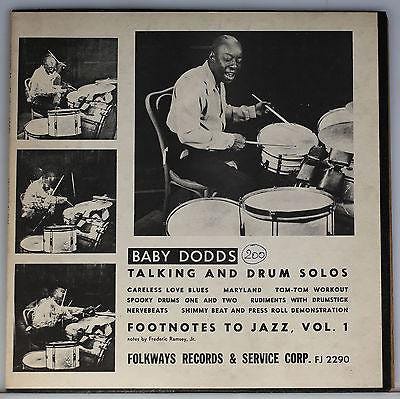
In January 1946, Dodds participated in the recording for which he’s best known today. Arranged by author Fred Ramsey18 and issued as Talking And Drum Solos (Folkways, 1946), this is as close to a drum lesson with Baby Dodds as we’ll ever come.
Throughout the relaxed and informative 25 minute session, Dodds speaks volubly, summarizing his career, demonstrating his press rolls and timekeeping, and improvising solos. Though brief and casual, Talking And Drum Solos is as complete a summary of Dodds as we could hope for.
Though Talking and Drum Solos is invaluable, a session just a few days before contained Dodds’s deeper music. Joined by Albert Nicholas and pianist Don Ewell on a repertoire of New Orleans classics, issued simply as Baby Dodds Trio19 on Rudi Blesh’s Circle label, Dodds is in a relaxed and flowing mood, especially on the session’s two unaccompanied drum solos which surpass those on the Ramsey session for depth of feeling and artfulness of construction.
If Talking And Drum Solos is the afternoon clinic, Baby Dodds Trio is that night’s gig. The clinic is great, but the gig is the thing.
Dodds stayed busy throughout 1946 and 1947, participating in a dizzying array of all-star New Orleans recording sessions and concerts— Jazz At Town Hall with Sidney Bechet, a World’s Greatest Jazz Concert featuring Pops Foster, Blesh’s continuing radio program, and even playing snare drum (while drummer Lawerence Marrero plays bass drum) on a 1946 album by the Original Zenith Brass Band.
While Baby was often recorded in New York, Dodds seems to have maintained his home in Chicago, where he spent more and more time after a series of strokes in 1949, ‘50, and ‘51 forced him into semi-retirement.
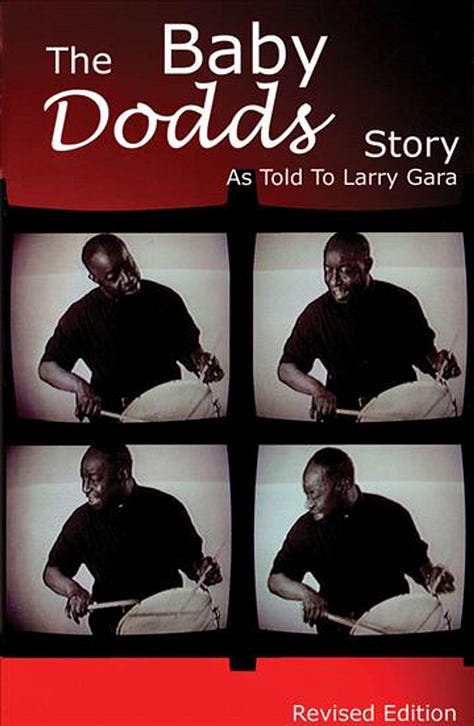
In 1953, Dodds was filmed, though without audio, for the 13-minute Baby Dodds, Drums: A Great New Orleans Drummer’s Technique, streaming now on YouTube. Around the same time, Dodds began work on his autobiography, assisted by graduate student Larry Gara. In print and widely available today, The Baby Dodds Story preserves Dodds’s analysis of his life, times, and music. Taken together with Talking And Drum Solos and the silent film, Dodds’s position as both a witness to jazz’s emergence and nonpareil innovator and consolidator was now preserved for all time.
Warren “Baby” Dodds died in Chicago in 1959 at age 60. His legacy of creativity and individuality sit at the very foundation of jazz drumming.
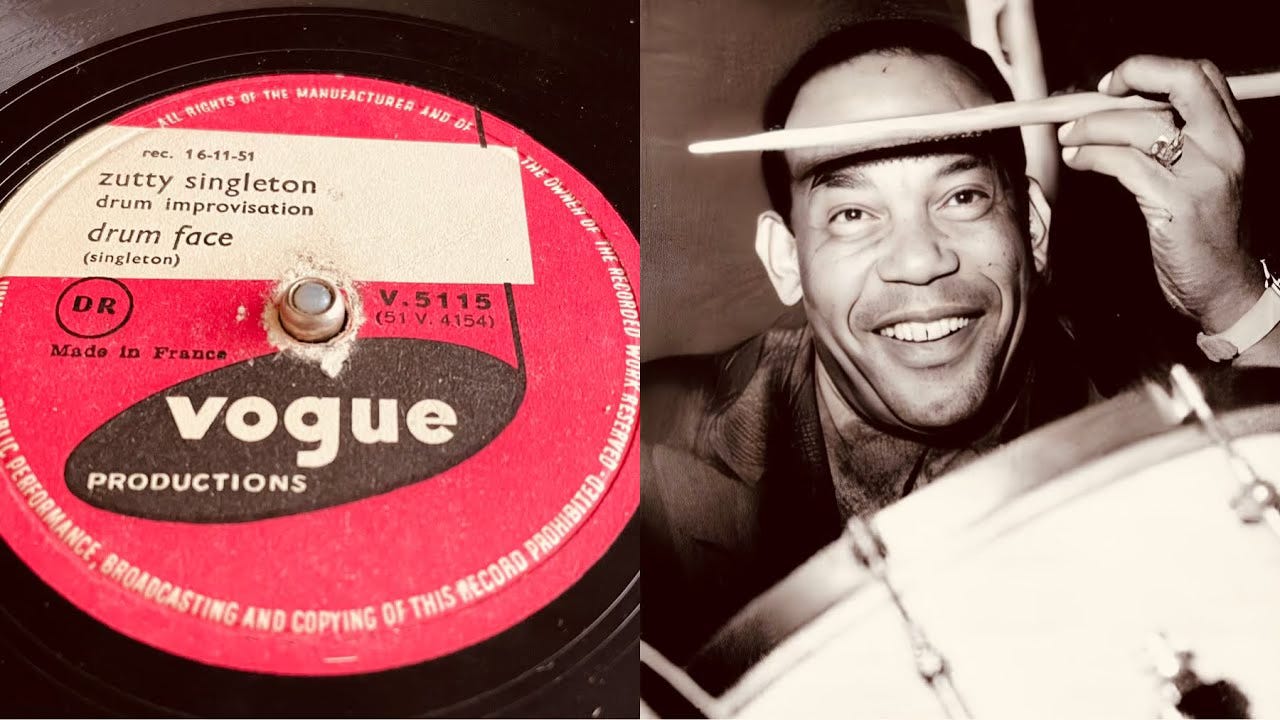
SMILING THE BLUES AWAY: ZUTTY SINGLETON
On the surface, Zutty Singleton is a near match to Baby Dodds, sharing a birth year (1898), state of origin (Louisiana), diminutive nickname, and professional milieu: both started in New Orleans, both played on the Strekfus steamboats under Fate Marable, both were close associates of Louis Armstrong, and both moved to Chicago in the Twenties.
But if Dodds was defined by his traditionalism, Singleton could be defined by his openness, his willingness to adapt and change. Zutty’s long career, which included recordings with Louis Armstrong, Roy Eldridge, and Dizzy Gillespie, reflect his willingness to experiment and musical bravery. Like Dodds, Singleton used a developing but integral jazz drum vocabulary. Unlike Dodds, Singleton seemed to seek out novel settings for that vocabulary.
Arthur “Zutty” Singleton was born May 14, 1898 in rural Bunkie, Louisiana and as a child moved with his family 150 miles southeast to New Orleans. According to his wife Marge, “Zutty” was a version of a Creole-language word for “cute”.
At a tent show on the outskirts of New Orleans around the time of Zutty’s 13th birthday, Singleton first became acquainted with Louis Armstrong, then just 11 years old and singing with a vocal quartet. This was the beginning of a lifelong friendship, though one not without its ups and downs.
By 1915, at age 16 or 17, Zutty was a professional drummer, playing with New Orleans pianist Steve Lewis20 before enlisting in the Navy as part of the nation’s effort in World War I.
Out of the Navy and back in New Orleans by 1919, Singleton was soon making the rounds, appearing with cornetist Papa Celestin’s Tuxedo Brass Band, clarinetist “Big Eye” Louis Nelson,21 John Robichaux’s band, and with Fate Marable on the Streckfus steamboats.22 Clearly, Zutty was an up-and-coming professional, a youngster to watch.
But for an ambitious musician, New Orleans, especially in the early 20th century, was a city to leave; opportunities for the city’s musicians were severely limited. By 1925 at the latest, Zutty had made his move, heading 700 miles north to St. Louis, Missouri, which, like all American cities with a sizable African American community, was a hotbed of innovative Black music and entertainment.
It’s in St. Louis that Singleton makes his first noteworthy recordings, “Market Street Stomp” and “Won’t Don’t Blues” with trumpeter Charles Creath for Okeh in 1925. Singleton sounds good, and Creath was an exciting player, known solely for his few Okeh recordings. Creath’s other connection to our story is his sister Marge, who married Singleton before 1926, when the couple moved to Chicago.
In the Windy City, Louis Armstrong received Zutty as more than a familiar face. Instead, in Zutty Singleton, Armstrong now had a friend, collaborator, and like-minded peer. With Zutty in his corner, Armstrong had all he needed, personally and musically.
Immediately, Singleton became part of Armstrong’s inner circle. In 1927, Singleton, Armstrong, and pianist Earl Hines, Armstrong’s most significant collaborator in this period, even attempted to go independent and make it on their own. Armstrong, Singleton, and Hines formed a leaderless co-operative trio and leased their own dance hall where they would promote their own shows. Though the collective effort went belly-up in less than six months, both Hines and Singleton formed the core of Armstrong’s ‘new’ Hot Five for Okeh Records.
These Hot Five recordings, made over the course of 1928, include some of Armstrong’s best-known early titles, including “A Monday Date”, “West End Blues”, “Muggles”, “Beau Koo Jack”, “St. James Infirmary”, “Hear Me Talkin To Ya”, and “Tight Like This”. All feature Singleton.
Though Zutty has nothing more than a suspended cymbal and a set of “Bock-a-de-Bock” hand cymbals— like a hand-held hi-hat— on “A Monday Date” and “West End Blues”, on the remainder of the titles, a full drumset is deployed. On “Muggles”, “Beau Koo Jack”, and the other 1928 classics, Singleton’s swinging bass drum is the heartbeat, with a nascent cymbal beat appearing at just the right moments23. Like Baby Dodds, Singleton is introducing a coherent vocabulary for jazz drumset. At this point, the two drummers sound more alike than different.
In 1929, Singleton left Chicago and moved to New York, ostensibly to join Louis Armstrong as his full-time, exclusive drummer. This did not work out quite as planned, but Zutty Singleton’s 4/4 bass drum powers Armstrong’s first recording of the song that put him on top: Fats Waller’s “Ain’t Misbehavin”.
Recorded in NYC on July 19, 1929 for Okeh Records and backed with “Black and Blue”, there is little Zutty does on “Ain’t Misbehavin” that grabs our ears, but this is the point: what Singleton does is the earliest version of what all drummers do today. Singleton’s 4/4 bass drum, the perfect complement to Armstrong’s irrepressible rhythm, ensured that “Ain’t Misbehavin” was unlike any other hit record from 1929. After Armstrong himself, it was Zutty’s bass drum that made “Ain’t Misbehavin” a jazz record.
Like Dodds, Singleton had more room in the spotlight with Jelly Roll Morton than with Armstrong. On Morton’s “Smiling The Blues Away”, also recorded in 1929, Singleton, switching discreetly from brushes to sticks, keeps time on the snare, makes some transitions, improvises fills, and implies (but never states) both the habanera and clavè.
Like Dodds with Morton in 1927, here at last, indisputably, is full-drumset jazz drumming. This might be the first occasion when listeners can compare or contrast jazz drummers; compared to Dodds, Singleton feels looser, more improvisatory. Yet they still feel far more similar than different.
In the early Thirties, while Armstrong was on the road24, Zutty freelanced around New York, before returning to Chicago. Back in Chicago, Singleton hooked up with trumpeter Roy Eldridge, then just launching his career, preparing to be the major trumpet stylist of the era. Eldridge’s “After You’ve Gone” on Vocalion, recorded in Chicago on January 28, 1937 and featuring Zutty Singleton, was a major event for Dizzy Gillespie. Here, Singleton finds a way to adapt his press roll/bass drum approach to the contemporary “swing music” idiom, including a thrilling two-bar tom-tom break. Clearly, Singleton was ready for anything, and is now distinguished from Dodds; I know of no Dodds recording in a similar vein.
For the next three years, Singleton, while still playing with Roy Eldridge, took part in a plethora of NYC small band recordings, often for small, jazz-oriented labels such as HRS and Commodore. This smattering of high-quality all-star ad hoc dates, is another reason we know Zutty’s name today. No drummer his age was better suited to these dates, as Zutty expanded his basic approach to suit any professional situation with style, personality, and charisma.
Among many highlights are Zutty’s tom-tom solo on Pee Wee Russell’s “There’ll Be Some Changes Made” on HRS, Sidney Bechet’s “Jungle Drums” on Vocalion, the all-star trio of Sidney Bechet, Jelly Roll Morton, and Zutty on “Oh Didn’t He Ramble” for Bluebird, and finally Singleton’s own session for Decca in May 1940, with “King Porter Stomp” and Spencer Williams’s minor-key “Shim-Me-Sha-Wabble” as stand-outs.
In 1943, Singleton relocated to Los Angeles, and immediately began appearing in new settings, including movies (1943’s Stormy Weather, where Zutty is playing with Fats Waller and even gets a solo) and radio. Trombonist and fellow New Orleanian Kid Ory tapped Singleton for regular appearances on Orson Welles’s radio show, an association that would later lead to Singleton’s second film appearance in New Orleans, starring Billie Holiday and Louis Armstrong, developed from an idea of Welles’s.
That’s Zutty playing tasty brushes on Slim Gaillard’s original 1945 “Cement Mixer (Put-Ti-Put-Ti)” on Cadet, and it was under the auspices of Gaillard that Singleton recorded with both Charlie Parker and Dizzy Gillespie in Los Angeles in December of 1945. “Dizzy Boogie”, the most well-known title from that session, features an infectious shuffle that widens and slows from Singleton and memorable choruses from both Gillespie and Parker. Singleton’s work with Gaillard can be heard as a stand-in for several quasi-R&B singers he worked with in this period, including Claude Trenier, Big Joe Turner, Sugar Chile Robinson, and Big Red Alton.
Zutty seems to be living in Europe in 1951 and 1952, where he plays with Sidney Bechet and Mezz Mezzrow, but is back in NYC by 1953. Upon arrival, Singleton was gigging with Roy Eldridge, recording with clarinetist Omer Simeon, Henry “Red” Allen, and Jimmy Rushing, and even appearing on a Riverside album, Songs Father Taught Me, by banjoist Father Joseph Dustin.
Perhaps Singleton’s biggest moment in this period was on Chicago and All That Jazz, broadcast on NBC in 1961. Though less coherent and sober than CBS’s 1957 The Sound of Jazz broadcast, the show, billed as a celebration of “Chicago’s jazz heritage”, features Zutty proudly swinging on a ride cymbal for solos from Kid Ory, Buster Bailey, Henry “Red” Allen, and Lil Armstrong on “Jelly Roll Blues” and “Dr. Jazz”. Now in his early sixties, Singleton’s musicianship was undiminished, and judging by his ease on the ride cymbal, he was, as ever, willing to make changes.
Singleton remained somewhat active throughout the Sixties. Though relations between Singleton and Armstrong had waxed and waned, Armstrong biographer Ricky Riccardi reports several long visits between the two men starting in 1969, as illness forced Armstrong to stay home and recover. Zutty then suffered a stroke in 1970, forcing him to retire, which spurred Armstrong, in his own final days, to even further levels of devotion to his old friend.
Arthur “Zutty” Singleton, the drummer from jazz’s first generation who most clearly showed the music’s natural adaptiveness, whose command of the earliest jazz drum vocabulary allowed him to thrive in every new musical situation, died in New York on July 14, 1975.
The range of Singleton’s credits most obviously predict Roy Haynes25, but I think Singleton’s example goes further. If Baby Dodds showed jazz drumming’s durability, Zutty Singleton’s long career shows the wide reach and potency of the African American percussion tradition, of jazz on the drumset.
CODA: CHICAGO, NYC, AND THE FUTURE
By 1929, seven years after leaving New Orleans, Louis Armstrong, riding “Ain’t Misbehavin”, was on his way to stardom. Jazz and jazz drumming, though in a rapid state of development, are quickly coalescing into sounds and conventions recognizable today.
From Zutty Singleton and Baby Dodds, jazz on the drumset is centered around the heartbeat 4/4 on the bass drum. In fact, the pulsing 4/4 bass drum, stated or implied, is becoming a signifier of jazz music, how you know you’re hearing jazz.
Meanwhile, the one-bar, long-long-short habanera and two-bar (2-3 or 3-2) clavè, both distillations of centuries of African wisdom, are mixing freely with the new heartbeat 4/4 and the inheritance of ragtime and military music.
To be sure, I know of no drummer from the Twenties or Thirties who ever spoke of clavè or habanera. But the music speaks for itself. Clap the clavè along with Oliver’s “Dippermouth Blues”, Morton’s “Jungle Blues”, or Armstrong’s “Potato Head Blues”, and feel the African heritage come through. Obviously, they were not treating clavè as Arsenio Rodríguez would. But it is there.
Ding-ding-a-ding, on a cymbal or with brushes, was, in the fast-moving days of the late Twenties and early Thirties, still only an occasional choice. Even as ding-ding-a-ding became more common, more accepted, it was not yet the center of the universe, for a smoothly flowing 4/4, with a walking bass line, blues-based riffs, and improvised solos, were not yet a central fact of jazz.
For the time being, Zutty Singleton was in NYC, but Baby Dodds was in Chicago, which, in the late Twenties and early Thirties, was the nation’s jazz capital. In a few years, Chicago jazz would give us Benny Goodman and Gene Krupa, in whose wake swing music became a national craze, and the jazz drummer would enter the hearts and minds of listeners everywhere.
In Harlem, drummer Chick Webb was leading a band that would, in 1936, cause Krupa to rethink his life. Sonny Greer, meanwhile, perhaps the most conceptually advanced drummer of his day, was finding new paths to victory with Duke Ellington.
Still others— Kaiser Marshall and Walter Johnson with Fletcher Henderson, plus New Orleanian New Yorkers Paul Barbarin, Tubby Hall, and Ollie Tines, were busy consolidating and sharing ideas on how to best work with Armstrong’s rhythms.
This story, of Chicago and Baby’s students (Dave Tough, George Wettling, and Gene Krupa) and Harlem of Sonny Greer and Chick Webb, will be the focus of the next chapter.
In truth, from 1923 to onward, the jazz idea was developing at a new, accelerated pace, and emerging all across the nation. Baby Dodds and Zutty Singleton, perfecting a drum vocabulary that could easily accommodate the new rhythmic paradigm of Louis Armstrong, were out in front, showing what could be done.
Though I fret for all the names left out, for all the contributions I have overlooked, one thing remains certain: the drummers who first put the idea of jazz on the drumset were innovating to an extent no drummer has since. With no external referent, these drummers— Singleton and Dodds are but the few names known to us now— were inventing a new musical language, permanently re-defining jazz and planting the seeds for all future music.
The outline of jazz drumming as we know it, emerging more and more clearly in this period, reflected a new way of thinking, for it allowed for the co-existence of African rhythmic wisdom and European-derived stick control. As it went on, it came to suggest a new way of living.
These include the Original New Orleans Jazz Band, led by Jimmy Durante— yes, the Jimmy Durante— with drummer Johnny Stein; Earl Fuller’s Jazz Band, formed in NYC in direct response to the success of the ODJB, featured clarinetist Ted Lewis, an early inspiration for Benny Goodman, and a drummer named John Lucas, about whom I could find nothing; The Louisiana Five were formed in New York City around New Orleanian clarinetist Alcide Nunez, and featured drummer Anton Lada, a recent emigre from what was known then as Bohemia; the Whiteway Jazz Band, little more than a name on some old 78s, which the deans of early jazz have not yet arrived at a consensus about the group’s personnel; the Original Memphis Five; and the New Orleans Rhythm Kings (also known as the Friar’s Society Orchestra).
The term “jazz” seems primarily derived from the word ‘jasm’, meaning, among other things, pep, drive, energy, and effervescence. In San Francisco in 1915, the word “jazz” is used in print for the first time to describe a pitch that can’t be hit, while Lewis Porter posits San Francisco in 1915 as a plausible time and place for the word to migrate from sports to music, possibly in the presence of Art Hickman. Since it was an exciting new word in 1920, any contemporary dance music was called “jazz”.
Even the ODJB was searching for away to create Whiteman-style smoothness with a five-piece group, with a now-contrite Tony Sbarbaro no longer playing straight through, but entering and exiting the music like a humbled servant on their 1920 Victor releases “Margie” (a hit for singer Al Jolson the same year) and “I’m Forever Blowing Bubbles”,
Despite an earnest search, early examples of jazz drumming are nowhere to be found on Paul Whiteman records.
For instance, the huge variety of styles on Harry Smith’s Anthology of American Folk Music all come from recordings made in 1923 or later. After 1923, not only Black, but virtually every variety of the American sound was documented. The catalogs of record companies like Paramount, Black Swan, Gennett, and Okeh are a marvel of jumble and juxtaposition. First, there were the race records— as Albert Murray is it pains to point out, to call a record a ‘race’ record was the exact opposite of term of opprobrium, but in fact an inducement for a certain kind of person ( a ‘race man’ or ‘race woman’, for instance!) to buy the record!— which included psalms, spirituals, and religious music of all kinds; lots of sermons; plenty of blues singers, from the rural South, industrial North, and Midwest, many of whom also sang religious or hillbilly songs, and, of course, jazz. On the other side of race were the hillbilly records by hillbilly singers, who were of course later called country or folk singers, each with a distinct mix of the music of their Scots-Irish heritage and the African-American innovations they eagerly picked up; Hawaiian music, played by Hawaiian and non-Hawaiians; and lots of brass bands, especially from Mexico. Above all, there were thousands of novelty records, mostly by vaudeville performers. That is more-or-less the record business of 100 years ago.
“Dippermouth Blues”, featuring a young Louis Armstrong, is the King Oliver track with an Oliver wah-wah trumpet solo that soon became common musical property. It also became the basis for Fletcher Henderson’s “Sugar Foot Stomp”, which featured Coleman Hawkins. And we go from there.
Dodds told Larry Gara that Oliver’s records struck him as exact reproductions of the group’s sound. Clearly, Dodds, hearing himself on nothing more than a woodblock, recognizes something essential about his music.
In my twenties, I was skeptical of these later recordings. How could a recording in 1946 convey the truth of what Dodds was doing in 1922?
However, I’ve changed my mind. I now believe that all of Dodds later recordings capture the essential truth, for the simple fact that the vast majority of musicians (Sam Newsome is an exception, the only one I know of) do not make fundamental changes to their style.
Having now watched my own cohort of musicians age twenty-five years, I’m convinced of this. We all sound pretty much the same.
Including New Orleanian Andrew Hillaire, sounding great with Jelly Roll Morton, plus a host of theater, studio, and society drummers with significant jazz pedigrees, including white Chicagoans Ben Pollack, Vic Berton, and Chauncey Morehouse, plus innovative New Yorkers like Stan King, Sonny Greer, and Kaiser Marshall. All were working, though few recording, in 1923.
Dodds did record on the washboard on several Twenties record dates, which he liked even less than brushes and the hi-hat.
Krupa was always generous with praise, ready with kind words for nearly every player of note. But when talking about direct inspiration, Krupa always gave credit to Baby Dodds and Chick Webb.
Krupa’s birthdate is Jan 15, 1909 (Krupa was a little less than three years older than Jo Jones, five years older than Kenny Clarke, and fifteen years older than Max Roach). In 1926-7, the period he seems to be describing, he would have been 17 or 18 years old. But what did ‘underage’ mean while Prohibition was the law of the land, as it was from January 1920 until 1933?
Oddly, Dodds himself gives his birthdate as December 24, 1894 in his as-told-to memoir, written with Larry Gara. Yet every other book and website gives 1898. Anyone know how to resolve this?
The glaring exception is of course Louis Armstrong, a child of truly hair-raising poverty with a topsy-turvy home life, something not found in the early lives of Duke Ellington, Sidney Bechet, or even Jelly Roll Morton, who disgraced his family by going into music.
Dodds’s rudimental knowledge, was, however, not the N.A.R.D.-approved, New England rudimental style, but a homegrown, possibly less formalized version.
This is the Chicago nightclub of that name of the early 1930s, not the 52nd Street club of the same name of the 1940s.
Ramsey was the head of the team responsible for Jazzmen from 1939, the first book of jazz history published in the United States.
The full album name is Baby Dodds Trio-Jazz A La Creole. Side A is the Dodds-Ewell-Nicholas trio, Side B is a larger group of Dodds with Danny Barker, James P. Johnson, and others, emphasizing “Creole” tunes like “Les Ognons”.
Steve Lewis known to those who understand this time and place as an associate of violinist Armand J. Piron, “the first Black New Orleans bandleader to achieve success in New York”, and the same A. J. Piron who along with Clarence Williams managed to con Armstrong out of “I Wish I Could Shimmy Like My Sister Kate”.
Nelson was a clarinetist who played with cornetist Freddie Keppard.
I don’t know if Zutty played with Armstrong on the Strekfus steamboats. Singleton is heard playing a few cymbal crashes on Fate Marable’s Okeh recording of “Frankie and Johnny” b/w “Pianoflage”, recorded in New Orleans in March 1924, when Singleton was 25 years old. Though these are less jazz and more in the peppy dance band tradition of the early 20th century, Singleton’s music career was off to a strong start.
As researcher and drummer Colleen Clarke has pointed out, keeping time with ding-ding-a-ding on a cymbal or woodblock was already in relatively wide circulation in 1928: Chauncey Morehouse played ding-ding-a-ding with Bix Beiderbecke in 1927; Ben Pollack is heard playing a more fully-conceived version of it with Benny Goodman on “Room 1411” from the same year; drummer Abe Lyman is seen playing it in a film from 1929; Stan King is playing the cymbal beat on “That’s A Plenty” with Miff Mole (trombonist) in 1929; while on the Uncle Dave Macon recording of “Way Down the Old Plank Road” from 1926, somebody taps out the cymbal beat (though not on a cymbal) between Macon’s verses. However, ding-ding-a-ding would eventually be paired with driving 4/4 swing and the improvised solo, and neither idea was yet widespread in jazz.
Armstrong was touring with Luis Russell’s orchestra, featuring New Orleanian-to-New Yorker Paul Barbarin on drums.
An exclusive focus on Zutty Singleton and Roy Haynes would cover most of the important jazz records ever made, a sign of how important Haynes and Singleton really are.
Comments
Nothing yet. Say the first thing.
Sign in to join the conversation.