
Thanks so much for the response to Sunday’s dispatch on my new documentary looking at the colonial legacy of British nuclear testing in Nevada. While I’m currently ‘making visible’ the storytelling & logistics for that (and navigating a half-term heatwave with two very frazzled kids!), I wanted to share this interview with you.
In my new film, I’m exploring how state secrets are hidden. Today, Jamie Heidel and I explore how a different kind of reality is often hidden in plain sight: the autistic experience.
If you enjoy this, why not subscribe to get all my posts sent straight to your inbox 😃
After sharing some of the still-forming thoughts and ideas that are simmering away in my brain about my own new film, today I’m turning my focus back towards other people’s films, with some more film-club related goodness for you.
If you missed my posts on the first two films in our current autism season, you can catch up with those here:
Our next film will be dropping early next week. In the meantime, I’ve got a related treat to share with you which I hope you’ll find as illuminating as I do. It’s not a long read, but it packs a lot of insight into a very manageable package.
The Film Thread is the monthly online film club for discerning cinephiles, curated by documentary director & lifelong film-lover, (that’s me!)
Each season, we follow the thread of a single topic through multiple films, from different decades, genres & countries, favouring lesser-known gems over big-name blockbusters and curious questions over obvious answers.
It’s totally free and ALL are welcome. If you’re not already subscribed to my newsletter, why not sign up to get all my film club picks sent direct to your inbox?
The background to this is the whole inspiration behind the ‘film thread’ concept of ranging around a single topic, in as broad and deep a way as possible. The chief way we’re doing that is through films of course. But as a documentary-maker, I do LOVE a good interview; for me, there’s just nothing like hearing from someone with direct first-hand experience to open up fresh, new perspectives I might not otherwise encounter from my own limited vantage point.
And so, taking the lead from my earlier The Atom & Us interview series (which is by no means finished, just taking a little rest right now), I’m delighted to present the first in what I hope will be a mini-series of interviews to accompany this current film club season, entitled, appropriately enough, Autism & Me.
As in the atomic interviews, I’ve pulled together a selection of questions for my interviewees to answer and will then share my own brief reflections afterwards. If any of the points raised resonate with you I’d love to hear about it - getting these conversations going is very much the point of The Film Thread after all.

And so without further ado, it’s my great pleasure to introduce our first Autism & Me interviewee:
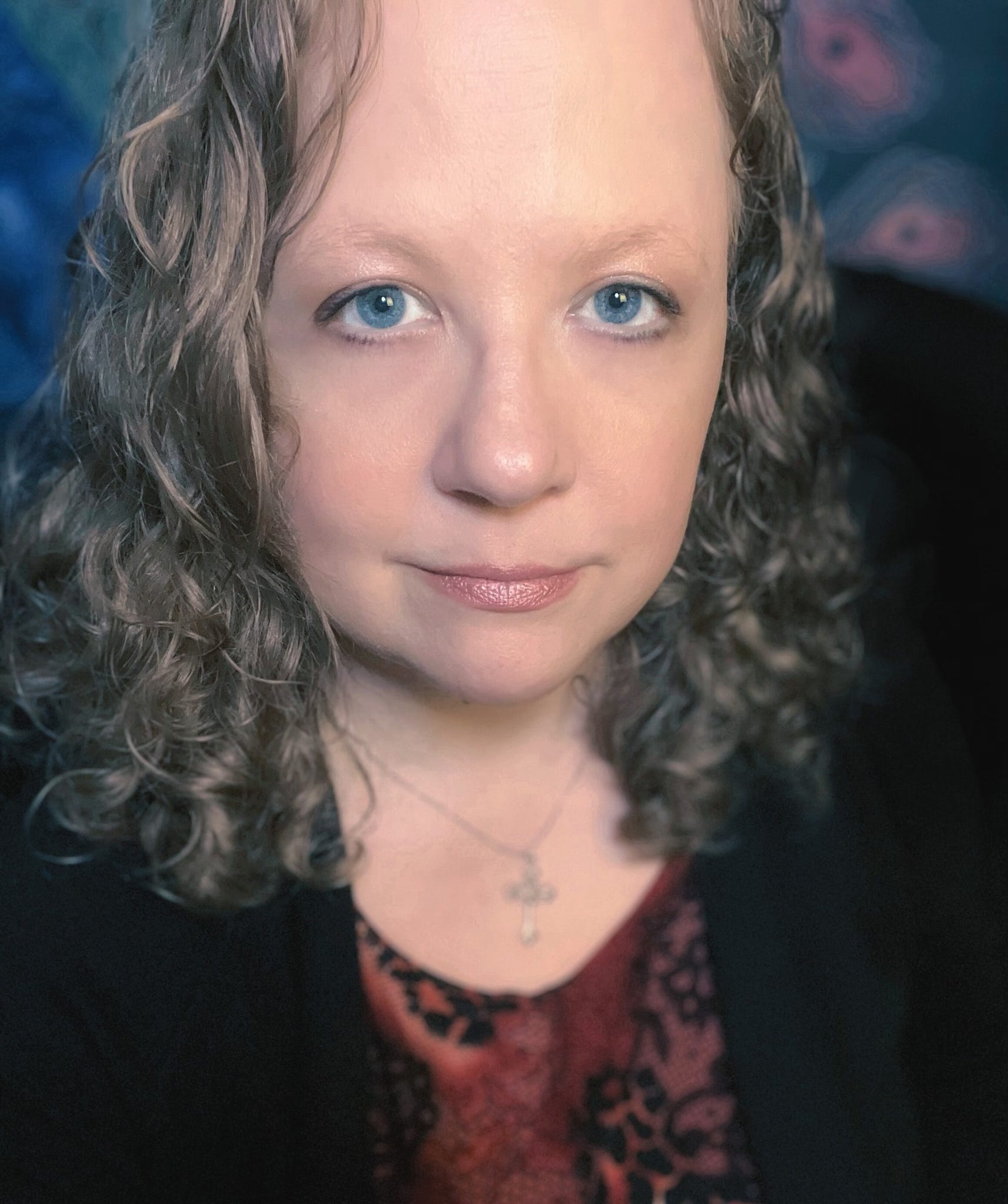
Jaime is one of the many people I’ve found via Substack who’ve helped me in my own education journey since my eldest child was diagnosed as autistic in late 2024, whether writing from a neurodivergent perspective themselves, or in an adjacent capacity as someone living or working closely with autistic people.
I’m indebted to all these writers for opening my eyes in so many different ways and I’d encourage any of you reading who want to learn more to head to the Substack homepage and search for autism and you’ll find a treasure trove of thought-provoking and enlightening perspectives awaiting you.
But for today, the spotlight is on Jaime - and here she is 😊
Thanks for reading Vicki Lesley is... Documental ! This post is public so feel free to share it.
I’m Jaime A. Heidel and I go by The Articulate Autistic. I’m an author, and I’ve self-published two books, What Did I Do Wrong? and Before You Fire Them.
My most important goal in life is to help neurotypical people understand and communicate more effectively with the autistic people in their lives, as this reduces frustration for the neurotypical person and trauma for the autistic person.
I do have a very vivid memory of being in my therapist’s waiting room and seeing a magazine with a pretty, wide-eyed woman staring into space, and it said something about Asperger’s. Mind, this was nearly 20 years ago, and the term ‘Asperger’s’ is no longer used due to its ties to Nazi Germany.
When I saw that cover, that woman, that expression, I was drawn to her. I had to read her story, and I found myself in so many things she explained and said that I’d never heard before. That was the start of my journey.
For me, it was a combination of both; a gradual unfolding through meticulous research. Once I started to study the autistic experience, suddenly, everything made sense. Then it hit me, looking through the lens of what I was learning, how so many social interactions had gone wrong in my life, and why I lost so many jobs.
The book that made me 100% sure I was autistic was Pretending to Be Normal by Liane Holliday Willey. Every single page I read made me tear up and nod in understanding. It was like someone was describing my life.
After that book, I started to ‘come out’ to my family about it. I had this, of course, purely autistic thought that I’d now put the information in front of them, and so many rifts would be mended. I was very wrong. They didn’t believe me, no matter what evidence I showed them. We’re estranged now.
I think the most important thing we can do overall is to believe an autistic person when they say they are autistic. Not automatically respond with, “We’re all a little autistic”, or “Everyone’s on the spectrum these days”, or “Oh, it’s just a fad”.
Being autistic is both a different wiring of the brain and a disability. It’s not a fad, a trend, or someone trying to avoid accountability. It’s everything that we are, and it affects every aspect of our lives, both positive and negative.
I think autistic people’s lives would be made better if neurotypical people were taught, at a very early age, how autistic people think and communicate, so it can become part of the societal norm.
This could prevent so many traumatic misunderstandings, frustration, confusion, and mental health struggles.
Also, there’s this semi-new thing going around that autistic people can’t be aware of their own gender or be able to consent to transition. Autistic people do not have “the mind of a child” and therefore can claim our own agency and what we choose to do with that agency. Being autistic doesn’t equate to “doesn’t understand anything and therefore can’t make decisions”. It’s not a deficit; it’s a difference in brain wiring.
Furthermore, for people of color (POC), we need to get much, much better at diagnosing autism instead of writing it off as some type of unknown behavioral problem or a purposeful act of defiance.
Not only does this erroneous viewpoint set young people up for a lifetime of confusion and failure (because they don’t speak the same ‘language’ as their neurotypical counterparts), but it can also put them in serious danger with authority figures as they age. This gaping diagnostic gap is a problem that needs to be addressed immediately.
“An autistic person expresses themselves - through words or actions - but their intended meaning is misinterpreted by the neurotypical person. This misinterpretation triggers an emotional reaction, leaving the autistic person shocked or bewildered by the outburst. The neurotypical person, frustrated, walks away, while the autistic individual spends hours going over the scenario in their minds, struggling to understand what went wrong - often without resolution.”
From: Before You Fire Them: A Practical Guide to Understanding Your Autistic Employee’s Traits, Intentions, and Communication Style - Jaime A. Heidel
I have encountered these misperceptions, and mostly I respond by trying to educate, because some people genuinely don’t know, as they don’t keep up with the autistic community’s changing vernacular. That said, if they have an autistic person in their life, the onus should not be on that autistic person to explain everything. I happen to like explaining things, so that’s usually my response.
Some phrases I’ve heard that can be very damaging are “profoundly autistic” or “severely autistic”, which not only come across as insulting, but also erase type 1 autistics. By the same comparison, “high-functioning autistic” can also be seen as insulting while also erasing those who have higher support needs.
Instead of “high-functioning”, say “low support needs” or varying support needs (most people have no idea how much level 1 autistics still struggle). You may not see it on the outside, but it’s there.
Instead of “profoundly autistic”, say “high support needs”. Not only is this more accurate, but it also centers support needs instead of suggesting that autistic level 3 people are in some way broken and have no thoughts, feelings, or agency of their own.
Although I struggle with socializing and working a typical job, I excel at pattern recognition, writing, advocating, and consulting. Because of who I am and how my brain works, I have a unique opportunity to build a bridge between the neurotypes. I also like my ability to hyperfocus on a task and zone in so completely that I barely know what’s going on around me. That flow state is bliss.
One, we’re not lying, making it up, or following a trend. Our brains work differently, and we are trying to communicate this to you. Autistic people are direct, literal, may speak in a monotone voice, or lack expected facial expressions, but that does not automatically equate to rude, slow, disinterested, or uncaring behavior.
Avoid making assumptions, see past what you’re perceiving as negative behavior, and look at the person, the human being in front of you.
I’ll start by shamelessly promoting my own books. lol! What Did I Do Wrong? aims to help parents and caregivers better understand their autistic loved ones, and Before You Fire Them for neurotypical employers who need to better understand their autistic employees. Literally, don’t fire your autistic employee until you read this book!
Other books I recommend are Sincerely, Your Autistic Child, Uniquely Human, Unmasking Autism, and Beyond Behaviors.
As for podcasts, I’d highly recommend The Autism/ADHD Podcast with Holly Blanc Moses. She’s great, and she and her guests break everything down into easy and actionable steps.
I could see the benefit of asking people about how being autistic has affected their family, social, and work life. I think this helps humanize the experience and makes neurotypical people want to learn more about the autistic people in their lives, to avoid further traumatizing them and alienating them.
I want to thank Jaime so much for responding to my questions with such care and honesty. Her mission to help neurotypical and autistic people better understand the different ways each may communicate and express their needs is so important - and sadly right now, still very much needed I think.
One of the biggest things I’ve experienced in my own family’s autism journey has been what I would call a process of ‘unlearning’ assumptions about what we might lazily call the ‘right’ ways to communicate with/act around other people. Just because certain ways are the dominant mode, that certainly doesn’t make them by default the correct or best ways. In fact when you pause to think about it, it’s pretty strange to imagine there would or even could be just one singular best way to be or act - there are literally billions of people on the planet and it’s self-evident that we are not all alike.
And yet, so much of society still just unthinkingly assumes we must all conform to the dominant mode. I hope it’s not a crass comparison to make but there are certain ways I live my life that deviate from the majority’s choices: I’ve been a vegetarian for 20 years; I’m in a long term relationship with children but have no plans to get married; I don’t fly for leisure (the last ‘personal flight’ I took was to my brother’s wedding in Japan in 2009 and my partner and I who’ve been together for 18 years have never been on a plane together) and I avoid flying for work unless it’s absolutely unavoidable, as when filming in the US.
I find myself having to answer questions about these choices (especially the flying) fairly often. I don’t particularly mind. But if I was having to defend the very essence of who I am in the world, simply because my emotional processing and communication worked differently to the majority of other people because of how my brain was wired, that would be incredibly difficult to bear.
The only way this gets better is if the neurotypical majority does the work to understand and make the accommodations needed to support autistic and other neurodivergent people, instead of punishing them when misunderstandings occur (on both sides).
Another thing that stood out to me in Jaime’s answers was her description of how she slowly came to recognise herself as autistic as a late-diagnosed adult - with a kind of forensic attention to ‘clues’ of feelings and behaviours that I’ve heard about from other people too.
There seems to a certain kinship there with the meticulous process of gathering and interpreting evidence that you see in some crime fiction - and in fact the autistic coding of TV detective shows is something I’m planning to talk about in a future live conversation with another of the brilliant autistic Substackers I’ve met over the past year Andrea Anderson from Belong...we are neurokin, who really got me thinking about the topic. So if that’s something that interests you, please stay tuned!
I’m so grateful to Jaime for giving up her time and if you’d like to go deeper with her, as well as seeking out her two books mentioned above, you can also visit her incredibly valuable and extensive blog at thearticulateautistic.com or find her on Instagram and LinkedIn.
Right, I’d better go see what those heat-addled kids of mine have been getting up to. As always I appreciate you reading and I’d love to hear your thoughts and responses to today’s post.
I hope you can find a quiet window this weekend to sit with Jaime's insights. I'll be back next week (hopefully with a working laptop!) with June’s autism film pick and till then, take care of yourself wherever you are.
Vicki x

Watch my film on Netflix & Disney+ (UK/Europe only) or Vimeo-on-demand - or see trailer, reviews & bonus content HERE
Find me on Bluesky & at LinkedIn
Support this work: My writing and film research is now 100% free for everyone, supported by those who value the time that goes into “making the invisible visible.” If you’d like to support the journey, you can still support me with a regular paid subscription of £4 a month or make a one-off contribution to my coffee kitty. Thanks! 🙏

Comments
Nothing yet. Say the first thing.
Sign in to join the conversation.