
In this issue: regulatory shifts, AI innovation, and a deep dive into how Fabry disease R&D is evolving.
Here’s what’s shaping the biopharma landscape this month, from FDA decisions that could reset precedent to AI breakthroughs changing how teams work.
In new draft guidance, the FDA moved to ease clinical testing burdens for biosimilars and categorize all approved biosimilars as “interchangeable.” This means a pharmacist can substitute the biosimilar for a more expensive brand-name reference treatment. (Fierce Pharma)
The U.S. risks losing its biotech leadership, warned BIO CEO John Crowley during a Senate HELP Committee hearing on maintaining the industry’s global competitiveness. (Endpoint News)
Last week, the FDA transitioned Mary Thanh Hai from acting to permanent director of the Office of New Drugs. (Endpoint News)
Kyverna Therapeutics reported positive interim Phase 2 results for its CD19-directed CAR-T therapy, KYV-101, in generalized myasthenia gravis (gMG), an autoimmune disorder causing muscle weakness. (Endpoint News)
Jim Wilson’s company, RareTx, is tackling the challenge of sustainable gene therapy for ultra-rare diseases by building a platform model with shared vectors, scalable manufacturing, and streamlined regulatory paths to accelerate translation across indications. (Endpoint News)
ALS remains one of the toughest neurodegenerative diseases, with over 50 failed trials and few validated targets. Bristol Myers Squibb and insitro are expanding their partnership with up to $20M to advance a novel ALS target, using insitro’s ChemML platform to design small molecules that modulate it. (Endpoint News)
Eli Lilly announced a $1.2 billion upgrade to its Carolina, Puerto Rico manufacturing site, part of over $50 billion invested since 2020 to expand U.S. production. The expansion will boost output of its growing oral medicine portfolio across neuroscience, oncology, immunology, and cardiometabolic diseases. (Fierce Pharma)
GSK CEO Emma Walmsley and successor Luke Miels reaffirmed the company’s £40 billion 2031 sales target after a strong quarter, despite Blenrep’s narrower U.S. label. Analysts noted the consensus forecast remains £6 billion below GSK’s goal. (Fierce Pharma)
BridgeBio Pharma reported that its experimental drug encaleret met all primary and key secondary endpoints in a Phase 3 trial for autosomal dominant hypocalcemia type 1 (ADH1). After 24 weeks, 76% of treated patients achieved normalized calcium levels versus 4% on standard therapy. (BioPharma Dive)
Genesis Therapeutics rebranded and unveiled a new AI model, Pearl (short for Placing Every Atom in the Right Location), which CEO Evan Feinberg says outperforms AlphaFold 3, Chai-1, and other leading models on multiple protein-ligand benchmarks. (Endpoint News)
Zag Bio launched with an $80M Series A backed by major biopharmas. The startup is developing thymus-based technology to train T cells to fight disease, aiming for a type 1 diabetes trial next year and broader applications across autoimmune disorders. (Endpoint News)
AI is transforming biotechnology by accelerating drug discovery, genomics, medical imaging, and personalized medicine, improving efficiency and cutting costs. This review highlights the power of multimodal AI, which integrates genomic, clinical, and imaging data for deeper biomedical insights, and examines its economic impact, innovation potential, and policy implications. It also underscores challenges around data quality, transparency, and ethics, calling for explainable models, stronger regulation, and equitable adoption in global healthcare. (Nature)
AI-driven immune profiling is transforming translational research. In AstraZeneca’s collaboration with Immunai on inflammatory bowel disease, single-cell and multi-omic data are used to model immune cell interactions driving inflammation, enabling smarter trials, better patient selection, optimized dosing, and clearer biomarker-MoA links. (BioPharmaTrend)
Fabry disease may seem niche, but it’s becoming a bellwether for how global innovation and modality shifts are reshaping rare disease pipelines.
Few teams are tracking just how quickly the Fabry landscape is evolving.
Using VibeOne, we mapped the global Fabry pipeline and applied AI-driven risk assessments across 70+ programs. Two clear trends emerged here for any biopharma starting a rare disease program or with an existing franchise:
Among the 70+ Fabry assets identified, nearly one in four originated outside the U.S. and Europe:
10% from China
12% from South Korea
Additional programs from Argentina and Taiwan
It’s worth noting that a significant portion of the data from these programs wasn’t published in English, which suggests that Fabry innovation is accelerating faster than many Western teams realize. This rise in regional R&D activity could reshape future competitive dynamics and partnership strategies.
Historically, Fabry R&D has centered on enzyme replacement therapies (ERTs) and molecular chaperones, with commercial successes from Sanofi, Chiesi Group, and others in the space.
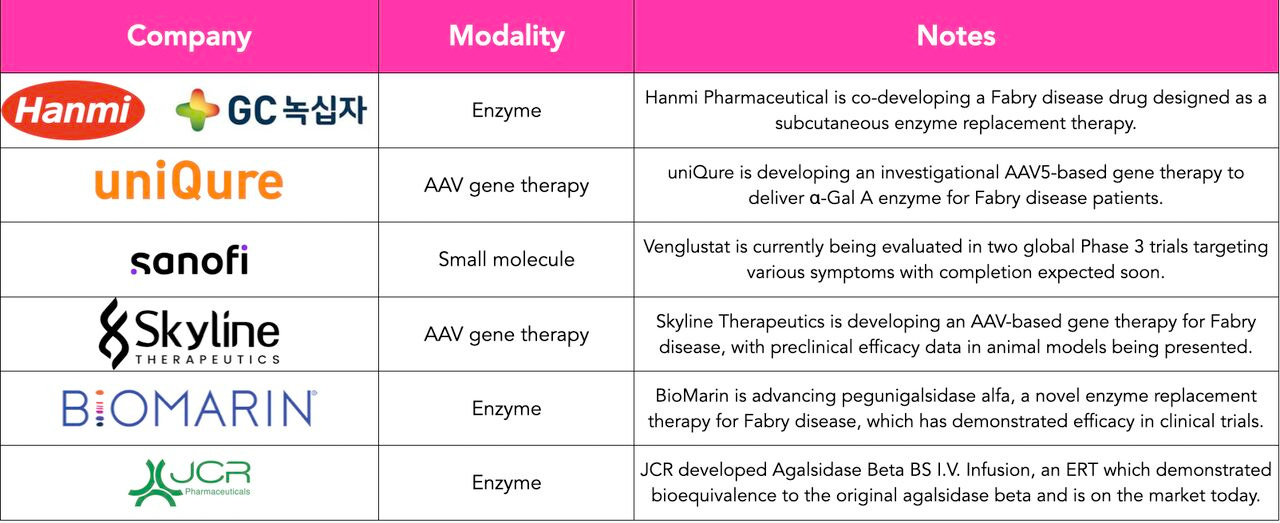
But the frontier is moving. Our analysis shows that ~30% of assets in development are now gene therapies or small molecules, modalities promising durable, potentially curative outcomes.
Meanwhile, ERTs appear to be losing ground, as patient experience remains a major unmet need. Many Fabry patients still face infusion times of up to six hours and require 2.5 hours of clinician supervision per treatment session, which is a challenging process for everyone involved.
One standout program in our analysis was SKG-0402, a gene therapy in development by Skyline Therapeutics, a private biotech based in Shanghai. The company recently shared preclinical data as part of a broader multi-indication strategy.
What makes this asset compelling:
CMC across multiple indications
One-and-done potential
Clear differentiation
Pathway to accelerated regulatory review
Fabry disease may be a niche indication, but it’s a case study in how global R&D acceleration and modality innovation can rapidly reshape a therapeutic area. Companies investing in rare disease portfolios should be monitoring these shifts closely, or risk being outpaced.
Request the full Fabry landscape and AI risk assessment of SKG-0402.
The search for promising rare disease therapies often requires navigating limited data, scattered programs, and fast-moving science. Vibe Bio partnered with the Orphan Therapeutics Accelerator to streamline global search and evaluation, using AI-driven analysis to rapidly uncover, compare, and prioritize high-potential assets across multiple rare indications. The collaboration turned fragmented information into clear, actionable insight for partnering decisions.
Read the case study to learn:
How AI accelerated discovery across rare disease pipelines
What insights guided prioritization and opportunity mapping
How data-driven intelligence powered faster, smarter evaluations
In biopharma, institutional memory often walks out the door — taking critical deal insight with it. When key insights get lost in inboxes, decks, or staff turnover, teams risk repeating mistakes and missing opportunities. Our latest blog explores how AI can help BD teams preserve and connect their institutional knowledge, turning scattered information into a strategic asset.
Read to learn:
Why institutional memory is critical to BD success
How AI can uncover and retain hidden insights
Ways to make knowledge-sharing a competitive advantage
Identifying the right opportunities in rare oncology is a challenge, especially in sarcoma, where data is fragmented and emerging programs can be hard to track. Vibe Bio partnered with Incite to accelerate a global search-and-evaluation effort, using Vibe’s AI-powered platform to surface and prioritize the most promising assets. Together, the teams combined strategic expertise with AI-driven insights to focus BD efforts where they matter most.
The case study shows:
How AI streamlined and accelerated global search efforts
What insights guided prioritization across the sarcoma landscape
How Vibe and Incite turned complex data into partnering advantage
While we refine our AI models and expand VibeOne’s capabilities, our team has been busy running analyses across new therapeutic areas — and sharing our insights.
In early October, Alok Tayi, PhD, cofounder and CEO of Vibe Bio, joined a panel discussion with leaders from around the world to discuss AI in healthcare at the STS Forum 2025 in Kyoto. The Emperor and Empress of Japan also attended this conference for the first time!

One of Christina Wong’s beloved kitties was diagnosed with advanced kidney disease, but Yoli is on the mend after surgery ❤️

We believe communities spark cures — thank you for being part of ours. Tell us what you’d like to see next month.
Follow us on LinkedIn, X, YouTube, and Bluesky for more stories.
Sincerely,
The Vibe Bio Team
#EveryCureforEveryCommunity
No posts
Comments
Nothing yet. Say the first thing.
Sign in to join the conversation.