
Here’s what’s shaping the biopharma landscape this month — from FDA actions that signal faster, more flexible regulatory pathways, to late-stage clinical readouts reshaping standards of care, and AI-driven platforms expanding what’s possible across drug design, development, and deal-making.
The FDA said it will expand the use of real-world data in regulatory submissions and pursue reforms to early-phase clinical trials to improve U.S. biotech competitiveness. (Endpoint News)
The FDA approved AstraZeneca and Daiichi Sankyo’s Enhertu in combination with Perjeta for first-line treatment of HER2-positive metastatic breast cancer, a move that could displace a decade-old standard of care. (BioPharma Dive)
The FDA granted Johnson & Johnson a National Priority Review Voucher for its Tecvayli–Darzalex combination in multiple myeloma, signaling a more proactive use of expedited review pathways for therapies with standout clinical data. (Fierce Pharma)
Immunome reported positive Phase 3 results for its rare desmoid tumor drug Varegacestat, setting up a potential FDA submission next year and positioning the therapy to challenge Merck KGaA’s recently approved Ogsiveo. (Endpoint News)
Latent Labs unveiled Latent-X2, a generative AI model that designs antibodies and peptides with drug-like developability and low immune activation from the outset, signaling a shift toward zero-shot biologics design. (Biopharma Trend)
Kyverna Therapeutics said it will seek U.S. approval for miv-cel following positive pivotal data in stiff person syndrome, positioning the therapy as a potential first CAR-T treatment for an autoimmune disease. (BioPharma Dive)
Yarrow Bioscience struck a potential $1.37B deal to license ex-China rights to a first-in-class TSHR antibody for Graves’ disease and thyroid eye disease from China’s GenSci, underscoring continued cross-border partnering around emerging autoimmune targets. (Fierce Pharma)
Sobi agreed to acquire Arthrosi Therapeutics in a deal worth up to $1.45B, adding a late-stage URAT1 inhibitor for chronic gout that could expand options for patients who fail first-line therapy. (BioPharma Dive)
Pfizer agreed to a potential $2B deal with Fosun Pharma’s YaoPharma to license an experimental oral GLP-1 obesity drug, marking another push into China-sourced assets as it seeks to catch up in the weight-loss market. (BioPharma Dive)
Insilico Medicine reported an AI-designed PROTAC targeting PKMYT1 that both degrades and inhibits the kinase in preclinical cancer models, highlighting the expansion of generative chemistry platforms into complex protein-degrading modalities. (Biopharma Trends)
The FDA cleared Medivis’ augmented reality cranial navigation platform for real-time use in neurosurgery, marking a first for AR-guided brain procedures and expanding image-guided navigation beyond the operating room and into the ICU. (Fierce Biotech)
Roivant spinout PsiThera raised $47.5M to advance AI-designed, oral small molecules targeting TNF, aiming to replicate biologic-like efficacy in immune diseases long dominated by injectable therapies. (BioPharma Dive)
As obesity drug development accelerates, the conversation is shifting from how much weight patients lose to what kind of weight they lose—and whether rapid fat loss worsens frailty. China-based Laekna Therapeutics is emerging as a company to watch in this transition.
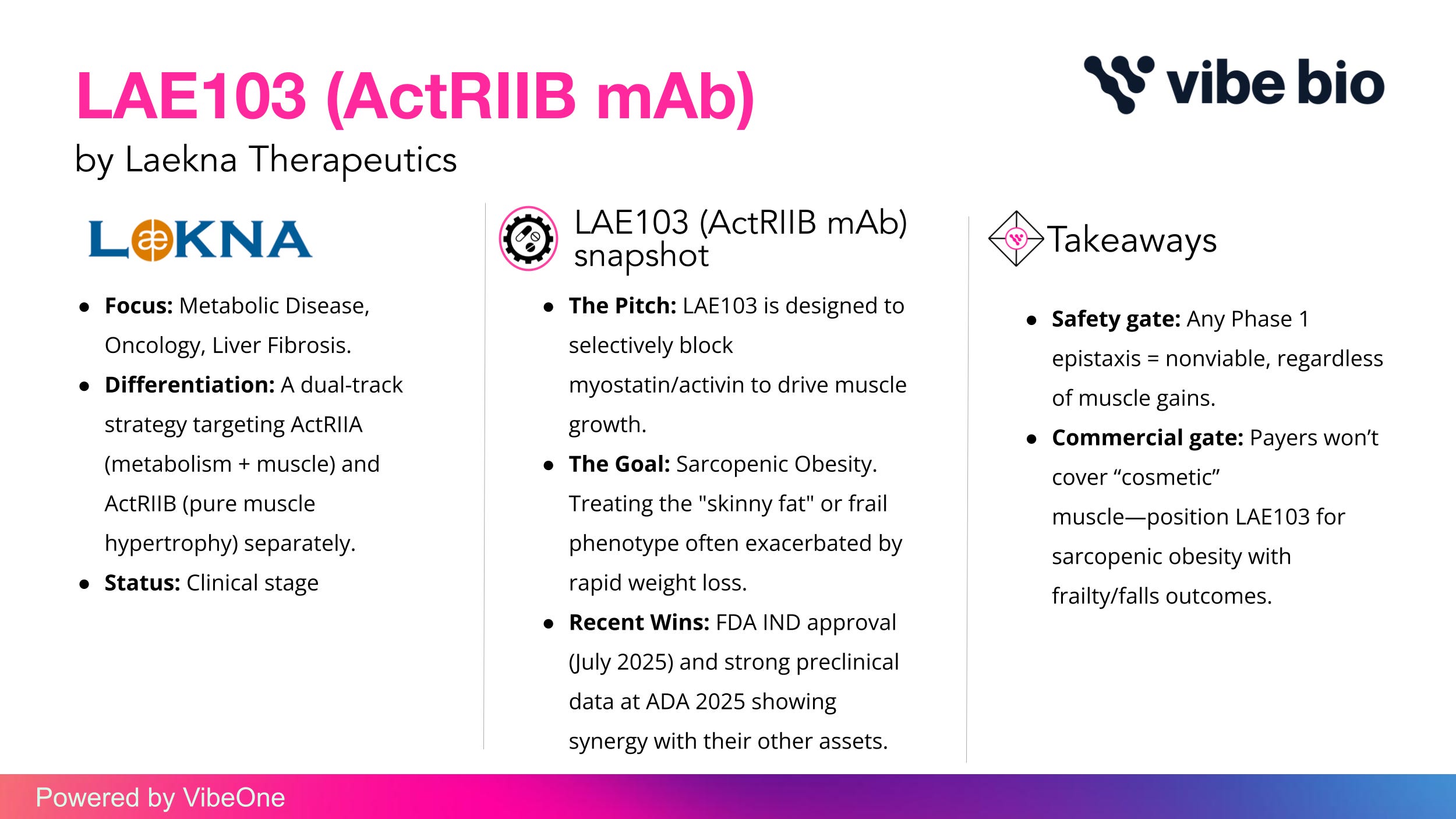
Fresh off a major partnership with Eli Lilly for its ActRIIA program (LAE102), attention is turning to Laekna’s unpartnered pipeline—particularly LAE103, an ActRIIB-targeting antibody designed to promote muscle hypertrophy in the context of weight loss.
Using VibeOne, we analyzed LAE103 and identified both its promise and its core translational risk.
Why LAE103 matters
LAE103 is positioned for sarcopenic obesity, a growing but under-addressed phenotype where weight loss exacerbates muscle loss and frailty. Unlike ActRIIA programs that blend metabolic and muscle effects, LAE103 aims to selectively drive muscle growth by blocking myostatin and activin signaling. Recent milestones—including FDA IND clearance and encouraging preclinical synergy data—support the biological rationale.
The critical risk: vascular safety
The ActRIIB pathway is notoriously complex. The receptor also plays a key role in vascular homeostasis through BMP9/10–ALK1 signaling. Earlier drugs in this class failed by acting as broad ligand traps, leading to vascular toxicity such as telangiectasias and spontaneous bleeding.
For LAE103, success hinges on true functional selectivity: strong antagonism of myostatin/activin without disrupting BMP9/10 signaling. Even minor safety signals tied to vascular effects could render the asset untenable.
Strategic implications
Safety is the gatekeeper: Any Phase 1 signs of epistaxis or vascular instability would likely be disqualifying, regardless of muscle gains.
Positioning matters: Payers are unlikely to reimburse a “cosmetic” muscle drug. Laekna will need to demonstrate that LAE103 meaningfully reduces frailty, falls, and functional decline in sarcopenic obesity—not just increases lean mass.
Bottom line: LAE103 highlights both the opportunity and the razor-thin margin for error in next-generation obesity adjuncts. Muscle preservation may define the next wave of differentiation—but only if developers can thread the needle between efficacy and vascular safety.
As deal flow accelerates and data volumes explode, BD teams are under growing pressure to make faster, higher-stakes decisions often before formal diligence even begins.
This blog outlines a practical, repeatable framework for evaluating external opportunities with greater strategic clarity and consistency. From defining disease priorities and stage fit to mapping internal capabilities, biases, and gaps, the blog shows how leading pharma teams can shift BD from reactive judgment calls to a disciplined decision system aligned with long-term strategy.

As the year comes to a close, we want to thank you for being part of the Vibe Bio community. We wish you a happy, healthy holiday season and look forward to sharing more insights, data, and stories with you in the year ahead.
We believe communities spark cures — let’s stay connected as we build the future together.
Tell us what else you’d like to see in future editions — your input helps us keep building a newsletter that reflects the communities driving every cure.
Sincerely,
The Vibe Bio Team
#EveryCureforEveryCommunity
No posts
Comments
Nothing yet. Say the first thing.
Sign in to join the conversation.