
Hello! I’m back with another FAQ-style post. This is just going to be a brain dump of my thoughts, not polished.
Questions I am covering:
What do AI-native companies actually look for in designers right now?
Why has design engineering exploded in recent years?
How do you test candidates for AI fluency?
What salary should I expect as a senior/staff designer in London?
What are the world-class designers doing differently in their roles?
How are career ladders for the IC and Management route changing for Product designers?
I’d love to know how to get past the CV screening by AI?
Let’s get into this:
This is taken from Granola, which has analysed over 140 calls focused on this topic, so here are my edits on these points:
The bar has shifted. A few years ago, companies wanted designers who understood AI and maybe dabbled; now it’s by default they expect you to be integrating it into your workflow where possible.
They want output-oriented designers, not someone with a linear process. One hiring manager told me they want someone “dying to implement AI.” They don’t want to hire designers who are technically experienced but haven’t updated how they work.
Technical fluency is now an expectation by default: Designers are expected to understand APIs, how to evaluate AI output, and how products actually get built. Handoffs are functional code, not static files. One company specifically wanted end-to-end AI usage across workflows: using AI for code analysis, data insights, and artefact creation not just surface-level brainstorming. It really does feel like a different role from what it was even 2 years ago. It’s wild.
Craft is the number one reason people get declined: The risk everyone’s worried about is that if designers just delegate execution to AI, everything starts looking the same. The designers who stand out are the ones with the taste to evaluate and direct AI output, not just generate it.
They want people who can think and do at the same time. Opinionated but ships. The red flag is someone who asks endless questions and waits to be told what to do. Attio’s final-stage interviewer looks for intentionality — not just competence. What gets you out of bed. What your relationship with work actually is. Vague answers don’t cut it.
What they’re not looking for: pure managers, process-heavy thinkers, or anyone who treats Figma as the end product. They want people who lead through the work, who are anti-process and craft-focused.
I asked a Design Engineer at a top-tier AI company exactly this:
The first is structural: Post-COVID, companies realised their narrowly split scrum teams weren’t producing great work. Splitting roles that finely opened a gap at the intersection of design, UX and interaction, and that intersection is where the last 10% of good work lives.
The result: a persistent gap between the Figma file and what shipped. Engineers couldn’t always see the intention behind a design, and something got lost in translation almost every time.
As they put it: the rhythm of an interaction, the texture of a micro-interaction, the right easing curve. None of that lives in a spec doc. It has to be built and felt. So what shipped was often a 40%-of-the-intent version of what was designed.
The second: AI-assisted development. People with good design taste can now ship production code far more easily than two years ago. The idea in your head reaches the screen exactly as you imagined it, without engineering as a bottleneck.
And here’s the line that stuck with me: “When anyone can build a product with AI, brand is what differentiates you. And brand is exactly the thing AI can’t yet do well on its own.”
Design engineers sit right in the middle of that. Brand-obsessed people who can actually build the thing.
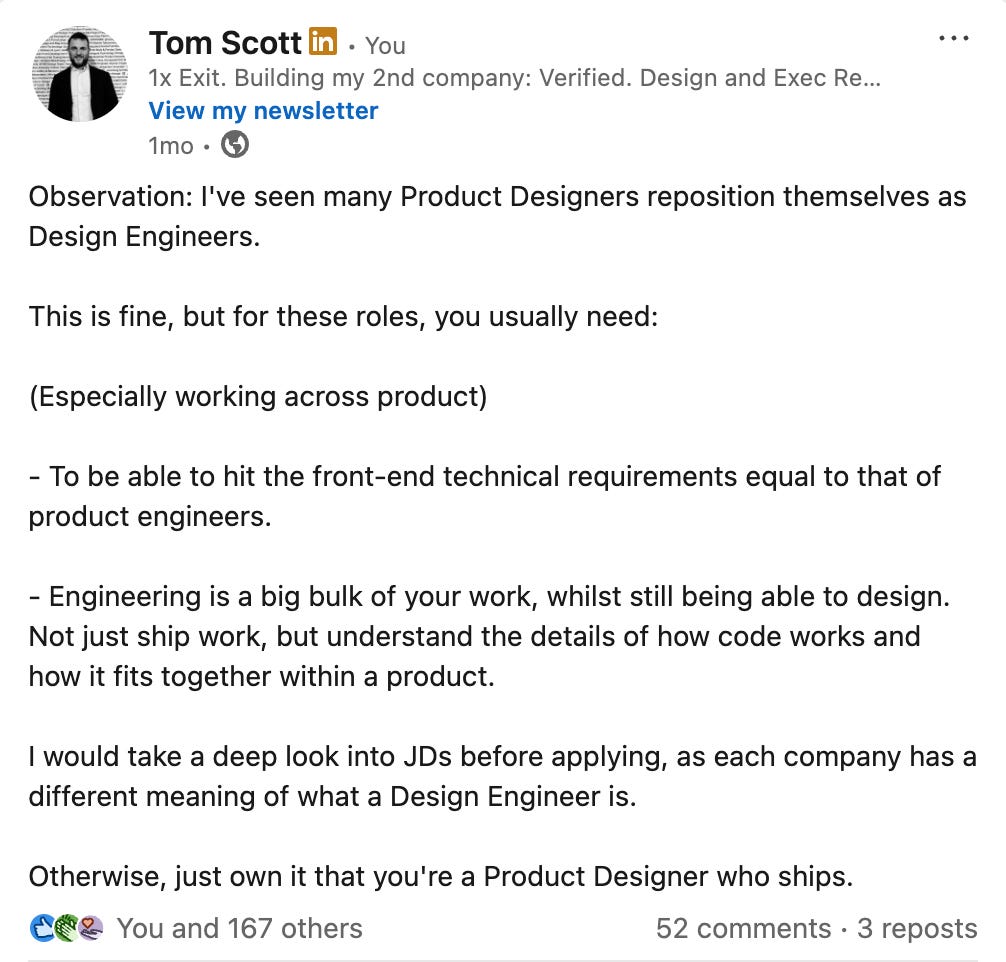
I spoke to one company last week that is only hiring Design Engineers, not Product Designers. Here were the reasons why:
They think the traditional PM/design/engineering triad is breaking down.
They want people matched to the problem, not fixed role boundaries.
They prefer an inverted workflow. Instead of a product designer gathering requirements and translating between PM and engineering, an engineer can create a POC and a design engineer can take it from concept to something intuitive and production-ready.
Speed to production seems to be the main benefit.
They still want design skills just embedded in a “builder” profile. The ideal person is closer to a product designer turned agentic coder than a frontend engineer, with strengths in human factors, intuitive UX, customer research, and enough coding ability to ship.
Interesting times.
I asked 3 hiring managers, “How do you test for AI fluency in designers?”
A CEO of an AI-native start-up said: I am primarily looking for empathy, smart/cognitive ability, and “good eye”. AI makes the need for decision/clarity of thinking even more important. In my experience, people who are good thinkers, curious, and have a good taste/eye are naturally drawn towards AI as a tool for faster prototyping.
A hiring manager at a top-tier AI company in London said: When it comes up as a means to an end, not the point itself. And when something got better because of it, whether that’s a better outcome or the same outcome done faster, not just “I used it here.” And if we go deeper on the subject, frustration is also a good signal, it means they’ve used it enough to know where it’s great and where it fails, specifically in the design discipline. Enthusiasm on its own isn’t a great signal.
Another Head of Design said: Someone who isn’t stuck in the traditional design process and instead can use AI as part of creative exploration early on. They can make decisions. In the AI era, I value more creativity, thinking outside the box, and playing with AI. Designers who are close enough to the technology and engineering team to understand what’s possible, who can ideate from what tech enables, and then shape and validate it.
The majority of people I ask this question to say something similar - they want to see the messy middle process type of work, to see how you think, they want to see someone who is curious and actually building.
This is why the interview processes I see are going back to seeing work in person (design crits, onsite test days, etc.) to assess how you think in this new way of doing design work.
This is a huge question. I’m going to focus my numbers on London as a baseline.
Things to take into account:
Certain countries can be hard to hire remotely from due to extra costs.
What one company deems as Staff will be Principal elsewhere.
Some companies offer sign-on bonuses to top up total comp.
High-growth companies want you to focus on equity as the real upside.
London and European salaries in general are going up, but so us the US.
AI companies and big tech will pay more than most industries.
From what I’ve seen this year:
Junior: 35-50k.
Mid: 50-80k.
Senior: 80-130k.
Staff: 130-190k.
Principal: 190-220k+
I think it’s more how the companies they work for are set up.
For example, they have immense ownership because they know design is a differentiator. They also have freedom to pretty much use any tool of choice to explore boundaries and what is possible.
I would say to get into these companies it’s about showing technical depth, polish (yes, it’s pretty much a dealbreaker) and demonstration of shipping actual products. I wouldn’t say all the designers that work here are “world-class”; they are surrounded by great people, which probably makes them look better.
The companies the “world-class” designers you usually see have 3 things some companies don’t have:
1. Money - It costs millions to hire the best designers. Even 3-5 designers will cost over a million in base salary in certain locations. 2. Mindset - High-quality crafted work is hard to measure and takes time. You have to get a senior executive who truly understands and values craft. All of the best companies have this at CEO/Founder/C-level level.
3. Environment - Few layers to the top, design-led culture, advocate for design is either the CEO or a very senior person, and the quality of other teams, such as engineering, is usually as strong as design, if not stronger.
You can have the best designer in the world, but if they are inside a company where they are not given time to roam and put their mark on work you won’t see the best of them.
I think external titles are becoming less important.
Typical IC path: Junior, Mid, Senior, Staff, Principal, Sr Principal.
Management: Design Lead, Head of, Director, VP etc.
I am seeing a lot more leaders decide to leave management to get closer to the tools. There is way less demand for professional people managers.So in short:
You will see a lot more IC roles at Staff/Principal route. These are builders and craftspeople.
A DRI for a certain area. For example, a Staff Designer with DRI across a certain output on a team.
A Head of Design to oversee.
As someone who just went through 500+ CVs from inbound, majority of companies have a human who does the final yes/no.
The screening by AI will not automatically reject, what it does is tells the recruiter who is reviewing how likely they are a fit based on your keywords picked up in a criteria evaluation usually based on core role (so if you’re applying for a Product Design role, don’t call yourself a UX Designer, small things like that), location, seniority and experience at target companies (In some ATS you can put in there to flag if someone has worked at XYZ).
So if you do want to submit a CV, tailor it based on the job spec to get a strong rating on the ATS.4 things I noticed when reviewing applications:
Always try find an internal referral. Majority of companies will prioritise those.
Submit LinkedIn and Portfolio links. I don’t look at CVs, only LinkedIn and portfolios.
Lead with the best work. Don’t lead with outdated work.
Have links that work. So many people submit portfolios with passwords.
What should I cover next?
Comments
Nothing yet. Say the first thing.
Sign in to join the conversation.