
What a first half of 2026 it has been in the hiring world of design.
I was reflecting on talks I saw at Hatch in 2025 specifically around “Designers who can ship” and at the time that felt new, but now that is industry standard and with that how and who has been hired is changing all the time.
Here is my round-up of the first 6 months of 2026:
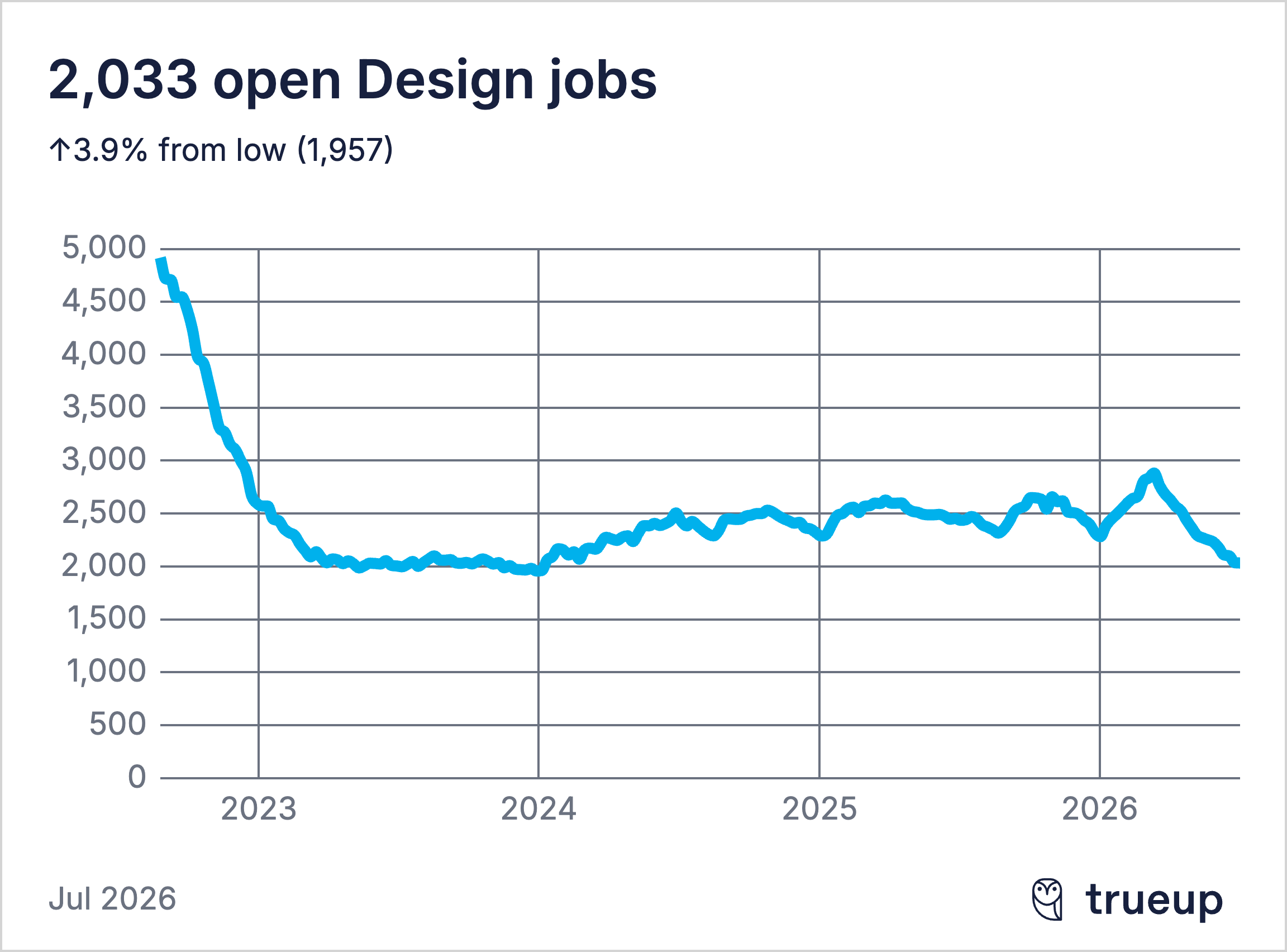
Roles have plateaued
Design hiring is changing
Everyone is a designer again
3 distinctive IC archetypes
Re-positioning to Design Engineering
AI fluency is expected
Shorter tenures are becoming normal
There is lots of excitement and anxiety
I used TrueUp for the data. It’s an incredible resource that you should check out. Please note this is not every job assessed; it’s mainly tech companies, I believe.
This is a course correction. I can't see why you need as many designers these days. Design teams are getting so much done with less. One of the red flags for you when interviewing should be around team size and whether it's bloated.
Why I see there are fewer roles:
You can achieve more with less. Talent density is everything. Companies would rather hire one 10x person than 10 1x individuals.
Someone who can only do UX or visual design will be replaced in the majority of companies by people who are "end-to-end", leaning into code.
The process-oriented people manager role is going. I'm convinced if you're not hands-on in design, you will struggle to find a role. I will add that I do not agree with the complete decimation of people managers; I believe they are crucial to team health.
Roles are blurring, so a lot of designers are doing PM/Eng work anyhow. It’s a matter of time before we see "builder" as a job title.
Many companies do not know what type of designers they need. They know they need to hire, but cannot predict 12-24 months away, so are actively looking for more flexible options such as fractional hires, long-term freelancers embedded or awesome studios to augment teams. Work trials are becoming a thing in hiring decisions. Usually because what people are building is so new, there is no way to judge if they will be the right hire based on previous experience. It's important to come to design crits during interview processes with a mix of side projects demonstrating your builder mentality, as well as commercial work which is shipped in the hands of users. Some companies will struggle to see how usable the work you're showing if you're only showing side projects. Both are important for different reasons.
Lots more companies are moving back to having a simple structure such as:
Designer/Builder
Director
DRI
Why it's happening:
Lots of companies are rebuilding their teams from old ways of doing things such as having very focused UX and visual designers to an approach where they hire generalist builders, with certain spikes in key areas, who originate with taste, high agency, don’t wait to act and understand the way of doing design work.
Teams want flatter structures so decisions move faster and less energy goes into company politics.
Scope and impact now matter more than titles. AI is blurring roles so fast. Someone with 3 years of experience might know more about AI than someone with 20+.
To focus on hiring designers focused on just the work, and obsessing about the craft of design.
Two of the main reasons I am seeing people get declined are that they are not technical enough or have “craft”. It's important to invest in learning technical aspects of design, but also not to neglect the craft and sweating the details, as they are still vital. That will get you a job over being uber technical in most cases.
Technical depth is no longer a bonus; it’s a must for some companies. Designers working on complex features, for example, branching, need to understand how systems work, and for that you need to understand what you’re designing for.
I would caveat all this: This can ALL be learned. Companies still need to hire people on potential.
The main archetypes I see for IC’s in design teams:
Product Designers who ship.
AI-pilled Brand Designers
Design Engineers (Eng to Design)
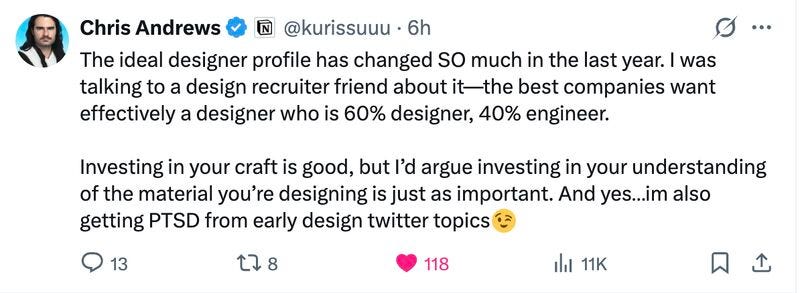
Many Product Designers are repositioning themselves as Design Engineers, but I can’t help but feel they are Product Designers who ship. I’ve found for Design Engineering roles you need (Especially working across product):
To be able to hit the front-end technical requirements equal to that of product engineers.
Engineering is a big bulk of your work, whilst still being able to design. Not just ship work, but understand the details of how code works and how it fits together within a product.
I would take a deep look into JDs before applying, as each company has a different meaning of what a Design Engineer is, otherwise just own it that you're a Product Designer who ships.
We’re at the point where you must be using AI, or you will struggle to find a design role. That’s not even controversial to say anymore.
This is what 3 hiring managers told me recently about what they look for:
A CEO of an AI-native start-up said: I am primarily looking for empathy, smart/cognitive ability, and “good eye”. AI makes the need for decision/clarity of thinking even more important. In my experience, people who are good thinkers, curious, and have a good taste/eye are naturally drawn towards AI as a tool for faster prototyping.
A hiring manager at a top-tier AI company in London said: When it comes up as a means to an end, not the point itself. And when something got better because of it, whether that's a better outcome or the same outcome done faster, not just "I used it here." And if we go deeper on the subject, frustration is also a good signal, it means they've used it enough to know where it's great and where it fails, specifically in the design discipline. Enthusiasm on its own isn't a great signal.
Another Head of Design said: Someone who isn't stuck in the traditional design process and instead can use AI as part of creative exploration early on. They can make decisions. In the AI era, I value more creativity, thinking outside the box, and playing with AI. Designers who are close enough to the technology and engineering team to understand what’s possible, who can ideate from what tech enables, and then shape and validate it.
I am seeing shorter tenures for designers, which I believe will be the norm for years to come.
Why?
We can't predict the future; companies may overhire and need to let people go.
We can't wait around for companies to figure it out, so people will not settle for working in average companies and will want to work for companies that "get" AI and the new way of doing design work.
It's less of a red flag for me to see a "jumpy" resume if they can back it up with solid reasoning as to why they left, and why they are applying for new roles.
I asked three designers, “What’s the most challenging part of being a designer in the AI-era at the moment?
A super IC said: Impostor syndrome related to the speed. You enter X and everyday you’re flooded with the cool projects from cool people. You question your abilities, struggle to find motivation to post because you feel irrelevant, or you feel bad at your job as you’re not doing such cool stuff as you see.
A Founding Designer said: The biggest challenge right now is adaptation. The fundamentals of design still matter, but the ways we apply them are changing faster than ever. What worked yesterday isn’t enough today.There’s a constant tension between excitement and uncertainty AI is opening new possibilities, but it’s also reshaping roles. We’re moving away from traditional team structures toward individuals owning entire outcomes end-to-end. That shift demands a broader skill set, faster learning, and a different mindset.As designers, the challenge isn’t just keeping up with tools it’s redefining our value in a landscape that’s being rewritten in real time.
A player-coach leader said: the output impact is still more than input (time you spend upskilling, experimenting, etc). making it difficult to show immediate ROI to leadership and adapt it as a team process. Tools are becoming less and less relevant so hard to feel secure in your job if the tools you spent years honing down are not relevant, and just because everyone can ship, not everything should ship, so as designers being articulate and sharp in scoping and driving alignment is key.
Comments
Nothing yet. Say the first thing.
Sign in to join the conversation.