
Physiotherapists are not philosophers. We are trained to analyse anatomy, form and function, not ideology.
I spend most of my working day thinking about bladders, bowels, painful sex and movement. Assessing someone with a pelvic health condition means answering things like:
What has this person stopped doing because of their condition?
Can they sit comfortably?
Does their bladder or pain disturb their sleep?
Does their condition interfere with their relationships?
Can they get back to living their life?
Increasingly, though, my reflective practice keeps returning to one question:
What the hell have we doing?
Last week I attended the joint conference of the Clinical Advisory Network on Sex and Gender (CAN-SG) and the Society for Evidence-Based Gender Medicine (SEGM) in London, hoping that some of the answers might become clearer.
The conference brought together clinicians, academics, researchers, surgeons, whistleblowers, journalists, parents, detransitioners and activists. Over two days I heard presentations spanning paediatrics, psychotherapy, psychiatry, ethics, primary care, surgery, neurodiversity and rehabilitation. It was an extraordinary concentration of expertise, and it was emotionally draining.
I’m up to speed with the evidence in this, rather barren, field, but hearing story after story, presentation after presentation, over the course of two days was surprisingly wearing.
A friend texted to ask how it was going.
“It’s great, but I’ve twice gone to the loo for a bubble.”
Apparently “bubble” is not English, but Scots vernacular for “weep”. My English friend briefly thought I’d taken to hiding in the toilets to drink fizzy wine and was preparing an intervention. Which was very kind of her.
Almost every session described harms that should have been prevented, complications that should have been anticipated, or patients and families struggling to find anyone willing - or able - to help them.
Meeting so many people who had lived through gender services themselves, parents trying to support sons and daughters through extraordinarily difficult circumstances, and clinicians determined to improve the lot of these individuals was inspiring.
Again and again I heard the same message: when healthcare had nothing to offer them, they found and supported each other.
Their peer support networks are remarkably organised, compassionate and knowledgeable. But they exist because, in many cases, there was nowhere else to go.
My contribution
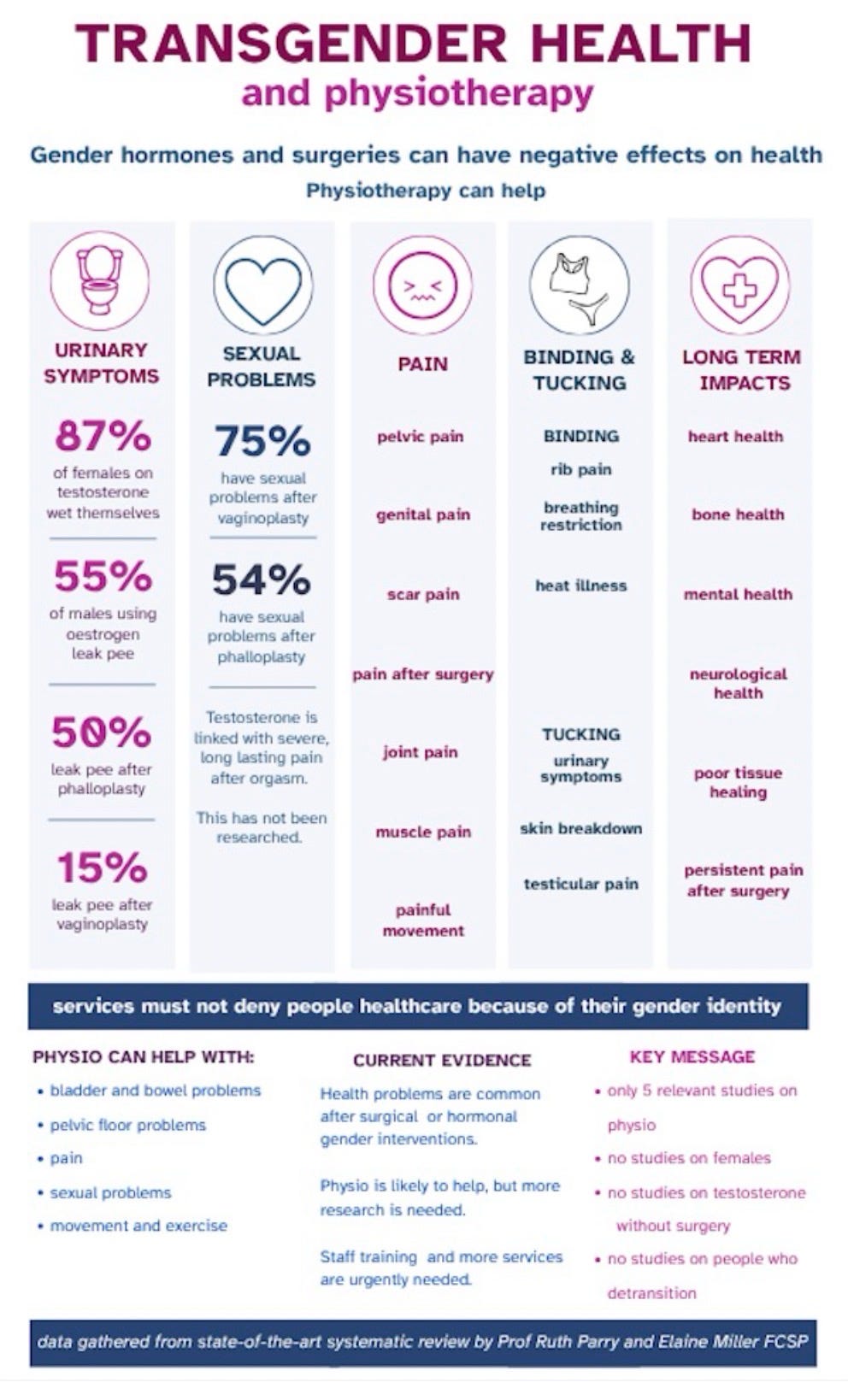
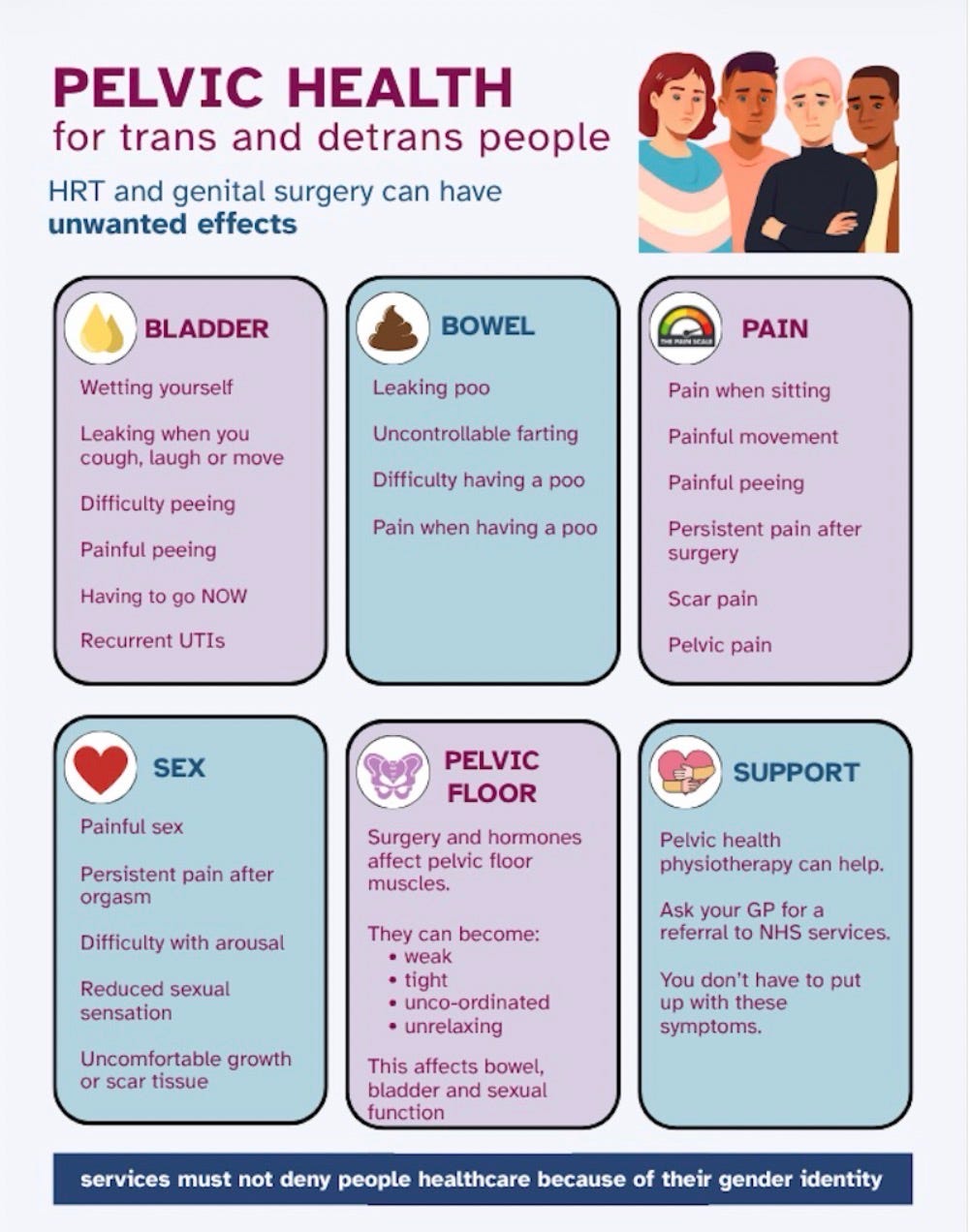
I presented the first findings from a review Professor Ruth Parry and I have been undertaking into urinary, sexual and pelvic health outcomes following transgender-related hormonal and surgical interventions, and whether physiotherapy has a role in helping people experiencing unwanted effects.
The review asks three simple questions.
How common are these problems?
Does physiotherapy help?
What should happen next?
Pelvic health physiotherapists routinely treat continence problems, pelvic pain and sexual dysfunction, and we are very good at it. Multiple Cochrane Reviews support that.
We think physiotherapy can be helpful in gender interventions because they do not create entirely new challenges. We already rehabilitate people after radical cancer surgery, major trauma and complex orthopaedic procedures. The principles are the same, personal identity doesn’t change physiology.
Surely these people deserve the same standard of care as everyone else? If so, why do I have evidence of pelvic health services refusing referrals because “we don’t deal with gender”?
My Heath Robinson infographics summarising the findings from our (as yet unpublished) review are above, and below, and Nick Wallis reported on my presentation here.
The next step
Ruth and I are now preparing the paper for peer review. Like everyone involved in this project, we work voluntarily. Our lived-experience contributors generously gave their time and trusted us with deeply personal experiences. They challenged our assumptions, improved our recommendations and made the paper immeasurably stronger. Our peer reviewers will also donate their expertise.
The only part of the process that isn’t free is making the evidence available to everyone. Publishing the paper as open access - so that clinicians, patients and families can read it without needing an expensive journal subscription - will cost around £5,000.
Normally these fees are covered by research grants or university funding. Work that challenges current practice often finds that support rather harder to come by. It is striking that work which supports the convention that gender interventions are always positive gets central funding and lashings of it.
Nevertheless, we think open access matters. Research that has the potential to improve patient care should be available to the people who need it. The Bright Club has a long history of academics disseminating their research through stand up, so maybe comedy shows could sort our funding issue. Realistically, we need to produce and publish a series of high quality but small studies to make ourselves eligible for proper funding. A study that gathers and analyses empirical data needs a host university or NHS Trust, a research fellow, a clinical supervisor and ethics - which needs hundreds of thousands of pounds. We all know that “shy bairns get nowt”, so we’ll give it a go.
Where next?
I think physiotherapy - and all Allied Health Professions - urgently need to develop expertise in this area.
An unknown number of people are living with unwanted effects of hormonal and surgical interventions, alongside a growing number of detransitioners. At present there are no dedicated rehabilitation services for them.
Long-term, complex conditions are bread and butter for rehabilitation professionals. I suspect we will work closely with primary care because many people with negative outcomes make it clear they have no wish to return to gender clinics.
The first challenge will be finding colleagues willing to address negative outcomes of gender interventions. Speaking publicly about these issues is not easy.
My own professional body has around 67,000 members. As far as I can tell, I am the only one currently speaking publicly about this aspect of care. Statistically, that seems improbable and I suspect the silence tells its own story.
Professor Ruth Parry and I are therefore exploring the creation of a support network for Allied Health Professionals, operating alongside organisations such as Biology in Medicine and SEEN in Health. The aim would be mutual support, collaboration, research and, ultimately, better training so we can deliver better care.
If you are an AHP and think you would find such a network useful, or would like to help develop it, please do get in touch.
Leaving the conference
What struck me most over those two days was not the hostility outside, but compassion inside. Attendees had nothing but concern for people whose lives have become more difficult following gender interventions, regardless of whether they continue to identify as trans or have detransitioned.
It is peculiar to me that the people expressing such concerns are characterised as being motivated by hatred. My impression is firmly the opposite, anyone speaking up wants the same thing: honest evidence, thoughtful discussion, legal protections and healthcare that helps people live the fullest lives possible.
For me, refusing to acknowledge that people with unwanted outcomes from these interventions exist, ignoring their symptoms, or denying them treatment because of assumptions about their gender identity is incompatible with compassionate healthcare, and uncomfortably compatible with transphobia.
I’m enormously grateful to the individuals who trusted Ruth and me with their experiences and helped shape our work. Their generosity will, I hope, improve care for people who come after them.
Thank you to CAN-SG and SEGM for hosting such a thoughtful conference and for giving us the opportunity to present our work. And to Nick Wallis who covered my talk.
There is plenty to be getting on with. I’m encouraged to see that the right people to answer my earlier question of “what the hell have we allowed?” just keep on finding each other. It’s heartening.
Comments
Nothing yet. Say the first thing.
Sign in to join the conversation.