
Welcome to week one of The Hidden Rules. Every Wednesday over the next eight weeks, we unpack one rule from our Capital for Nature report. One rule, one myth flipped, one voice from the people who move money into nature.
Week two of The Hidden Rules. Last week we argued that most nature ventures should not raise VC. This week: the money that was supposed to be the alternative, and why it is getting scarce.
Start with a picture
Imagine a group standing at a cold lake. Everyone wants to swim. Nobody wants to jump first. Then one person jumps, survives, and suddenly everyone is in the water.
Nature finance works exactly like this. Big deals are funded in layers: one investor agrees upfront to absorb the first losses if the project underperforms. That promise is what makes everyone else jump. In finance speak it is called first loss or catalytic capital. In plain speak: the brave first money.
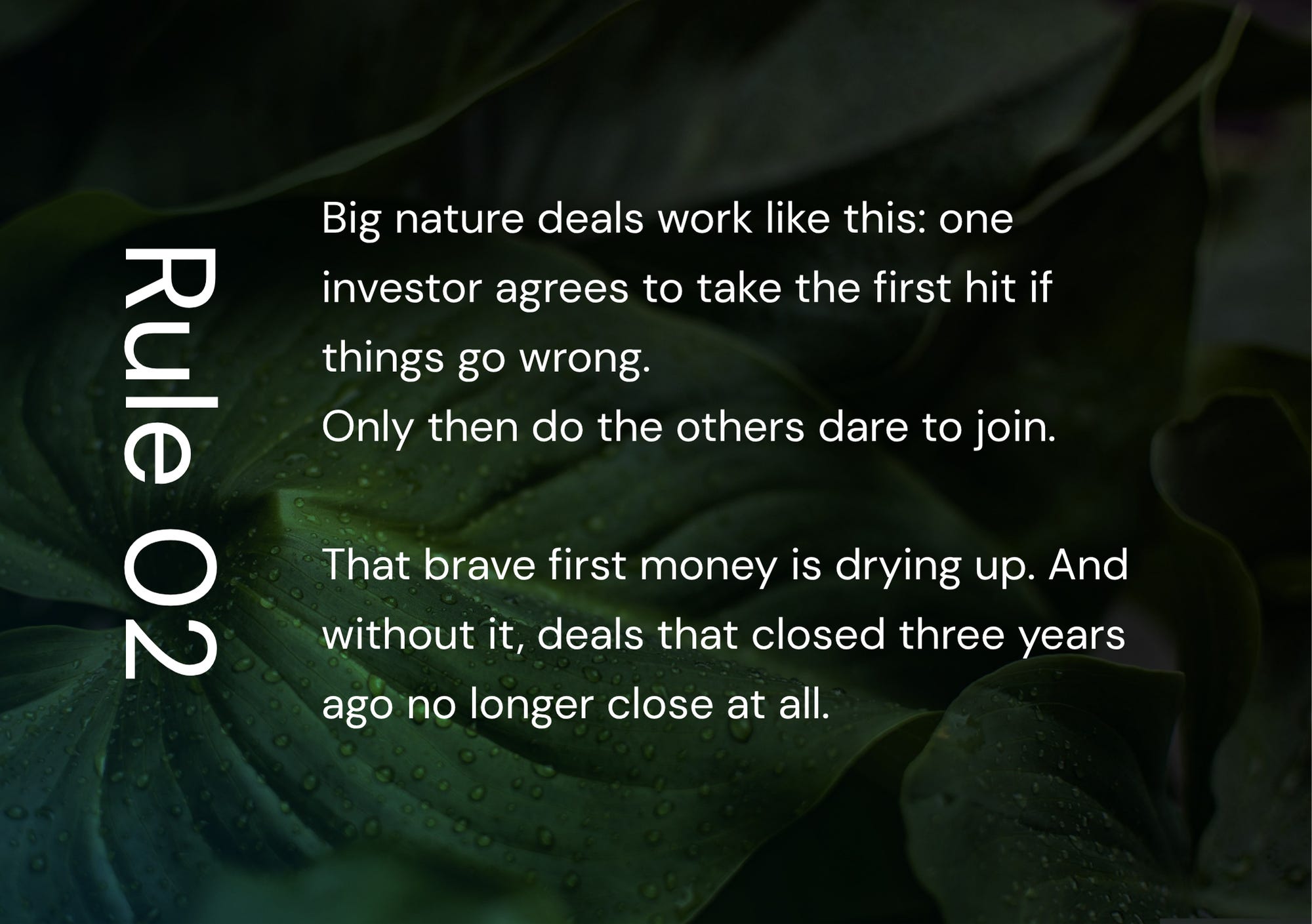
The rule: the brave first money is drying up.
For years, big public development banks played the first mover.
Why the retreat? Public budgets are shifting toward defense, and the development banks believe their job is done: the model is proven, private investors should now jump on their own.
Except they will not. David Albertani of the Catalytic Finance Foundation summed up the standoff at the lake: “Catalytic funders want indication of private sector interest, while private investors want de-risking first.” Everyone is waiting for someone else to get wet.
And Henrique Martins of the Nature Finance Accelerator adds an uncomfortable twist: the brave first money that does still flow is not always brave. Too often, he says, it ends up “subsidising commercial returns, benefiting the investor rather than the end beneficiary.” The safety net is protecting the wrong people.
The hopeful part
New first movers are appearing. Albertani’s Canopy Trust Program has raised $92M, targeting $500M by 2035. Foundations are moving away from classic grant-making and asking how far one euro can carry.
What this means for you
If you are a founder: these funders want proof that their jump gets others in the water. So bring commercial investors who are already interested, even informally. Do not ask them to fund 80 percent of your venture. And if you are projecting sky-high returns, this is not your money, and that is fine.
If you fund nature: the first mover seat is open. Pension funds, development agencies, foundations, this is the moment to take it, with clear rules about who absorbs what.
The full report, with all 8 rules and both playbooks, is here: https://brainforest.global/reports#capital-for-nature

Next Wednesday, rule 03: there is no shortage of money for nature. There is a shortage of things to invest in.
And one more thing before you head off: this Saturday we open applications for Cohort 8 of our Venture Program. If you are building a venture rooted in biodiversity and regeneration, or know someone who is, keep an eye on our channels.
Comments
Nothing yet. Say the first thing.
Sign in to join the conversation.