
When I started writing personal essays in May last year, I expected it to be a fun, low-stakes creative experiment. I had always been drawn to writing, first through stories and later through essays in university, so I expected it to feel familiar. What I did not anticipate was how profoundly it would change the way I think, process experience, and make sense of my life.
That sounds somewhat dramatic, but many people speak about how beginning a writing practice changed their life in similarly grand terms. I wanted to understand more precisely what that change actually consists of, and what writing might be doing to the way we think, notice, and process experience. Partly, I wrote this essay to make sense of the change for myself. I also wrote it for anyone with even the slightest urge to begin writing, because following that urge may change your life, as it changed mine.
Prior to starting this blog in May last year, most of my writing took place in my Notes app, some examples of which are included below. These were mostly fragments, sentences, or paragraphs of stream-of-consciousness thoughts jotted down while in an Uber rushing between meetings, or on a plane to or from a client site.
At the time, my job was all-consuming, in terms of time, but even more so in terms of mental space. Evenings and weekends were mostly recovery periods, spent rebuilding enough energy to be ‘on’ again when the week began. I would often doomscroll through reels of cats to dissociate and approximate a sense of rest. There was very little capacity left to meaningfully engage my creative or intellectual faculties beyond work. My thoughts had a slippery quality to them, loose and light. They came and went without anywhere to land, rarely staying long enough to gather weight or take form.
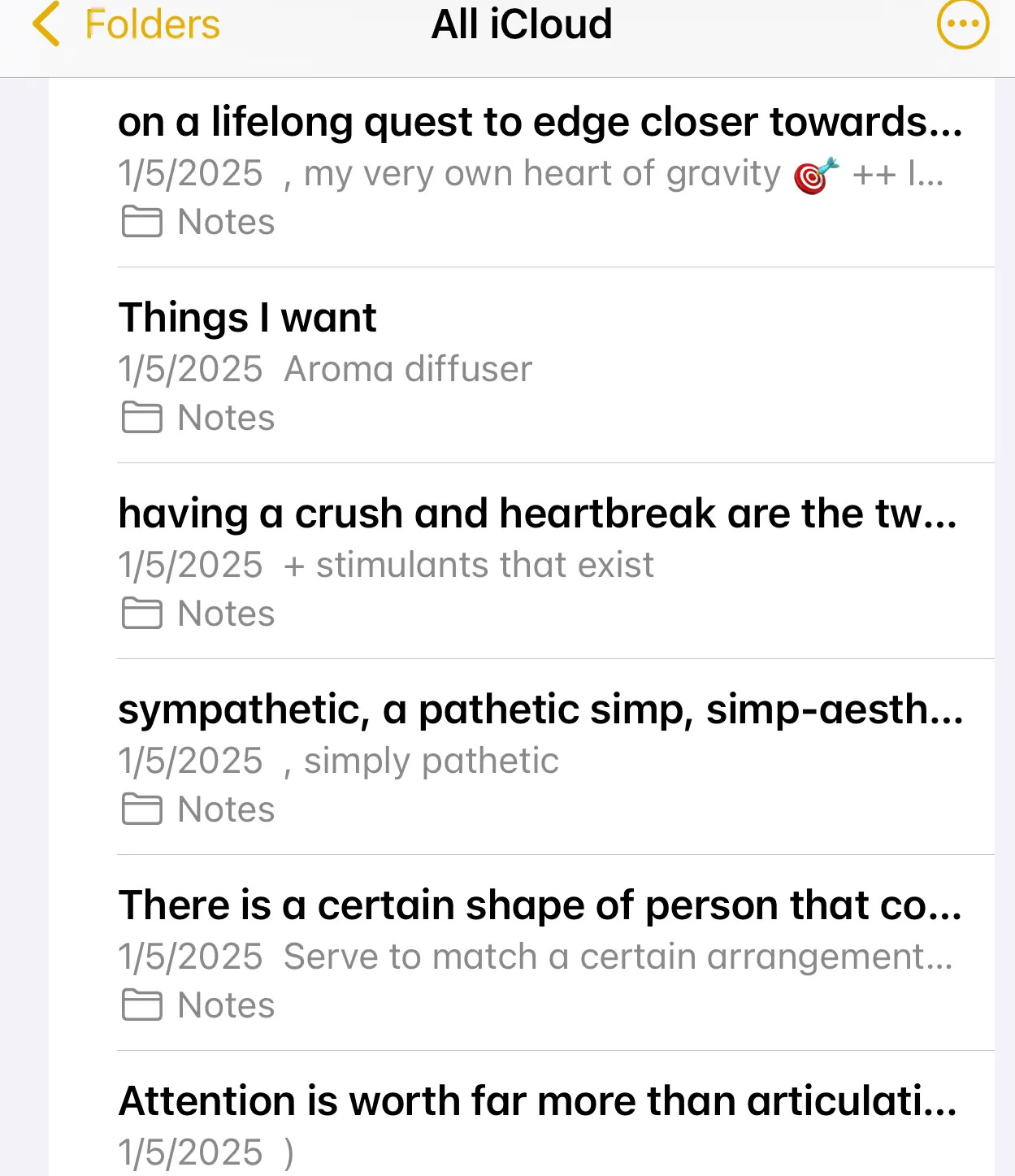
As I became increasingly aware of this, I grew alarmed. I worried that the capacity for deep thought I had worked so diligently to develop throughout university had begun to atrophy during my three years in a full-time corporate job.
So, exactly one week after I quit, I tried my hand at writing essays, partly to reassure myself that I could still think deeply, and partly to better understand my own mind. For the first time in years, I had enough space to turn toward the thoughts that had been accumulating at the edges of my awareness.
I could sense that these loose, slippery thoughts were connected, that a worldview of some kind was beginning to gather shape beneath them. Every now and then, I would glimpse it in a conversation or a passing thought, only for it to disappear again, the connections dissolving back into the present before they had anywhere to land.
I had never turned my attention toward tracing those connections, so no larger pattern had the chance to emerge.1 It turns out that when you do not look for the connections between your experiences, there are no dots to connect. But once I directed the flame of my attention toward them, patterns that had always been there, previously out of sight, began to reveal themselves, each one illuminating the next. The next question was how to keep those passing thoughts from disappearing long enough to follow where they led. For me, it began by giving them somewhere to go.
I often text myself sentences and fragments while walking around or after a conversation, some of which are shown in the screenshot below. Taken out of context, these text threads look like a very one-sided relationship. When E saw one of these threads, he remarked, ‘Wow, why are you texting this person? It looks like they never reply.’
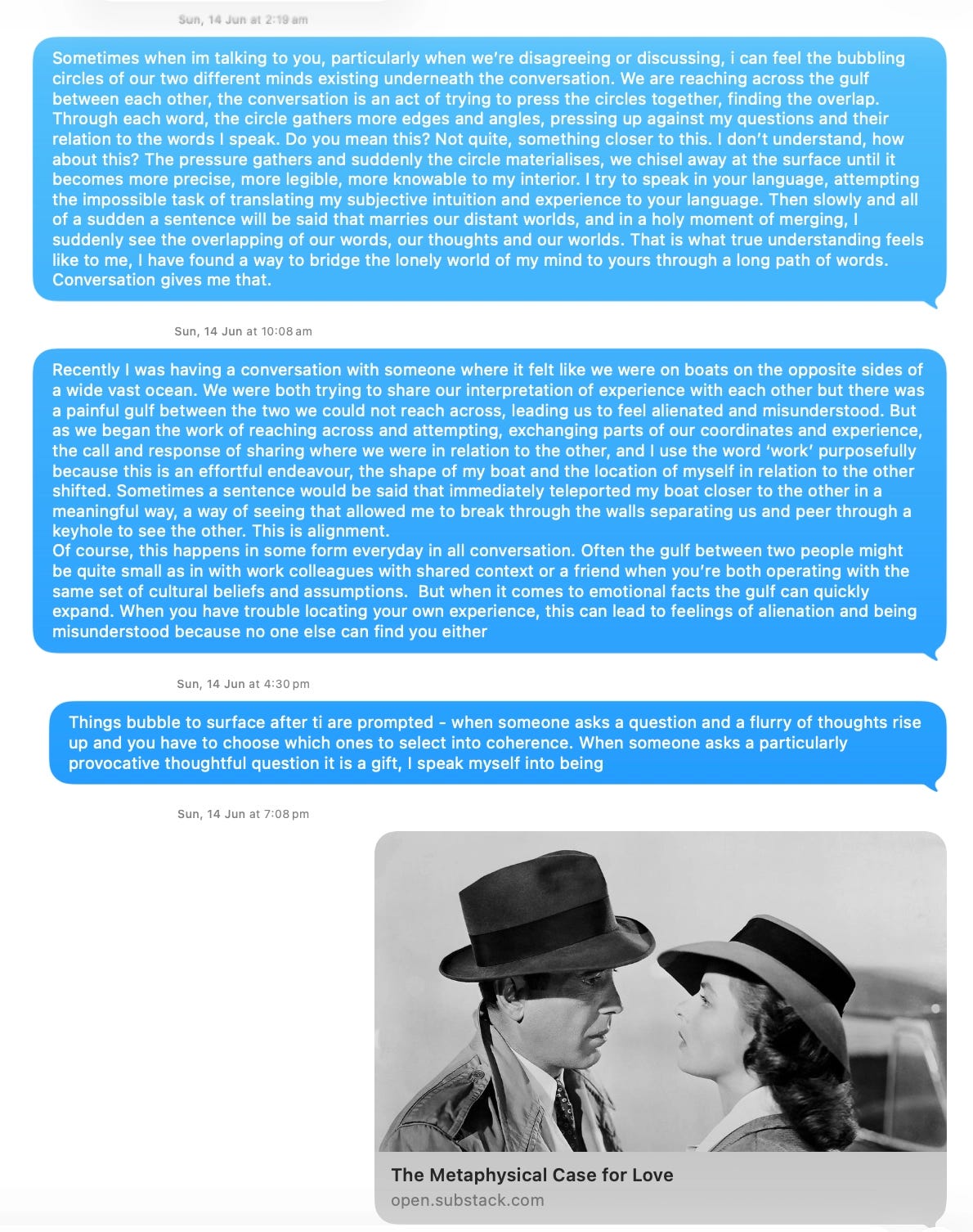
The difference from when I used to do this is that I now have somewhere to store, collect, and connect these fragments. When I get to my laptop, I move them into a Notion folder, where I organise ideas and drafts by theme and stage of progress. When a thought opens up a new theme, it gets a page of its own. Some of these pages contain only a single messy note, but even then, the thought has a home I can return to later. Otherwise, it finds a place inside something I am already exploring.
Previously, my fragments accumulated without becoming anything. Now they have a home to live, somewhere they can meet other thoughts and gather weight, rather than remaining loose and slippery. It is the combination of the tool and the ritual of returning that allows these passing thoughts to become some line of inquiry.
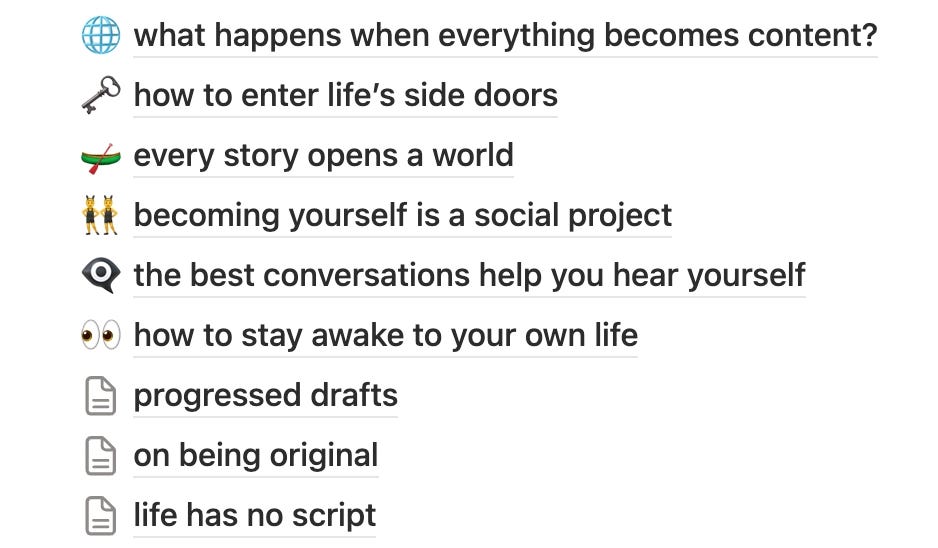
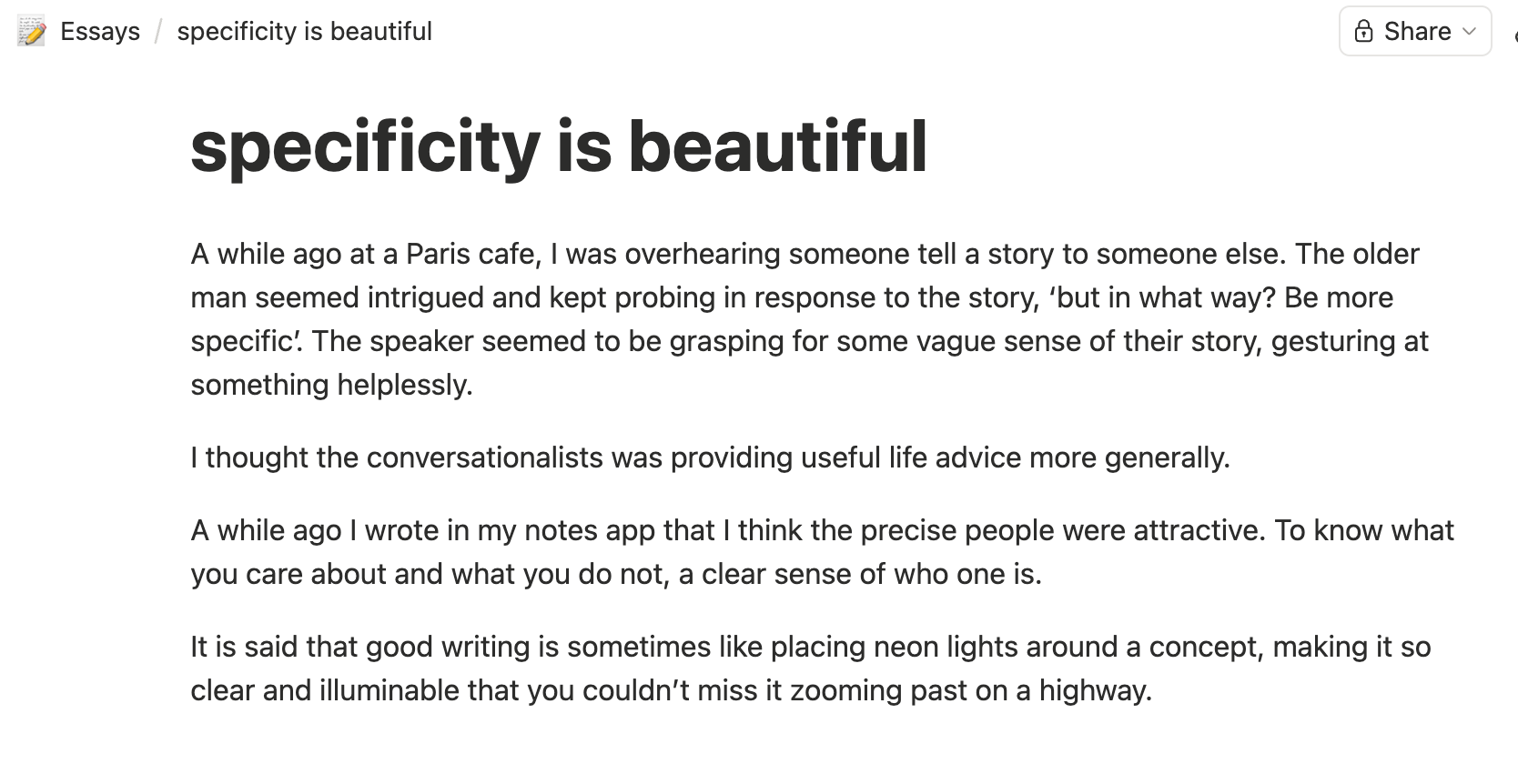
Giving thoughts somewhere to go seems to do more than keep them from disappearing. It changes the entire shape of my attention, making me more alert to what might connect, deepen, or become something else. Once written down, a thought begins to exert a kind of gravity, drawing other ideas, memories, and experiences toward it until it gradually takes on a larger form.
The best analogy I have come up with is that writing creates mental nets for catching thoughts as you move through your day. Previously, my mind felt more like a sieve. An interesting conversation with a friend or a provocative text would stir up ideas and memories, but they would soon wash through and disappear. Most of the time, I would forget the thought had ever occurred to me.
A writing practice has changed this for me. Active drafts create nets around ideas I have already begun exploring, giving conversations and passing moments something to catch onto. New thoughts no longer slip through quite so easily. They attach themselves to an existing line of inquiry and have somewhere to remain.
In some sense, what a draft really creates is an unfinished question. Once that question exists, some part of my mind continues looking for possible answers, even while my conscious attention is elsewhere. The world begins offering up material that might help me understand it. Over time, these questions occupy a sustained space in the mind and become structures through which the world is perceived.2 Everything begins to contain more potential energy, more possible ways of being transformed into something else.
For example, over lunch with E, he asked what I had been writing that morning. As I tried to explain this essay, I began testing out new ways of articulating what I meant. His clarifying questions brushed up against my initial instincts and helped the idea take on a more precise shape. That conversation then found its way back into the draft you are reading now, which looks very different from the fragments it began as. The first idea for this piece was simply the net analogy; everything else emerged from there. In this way, the essay took form in the shared space between us, through conversation.
This is how all conversation works, through association, as we connect our experiences and stories. Every conversation is, in itself, a deeply creative act. When people tell me they have no idea what they would write about, I often think that if they recorded a single conversation with a close friend, they would find endless essay ideas emerging from it. When you pay attention, these conversations reveal the recurring loops of interest you keep returning to. What do your friends ask you about? What can you not stop talking about? I often find that these are the richest grounds for essays. An essay is often simply me following one of those threads more deeply, turning my attention toward it to uncover and unravel what is already there. I wrote more about how conversations become essays in an earlier post the best conversations help you overhear yourself.
One of the most magical things about this practice is that it revealed how much richness can lie inside a passing thought. When I gave one enough time and attention, following the thread and patiently unravelling what lay beneath it, I often found far more there than I initially expected. The world began to feel almost infinitely abundant, as though ideas were lying latent behind everything I encountered, waiting to be discovered if only I stayed with them for long enough.
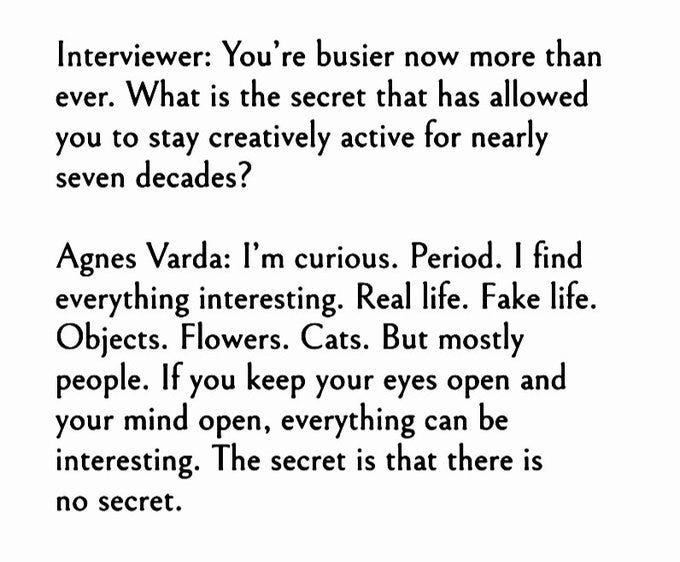
Conversation is one place where this abundance reveals itself, but the associative process extends far beyond it. Writing has made me more alert to connections across everything I encounter, sometimes giving me the embodied impression that absolutely everything is connected. Even as I wrote this essay, I began thinking of other essays tied to the same idea. By turning my attention toward those connections, I started drawing out patterns that had always been there but remained invisible.
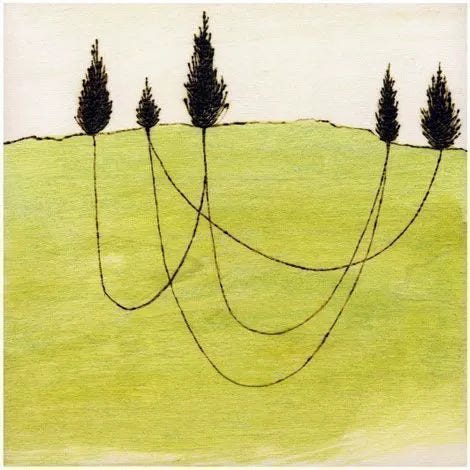
But I don’t mean to entirely romanticise this process. There is also a darker side to walking through life with so many nets cast around you. In her Nobel Prize for Literature acceptance speech, Annie Ernaux wrote, ‘Maybe the true purpose of my life is for my body, my sensations and my thoughts to become writing. In other words, something intelligible and universal, causing my existence to merge into the lives and heads of other people.’ Elsewhere, in her unpublished journal entries, she remembers ‘living and walking through the streets exactly as if things were about to turn into words, sentences’. If not careful, this way of thinking can conjure the unsettling image of everything you experience becoming mere ingredients, pieces of material to feed an ever-hungry artistic practice, a machine that converts raw experience into meaning.
A recent conversation with a friend helped me see the cost of this more clearly. When I asked whether he considered himself a writer, he told me he approached writing with some caution, because the act itself can create distance from experience, alienating you slightly from your own life. Instead of simply living through something, part of you is already standing outside it, observing and shaping it into a story.
This is one of the difficulties of writing personal essays publicly, and part of why I am careful not to share everything that happens to me here. I think some experiences have to remain partly untouched, kept outside the machinery of interpretation and disclosure. At the same time, some degree of distance is inseparable from art. Writing asks one to step outside an experience long enough to examine it, understand it, and make it intelligible. I am not sure this tension can be neatly resolved. Perhaps the question is simply how to write from life without allowing the writerly gaze to entirely consume it.
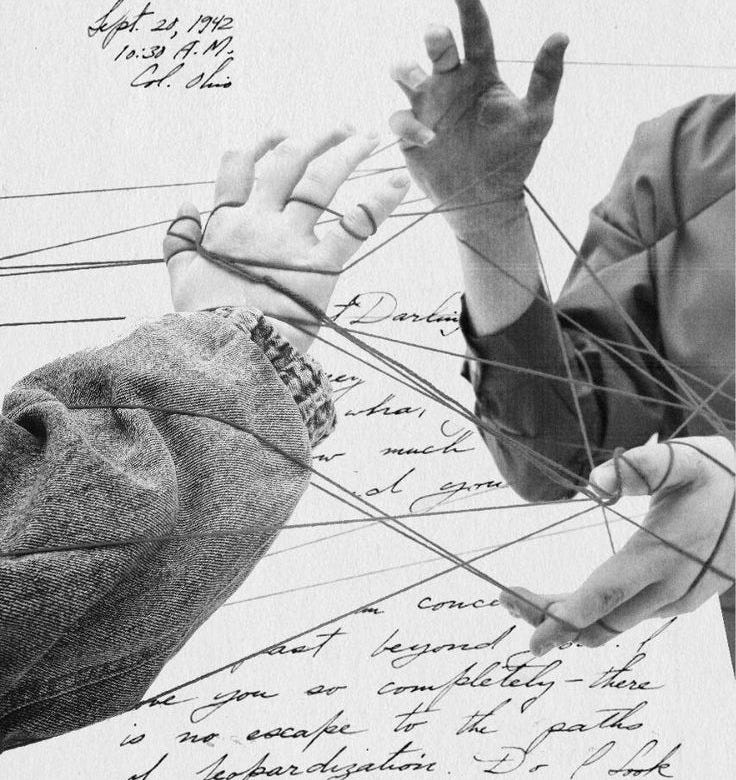
The most immediate change writing made to my life was that fewer things simply passed through me. It gave thoughts somewhere to live, made connections easier to perceive, and turned experiences I might once have forgotten into questions I could continue following. Writing also significantly changed my relationships, career and entire life path, but that is a story for another essay.
Some people resist the idea of writing because they simply don’t think of themselves as a writer. But my primary identity is not that of a writer either. In his essay Developing creative identity, Michael Nielsen writes, ‘I’m not a writer. I’m an explorer and researcher who also writes.’ I relate to this - I experience life and go about my days, and writing is simply the mode through which I make sense of it.
Writing is an act of thinking. It is a way of attempting to understand my days and my life, connecting the dots between disparate experiences and memories. Words happen to be a particularly useful medium for this process because they are one of the primary means through which we interpret and organise reality. Writing can be a tool through which you become more fully yourself, a way of paying closer attention to your life, and sometimes even changing it.
I’m curious and would love to hear from you in the comments: do you have a writing practice, and what does it make more visible to you? If you do not write, have you found another way of making sense of experience?
If you find some value in my writing, you can buy me a coffee. Other ways to support are just as meaningful: subscribing or pledging to my Substack, leaving a comment, or sharing this with someone you think would enjoy it. Each small signal helps others find their way through the noise.
If you enjoyed this, here are more of my essays related to writing:
speak so you can be found
·
August 7, 2025

Someone was telling me about her relationship the other day: “He just doesn’t see me. We can’t talk properly. I don’t think we really understand each other.” She sounded devastatingly tired, like someone flicking a flashlight through fog, trying to find the edges of something that never quite takes shape.
I wrote more about this intention in my first-ever blog post, sunrises we sleep through: ‘hopefully [this blog is] a space where the ideas living in my brain can stretch out, take detours, and slowly unfurl beyond the fragmented state they usually live in.’
Comments
Nothing yet. Say the first thing.
Sign in to join the conversation.