
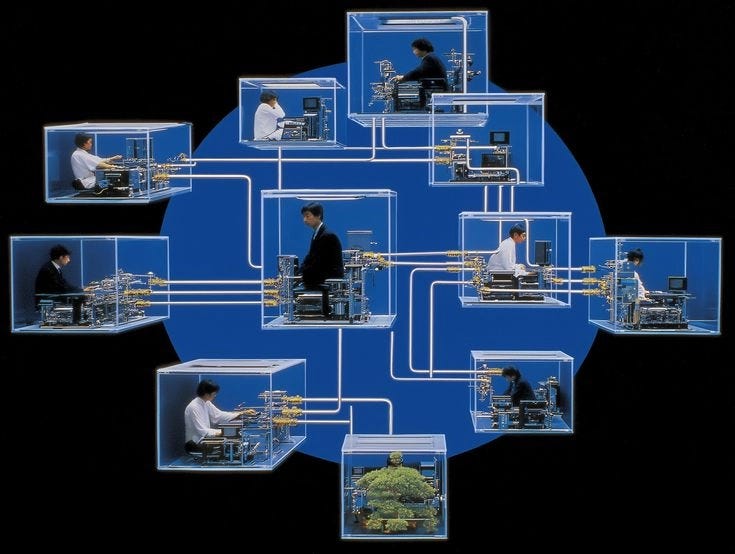
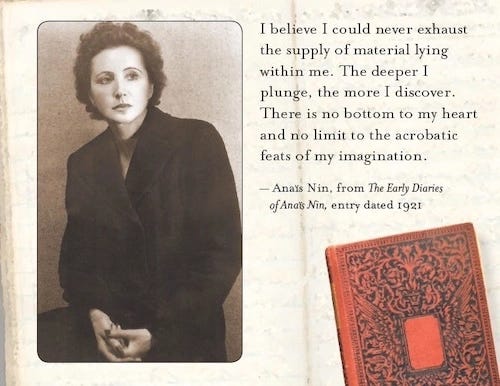
“Writing to me means thinking, digging, pondering, creating, shattering. It means getting at the meaning of all things; it means reaching climaxes; it means moral and spiritual and physical life all in one. Writing implies manual labor, a strain on one’s conscience and an exercise of the mind … Yes, my life flows into ink!” (The Early Diaries of Anaïs Nin, 1921)
My friends who code were rapidly accelerating their work with AI, accomplishing in days what previously would have taken months. The promise was an exciting new technology that might uplift every part of our lives. So, of course, I began wondering how I might experiment with using AI to help with writing and editing, an activity that took up much of my time and often felt tedious, though rewarding. Given how useful it seemed elsewhere, this felt like a natural question to ask.
What was less obvious were the creative, personal and philosophical implications. I’ve been writing all my life in one way or another, from weird stories as a child to college essays, but ChatGPT came out the year after I graduated. I was no stranger to the labour by which you assemble words into some collage of meaning, but I did not yet understand what outsourcing parts of that labour might do to my thinking or my relationship with my own voice.
Still, one of my hotter current takes is that the discourse around AI and writing is often reductive and unimaginative. Yes, there are real reasons to be cautious, many of which people have helpfully pointed out. I suspect there are also effects we simply do not yet have the language to see.
I understand why people are alarmed, because the risks are real and hard to see. I have sometimes felt AI make me lazier. There have been unsettling moments when I realised I was blindly accepting a sentence. I am also sure it is changing parts of our thinking in ways we cannot yet see clearly. Still, the position ‘do not use AI to write’ feels like too simple a conclusion to me, because different interactions with a language model affect the mind in very different ways. I wish we were more curious about the differences, asking questions like where in the process does AI weaken your thinking? Where can it extend it? What abilities are you practising, and which ones are you giving away?
I certainly do not know all the answers yet, which seems more interesting to me than pretending the only choices are never use it or let it do everything. What follows is an attempt to grapple honestly with how I have used AI in my own writing, what I think it gave me, and what I may have unknowingly given away in return. I will also break down the different stages of the writing process, because I have come to believe that the risks and acceptability of using AI vary dramatically depending on where it enters.
To understand why I remain resistant to simple prohibitions, it may help to explain what I was actually doing with AI in the first place. Previously, in my younger and more technologically promiscuous days, I had a fairly laissez-faire approach to using AI for writing. I knew that everything I wrote came from experiences and ideas with which I had personally grappled. If AI suggested a different expression or arrangement of sentences, I reasoned that this was not so different from an editor proposing an alternative phrase. The ideas were mine, AI was simply helping make them more legible.
I would ask questions such as does this structure make sense? Have I repeated myself? Is there another word for what I am trying to describe? I saw AI as a fairly mediocre but endlessly available editor. As an independent writer, I did unfortunately not have the resources to employ an experienced human editor, whose work is often expensive precisely because it requires time and skill. I relied on my partner and friends, but they only had so much time and energy to answer my endless questions.
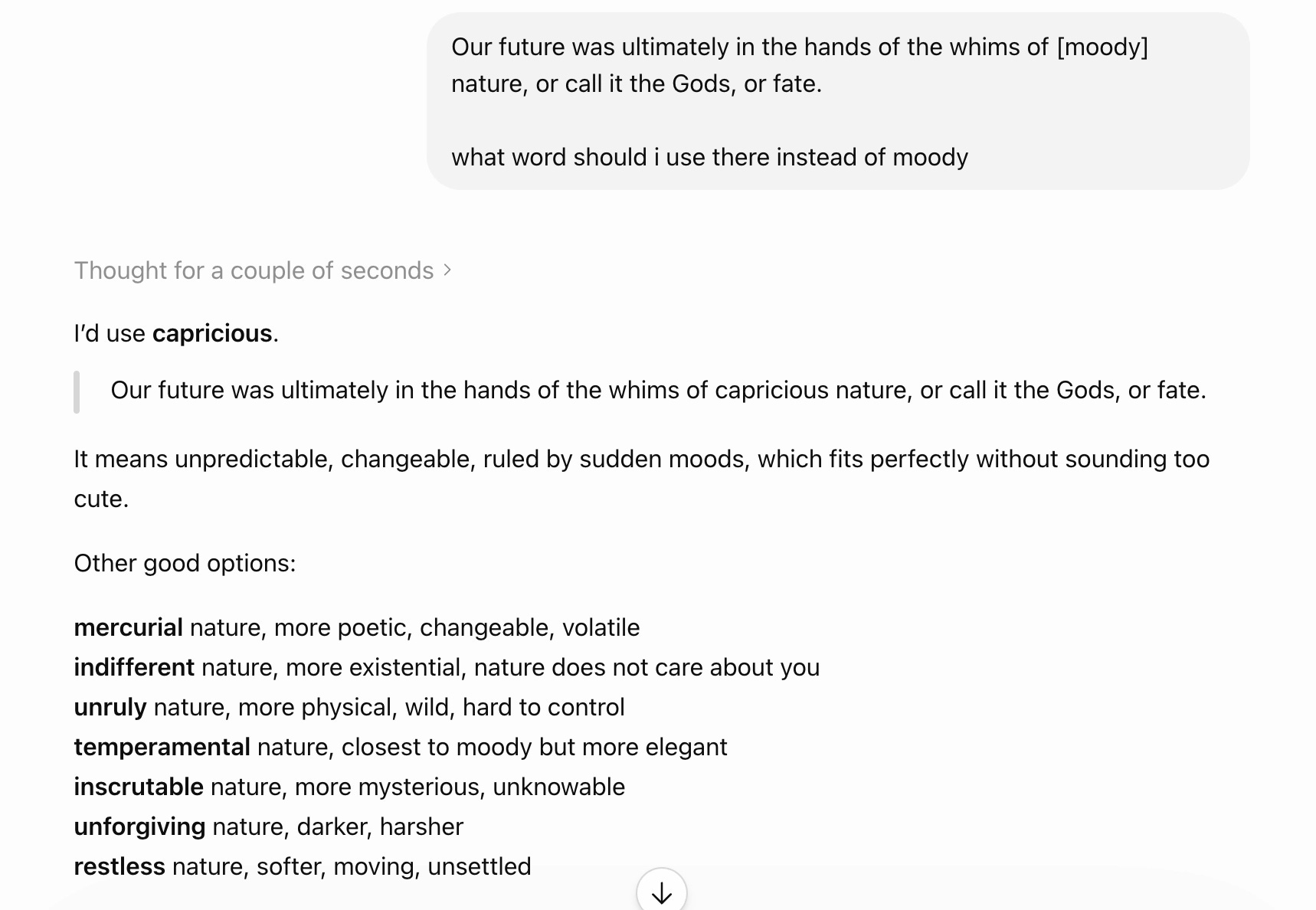
At its best, I used AI by requesting several possibilities and then exercising my own judgement among them. Once, I asked for words that might describe a particular experience. It suggested ‘capricious,’ which I immediately knew was wrong. Another suggestion, ‘indifferent,’ was closer. Seeing the incorrect word helped me recognise the distinction I was trying to make; the machine had usefully presented a surface against which I could clarify my own idea, much as hearing someone offer a completely wrong interpretation can suddenly reveal what you actually think.
There was another reason the tool felt natural to me - conversation is one of the primary ways I think, and is an extremely generative creative process. One of the themes I return to in my writing is how relationships and conversation reveal us to ourselves (as in this essay, this one, this one). We learn through the space between people. On one level, AI can help create this kind of space. I can bring it an idea and ask it to argue against me, then it can surface similar concepts or expose assumptions I have not noticed. My thinking can become stronger as though I were arguing with a particularly opinionated, sometimes annoying and unnervingly well-read friend.

The danger is much higher when you use AI at a stage where the thinking is still alive and unformed. If you begin with ‘write me an essay about love,’ you are likely to receive a set of generic observations that nevertheless carry the possible false appearance of insight. Without a strong point of view of your own, it is easy to accept the machine’s framing before you have worked out whether you believe it. Getting AI to articulate your ideas can slowly become AI coming up with the ideas entirely.
For a while, these distinctions allowed me to feel reasonably confident in my own practice. I was still generating the ideas and making the final decisions. But over time, I began to wonder whether that account was too neat. A tool can remain formally subordinate while still changing the person using it.
I still maintain that some use of AI as an editor or thought-pressure-tester can be acceptable. The problem is that it can easily become a slippery slope. It is like using an assisting machine to lift a weight and then forgetting to remove the machine because lifting with it feels easier. You continue performing the movement, but the muscle is no longer doing the same work.
With the benefit of hindsight, I now think I leaned too hard on accepting prose that was more readable or technically polished. I still felt I was grappling with the ideas because they came from my experiences, conversations and reading. But I think I could have pushed further! I could have sharpened my mind by insisting on the very best word and the most precise articulation I was capable of finding. I now think there is immense value in that selection process, in the shuffling and fumbling through the mind for the exact conceptual locator. I wish to say exactly what I mean, and the labour of getting there is part of the work.
One day, while thinking about this topic, I began writing in my Notes app. I later reread the passage and, with some horror, discovered that it sounded like AI to me. There were certain LLM-like tics in the rhythm of the sentences. I put it into an AI detector, and it came back as 100 per cent AI-generated despite the fact that I had just written it myself.
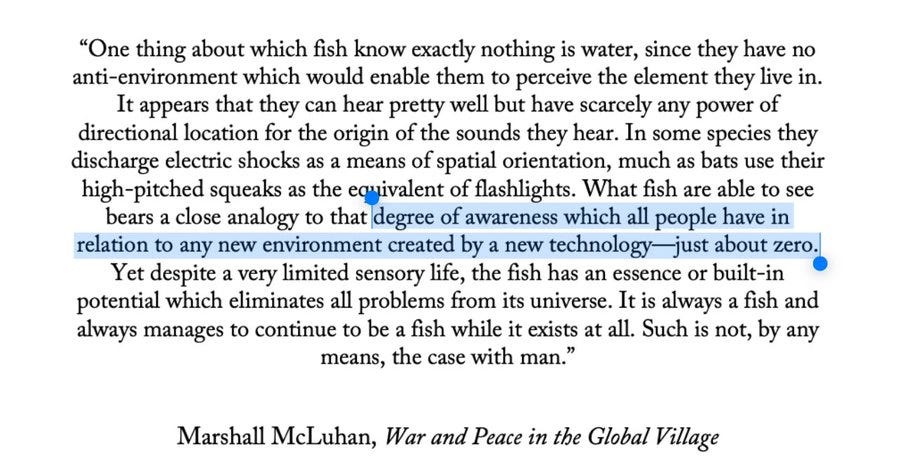
I then had to reckon with this. Anything we talk to enough can become part of a co-evolutionary loop. Was writing with AI shaping my own prose into a flatter form? Was its statistical rhythm entering mine? Marshall McLuhan famously observed that we shape our tools and thereafter our tools shape us. The fish cannot easily see the water around it. Perhaps AI was doing something to my language just outside the edges of my awareness.
At the same time, parts of my natural style overlap with the kind of prose language models tend to produce. This is slightly embarrassing to admit, but it is partly a relic of my upbringing through academic essays and corporate consulting, both of which prize legibility and clarity over artistic style. AI was trained on vast quantities of this prose, so of course it gravitates towards similar patterns. I am also prone to lofty abstractions, overly neat conclusions and the occasional cliché, as all young writers are. Sometimes, unfortunately, I simply write badly because I do not yet entirely know what I am doing, and an AI detector cannot, at least for now, distinguish between these possibilities.
The experience forced me to ask a question I had previously avoided, namely what exactly was the labour I had been outsourcing, and was its inconvenience perhaps part of its value? If language were merely a container used to transport ideas from one mind to another, perhaps it would not matter whether some of the phrasing originated elsewhere. My reaction suggested that I believed writing was doing something more.
I think much of the confusion about AI and creativity comes from a deeper confusion about what writing is for and how it interacts with our minds. If writing is purely functional, a vehicle for conveying information from point A to point B, then there may be little wrong with asking a machine to make the information clearer and more concise. I imagine this is why people generally feel less disturbed by AI being used for business documents or administrative emails.
But if an essay is also a personal creative act, the specific articulation matters. Their selection is part of the thinking, and their arrangement becomes evidence of a particular human consciousness. Words are the currency of my imagination. The precise expression is proof that this experience passed through this person, with their fractal of experiences and ways of seeing.
Anaïs Nin wrote that ‘writing implies manual labor, a strain on one’s conscience and an exercise of the mind.’ Elsewhere, she said it was persistence and love of the craft that finally made her a craftsman and a writer: ‘The only reason I finally was able to say exactly what I felt was because, like a pianist practicing, I wrote every day.’
There is a wrapping together here of writing and labour. Any writer who has sat in front of a laptop rearranging words, searching for the precise expression of an experience, knows the toil involved. There is the fumbling through the mind’s library for the exact word, the sharpening of the knife of the sentence, the attempt to locate the heart of what you mean. I used to think the idea mattered most and its precise expression somewhat less. I now think that the labour of finding the exact expression is often where the idea becomes fully understood.
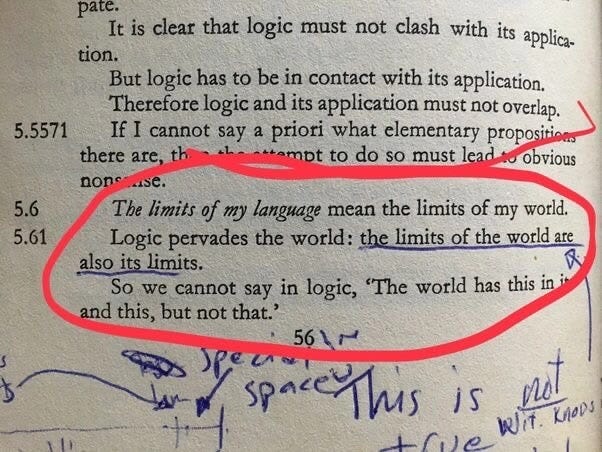
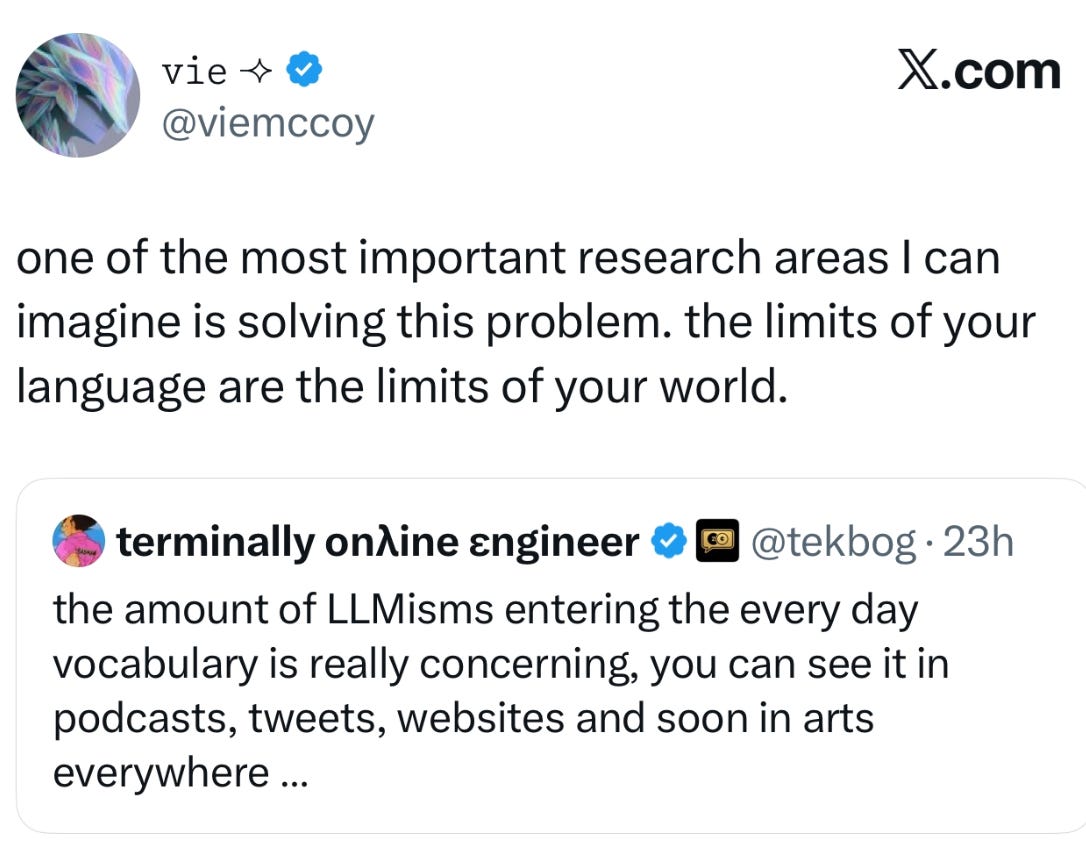
The French phrase mot juste refers to the exactly right word or the perfect expression. The search itself sharpens the thought. The limits of my language may indeed be the limits of my world, because every new distinction I learn to express becomes something I can more clearly perceive.
To me, this is perhaps clearest in poetry. As an occasional writer of poems, I personally do not see much of a place for AI in poetry except as part of some experimental artwork commenting on our relationship with technology. The function of a poem is inseparable from its language. Its meaning is bound up with the exactness of its sound and form. Essays are more ambiguous because they live somewhere between communication, thought and art, but the particular expression still matters.
If finding the exact language is part of discovering the thought itself, then the difficulty of writing begins to look different. Rather than an unfortunate barrier between the writer and the finished work, the friction itself is the process through which the work, and the writer’s understanding, come into being.
Even when we understand that some difficulty is valuable, it is still natural to want relief from it. Writing is hard, often frustratingly so, which helps explain why people turn to AI in the first place. The struggle can be deeply uncomfortable, and it is natural to want to escape it. But not all toil is created equal. Which toil is a Herculean effort we can happily outsource, and which toil is worth grappling with? What happens to us when we outsource the connective tissue of our thinking?
In some ways, I am grateful that AI makes essay writing more accessible. Anyone can dump a stream of consciousness or a collection of fragmented thoughts into a model and receive guidance on how they might be organised. Someone who previously felt unable to write may see for the first time that their scattered observations contain the beginnings of an argument. This can be truly empowering and interesting.
The issue is when the thinking stops there. If a machine performs the work of connecting every fragment, the writer may receive a polished result without having understood why those fragments belong together. They gain the appearance of coherence without necessarily passing through the experience of creating it.
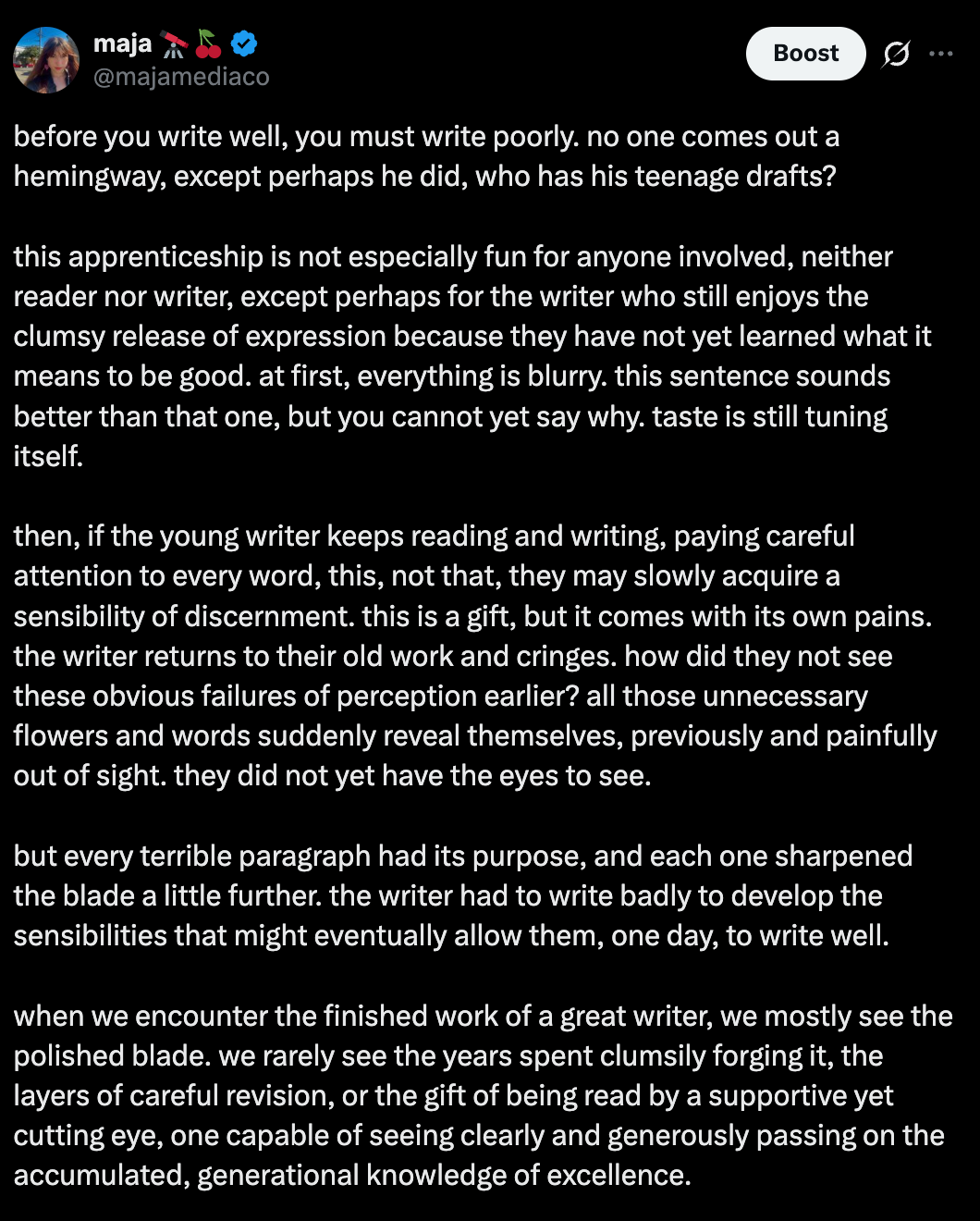
This matters because there is a difference between removing unnecessary friction and removing the experience through which a capacity develops. Indeed, confusion can often be a necessary state in which a person learns how to think, rather than evidence of failure. One of the most important lessons a writer can learn is that the first attempt will probably always be bad and that this does not mean they are bad!
These questions become more urgent when AI enters education, where the difficulty being removed is often the very capacity the exercise was designed to develop. I thought about this often while teaching college students this past semester. When I graded assignments, some carried the faint but unmistakable sniff of AI usage. A few students may simply have run out of time or wanted to avoid the work, but I do not think most were knowingly committing some great intellectual crime. I suspect they had not considered what using AI at that stage might do to their own learning and development. They had been given access to an extraordinarily powerful tool, but no map for distinguishing the forms of struggle that were disposable from those that were the substance of the education itself.
Perhaps naively, I believe the outcome would have been different for at least some of them if they had understood the trade-off more clearly. If someone had explained that the awkwardness of forming an argument and discovering why one thought follows another was part of the capacity the assignment was intended to develop, they might have made another choice. Instead, we have largely handed students the technology first and left them to infer its consequences alone.
This is why I am less interested in treating every use of AI as evidence of laziness or moral failure than in helping people understand what they may be giving away. The polished essay arrives immediately, while the loss of judgement or independent thought may only become visible much later. Alarmingly, this harm accumulates silently through the repeated removal of precisely the difficulty that was helping a person grow.
Nor does this problem disappear once formal education ends. It simply becomes entangled with professional incentives. People have already been talking about this in the context of coding. My friends who code tell me they can feel parts of their knowledge atrophying, but that they are now working so quickly they cannot stop. If they return to writing everything manually, they fear they will fall behind. Perhaps that is a rational trade-off for some kinds of work. But it is still worth pausing to ask what is lost when parts of a process are outsourced, particularly when the process shapes the mind of the person doing it.
Writing is an especially unusual and fragile case because it is both a product and a method of perception. When you outsource an administrative email, you may lose very little. When you outsource the articulation of your own emotional life, you may gradually weaken your ability to know what you feel.
So far, I have mostly described writing as something that forms the person doing it. But writing also moves outward. Beyond an extremely powerful technology of thought (writing is thinking!), it is one of the primary ways we make ourselves present to other people.
Writing about Wittgenstein and AI, Alexander Stern argues that language, especially for the young, does not merely act as a set of signs for objective things. It is a vehicle through which we connect with other people. Often, communication is as much an act of relation as it is an act of description. When we speak to someone we love, we may sometimes be trying to accomplish something practical, but the deeper purpose is simply to be together.
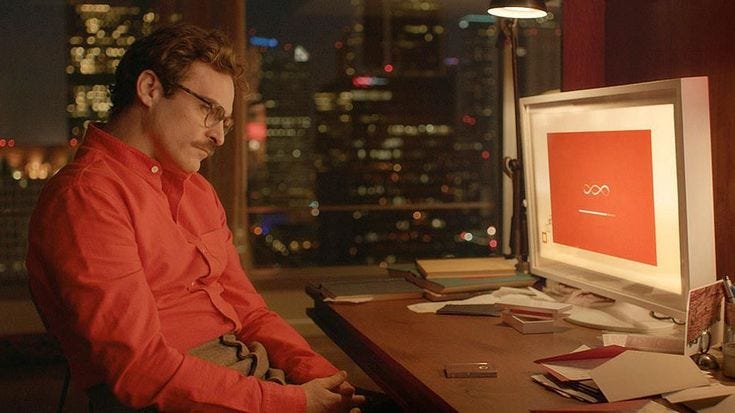
This is part of why AI-written personal language can feel disturbing. In the film Her, the protagonist writes intimate greeting cards on behalf of strangers. The recipients experience language that sounds personal and loving, but the person whose name appears at the bottom did not actually produce it. The words still convey something, perhaps even something beautiful, but the connection has become detached. What appears to be an expression of one person’s attention is actually the work of another.
In the end, we write to lure, enchant and console others. We write to serenade our lovers. We write, as Nin said, to taste life twice, in the moment and in retrospection. When the words are meant to be evidence of presence, it matters who or what produced them. Rather than merely to transmit the correct sentiment, the effort itself can be part of the gift. This is why a generated meeting summary and a generated love letter contain different implications, even if both contain perfectly serviceable prose. In one case, language is primarily carrying information. In the other, the effort of finding the words is part of what the words are meant to communicate.
Once we recognise that writing performs several different cognitive, creative and relational functions, the question ‘Should we use AI to write?’ begins to look almost comically underspecified. The more useful question is where in the process AI enters, and what human capacity that particular stage is meant to exercise.
I’ve created the diagram below to offer my own humble view, which you may take or leave. Perhaps hilariously, and somewhat ironically, I used AI to generate the diagram itself. It was very useful for that purpose, though the ideas and judgements within it are entirely my own.
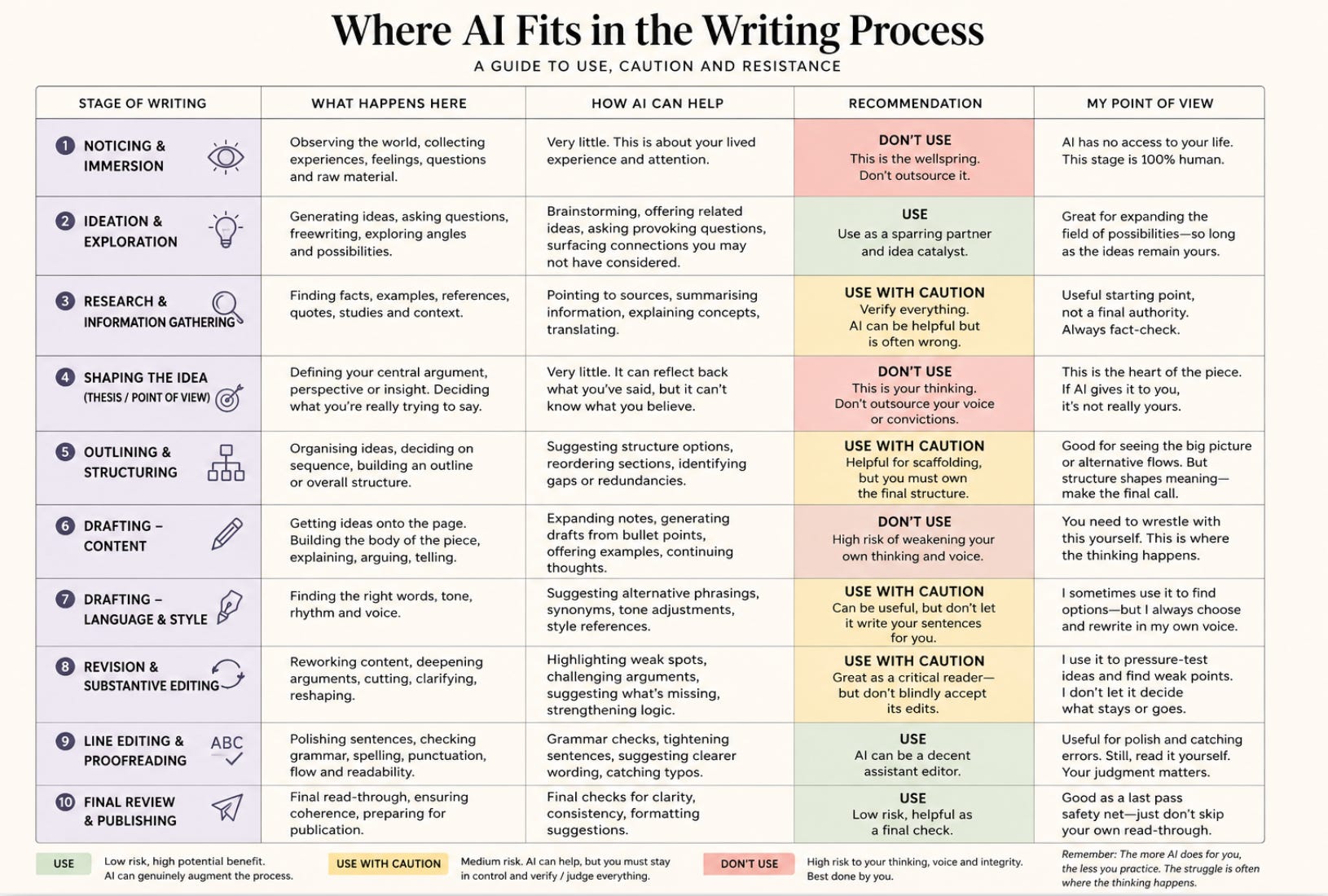
These stages often overlap in practice, but separating them helps reveal that each asks something different of the writer. In brief, my position on each of the stages of the writing process:
Using it to generate the central insight, emotional revelation or thesis of a personal essay carries the highest risk. This is where the writer needs to sit with uncertainty, search their own experience and develop a point of view. Outsourcing this stage can produce a false sense of insight and weaken the capacity to know what you actually think.
Using AI to surface references or related ideas for further research can also be creatively generative, provided its answers are verified. It can function as an associative engine, pointing towards concepts the writer may not have encountered. But there remains a risk that its suggestions narrow the inquiry towards what is already most statistically available.
Using AI to pressure-test an argument or present the strongest opposing case can be useful. This asks the machine to create friction rather than remove it. The writer still has to decide what they believe, and integrate the challenge, which often strengthens the work.
Using AI to restructure material is more ambiguous. It can help identify repetition or possible sequences, particularly when the writer has already produced the substance. But structure is also meaning! Shuffling an essay can change the argument and emphasis, so the writer must continue making the final decisions.
Using AI to draft the language of a personal or creative piece is also risky. Even when the underlying ideas are yours, the act of articulation can reveal further meaning. Allowing the machine to perform that act may make the work smoother while removing the ripples of the mind that produced it.
I think using AI for editing is more defensible, although still not neutral. Asking whether a passage is clear or incoherent can resemble the work of an editor. Yet if every awkward sentence is immediately handed over, the writer may never develop the judgement required to diagnose and repair their own prose.
The clearest principle I have arrived at is that AI is most useful when it increases the amount of discernment I must exercise rather than reducing it. The more decisions I continue to make, the less likely I am to surrender the capacities I value. When it offers possibilities that I assess and transform, it can extend my thinking. When it offers answers that I passively accept, it begins to replace it.
I remain interested in uses of AI that make writing more effortful rather than less. It can be instructive to generate many variations of a sentence and see the same idea refracted through different forms, because you can say the same thing a thousand different ways. Seeing those refractions can make the source thought clearer, provided you already possess the source thought and continue to make the final decisions yourself.
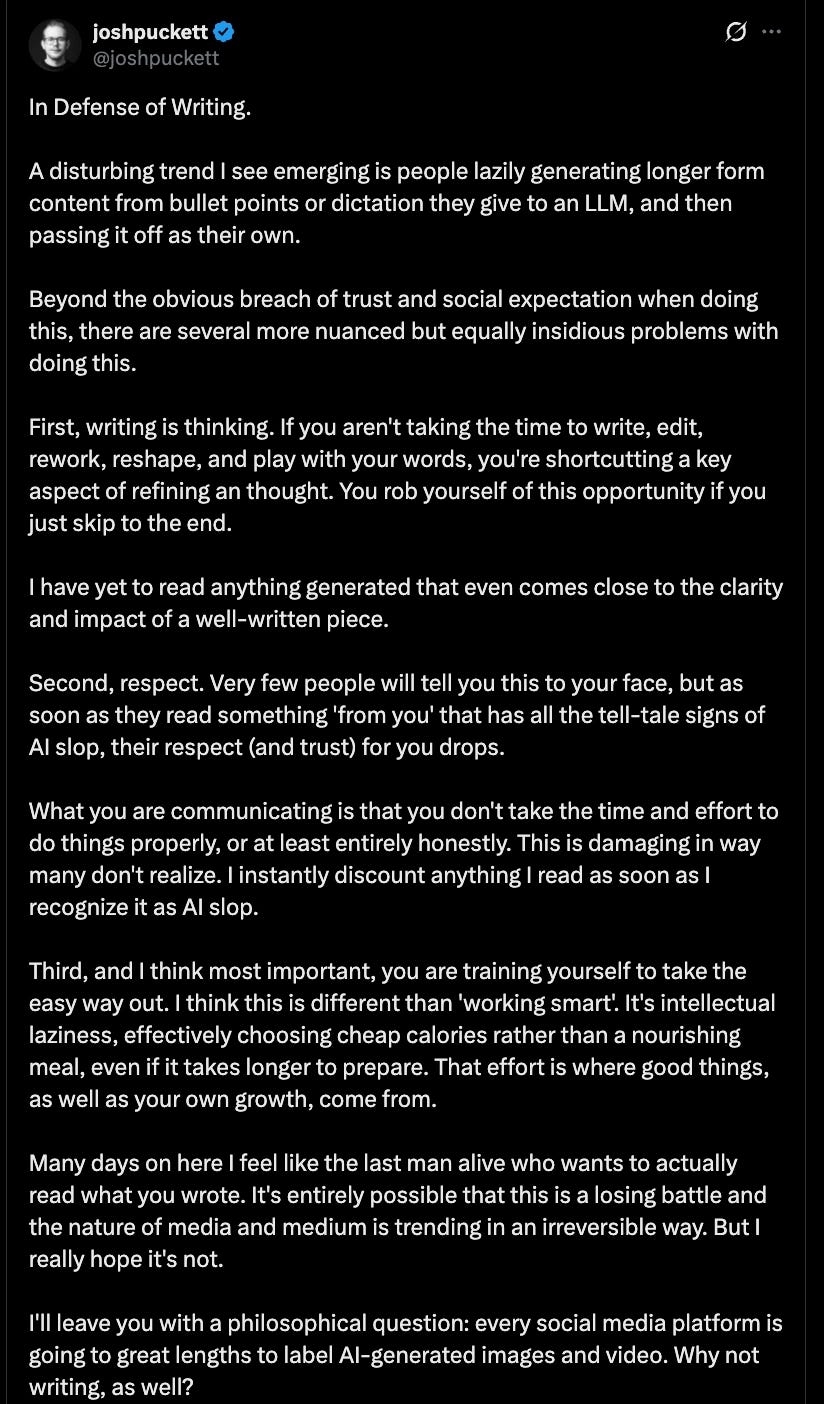
The trouble is that our public conversation rarely has the patience to make these distinctions. Instead, the many stages and possible uses of AI are often compressed into a single moral question: did you use it or not?
Unfortunately but understandably, the public discourse around AI and writing still tends to collapse these distinctions into a single moral category. Part of me has hesitated even to write this piece. The conversation is loud and full of rage, and admitting that I have used AI in any part of my process can feel a little like confessing to a crime. I believe I have maintained a sense of creative integrity, but that is ultimately mine to reckon with, not the peanut gallery’s (with all respect to the peanut gallery). Nor do I wish to become the protagonist of the AI-writing discourse, valiantly throwing myself in front of the mob to defend the machines. I am on the artist’s side, don’t you see, I have sometimes wanted to say to people who seemed to disregard me the moment I admitted to experimenting with it.
I am, in fact, deeply sympathetic to the ‘no AI in writing at all’ sensibility and respect the sanctity with which its adherents uphold the creative process. If I have any allegiance on some ‘yay AI versus no AI’ spectrum, it is probably somewhat closer to these people, who I understand to value and seek to protect humanity above all ends. I ultimately wish to protect our humanity too, so I think we share the same core animating motivation.
Especially for artists who have spent the last several decades watching technology companies devalue their work, the fear of AI makes complete sense. Many people are afraid because parts of the technology industry have spent years trying to underpay or otherwise diminish the value of creative labour. When you realise how much has already been taken from creative industries, it is an understandable human reaction to ask whether AI will make this worse and remove the human being from the act of creation entirely.
I understand the resistance, then. But I wish for us to become far more literate about the consequences and possible uses of AI. Here we have a technology with associative abilities at a scale never previously seen, capable of surfacing ideas that are remarkably relevant to the exact context of a question. From a creative point of view, this is extraordinary. It seems unfortunate to me that our curiosity about this possibility should begin and end with reprimanding anyone who touches it.
For the record, I think many uses of AI in personal and creative writing are bad for the process, the reader and the writer alike. But I also think the ‘no AI in writing’ position often misses part of the picture. There are many stages involved in producing a piece of written work, including noticing, ideation, research, conversation, drafting, structuring, editing, refining sentences and selecting the exact words. Using AI at each of these stages has radically different implications. Collapsing them into one moral category makes it harder to understand what is actually happening.
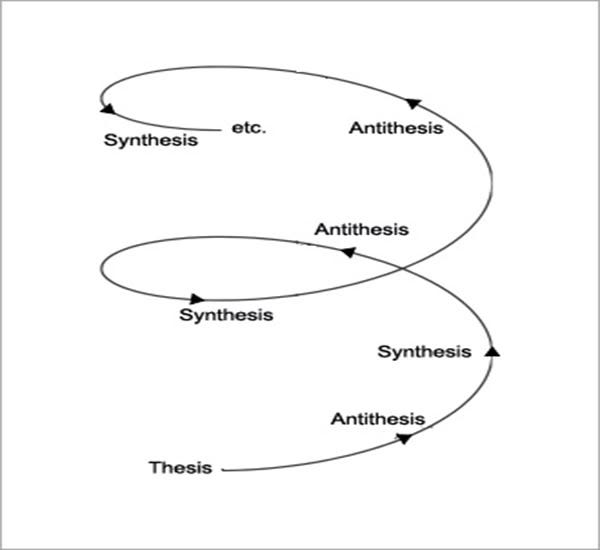
We are clearly in the messy middle, where new norms have not yet settled and our language for navigating the technology remains underdeveloped. Something new arrives, people experiment, others react and get angry, and eventually some of that reaction is integrated. Ideally, we arrive at a more synthesised position, one that is more nuanced than either total acceptance or total refusal. In the meantime, people are making choices that may be harmful without fully understanding why.
Unfortunately, the tools we currently use to police these boundaries are often even blunter than the discourse itself. Substack recently introduced AI detection, allowing readers to scan an essay and receive a judgement about how much of it was supposedly generated by AI. Ignoring the technical uncertainty of these tools for a moment, I find it revealing that a ‘100% AI-generated’ badge functions as an immediate indictment. Rather than being given a nuanced description of how AI may have been used, you are simply branded as machine.
I am nevertheless grateful that Substack has introduced the tool. Even in its current imperfect form, it is useful for making these questions more visible and moving the conversation forward. My concern is less with the existence of AI detection than with the certainty its results can appear to carry, particularly when the technology cannot yet clearly distinguish between AI-generated and AI-assisted work.
Some of my own essays have registered as 100 per cent AI-generated. Indeed, and somewhat amusingly, parts of this essay are registering as AI-generated too. I do not think that is a fair representation of the paragraphs being highlighted, though I would happily accept the label ‘AI-assisted,’ since I have used it for organising and refining in the ways described above. But alas, some sentence structures seem to trigger the detector almost automatically with a questionable level of certainty.
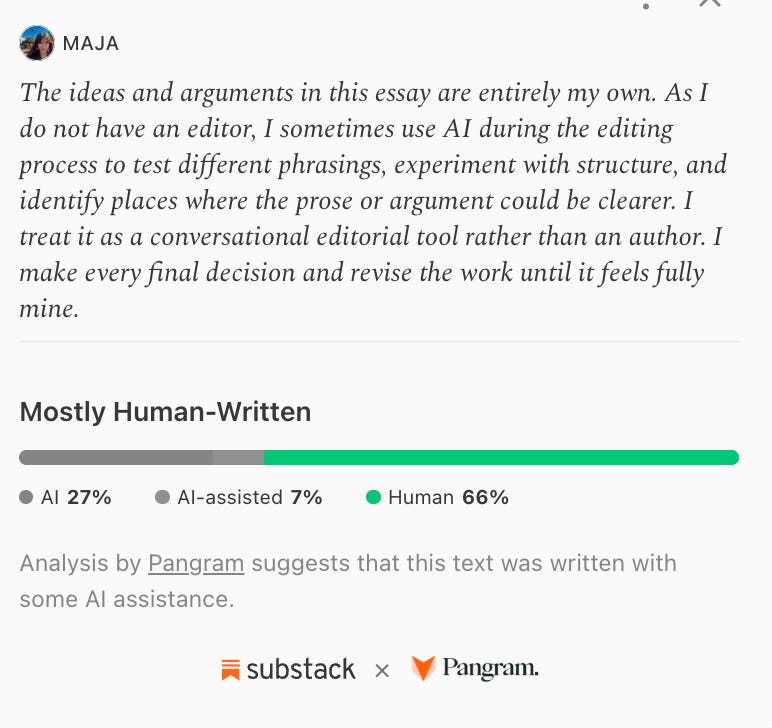
What are we to make of this? I have used AI in the past to help with prose, and perhaps the slippery slope was indeed too slippery. I regret not thinking more carefully about that at the time. But ‘entirely AI-generated’ still carries very different implications from ‘AI-assisted,’ and current detection technology is not capable of reliably recognising or communicating that essential distinction (you can read more about here in this excellent essay by an AI researcher, Ethan).
The reaction has occasionally felt dehumanising, which of course makes a certain kind of sense. The fear is precisely that AI has removed the human being from the work. Once the badge appears, the writer’s account of their own process can become less credible than the software’s judgement. Years of lived experience and thought may be erased by a percentage delivered with more certainty than the underlying technology deserves.
What disappointed me most in some of these interactions was the immediate assumption of bad faith. People with whom I had previously had thoughtful conversations jumped directly to the worst possible interpretation of my intentions, rather than allowing for ignorance, experimentation or the possibility that the software itself was mistaken. I began to see this as a useful barometer of the current discourse and how little nuance it presently has the capacity to hold. There is an immediate knee-jerk reaction, followed by categorisation and contempt. At times, I found myself grateful to have read Arthur Miller’s The Crucible in high school; the atmosphere of accusation, purity-testing and presumed guilt felt uncomfortably familiar.
I do not say this merely to tone-police people who are understandably angry. I mean it as a practical question about how we actually help people understand what happens when they outsource writing and encourage them to change their behaviour. For people with strong creative sensibilities, it may be immediately obvious why using AI to write can harm the writer and the work itself. But I do not think this is obvious to everyone.
Perhaps this reveals my own ignorance, but even as someone who had written in various forms for years, it took me time to understand what certain uses of AI were doing to my thinking. I did not yet possess a clear model of what I was giving up. The technology arrived incredibly quickly and was presented as a helpful, largely neutral tool. People were naturally curious about what it might make possible.
My students returned to mind here. Many people are not knowingly choosing cognitive atrophy over intellectual development; they are using a tool placed directly in front of them without having been taught how to understand the trade. As I saw in the classroom, they have been given the technology, but not the map.
Shame and suspicion can make people defensive before they have had a chance to understand the actual problem. The wider atmosphere can begin to resemble a witch hunt, where anything that ‘smells like AI’ becomes grounds for contempt and many different behaviours and intentions are collapsed into the same moral category.
It is possible that we differ in our theory of change. A strong social stigma may be necessary to establish a norm, and there has been some use in the reprimanding. I probably only realised the gravity of what was happening because a few people reacted so strongly. While shame is helpful for telling someone that they have crossed a boundary, it usually does not explain what the boundary is protecting. Thus, it may effectively stop a behaviour while leaving the person no more capable of understanding why that behaviour was harmful.
I think we need better shared explanations of what people lose when they outsource writing, especially the thinking and struggle that happen through the work itself. We need a language capable of distinguishing between using AI to test a belief and asking it to supply one, between mechanical correction and the outsourcing of personal expression, between augmentation and abdication. I believe this approach will bring more people along than simply telling them they are lazy or that we no longer respect them.
A detector may be able to produce a percentage, and a crowd may be able to issue a verdict. Neither can reliably tell us what happened inside the writer while the piece was being made. That leaves the writer with a more difficult responsibility of deciding which forms of assistance remain compatible with the capacities and values they wish to preserve.
After reckoning with all of this over the last few months, I arrived at an embarrassingly obvious realisation that writing is work I enjoy. It turns out I love the grappling with words! It is tedious and inconvenient, and that is precisely part of the point.
Writing an essay is very different from writing an administrative email or a piece of functional copy. The resistance is a healthy tightening of the muscles and mind. I want to remain receptive enough to hear the exact word when it eventually arrives.
I will continue to use AI to help me write tedious emails so I have more time for the kind of writing I love. I will probably continue using it to present counterarguments and pressure-test beliefs. AI can help me clarify what I believe when I arrive with a real idea and remain responsible for the conclusions.
I have far more hesitation now about using it to shape the actual prose of personal essays. Although I still believe editing and thought pressure-testing are different from one-shotting an essay, the way these tools are currently designed makes it easy to move from one use into another without noticing. I also worry about the effects on my natural writing ability and the development of my voice. I want to preserve the muscles involved in finding my own language.
There is also, more prosaically, a practical reason. Current AI-detection tools are not capable of conveying the nuance of how AI has been used, and the association created by an ‘AI-generated’ judgement is no longer worth the minor convenience or readability improvements I might gain.
Should writers disclose every use of AI in editing? I am still unsure. Writers do not usually list every intervention made by a human editor, despite the fact that editors can dramatically reshape a thesis, even rewrite whole paragraphs or replace specific words. At the same time, AI is different from a human editor and carries distinct cultural and cognitive implications.
Perhaps disclosure will become a healthy norm in due time. I appreciate that Substack now gives writers the option to add a note about how they have used AI, and I have added one to my blog.
There is some irony in the fact that AI has forced everyone to articulate why writing matters. The threat of automation has made us look again at the parts of the process that appeared inconvenient or obsolete and ask whether they were secretly the point. Through this reckoning, I have come to understand more clearly why I do this gestures vaguely at all.
At a meta level, I also formed much of my position through the act of writing this essay. It emerged from reading widely, observing the discourse unfold and speaking with friends and other writers about how they were thinking about AI. I also had several interesting conversations with people who had publicly criticised my own use of it. In trying to understand their differing views, I arrived at a more accurate map of my own. Writing this essay was an essential part of how I reached my conclusions.
At the end of the day, no detector or public norm can entirely replace the personal knowledge of how you made something. You must decide whether the output and advice AI gives you are right, and whether the process remains compatible with the kind of writer, and person, you wish to become. This is where discernment and self-respect enter.
One of the best takes I have heard on this came from Jasmine Sun, who said on the Jackson Dahl’s Dialectic podcast that you know whether you have upheld your integrity. This reminds me of Joan Didion’s writing on self-respect. Self-respect is the knowledge that you can live with the choices you made when nobody else was there to observe them.
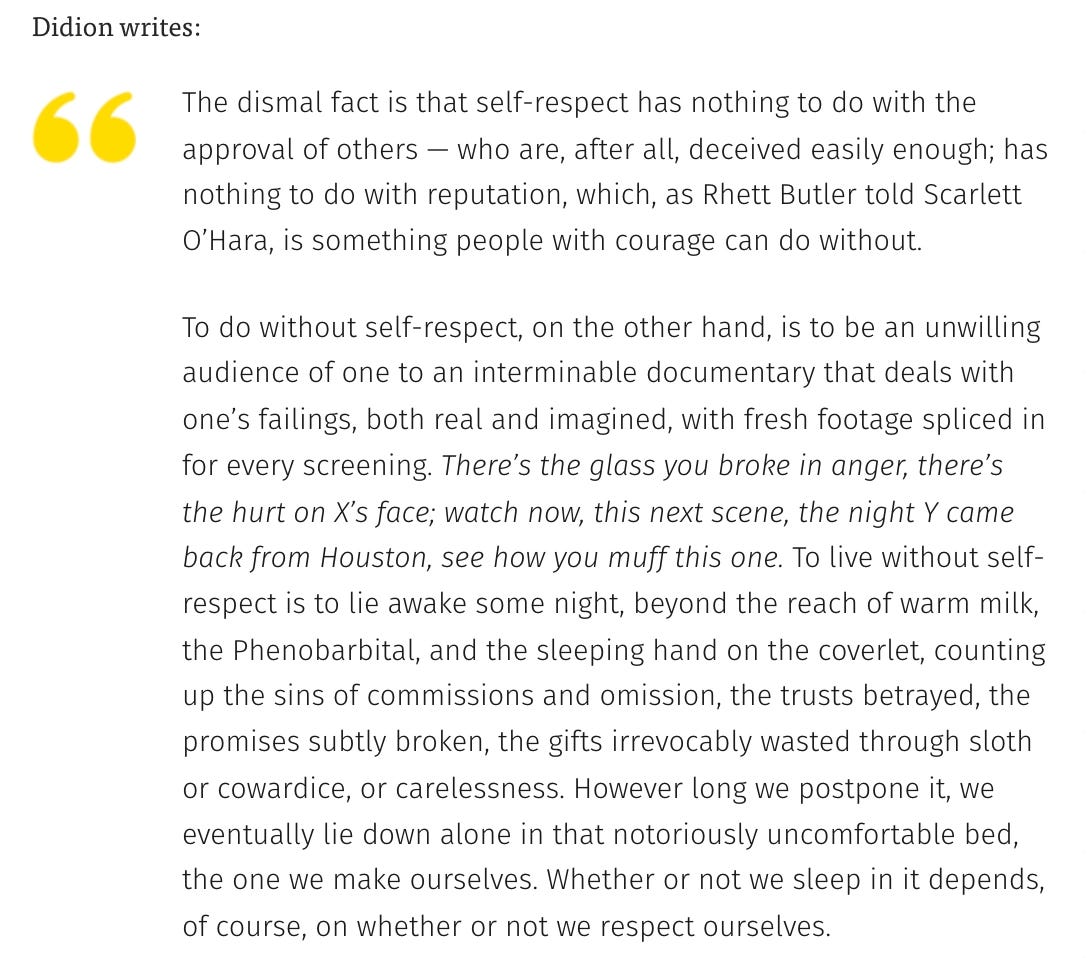
I always slept fine at night using AI in my writing process because the ideas and core essence felt mine. The subjects I write about are animated in my heart and come from my experiences. But integrity requires continuing attention to whether your stated principles remain true in practice. I can acknowledge that my intentions were sincere while also recognising that I sometimes relied on the tool more than I now think was wise.
Writing, to me, is a second life, a way of living in a more heightened way. I write to understand what I have lived and to reach beyond the borders of my existing mind. Perhaps AI can indeed sometimes help with that. Perhaps it can surface a connection I would not have found alone, or present the wrong sentence that teaches me what the right one must do. But it can also offer the relief of apparent understanding before understanding has occurred.
The question, then, is more than merely whether AI produced some of the words. The more important question, I think, is what happened to the writer while the words were being made. Did the tool widen the mind or allow it to retreat? Did it sharpen discernment or replace it? Did it help the writer move more deeply into the experience, or provide a polished route around it?
I remain less interested in declaring AI either pure or corrupt than in learning to perceive these differences. We should tread lightly because creativity is sacred, and because the consequences of our tools often emerge only after they have begun changing us. Still, I believe we need better maps, more honest experiments and a language capable of distinguishing augmentation from abdication.
The labour is sometimes the love. The struggle to find the words is sometimes how we discover what we have to say.
I’m curious to hear how you think about the use of AI in writing. If you’re a writer, do you use it in your own process? Why or why not?
If you find some value in my writing, you can buy me a coffee. Other ways to support are just as meaningful: subscribing or pledging to my Substack, leaving a comment, or sharing this with someone you think would enjoy it. Each small signal helps others find their way through the noise.
Related reading:
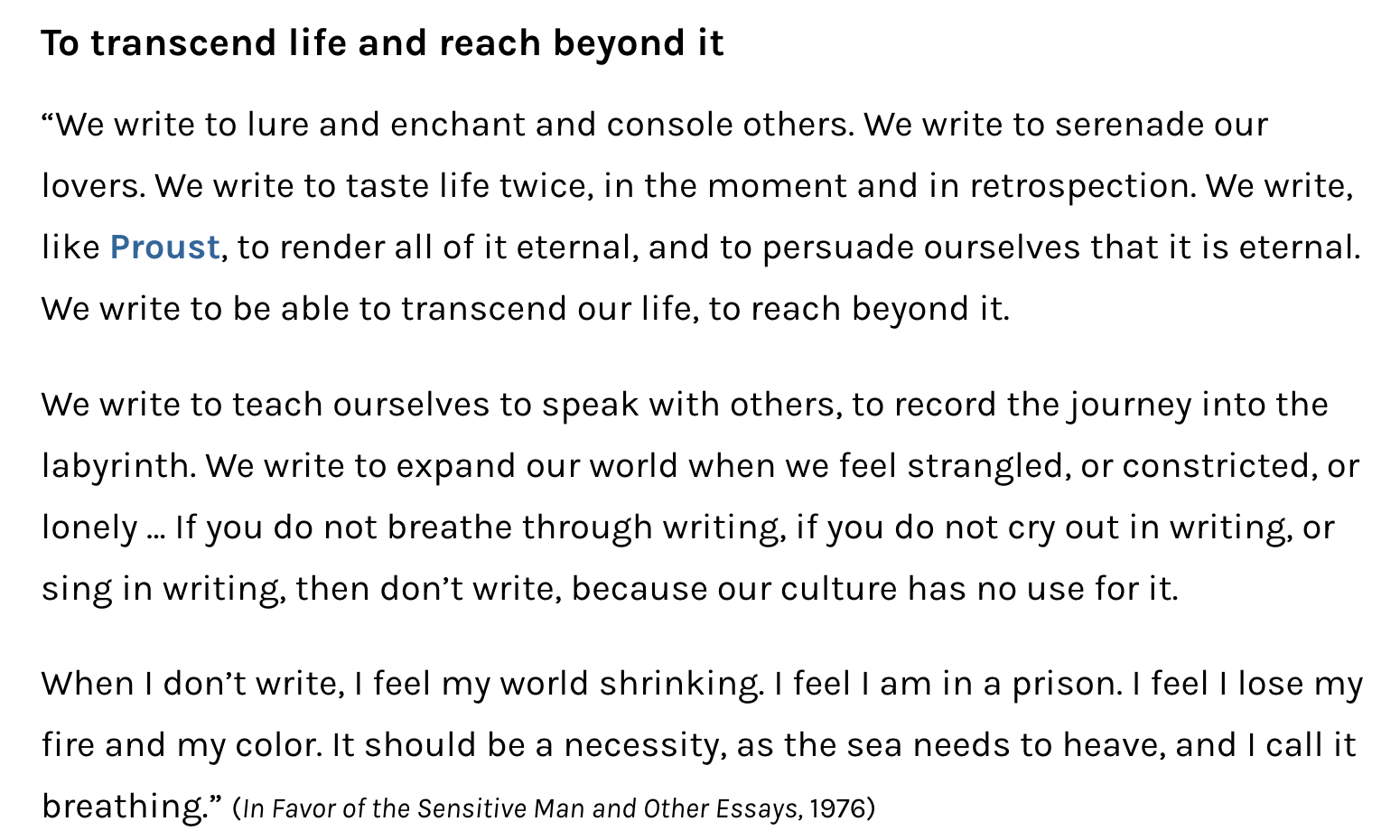
Anaïs Nin: Writing to find meaning in life
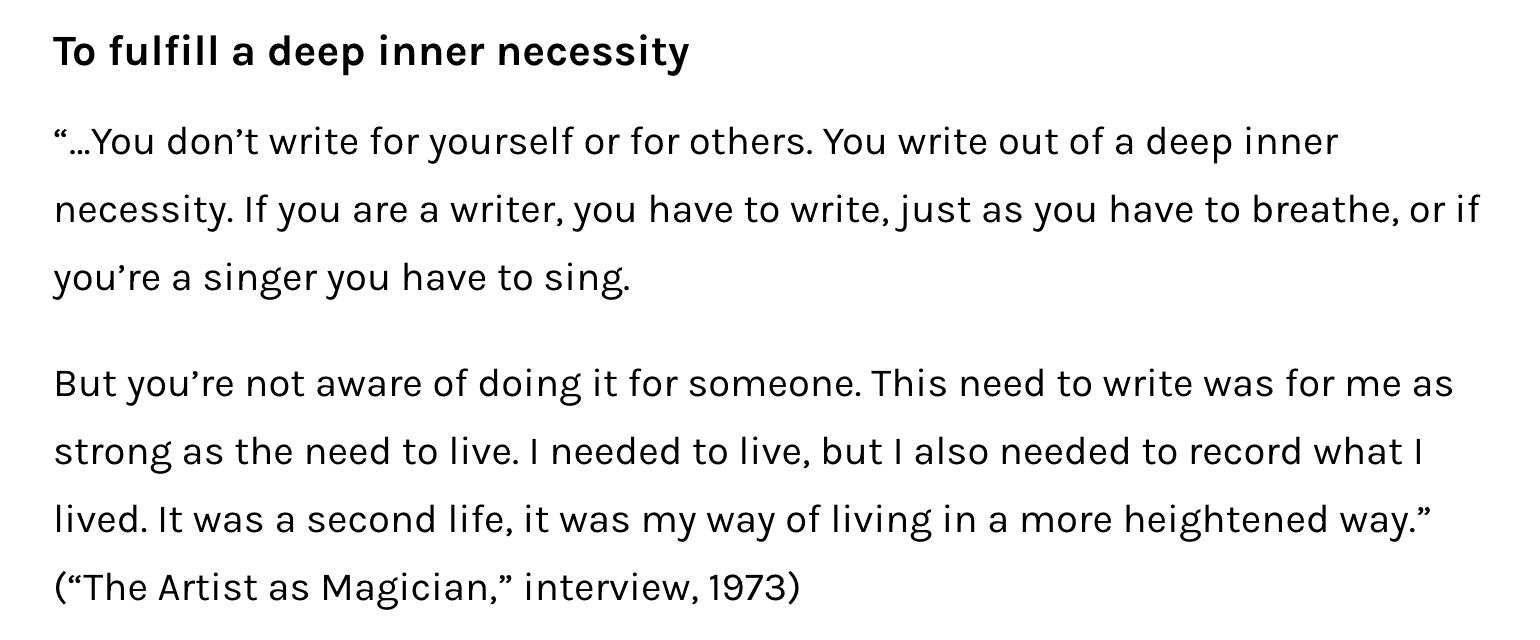
Wittgenstein’s Apocalypse: AI and the crisis of meaning by Alexander Stern
If you’re over 40, you’re ready to use AI, NYT Opinion, Debbie Milman
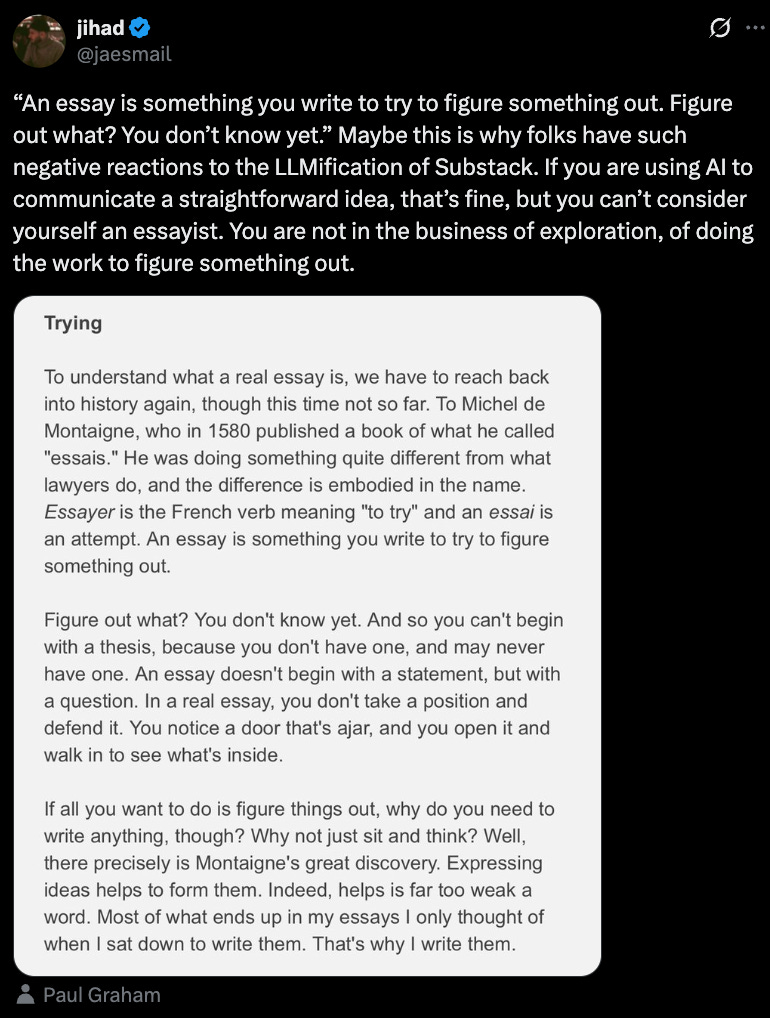
The Age of the Essay by Paul Graham
Comments
Nothing yet. Say the first thing.
Sign in to join the conversation.