
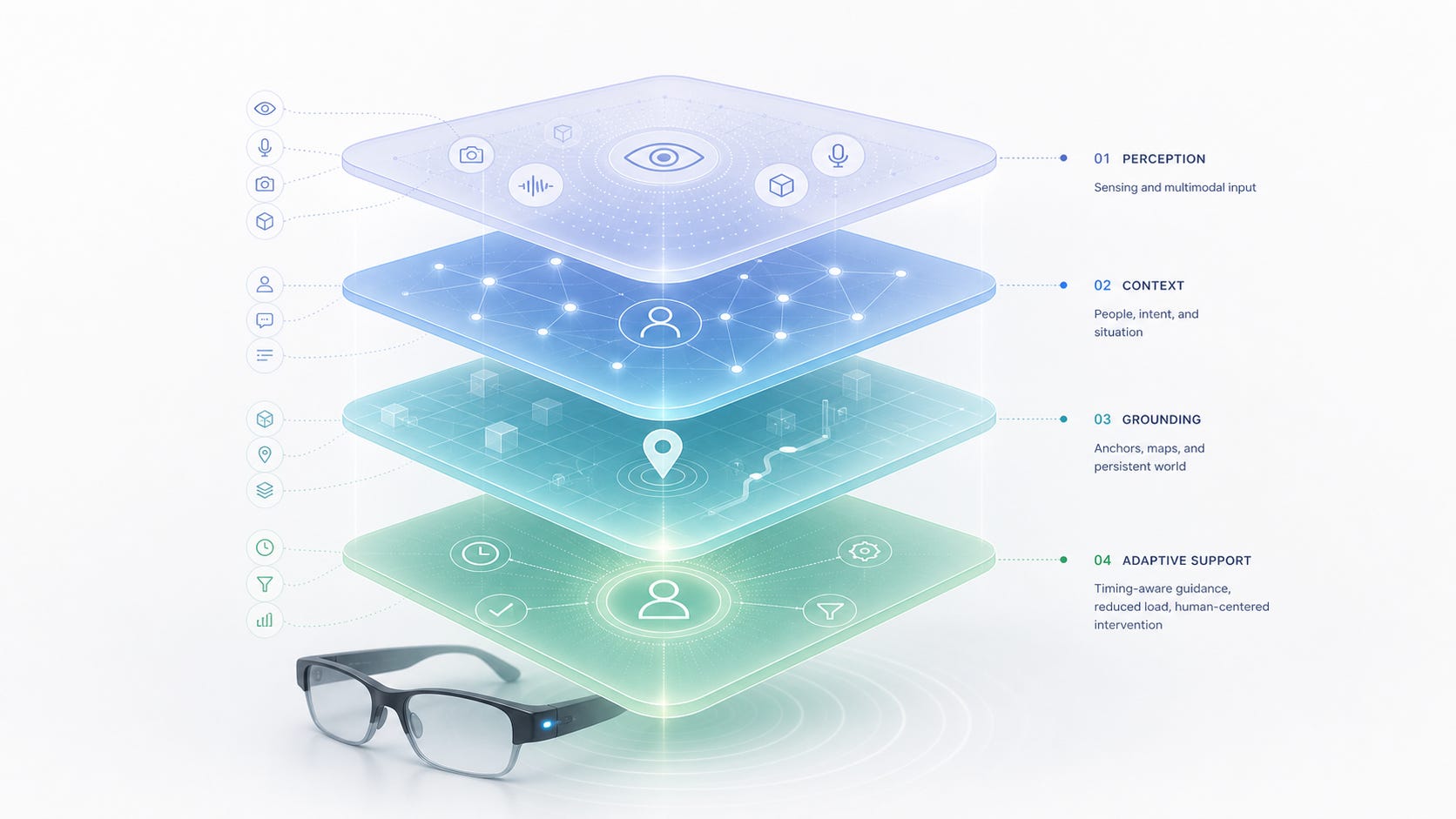
A year ago, XR was mostly a hardware story. Now it is becoming an inference story.
For a long time, public conversation around AR glasses, VR headsets, and spatial computing stayed stuck in one of two modes: hype or prototype. We saw ambitious demos, strong hardware claims, and a lot of vague language about the future. But the underlying stack still felt fragmented.
The major players are now converging on a more concrete direction. Google is building Gemini-native Android XR glasses and multimodal interaction frameworks. Meta is pushing AI wearables that can see and respond in real time. Snap is building lightweight AR glasses with spatial UI, hand interaction, and developer tooling. Apple continues to shape persistent, high-trust spatial workflows through Vision Pro. Niantic Spatial is arguing for a shared map layer that grounds devices and agents in the physical world.
This is no longer just “XR plus AI.”
It is the emergence of a new computing stack built around perception, context, and assistance in physical space.
But even with all this momentum, I think the most important layer is still missing.
The next challenge is not just building systems that can perceive the world.
It is building systems that know how to support people inside that world without overwhelming them.
That is where adaptive interfaces start to matter.
The public signals are clear enough now that we can stop speaking in generalities.
Google’s recent Android XR announcements point toward hands-free, heads-up assistance, with more explicit support for multimodal transitions between gaze, gesture, touch, and controllers. That matters because it suggests the platform is being designed as an interaction system, not just a screen near your face.
Meta is moving in a similar direction through wearables. Its recent AI glasses work emphasizes live perception, contextual assistance, and first-person understanding. The assistant is no longer just responding to typed prompts. It is increasingly expected to interpret what the user is seeing and respond in the moment.
Snap is approaching the problem through platform and tooling. Its Specs roadmap, Lens Studio workflow, and spatial APIs point toward lightweight glasses as a practical surface for hands-free spatial interaction, guided experiences, and AI-assisted overlays. The emphasis is not only on assistant behavior, but on how developers actually build spatial UI and glasses-native experiences.
Apple remains somewhat different, but still relevant to the same larger shift. Vision Pro and visionOS are less public about agentic assistance, but they are shaping another essential part of the future: persistence, trust, continuity, and enterprise-grade spatial workflows. Apple’s contribution is less about conversational intelligence and more about interface quality and legitimacy.
Then there is Niantic Spatial, which may be building one of the most foundational layers of all: a persistent, shared spatial model that allows machines, devices, and agents to localize and reason in the same world instead of operating in isolated fragments.
Taken together, the direction is easier to name now.
first-person perception
multimodal interaction
persistent context
spatial grounding
on-device or edge-aware assistance
real-time contextual computing
That is real progress.
But perception is only the first half of the problem.
Once a system can see, hear, localize, and infer context, a harder question appears:
This is where many AI glasses and XR discussions still feel incomplete.
Knowing what object I am looking at, where I am standing, what I just touched, or which step of a task I am in does not automatically make a system useful. It only creates the possibility of useful assistance.
The real design problem is adaptive support.
when to intervene
when to stay quiet
when to reduce information instead of adding more
when to guide step by step
when to let the user continue uninterrupted
when the user is overloaded, distracted, transitioning, uncertain, or fully engaged
This matters because the main failure mode of AI-enhanced spatial systems is not only bad perception.
It is bad timing.
Think about what that looks like in practice. You are mid-step in an unfamiliar assembly task, hands occupied, focus locked in — and the glasses surface a suggestion for the next phase before you have finished this one. The information is technically correct. The timing is wrong. The moment of flow breaks. You lose the thread. That is the failure mode this field has not yet solved.
A system can be technically impressive and still become cognitively exhausting if it keeps surfacing prompts, overlays, or suggestions without regard for the user’s mental state. The more capable these systems become, the easier it becomes for them to increase cognitive burden rather than reduce it.
We are already seeing a version of this in everyday AI workflows. Automation often reduces manual effort but increases supervision, review, prioritization, and context switching. Spatial systems will face the same tension, but in a more sensitive form, because attention in XR is tied directly to movement, embodiment, and task flow.
So the real gap is not just contextual awareness.
It is context-sensitive adaptation.

Controlled training environments make the timing problem concrete, because the cost of bad intervention is visible and measurable.
In a controlled XR training task, the user is not just interacting with objects. They are following instructions, monitoring progress, shifting between steps, recovering from mistakes, pausing, and managing workload.
A useful system in that setting should do more than detect actions.
It should infer what kind of support is appropriate for the moment.
That might mean:
refocusing the user when attention drifts
reducing information density when workload is high
surfacing the next step only during transitions
suppressing unnecessary prompts when the user is already engaged
distinguishing between active task flow and low-value interruption
This is where adaptive interfaces start to matter much more than static immersive content. Recent work on intention-aware communication for AI glasses and always-on agent architectures points in the same direction: the interface layer has to be aware of cognitive state, not just task state.
The future of spatial systems will not be defined only by better displays, smaller hardware, or stronger models. It will also be defined by whether the system can modulate assistance in a way that respects human attention.
In other words, the next layer of XR is not just richer perception.
It is better judgment.
That is what makes this moment interesting.
The platform layer is moving fast. Google is making glasses and Android XR more interaction-aware. Meta is making wearables more contextual and perceptual. Snap is building lightweight spatial interfaces and developer tools. Apple is maturing persistent spatial workflows. Niantic is building the map layer for grounding and shared world understanding.
All of that matters.
But none of it, by itself, solves the hardest human problem: how assistance should adapt under real cognitive conditions.
The adaptive layer is still early — and that gap is what makes this moment the right time to work on it.
There is now enough platform maturity to make this a serious design and research problem rather than a speculative one.
The question is no longer whether devices will have perception, multimodal input, and context.
They will.
The question is whether they will know how to help without becoming another source of overload.
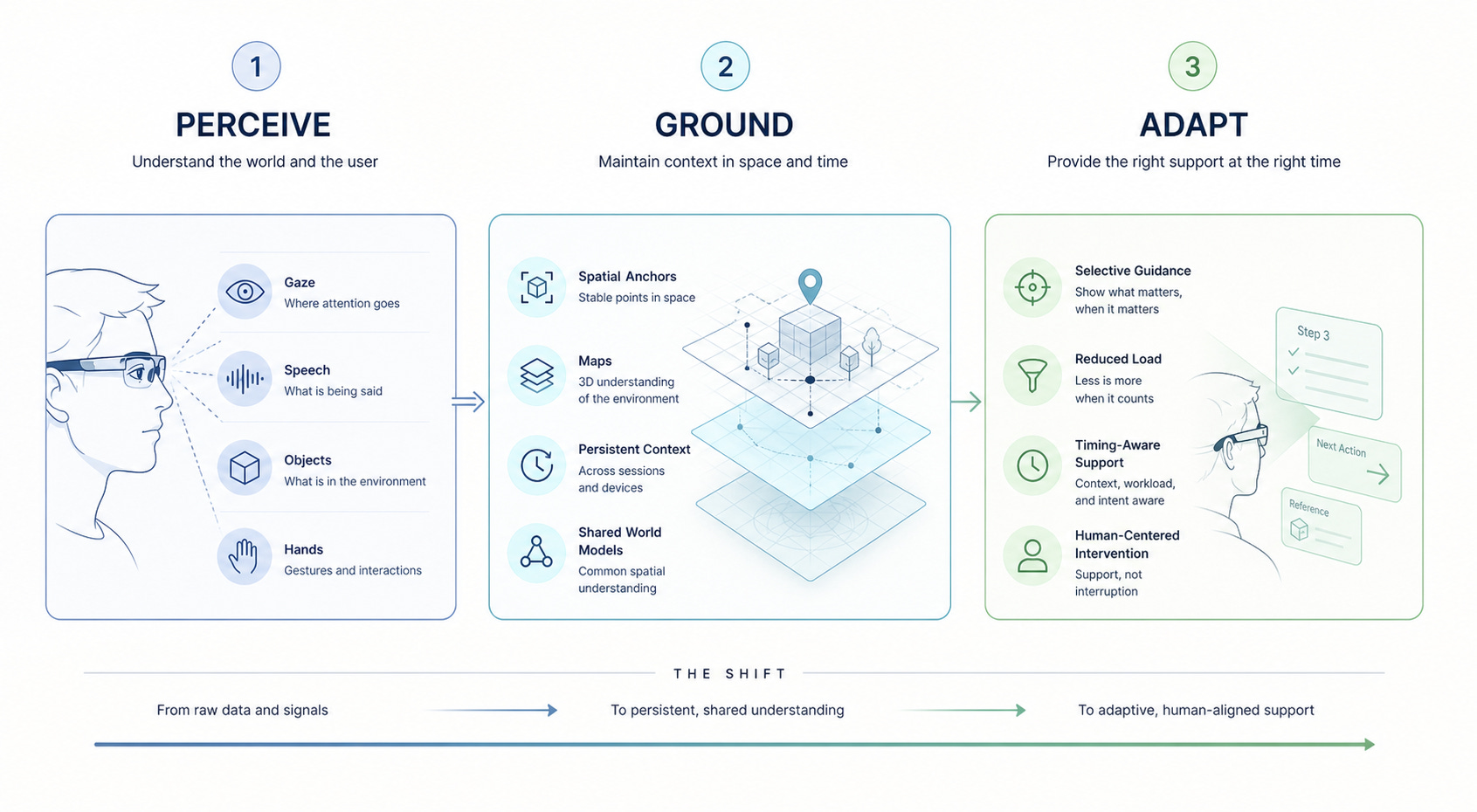
I think this space is moving through three stages.
First, systems learn to perceive.
They identify objects, gestures, gaze, speech, space, and user actions.
Second, systems learn to stay grounded.
They persist across sessions, maintain spatial context, and connect to shared maps or world models.
Third, systems learn to adapt support.
They decide not just what is happening, but what kind of intervention actually helps the user in that moment.
We are making real progress on the first two.
The third is still underdeveloped, and that is where I think some of the most meaningful work lies.
Not in making AI glasses more impressive. In making them more useful, more restrained, and more aligned with how people actually think and act in context.
That means the most valuable near-term work is probably not another perception model. It is the inference layer that sits between what a system knows and what it decides to do — deciding when a prompt helps, when silence helps more, and when the right move is to reduce what is already on screen. That is where I think the most tractable and most neglected research lies.
The future of spatial intelligence will not come only from systems that can perceive the world.
It will come from systems that understand when to assist, how to assist, and when not to.
That is where spatial computing starts to become genuinely human-centered.
No posts
Comments
Nothing yet. Say the first thing.
Sign in to join the conversation.