

Hey, welcome back to the VWV Bulletin! We hope you had a restful winter break and have had a great start to the new semester! This week, we’re covering the latest news and moves in VC and tech. Let’s get into it! 🕺
📌 For this semester, keep up with our content if you’re interested in:
Demystifying & breaking into VC
Finding opportunities in the start-up world
Keeping up with VC investment news at Brown & beyond (pro tip: this is essential to breaking in and finding opportunities)
Enjoy the Bulletin!
Waymo just raised $16 billion in one of the largest private funding rounds in tech so far this year, valuing the Alphabet-owned self-driving company at roughly $126 billion. Dragoneer Investment Group, DST Global, and Sequoia Capital, alongside Alphabet, led the round. This is a testament to investors’ belief that autonomous rides are finally crossing from experimental technology into a scalable commercial business.
Waymo already operates fully driverless rides in cities like San Francisco, Phoenix, Los Angeles, and Austin, and has more than tripled its rides to 15 million last year. With fresh capital, the company plans to expand road testing and commercial service into 20+ new cities, while also pushing internationally into markets such as London and Tokyo. In San Francisco, its cars have become a near-constant presence, recently expanding service to highways and beginning limited trips to SFO, an important signal that Waymo is moving into higher-complexity, higher-value routes.
Strategically, this raise widens the gap between Waymo and competitors like Zoox and Tesla’s early robotaxi ambitions. More importantly, it strengthens Alphabet’s broader AI story: autonomous vehicles are among the most demanding real-world applications of AI, and Waymo’s progress reinforces Alphabet’s advantage across compute, data, and deployment.
Alphabet is taking the most “we’re in this for the long haul” route possible to fund its AI buildout, lining up a rare 100-year bond as part of a multi-currency debt deal that spans U.S. dollars, British pounds, and Swiss francs. The centerpiece is a sterling-denominated century bond, an extreme maturity that’s unusual for corporates and almost unheard of for tech.
The scale matters too. Alphabet’s dollar bond portion is $20B (upsized from earlier expectations due to strong demand), and it’s also debuting in sterling and tapping the Swiss franc market to broaden its investor base. This comes as Big Tech shifts from historically asset-light models toward capital-intensive AI infrastructure, data centers, chips, and networking, where funding needs are so large that issuers are increasingly looking beyond the usual “just issue in dollars” playbook. 
For Alphabet, the strategy is to lock in long-duration funding and access different pools of capital, especially UK pension funds and insurers, the natural buyers of ultra-long sterling debt. For the market, it’s a sign of the moment that AI capex is big enough that even “century bonds” are back in the conversation, despite the obvious irony that the banker underwriting the deal won’t be around when it matures.

Jump Trading is a proprietary trading and market-making firm that trades the firm’s own capital rather than clients’ money. It is known for quantitative and high-speed strategies across assets like futures and crypto. Jump sits in the plumbing of markets, quoting prices, absorbing flow, and keeps trading “liquid.”
Now, Jump is reportedly extending its business into prediction markets, planning to take small equity stakes in Kalshi and Polymarket by providing liquidity/market-making capacity on the platforms. There are no disclosed numerical details yet on the exact amount of equity Jump Trading will receive in Kalshi or Polymarket, but the structure of the arrangements has been partially outlined. Reports indicate Jump will receive a fixed equity stake as part of a strategic agreement tied to its role as a liquidity provider.
The bigger signal is what this says about the category. Kalshi and Polymarket, both discussed at multi-billion-dollar valuations, depend on professional market makers to stand ready as the counterparty so users can trade instantly, especially when outcomes are uncertain and volatility spikes. If a firm like Jump is taking an ownership position in exchange for providing that liquidity, it’s a strong hint that prediction markets are becoming a serious, institutionalized corner of derivatives, where distribution, spreads, and depth matter as much as headlines.

Paramount is sweetening its hostile bid for Warner Bros.. Paramount is keeping the offer at $30 per share all-cash, but adding a $0.25-per-share “ticking fee” that kicks in for every quarter the deal hasn’t closed after December 31, 2026. In other words, if regulators or process delays drag the transaction into 2027, WBD shareholders start getting paid extra for the wait, roughly $650 million per quarter in aggregate, according to the reporting. 
The other big add: Paramount says it will cover the $2.8B breakup fee Warner would owe Netflix if Warner walks away from Netflix’s existing agreement. That’s meant to neutralize one of the scariest parts of abandoning a signed deal; shareholders don’t want to “win” a higher bid only to watch value get burned by termination penalties and financing friction. Paramount is also offering to address Warner’s financing costs and obligations tied to debt moves, including up to $1.5B in fees around refinancing/debt exchange issues. 
This is Paramount trying to turn its pitch into a certainty package: “same $30, but with time-value protection + fee protection + financing support.” While Netflix’s offer remains $27.75 per share, all-cash for select assets (studios + HBO Max), it continues to face heavy scrutiny. Whether it moves the needle depends on whether shareholders believe Paramount can actually close faster/cleaner than Netflix, and whether these sweeteners are enough to compensate for the risk of switching horses midstream.
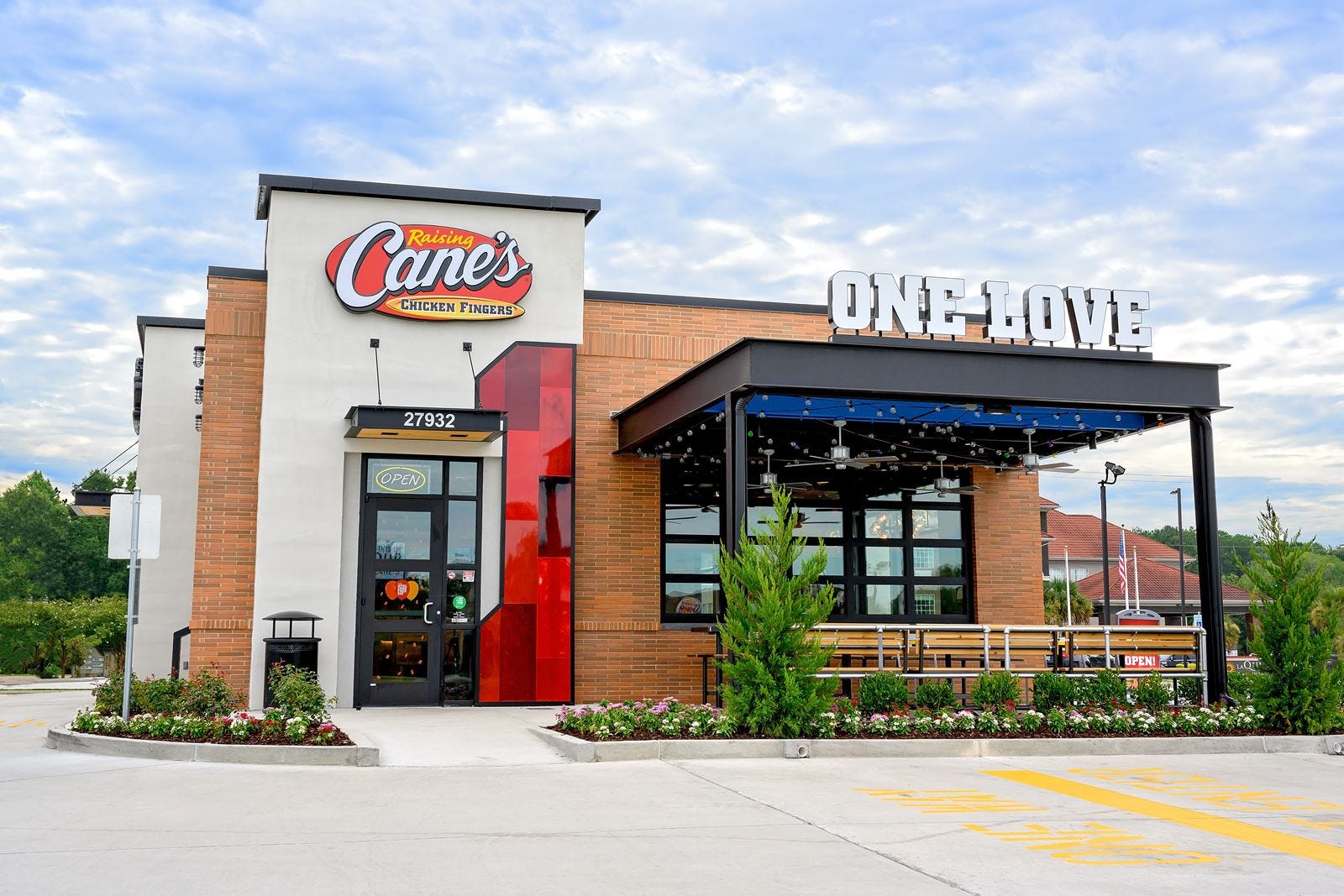
Raising Cane’s Chicken Fingers was founded in 1996 with a radically simple idea: do one thing better than anyone else. While most fast-food brands expanded menus to drive growth, founder Todd Graves built Raising Cane’s around extreme focus, chicken fingers, a few sides, and a signature sauce. That simplicity wasn’t a limitation, but rather became the company’s competitive advantage, enabling tighter operations, faster service, and consistent quality.
Growth came deliberately. Raising Cane’s didn’t chase early venture capital or rapid national expansion. Instead, it relied on strong unit economics, customer loyalty, and disciplined execution. Each new store was opened only when training, supply chain, and culture could scale without compromise. Customers weren’t just buying food. They were buying consistency, familiarity, and a brand that felt the same in every market.
In 2016, the company partnered with Roark Capital, marking a strategic acceleration. The capital and operational support helped Raising Cane’s expand faster while preserving its founder-led culture and focused model. This move wasn’t about menu innovation or trend chasing; it was about amplifying what already worked.
Raising Cane’s is a powerful lesson in restraint. By saying no to complexity and yes to discipline, the brand scaled into a multi-billion-dollar business. Its success shows that in food and beverage, clarity of vision and the patience to protect it can be just as valuable as speed. As of the latest, Raising Cane’s has over 900 locations across the U.S., with some estimates saying it may cost up to $3.5 million to franchise just one location.
We love our website, and want to make sure it is accurate and up-to-date. Please let us know through this form if you are a part of the VWV team (Investment Committee, Advisors, Alumni) and have changes you wish to make to your personal profile.
That’s it for this week, feel free to email me eason_zhang@brown.edu with any thoughts or inquiries! 💌
Follow us:
Instagram: @vanwickleventures
Twitter: @VanWickleV
No posts
Comments
Nothing yet. Say the first thing.
Sign in to join the conversation.