
This piece was originally published about a year ago. It’s the third of this summer’s reposts.
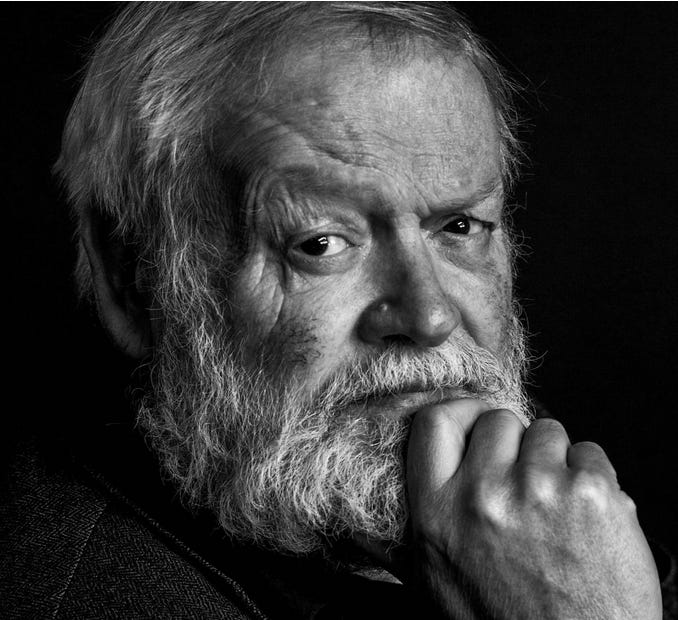
I was very struck the other day (that is, about a year ago now) by a poem by Michael Longley that Andrew Neilson posted on Twitter/X. The poem, which appeared in Longley’s 2000 collection The Weather in Japan, is called ‘Remembering the poets’, and it goes like this:
As a teenage poet I idolised the poets, doddery
Macer trying out his Ornithologia on me,
And the other one about herbal cures for snake bites,
Propertius, my soul mate, love’s polysyllabic
Pyrotechnical laureate reciting reams by heart,
Ponticus straining to write The Long Poem, Bassus
(Sorry for dropping names) iambic to a fault,
Horace hypnotising me with songs on the guitar,
Virgil, our homespun internationalist, sighted
At some government reception, and then Albius
Tibullus strolling in the woods a little while
With me before he died, his two slim volumes
An echo from the past, a melodious complaint
That reaches me here, the last of the singing line.
Michael Longley, who died earlier this year, was a Northern Irish poet of roughly the same generation as Seamus Heaney and Derek Mahon.1 It is quite well-known, I think, that Longley called Mahon the ‘master of the singing line’ — a kind of echo of Ben Jonson praising Marlowe’s ‘mighty line’.2 Here in this poem Longley describes himself as the ‘last’ of that line. The allusion to (Longley’s description of) Mahon seems fairly obvious, though in 2000, Mahon and Heaney were both still alive and active as poets.
Longley himself described this poem as a “learned leg-pull”, and this quite often seems to have been taken to refer specifically to the description of Virgil as ‘our homespun internationalist, sighted / At some government reception’. Though as far as I can find, Longley never confirmed it, this has widely been taken to refer to his long-term friend and fellow poet, Seamus Heaney who, like Virgil, achieved a rare level of fame, prestige and regime endorsement after he won the Nobel Prize for Poetry in 1995. Certainly, Longley himself said of this poem that ‘the personalities of my own brilliant contemporaries kept crowding in from the back of my mind. The poem expresses brotherly love for them and for the poets I converse with across the millennia.’
In his tweet, Andrew said that he thought the poem was ‘more than [a leg-pull] . . . deadly serious, even’. In an interesting exchange in comments on the original post, he went on to say how moving he found the implied parallel between Longley and his contemporaries on the one hand, and the poets of Augustan Rome on the other, and the implication that Longley saw himself as coming at the end of a particular tradition.
I found this fascinating because my experience of the tone of the poem, in particular, seemed quite different to Andrew’s. I found the poem initially enigmatic — almost to the point of being unsuccessful — and very hard to pin down tonally, though I agree with Andrew about the nostalgia and apparent sincerity of the final line. This seemed to me a good case study for thinking about the assumptions poets make about their readers’ knowledge, or lack of knowledge, and to what extent that judgement effects whether and how a poem “works”.
I would guess that Longley’s average reader would recognise the names Propertius, Horace and Virgil — and perhaps Tibullus — and recognise too at least the rough outline of their characterisation: Propertius writes fancy love poetry; Horace has a guitar because he was a lyric poet, though the naming of a guitar rather than a lyre immediately suggests we might be meant to think of contemporary equivalents; Virgil’s poetry (like Heaney’s) was approved by the establishment even within his lifetime. If you begin to suspect that there is an element of contemporary pen-portrait here, you might start to try to “solve” the code and work out which Irish, or specifically Northern Irish, poets all these Roman names are standing for.3
We might also be tempted to take the poem somewhat literally, as a version of Longley’s shaping encounters with classical texts, given that he read classics at university, began his poetic career with some translations of Propertius (whom Mahon also translated), and published in 1979 a version of Tibullus 1.10, titled ‘Peace’, which, like several of his other classical imitations, comments upon the violence in Northern Ireland.4 That poem was published in a collection called The Echo Gate, to which ‘An echo from the past’ in the penultimate line of the poem perhaps alludes.
There’s a hint of showing off too — the poet shows that he knows that Tibullus only wrote ‘two slim volumes’. If you buy an edition of Tibullus even today, it usually contains three books — but the well informed classicist knows that the last of them is not actually by Tibullus, but contains various poems including those of Sulpicia, the only female poet to have survived from Augustan Rome. So we might imagine that this poem is — as he himself implied — about both his relationship with certain contemporary poets and about his affection for (and knowledge of) the poets of Augustan Rome.
But there’s an immediate problem with both of these interpretations, because the names Macer, Ponticus and Bassus are of a quite different type from Propertius, Horace, Virgil and Tibullus. A lot of readers, I imagine, might assume that these names refer to less well-known Augustan Roman poets that they just happen not to have read, but this is not quite true. Bassus and Ponticus are both addressed in Propertius’s first book of elegies, in which Ponticus is clearly an epic poet (hence ‘The Long Poem’), apparently working on a Theban epic, and a convenient foil for Propertius’ own Callimachean poetics of the polished small-scale and apparently trivial. But not a single line of this Ponticus has survived, and nor is he ever mentioned by any ancient grammarian, scholiast or literary historian. Meanwhile in Propertius 1.4, the only poem in which he appears, Bassus is not obviously a poet at all, but just a friend, who keeps encouraging Propertius to see other girls rather than obsessing endlessly about Cynthia — another kind of foil for his elegiac project. (The reader of Propertius might have some sympathy with Bassus’s point.) But either way, nothing of either of these poets — if they were indeed poets — has survived.
Macer, with whom Longley’s poem starts, refers more definitely to a largely lost Roman poet (though in this case there are a few extant fragments), this time of didactic poetry, who probably — like Virgil — died a decade or two before the birth of Christ; but Propertius does not mention him, and only an ultra-specialist would be likely to have heard of him. So what is the poem up to? Why do we have this odd jumble of well-known Roman poets, barely-known and lost Roman poets and possibly-not-even-a-poet Roman poets? And also, we might wonder, why no mention of Ovid, surely the best known of the elegists and a poet to whom Longley very often referred?
The answer is that this whole poem is in fact a translation or fairly close ‘version’ of Ovid, supposedly recalling his own poetic youth in a passage from Tristia 4.10; in the passage and translation below I’ve put the poets’ names in bold so you can see where they come in:
temporis illius colui fovique poëtas,
quotque aderant vates, rebar adesse deos.
saepe suas volucres legit mihi grandior aevo,
quaeque nocet serpens, quae iuvat herba, Macer.
saepe suos solitus recitare Propertius ignes,
iure sodalicii, quo mihi iunctus erat.
Ponticus heroo, Bassus quoque clarus iambis
dulcia convictus membra fuere mei.
et tenuit nostras numerosus Horatius aures;
dum ferit Ausonia carmina culta lyra.
Vergilium vidi tantum: nec avara Tibullo
tempus amicitiae fata dedere meae.
successor fuit hic tibi, Galle, Propertius illi;
quartus ab his serie temporis ipse fui.5I cherished and cultivated the poets of that era,
I thought all the bards alive then were gods on earth.
Often that older man, Macer, read me his birds,
and which snakes are poisonous, and which herbs are healing.
Often Propertius would recite his passions,
by right of that friendship by which we were united.
Ponticus, famous for epic, Bassus for iambics,
were members of that mutual circle dear to me.
And Horace with his many metres captured our ears,
as he sang his polished songs to the Italian lyre.
Virgil I only saw: and greedy fate granted
Tibullus no time for my friendship.
He came after you, Gallus: Propertius after him:
I was the fourth, after them, in temporal sequence.
The Tristia were written towards the end of his life when Ovid was in exile on the Black Sea, and there’s perhaps just a hint of that at the end of Longley’s version, when he says that Tibullus’s poetry ‘reaches me here’ — i.e., even here, so far removed in time (for Longley) and in space (for Ovid).
As a translation, there’s a lot to appreciate in Longley’s poem. Ovid said he only ‘glimpsed’ Virgil — implying he didn’t really know him — which has become ‘our homespun internationalist, sighted / At some government reception’. Ovid said Tibullus died too young for them to get to know each other — though in a typically Ovidian way what he actually says is that Tibullus lost the opportunity to know him, Ovid.6 Longley’s version also alludes to Tibullus’ death but makes it clear that they did have a chance for friendship: ‘strolling in the woods a little while / With me before he died’; probably as we’ve seen an allusion to how Longley had translated Tibullus. Longley makes Bassus an iambic poet because that’s how Ovid describes him (clarus iambis, ‘famous for iambics’), and he glosses Ovid’s allusion to Macer’s work by adding in the title of his poem on birds, the Ornithologia.
The only person Ovid addresses directly in the original passage is Gallus, the famous lost love elegist of Augustan Rome, to whom almost all the contemporary poets paid tribute. Gallus, however, is the only name Longley leaves out: there is no direct address in his poem. He ends by calling himself ‘the last’ in the poetic line, rather than, as Ovid does, specifically the fourth in a sequence of elegists (Gallus, Tibullus, Propertius and Ovid).
So in this poem Longley speaks as Ovid, late in his life, recalling the poetic friendships of his youth. In fact, this passage of Ovid is the only source of corroborative evidence for the existence of the poets Bassus and Ponticus, who are mentioned nowhere else. The Loeb edition of Propertius, for instance, adds a note to elegy 1.4 (addressed to Bassus): ‘Although Bassus is named only in this poem, he was a real person, who with Ponticus and Ovid formed part of Propertius’ literary circle.’ The Loeb doesn’t say so, but this is based purely on the fact that Ovid mentions him as well.
The experienced reader of Ovid, though — which Longley certainly was — does not take much at face-value. Ovid is never knowingly unironic, and he’s writing here in a tradition of passages in which one poet name-drops a whole series of other distinguished poets and readers, supposedly in tribute, but also for self-aggrandisement.7 Notice how the passage ends with Ovid describing himself as ‘fourth — in temporal sequence’ (i.e., not fourth in importance or achievement). Longley indicates that he’s conscious of the tone of the passage, I think, when he ironically puts in that ‘(Sorry for dropping names)’ after mentioning Bassus, one of the most obscure of them all.
Moreover there are some temporal problems which suggest that Ovid is not speaking literally. Ovid is very unlikely in fact to have been a member of any circle of intimates around Propertius around the time he wrote the first book of Elegies, as he would only have been in early adolescence, probably 13 or 14, or potentially even younger, when that book appeared.8 We are probably meant to understand not that he was actually there, but that he felt as if he were there because he learnt about love poetry by reading Propertius.
Indeed, a fairly recent article argued — quite convincingly, I think, though I won’t rehearse all the arguments here9 — that Propertius’ (and therefore also Ovid’s) Bassus and Ponticus are made-up names, a continuation of a kind of game initiated by Horace in the first book of satires published not long before (where he dubs a contemporary bad poet, probably actually called Furius, Alpinus). According to this interpretation, Ovid knows perfectly well that Bassus and Ponticus did not really exist, and that’s part of the joke — he is recalling or imagining a naive first reading that took them at face value.
What does all this mean for Longley’s poem? How much of any of this do we need to know to appreciate the poem? I think we have to feel that he is teasing his readers (as he said himself, “a learned leg-pull”). He doesn’t tell us it’s a translation, and makes no effort to explain those obscure names. You can’t, I think, reasonably expect even a very educated and well-read late 20th century reader to identify the passage themselves, though you could, perhaps, expect them to note the odd discrepancy between the poets they have heard of and those they haven’t. It might, slightly slyly, be relying on the reader’s mild discomfort, as we ‘nod along’, assuming that we ought to know who Macer, Ponticus and Bassus actually are and not quite wanting to reveal that we don’t — sending up the earnest reader who doesn’t want to be caught out in ignorance.
Meanwhile, the implication, apparently encouraged by Longley himself, that these figures might map onto real contemporaries only extends the tease. What sort of contemporary poet could possibly stand in for Macer, whose work is almost entirely lost, or for Bassus and Ponticus, of whom nothing at all survives, and who may not have existed at all? (Not to mention the much-cancelled Gallus, deleted from this passages as he has been from literary history.10) Longley’s ploy tempts the reader to behave as a kind of dogged scholiast, foolishly attempting to crack the “code” of his poetic whimsy. Overall, I think the poem is both much more and much less precise thatn we might think — much more, because it’s a relatively close translation of one particular passage; much less, because it’s more, as they say, ‘a mood’ than a code. A reminder that when a poet thinks about the other poets who have mattered to him he might be tender and sincere, but also self-important, selective, mischievous and even intentionally obscure.
Thanks for reading Horace & friends! This post is public so feel free to share it.
Longley’s widow, Edna, a poetry critic, recently published a touching and fascinating essay about his poetry, how she felt about it and also (in large part, despite the title of the piece) about how he felt about and understood his own work. The essay is in The Dark Horse — it’s not online, but it’s a bumper issue which is well worth its cover price. For full disclosure: I also have an essay and a poem in that issue. The essay, on a biography and collected poems of Anthony Hecht, is also available for paid subscribers to this substack here.
Jonson’s tribute to Marlowe is found in fact in his poem on Shakespeare, ‘To the Memory of My Beloved the Author, Mr William Shakespeare’. The point, in context, is that Shakespeare outdid all of his contemporaries as a playwright. It is striking that Jonson in this tribute describes Shakespeare only in relation to other playwrights, ancient and modern, not poets more generally.
There is a good discussion of Longley’s translations of Propertius and Tibullus in Donncha O’Rourke, ‘Elegies for Ireland: W. B. Yeats, Michael Longley, and the Roman Elegists’ in Classics and Irish Politics, 1916-2016, edited by Isabelle Torrance and Donncha O’Rourke (OPU, 2020), 291-307.
Tibullus died in 19 BC. Ovid was born in 43 BC.
There are similar passages in Propertius 2.34, Ovid Amores 1.15 and Horace, Satires 1.10.
Ovid was born in 43. The traditional dating of Propertius’s first book is 30/29 BC though some scholars have argued for an earlier date, around 33/32 BC. On this point see Peter Heslin, ‘Virgil’s Georgics and the dating of Propertius’ first book’, Journal of Roman Studies 100 (2010), 54-68.
Peter Heslin, ‘Metapoetic Pseudonyms in Horace, Propertius and Ovid’, Journal of Roman Studies 101 (2011), 51-72.
Until 1978, we had only a single line of Gallus. In 1978, a papyrus containing a further 9 lines was discovered in Egypt.
Comments
Nothing yet. Say the first thing.
Sign in to join the conversation.