
I want to tell you about a company most investors have never studied.
It’s not in the headlines. It doesn’t host flashy investor days. Its founder doesn’t post on X. For four decades its CEO gave almost no media interviews because, as David Thomas writes in The Fairfax Way, Prem Watsa simply always wanted to build a business, not talk to the media.
After 40 years, the numbers speak for themselves.
Since 1985, Fairfax’s book value per share has compounded at 18.7% per year, including dividends.
Nearly 19% a year. For four decades.
And yet most investors couldn’t pick Prem Watsa out of a lineup.
This is going to be a long one. Grab a coffee. I want to give you the full picture: the good, the ugly, and the parts where I part ways with management.
Part 1: For everyone who’s new here
Let me start from scratch. No jargon. If you already know Fairfax, skip ahead to the valuation section.
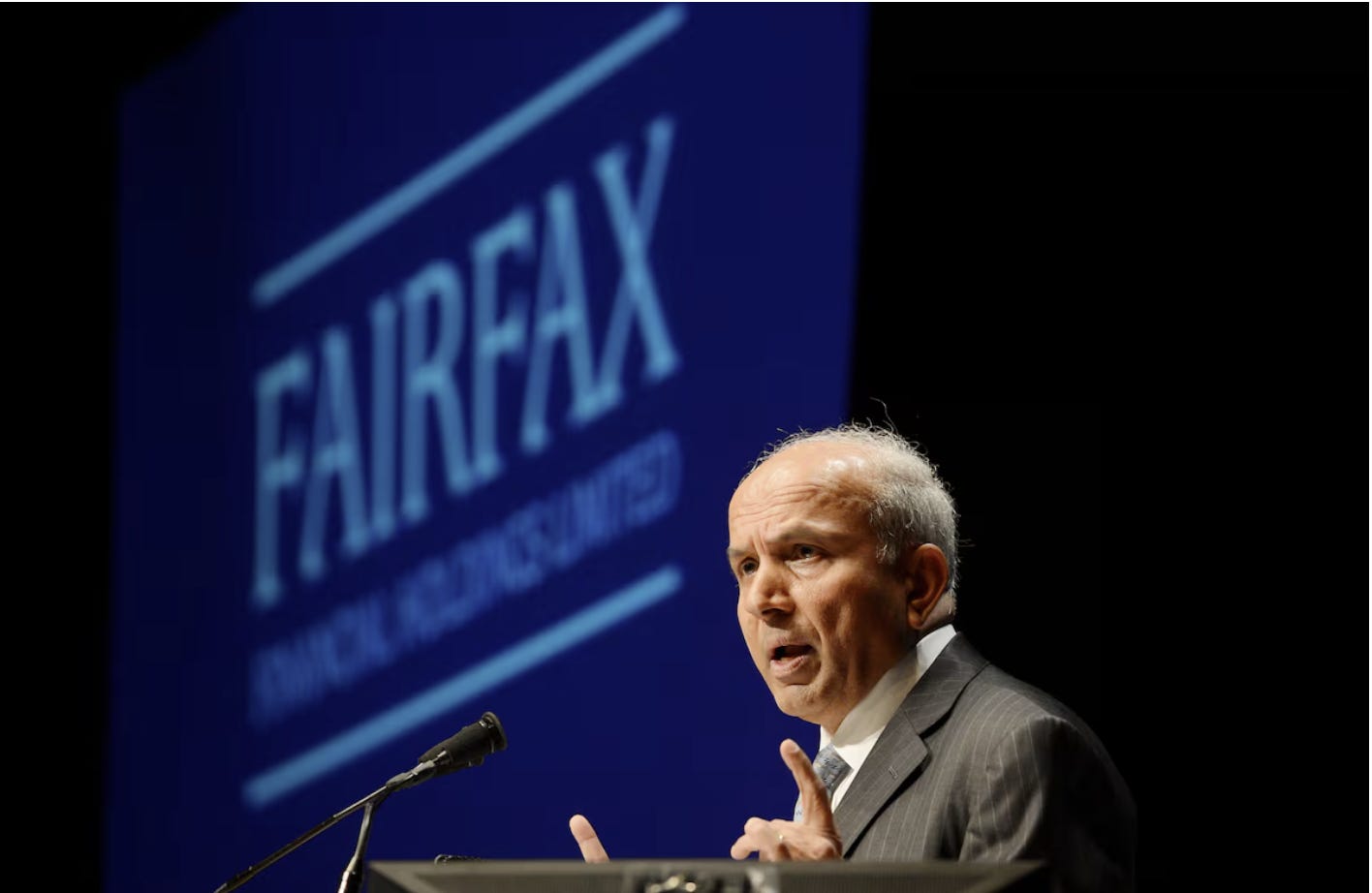
Who is Prem Watsa?
He was born in Hyderabad, India. He came to Canada with almost nothing.
To pay for his MBA at the University of Western Ontario, he sold appliances door to door.
He found Warren Buffett’s letters. He became a value investing convert. And in 1985 he founded Fairfax with one goal, to build the Canadian Berkshire Hathaway.
He’s 75 now. Still running it. Still writing the annual letters himself.
The team built to outlast its founder
Here’s something I respect about Fairfax. It isn’t a one-man show, even if Prem is the heart of it.
Like Berkshire, Fairfax is built to endure for decades, not quarters. The structure is deliberate: capital allocation is centralised under Prem and a small group at the top, while the operating businesses run themselves in a decentralised way.
Andy Barnard has overseen the insurance operations since 2011 and quietly transformed underwriting quality across the group. Wade Burton and the investment team manage the portfolio with the same patient, value-driven temperament Prem instilled. A successor is already in place. This is a company designed to keep compounding long after its founder is gone.
But it always comes back to Prem. And what I admire most is not his record. it’s his honesty.
Read his annual letters and you’ll find something rare in this industry: a CEO who openly catalogues his own mistakes. He has called the equity hedges a mistake, in writing, more than once. He owns the bad equity picks.
He doesn’t spin a lost decade into a “challenging environment.” He names it. Buffett built a cult following partly on this kind of candour, and Prem writes in the same spirit, self-critical, plain-spoken, allergic to promotion.
That matters more than it sounds. A management team that hides its errors repeats them. A team that confronts them learns. The whole reason I trust the post-2018 turnaround is that the people running Fairfax were willing to stand up and say, out loud, what went wrong before. You don’t fix what you won’t admit.
That’s the temperament I want stewarding my capital for the next twenty years.
What does the company actually do?
Think of Fairfax like a bank but better.
A bank takes your deposits, pays you a little interest, lends the money out higher, and keeps the spread.
Fairfax does the same thing with insurance.
When you buy a policy, you pay your premium upfront. The insurer holds that money until you file a claim. That pool of held cash is called the float.
And it’s big. Fairfax’s insurance float has grown to around $39 billion.
That’s $39 billion of other people’s money. And Fairfax gets to invest it for free as long as it runs the insurance side without losing money.
Here’s the magic. If Fairfax writes insurance profitably, the float costs them nothing. They’re essentially being paid to hold someone else’s capital. Then they invest it and keep the returns.
That’s the Berkshire model. Prem understood it before almost anyone in Canada.
How do they make money? Viking’s five buckets
Before I go further, I owe a debt.
There’s a forum called the Corner of Berkshire & Fairfax. It’s been running since 2002. It’s where the most serious Fairfax investors gather and dissect every detail.
One member stands above everyone. He posts as Viking. If you want to understand Fairfax, you read Viking first. He tracks the company more closely than most paid analysts. He’s even compiled his work into a book-length study of the company.
Much of how I think about Fairfax comes from him. I’m not going to pretend otherwise.
Viking breaks Fairfax’s earnings into five income streams. Picture five buckets.
The five streams are underwriting profit, interest and dividend income, share of profit of associates, investment gains, and non-insurance consolidated companies.
The first two are the boring, reliable engine. Underwriting profit is what’s left after paying claims. Interest and dividends is what the bond portfolio throws off every year.
The next ones are where Prem’s stock-picking shows up both the steady kind and the lumpy, unpredictable kind.
Most analysts only model the lumpy bucket and get confused. Viking’s insight is that the boring buckets alone now produce enormous, durable earnings. The rest is gravy.
The discipline that makes it work
Most insurers get greedy in good times. They cut prices to win business, write bad policies, and blow up when disasters hit.
Fairfax does the opposite.
When the market softens, the Fairfax culture says: write less business. Even at the expense of short-term results. Even if it persists for years.
The key number is the combined ratio. Below 100 means underwriting is profitable on its own. Above 100 means losing money.
In 2025, Fairfax made a record underwriting profit of $1.8 billion despite $1.2 billion in catastrophe losses, mainly from the California wildfires.
Over a billion in catastrophe losses. And still a record profit. That’s not luck. That’s 40 years of saying no to bad business.
Part 2: The ugly history nobody talks about
Now here’s the part most bullish write-ups skip. I won’t.
Fairfax was not always a great company. For a long stretch it was, in Viking’s own words, the ugly duckling of the insurance industry.
The lost decade
2010 to 2020 was largely a lost decade for Fairfax shareholders. Bad decisions. Poor communication. Terrible business results. Long-term shareholders capitulated in May 2020, and the stock dropped to US$230.
Read that again. The “Canadian Berkshire” went nowhere for ten years. Shareholders gave up. The stock cratered.
The hedging disaster
This is the one that still makes me wince.
After the 2008 financial crisis, Prem became convinced another deflationary collapse was coming. So he hedged. He shorted the market. He bought deflation protection.
He was early on the financial crisis itself, Fairfax made real money shorting in 2008, a fact most people don’t know. But he refused to take the hedges off afterward. And the market did the opposite of what he expected. It ripped higher for years.
The equity hedge and short position cost Fairfax shareholders a total of $5.4 billion from 2010 to 2020, an average of $494 million per year for eleven straight years. In one final slap, the “hedge” lost $529 million in 2020.
How does a hedge lose half a billion dollars in a bear market? It shouldn’t. That’s how badly the positioning was broken.
The bad equity picks
It wasn’t just the hedges.
Fairfax’s equity picks from 2014 to 2017 were mostly terrible. Roughly ten purchases from that period ultimately produced losses totalling about $1.5 billion.
BlackBerry is the famous one, a concentrated bet on a fading company. But there was a whole string of them.
This is the history. A brilliant founder who lost the plot for a decade. Bad bets. Worse communication. A reputation in tatters.
Why I tell you this
Because something changed around 2018.
Decision-making improved. Communication improved. Results improved. Fairfax vowed it would no longer short individual stocks or market indices.
The turnaround is real. The numbers prove it. But I want you to buy this company with your eyes open. Viking himself keeps the trust question at the very top of his risk list and so do I.
As Viking puts it, Fairfax shredded its reputation over a decade, and trust can only be rebuilt with time. We need more.
Part 3: The transformation
Here’s what changed, and why I think the market still hasn’t fully caught up.
In the last four years, gross premiums are up 40%, underwriting profit is up 127%, interest and dividend income is up 302%, and book value per share is up 100%.
That’s not improvement. That’s a different company.
The hard insurance market that began around 2019 let Fairfax raise prices sharply. They seized it and did it organically, without buying another insurer.
Of the $20 billion in premium growth since 2017, $17 billion was organic. That growth was obtained for free.
Meanwhile, they locked in good bond yields before rates fell. Viking pegs the fixed income portfolio at over $40 billion, earning roughly 5%, short duration and mostly government bonds.
Forty-plus billion at 5% is more than $2 billion a year in bond income alone, before anything else happens.
The equity wins
Prem hunts where others won’t.
His best investment in 40 years has been Eurobank, a Greek bank everyone wrote off after the debt crisis.
Prem called Eurobank “by far the best investment we have had in our 40 years.”
It contributed $474 million to earnings in 2025. Poseidon, a shipping company, added another $287 million.
Comments
Nothing yet. Say the first thing.
Sign in to join the conversation.