

A week or so ago, I was asked about the product, Oestra for menopause hormone therapy. I wasn’t familiar with it, so I got around to Googling and, well, wow. Yikes on a bike!
So here’s my product review.
I do not recommend this product.
Read on for the full meal deal.
Oestra is a compounded vaginal estradiol and progesterone meant for systemic absorption or delivery into the blood and is sold by Inner Balance. The Inner Balance website says that it was started by Dr. Sarah Daccarett, MD. The website refers to Dr. Daccarett as a board-certified physician, but did not specify which board she is certified by. Previous readers of mine will know that is a red flag for perhaps not having board certification in the relevant clinical area (check out this post on board certification), so I looked her up on the American Board of Medical Specialties, and the only Sarah Daccarett is a board-certified pathologist.
She apparently was motivated to create Oestra because she felt sad, anxious, and exhausted when she was postpartum.
After spending some time on the Inner Balance website, I have many questions and concerns. Frankly, the product does not deserve this much of my time or yours, but there are some lessons to be learned, so I felt it was worth proceeding.
After all, isn’t that the real joy of debunking, the lessons we learn along the way?
The Product is a Compounded Medication
Compounded hormone medications are not recommended as first-line therapy for menopause. According to the 2020 National Academies of Sciences, Engineering and Medicine review on compounded hormones, people are driven to use them because of “unsubstantiated marketing claims of superior safety and effectiveness, boutique patient experience, financial costs, and the appeal of “natural” hormones and/or dosage forms.” The National Academies and various medical professional societies suggest there may be a small population of patients with a therapeutic need for compounded hormones, such as those with an allergy or intolerance to an ingredient. So right off the bat, I can tell you I don’t recommend Oestra because it is compounded.
Product stability with compounded hormones is notoriously unreliable, especially with progesterone, and absorption is also unknown. It takes significant research to understand how hormones might be absorbed, and individual recipes require extensive testing because absorption depends on the delivery vehicle and even on the order in which ingredients are added when making the prescription. As this product contains two hormones, it requires pharmacokinetic studies because we don’t know whether one might affect the stability or absorption of the other.
A compounded estradiol and progesterone vaginal cream meant for systemic absorption with no relevant studies for safety or effectiveness is not recommended by major medical professional societies or by me. There are a multitude of safe, government-approved products.
Sleight of Hand with Studies
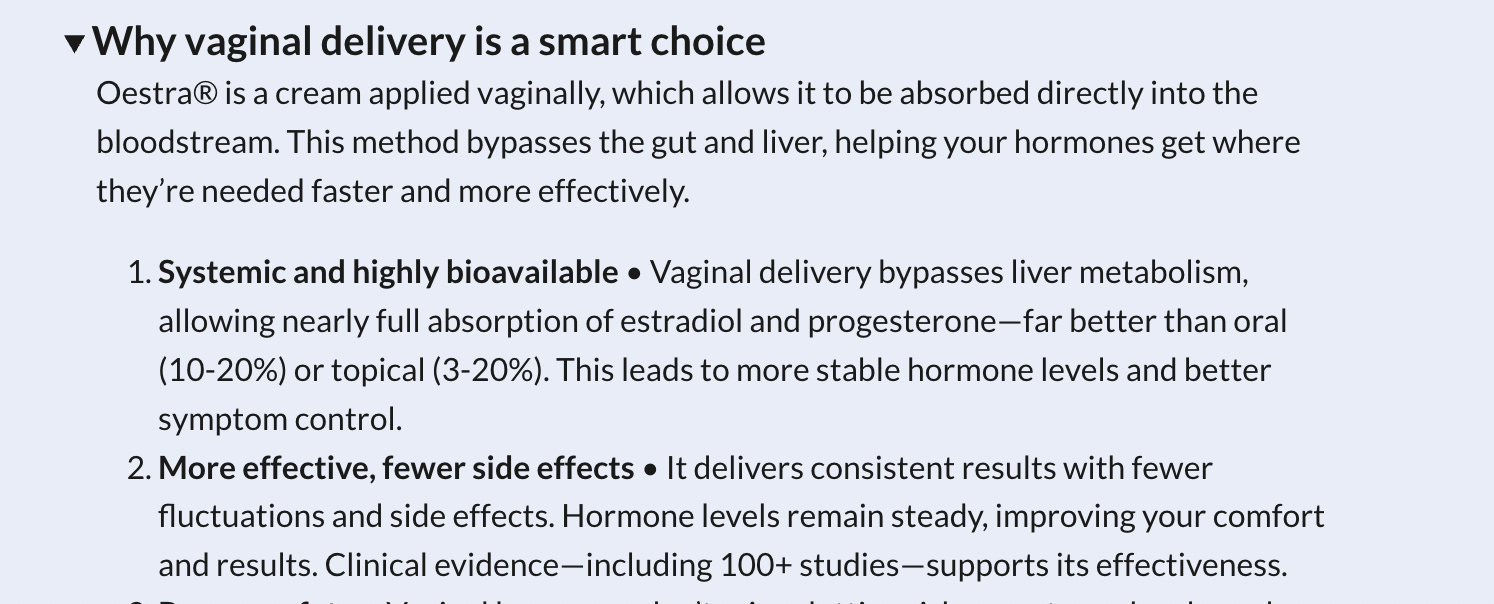
On one page, there is a claim that 100+ studies support the effectiveness of vaginal delivery, which could easily be interpreted as suggesting that over 100 studies support Oestra. I can find no clinical trials or any retrospective studies about this product. I spent some time on the website and found no links or mentions of peer-reviewed studies of the product.
Yes, there are well over 100 studies with vaginal estrogen in the literature, and not one of them is relevant here. To be of use, they would have to be about compounded vaginal estradiol and progesterone using this recipe for the intended purpose, such as hot flashes or endometriosis.
Speaking About Dosing and Levels…
The main Oestra product page currently states that one pump contains 3 mg of estradiol and 100 mg of micronized progesterone.
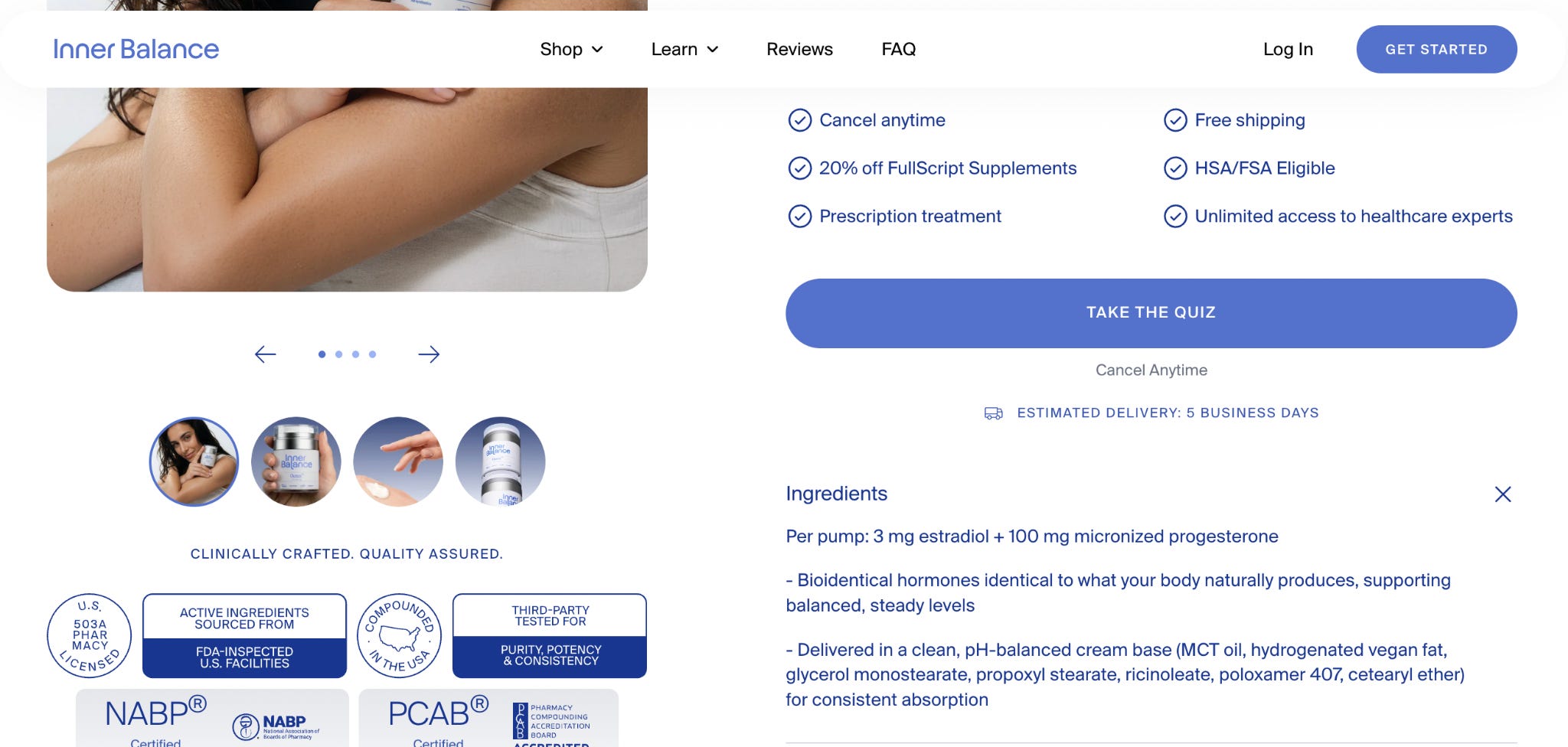
But after doing some digging, there is also an Oestra Menopause, containing 0.5 mg of estradiol and 50 mg of progesterone, but also an an Oestra Start, containing approximately 2 mg of estradiol and 80 mg of progesterone (approximately is not reassuring with a medication dose). Not sure how to reconcile the “about 2 mg” per dose with Oestra Start with the 3 mg per pump in the screenshot above. Are there two or three different products?
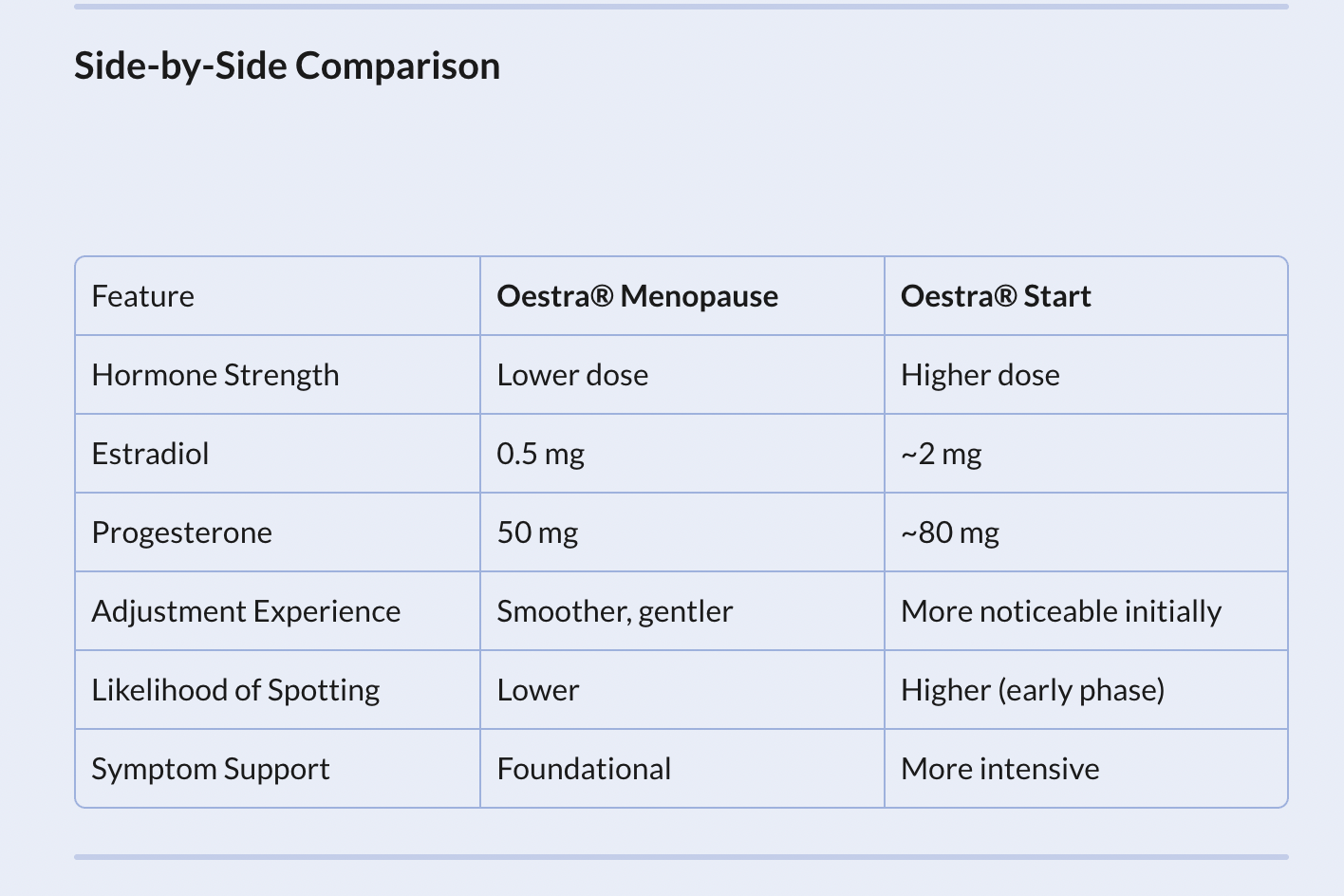
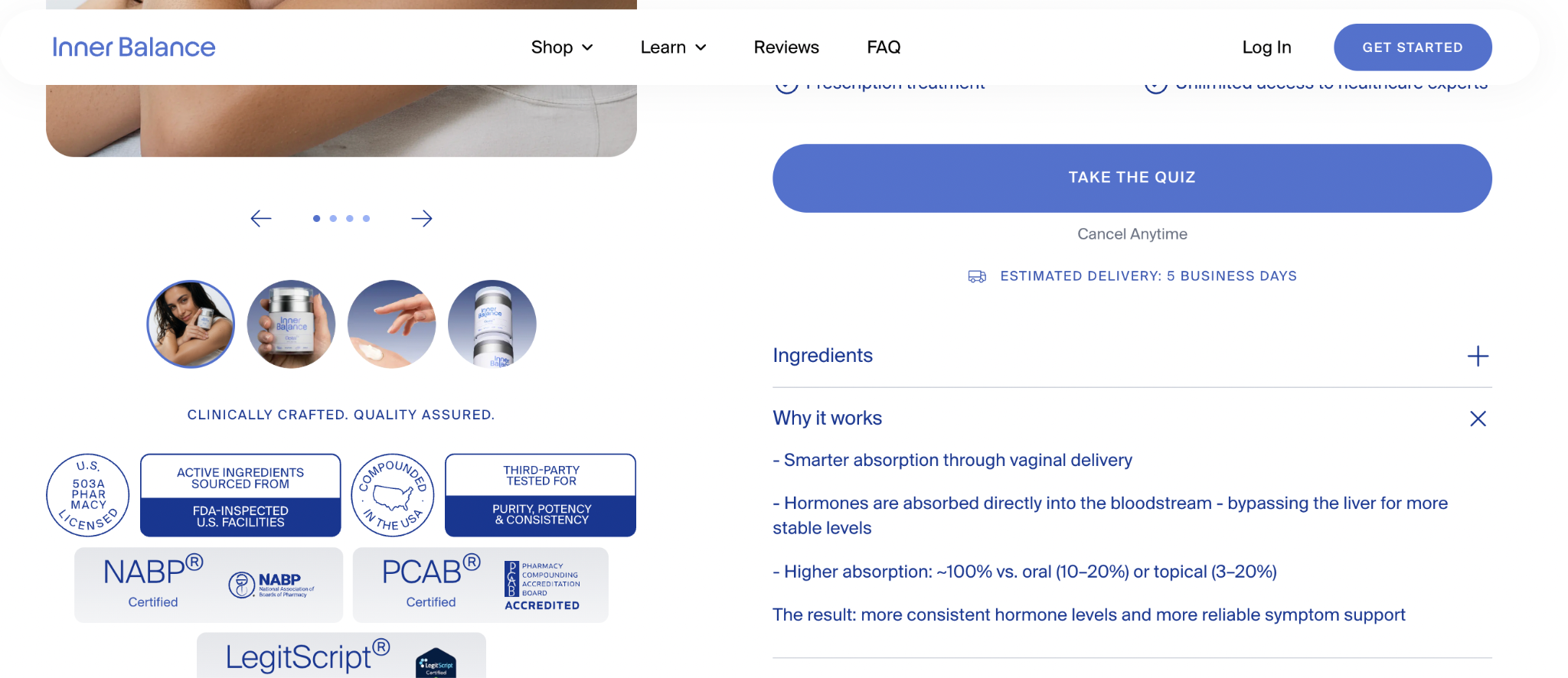
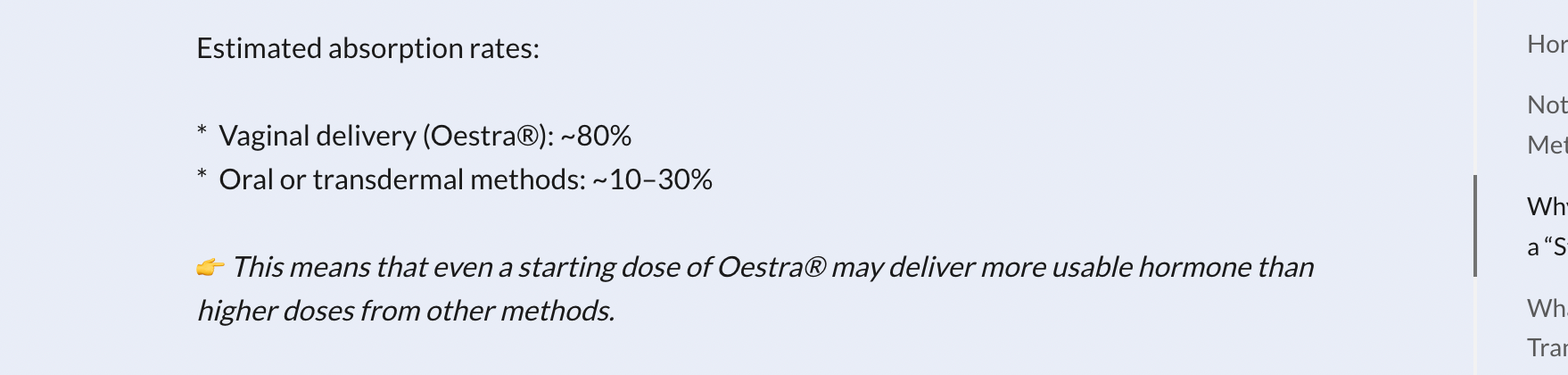
Inner Balance’s own website is inconsistent about how much of the drug is absorbed. While the product page describes vaginal absorption as “~100%” (see the first screenshot below), another page describes it as about 80% (see the second screenshot below). Which is it? There are no published product-specific pharmacokinetic studies to determine which is correct, and this internal inconsistency is not a good look.
What are numbers anyway? Just curvy and straight lines on a page. Right? (all screenshots August 12, 2026).
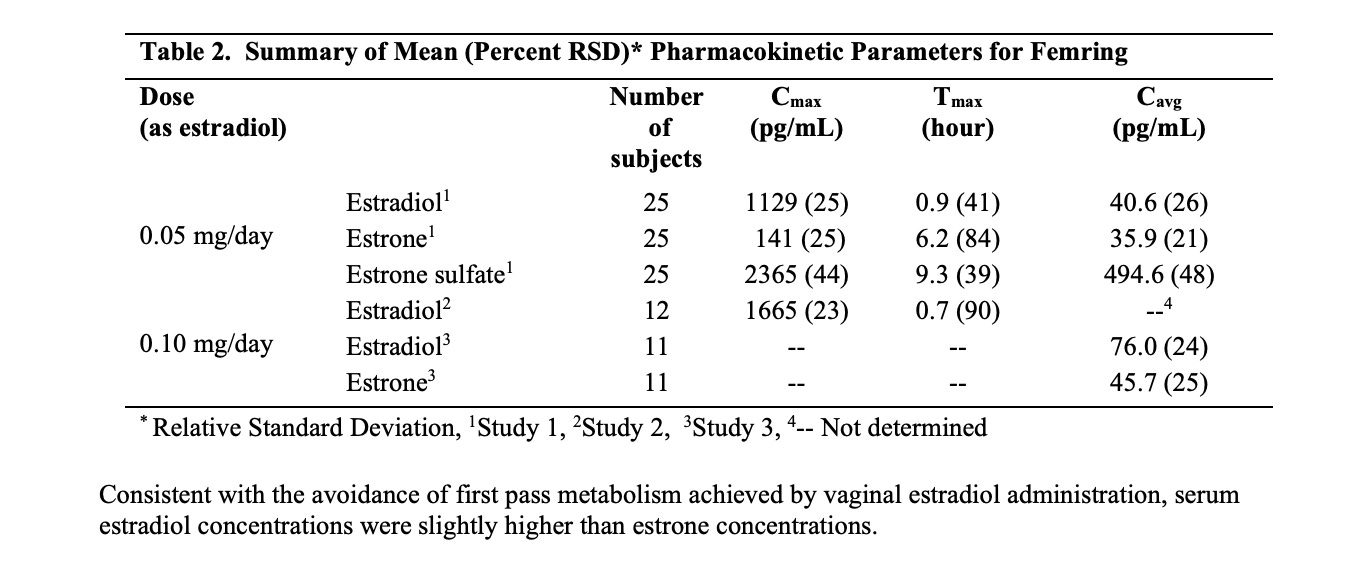
I can look up absorption data for all FDA-approved products. For example, Femring, a vaginal estradiol ring that releases 100 mcg a day; the average blood levels are about 76 pg/ml. I can easily check that in the Femring product monograph! No monograph for Oestra.
If “100% absorption” means what a reasonable reader would think it means, then approximately 500 mcg of estradiol from each pump of the menopause product would be absorbed and enter the bloodstream. If it means something else, the company needs to explain what that is, because if even 80% of a 500-mcg vaginal dose of estradiol were reaching the bloodstream, that would represent a very large amount of estradiol.
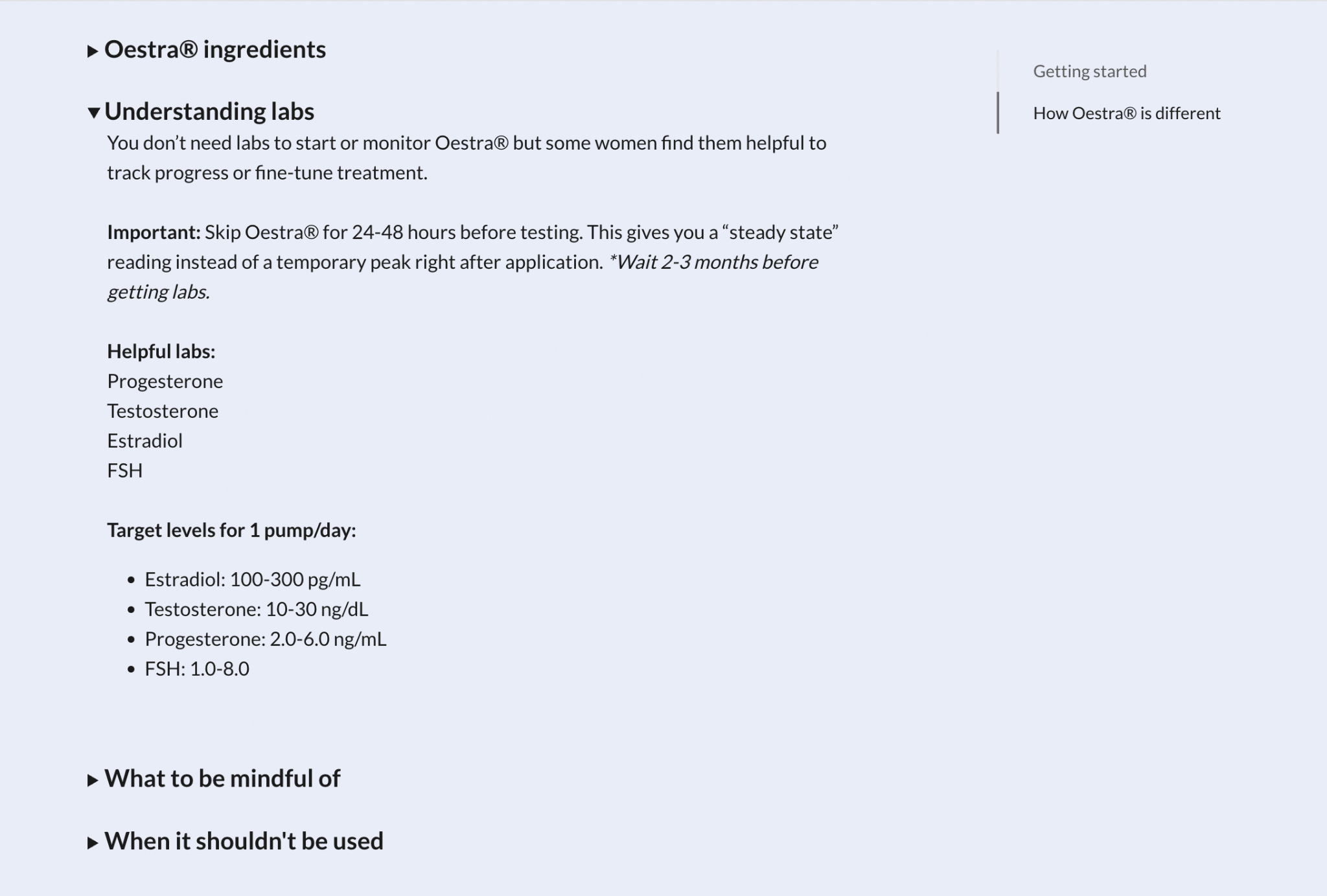
Inner Balance claims that one pump of Oestra produces estradiol levels of 100–300 pg/mL, although it’s unclear which product. I can find no published pharmacokinetic study demonstrating this. Without product-specific pharmacokinetic data, this claim is scientifically uninterpretable.
I also found an anecdotal report on Reddit from a woman who reported an estradiol level of 1,080 pg/mL while using Oestra. I cannot verify the dose she was using, laboratory result, timing of the blood draw, or even the units, so this is not evidence that Oestra produces estradiol levels that high. But neither can I verify the claim from Inner Balance that one pump of Oestra results in estradiol levels of 100-300 pg/ml. So yeah. (screenshot from Reddit, August 12, 2026).
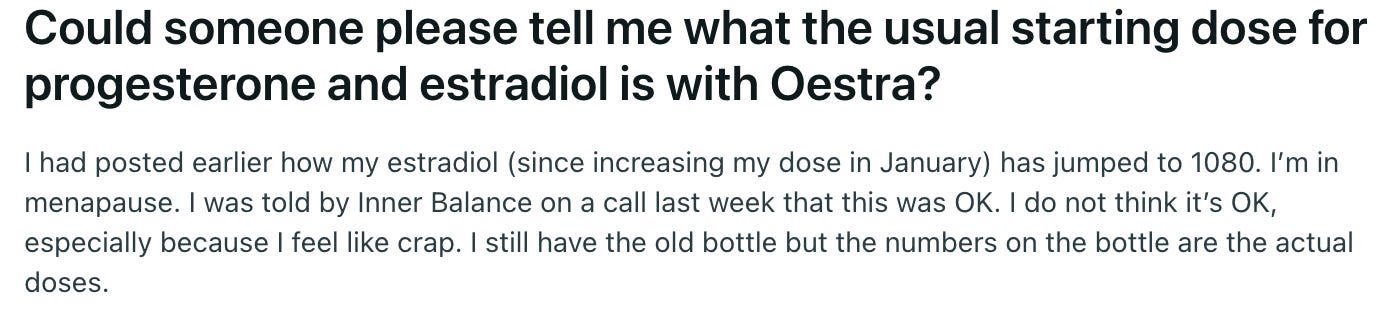
For perspective, the average daily estradiol level for someone who is menstruating, if you average it out over the entire cycle, is about 100 pg/ml. Most of the studies for menopause hormone therapy have evaluated products that result in estradiol levels of 100 pg/ml or lower. What is the risk of endometrial cancer with higher levels? Breast tenderness? Breast cancer? Blood clots? I mean, who knows. No published safety data on MHT can apply here.
The Claim that Estrogen and Progesterone Will Raise Testosterone. Unsupported.
Oestra contains no testosterone, yet the company claims that its progesterone will “support” testosterone and improve production as progesterone is a steroid precursor.
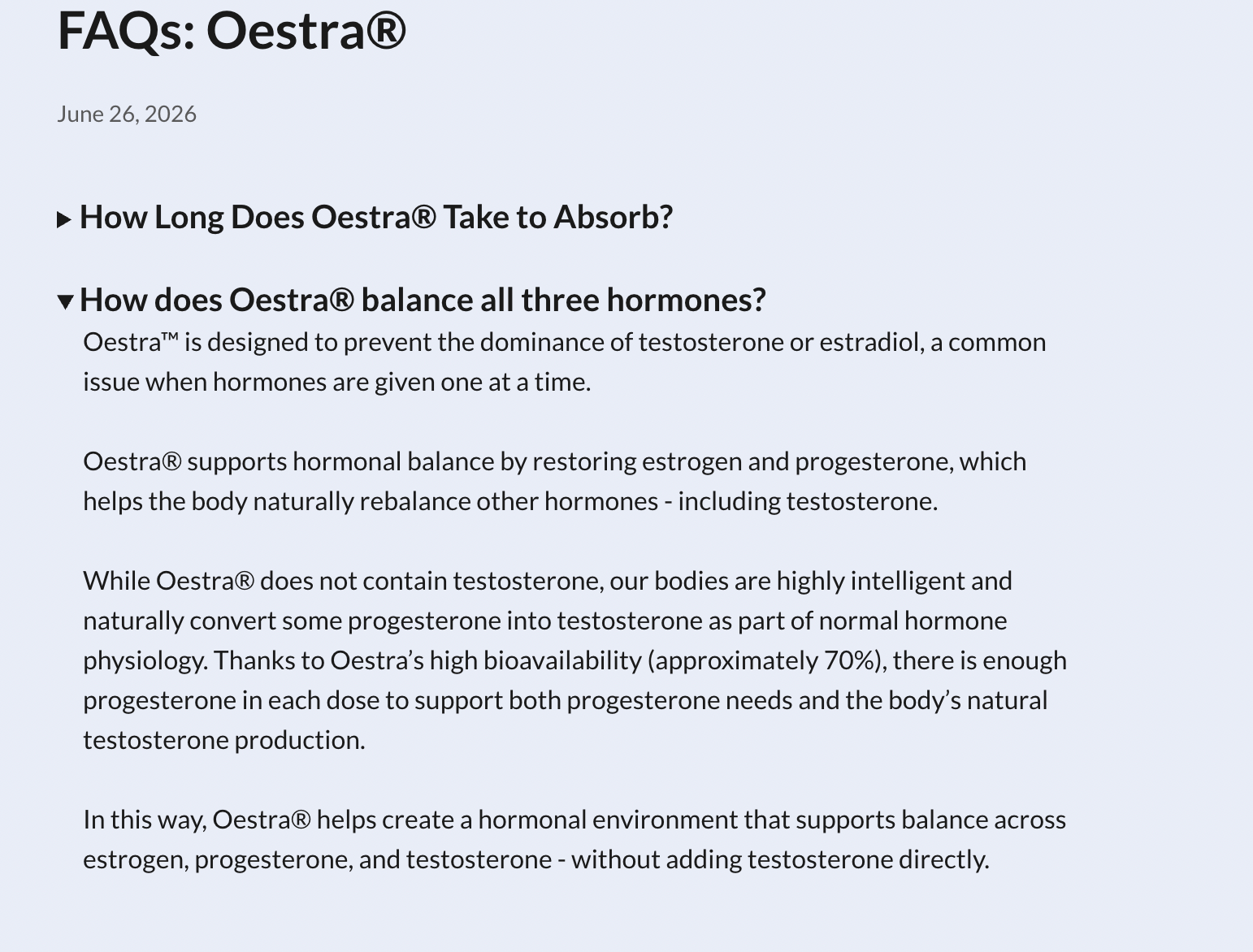
Being a steroid precursor does not mean that administering progesterone predictably increases circulating testosterone
Metabolic pathways, such as testosterone production, do not operate like a conveyor belt, in which adding more raw ingredients forces the conveyor to move faster. Testosterone production is tightly regulated within cells via intracrinology, and the specific signals that drive cells to produce more testosterone remain poorly understood. We could provide 10 times the amount of precursor hormones to the cells, but if the right signaling isn’t there, testosterone production doesn’t increase.
In a study of a transdermal estradiol 50 mcg patch with oral progesterone 100 mg a day that looked to see if menopause hormone therapy affected the levels of testosterone and other hormones (Shifren et al 2007). The regimen produced a minimal effect on testosterone, increasing the levels by 1%. We would not consider that to be clinically relevant.
We also have data from transgender hormone therapy, and the addition of progesterone has been studied; it does not increase testosterone for trans women. In fact, some data suggest it may help lower testosterone levels.
If giving progesterone naturally increased testosterone levels and “supported libido,” we’d know. But hey, I challenge Inner Balance to do a clinical trial and publish it in a peer-reviewed journal and prove me wrong.
A Word About Those Studies
This is from a post from Inner Balance dated January 3, 2026:
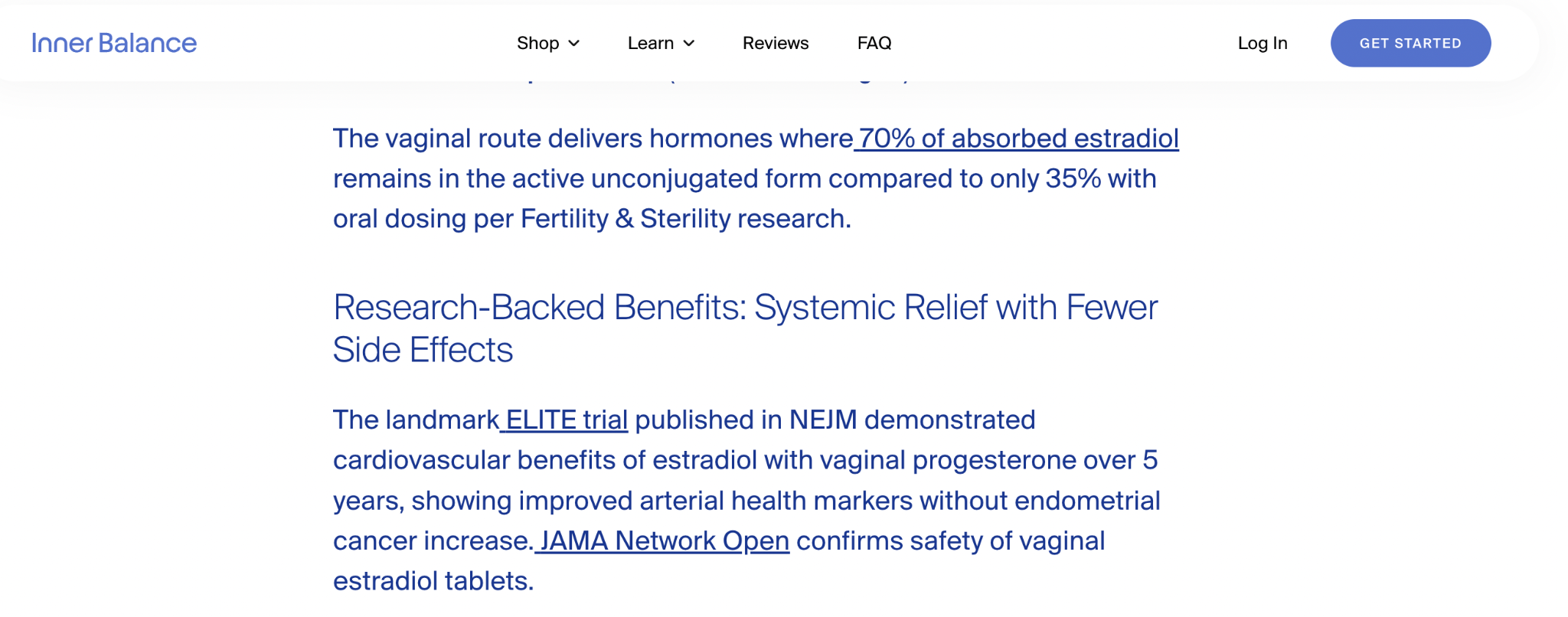
Because I am me, I decided to click the hyperlinks. Yikes!
The first one about “70% of absorbed estradiol” is from a study of a different estrogen preparation (conjugated estrogens, so not estradiol) and compared a low-dose vaginal preparation, meant for the vagina, with a low-dose oral. It did not study estradiol and progesterone meant for systemic absorption. This study is meant to understand whether any vaginal estrogen is absorbed from low-dose vaginal preparations, and has nothing to do with systemic therapy.
The ELITE trial has not confirmed the safety of vaginal progesterone nor proven the cardiovascular benefits of vaginal estradiol, or even estradiol. In the ELITE trial, 45 mg/day of vaginal progesterone gel for 10 days per month did not adequately protect the endometrium from 1 mg/day of oral estradiol. Saying that ELITE demonstrated cardiovascular benefits is quite the stretch. ELITE showed that women < 6 years from their last period who took oral estradiol had less CIMT accumulation, a surrogate marker, than those on placebo. The difference in CIMT progression was very small and likely not meaningful. In addition, CIMT is no generally longer considered a sufficiently validated surrogate endpoint for cardiovascular clinical events.
And the JAMA Network Open study that “confirms” the safety of vaginal estradiol tablets? Oestra isn’t a vaginal estradiol tablet, so there’s that. But the study looks at 10 mcg vaginal tablets for vaginal therapy, not systemic therapy! It is also not a safety analysis; it is a secondary post hoc analysis of data from a randomized clinical trial of 10 mcg estradiol vaginal tablets meant to be local therapy for moderate to severe genitourinary syndrome in women who are postmenopausal. This is what the authors have to say about safety:
Definitively answering the question of whether low-dose vaginal estrogen preparations are safe would require a very large randomized clinical trial. However, our analysis, in combination with findings from multiple previous cohort studies,6-10 suggests that vaginal use of estrogen preparations does not substantially alter serum concentrations, and adds to the evidence that any changes in serum estrogen concentrations likely have limited clinical significance.
I mean…
Very Real Concern About Endometrial Safety
We have no good safety data on vaginal progesterone protecting the uterus at standard MHT doses (I have written about that previously here).
What is more concerning is that Oestra is a compounded vaginal progesterone product, so we do not know how much progesterone is actually absorbed and delivered to the endometrium.
The lower-dose Oestra Menopause formulation contains 500 mcg of estradiol per dose. How much of that is absorbed? Unknown. So how much progesterone is needed to adequately protect the endometrium from that estrogen exposure? Also unknown. Also, 50 mg of progesterone has not been adequately studied to protect the endometrium either oral or vaginal. And what about the higher-dose formulation with 2,000 or 3,000 mcg of estradiol? (there is a difference, and the fact that I am not clear which one is the actual higher dose product or if there are two is another problem) Again, we don’t know how much progesterone to give. Giving high doses of estradiol to women who are still menstruating for reasons other than menopause could also cause endometrial precancer and cancer. And of course, high doses of estrogen could flare endometriosis!
If the company’s claims about estradiol absorption are anywhere close to correct, the amount of progesterone being prescribed becomes particularly concerning. We simply do not have product-specific evidence demonstrating that these doses of compounded vaginal progesterone provide adequate endometrial protection at these claimed levels of systemic estradiol exposure. I would be very worried about the risk of pre-cancer and cancer of the endometrium.
There is a post from January 5, 2026 in Inner Balance, claiming that “vaginal progesterone can provide effective endometrial protection when dosed appropriately.” The link is a pharmacokinetic study of 24 women that examines blood levels at different doses of a progesterone gel, with no endometrial evaluation. Oops.
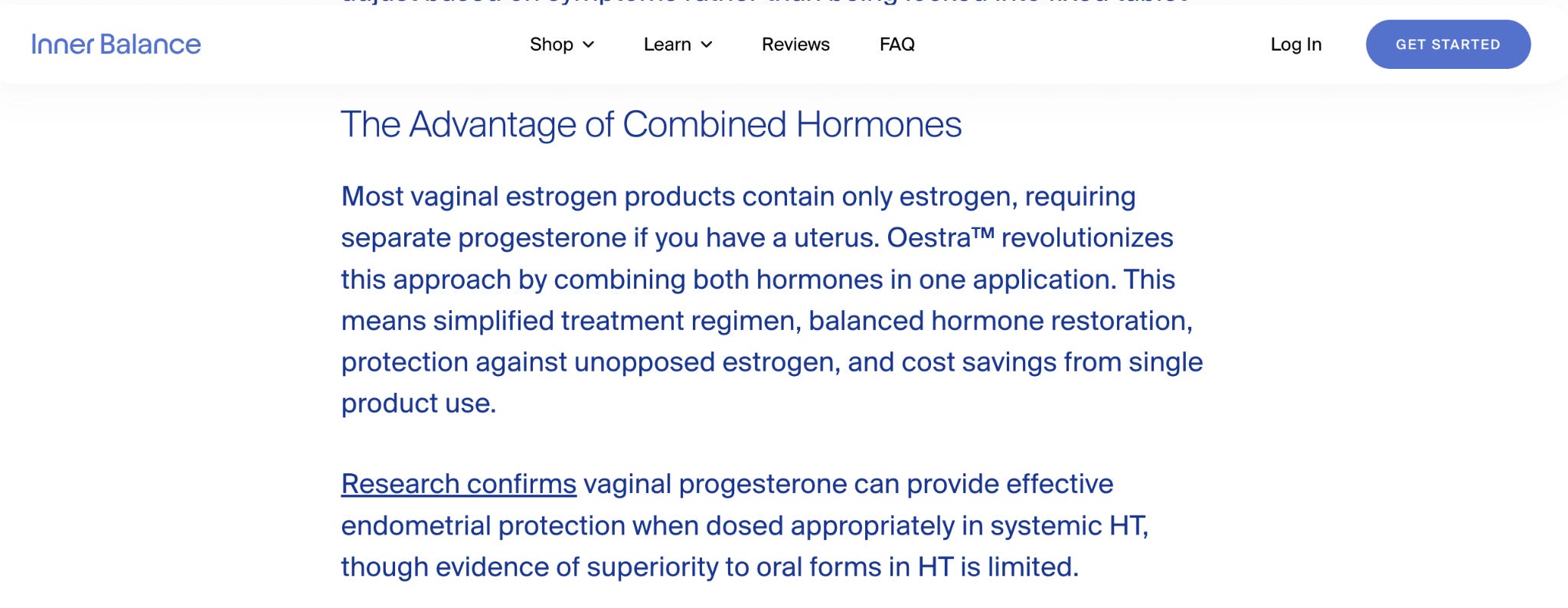
Not reassuring at all.
The Claim that it Can Treat Multiple Conditions
The website suggests that compounded vaginal estrogen and progesterone can be a therapy for postpartum fatigue, anxiety, brain fog, and mood swings, as well as treatment for PCOS and endometriosis. And then there is the claim that endometriosis is caused by low progesterone.
It’s not.
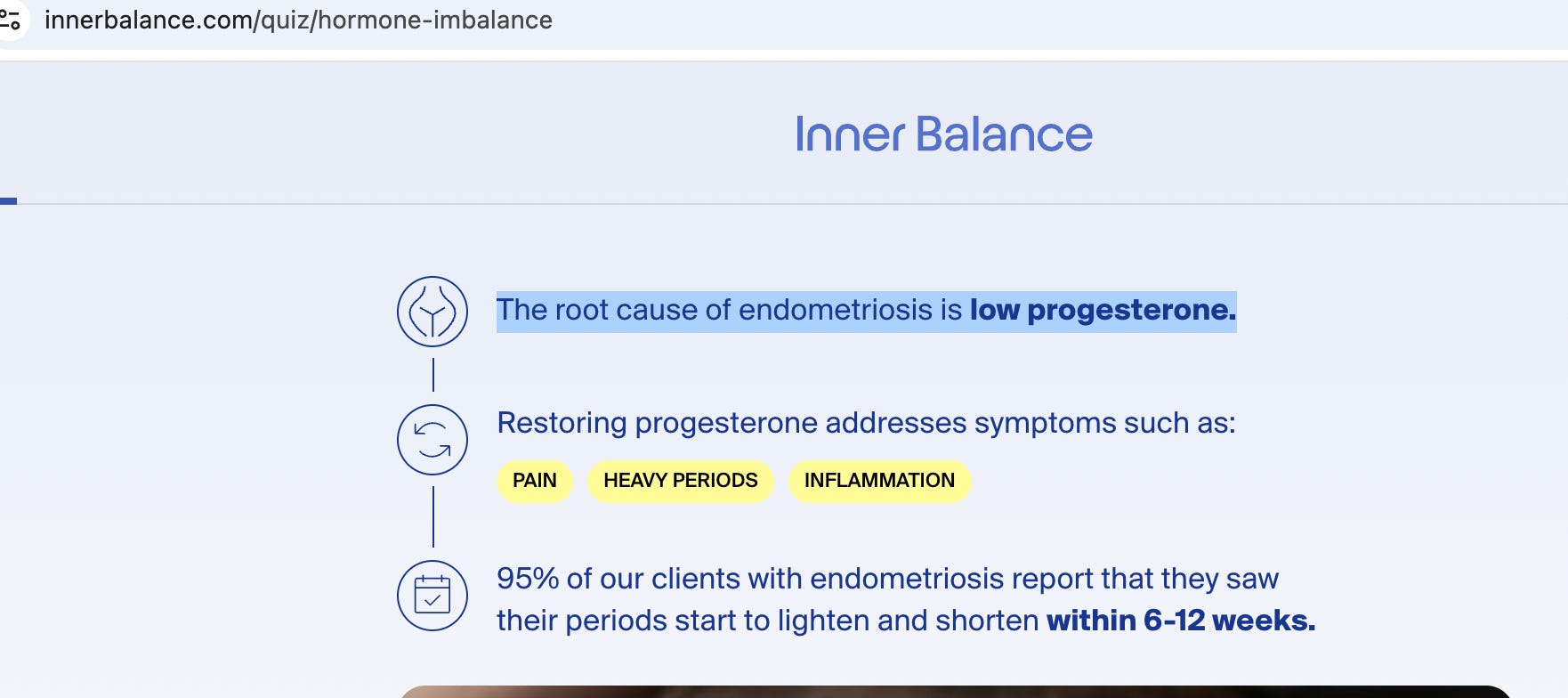
The claim that compounded estrogen and progesterone can treat a large number of gynecological problems as well as a variety of postpartum symptoms is absurd on the face of it. Bold claims with no studies to back them up are marketing, not medicine.
Conclusion
There is more, but frankly, I could have stopped after I mentioned this is a compounded therapy.
There are no clinical studies of this product. There is no reliable way to know how much estradiol and progesterone are being absorbed, whether the product has side effects, or how effective it is.
Are you getting any estradiol in your blood? Maybe? How much? Who knows. Does that matter, yes! If you are absorbing as much a sthey claim, what are the clinical implications? Unknown.
Are you getting enough progesterone to protect your uterus with Oestra? Unknown. No studies of endometrial thickness with ultrasound or endometrial biopsies. You are on your own.
And that is why this product is a hard pass for me.
No posts
Comments
Nothing yet. Say the first thing.
Sign in to join the conversation.