
Women are searching for menopause content online, and that is a good thing. For too long, menopause has suffered from a uniquely terrible intersection of sexism, ageism, and taboos. It was under discussed, underfunded, and understudied, and, consequently, women suffered. The Internet has helped democratize access to information, so an increasing number of women are learning more and exploring their options. I have long been a staunch proponent of democratizing access to quality information for women’s health. That is why I started writing for the public and became active online back in 2010, because day after day I would see women in the office and find myself answering the same questions. How did women not know this, I wondered? A collision of lack of education, shame, and science. I realized women needed information before they came to see me in the office, and so began my mission of empowering women with accurate information.
Over the past few years, menopause has entered the mainstream, moving from a vortex of shame and disinterest to something to discuss, reclaim, and be proactive about health-wise. And it’s no wonder, as women are hundry for information. In one survey of > 900 women from the United Kingdom who described themselves as being in perimenopause, 90% said they had not been taught about menopause in school, and only 2.1% reported they were very informed about perimenopause/menopause.(1) School (84%) and the doctor’s office (65%) were the most common places women felt they should be learning about menopause. It is not surprising that there was a theme of anger in their lack of education and frustration about how they were treated by their doctor. In this survey, most women started looking for information when symptoms started or shortly thereafter (85%).
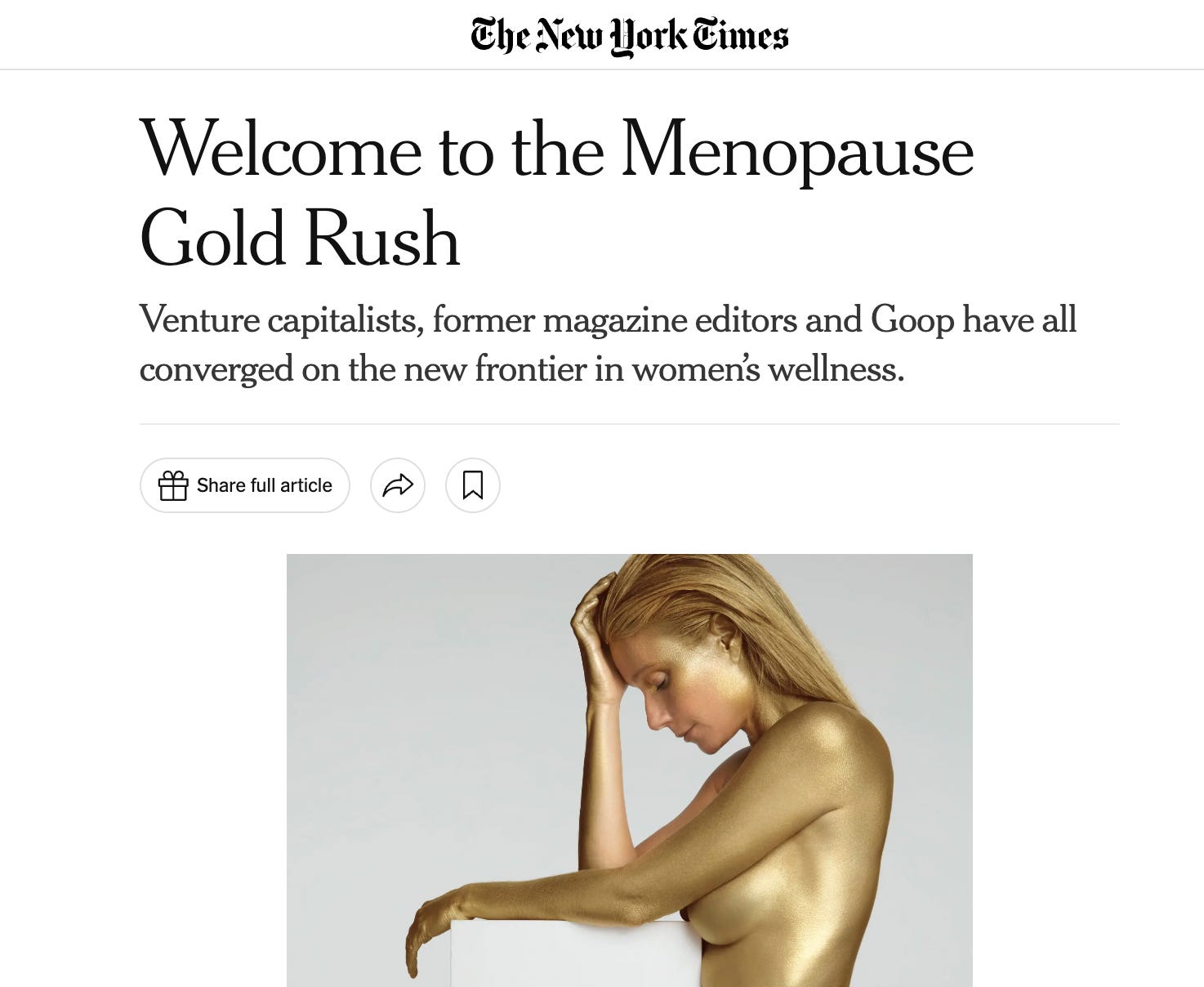
Some of this first wave of public menopause renaissance likely due to Gen X being the first generation to be active online before reaching menopause, so they are comfortable sharing, but this has also happened at a time when researchers who have been working hard to get quality research funded are starting to see results. Of course, we also have the rise of the menopause influencer. While many influencers have done a great job destigmatizing menopause and providing information, over the past few years, as menopause has gone mainstream, I feel there has also been a shift from information to misinformation and from education to education + product promotion. I am not the only one to notice both the growing commercialization of menopause and the rise of misinformation. After all, many people, including me, have called it the menopause gold rush (the NYT screenshot is from 2022). And a gold rush it is, with an estimated market in the billions.
Here at The Vajenda I do my best to balance content between topics that I find interesting (usually if I do, many of you do as well), new research, and answering your questions. I have noticed an increase in the number of questions about services and products, and so I was very interested in a recent article looking at Google Trends for menopause content and how that has changed over the past 20 years.
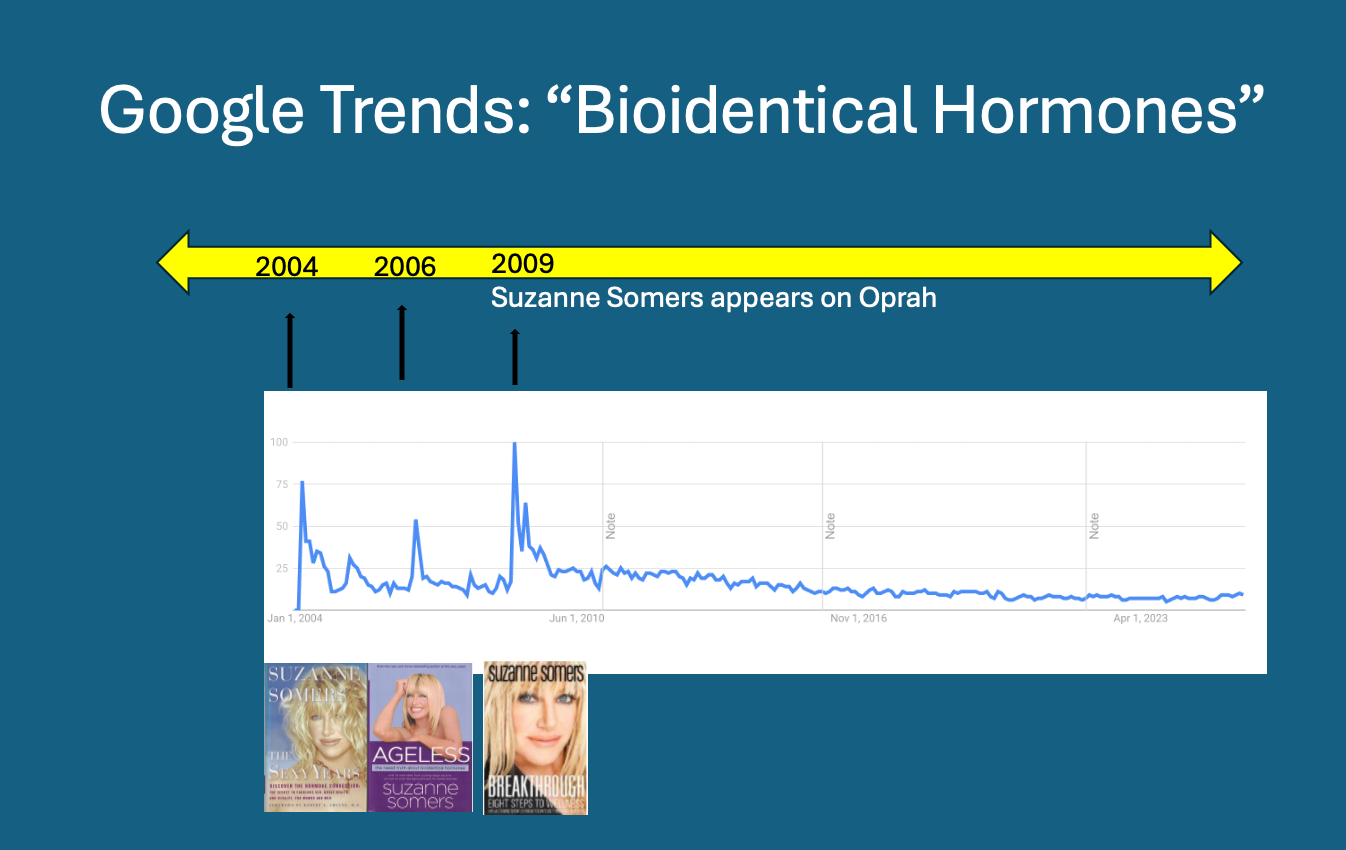
What is popular online can give us insight into the menopause zeitgeist. This is one of the reasons I pay close attention to your questions and comments! Also, misinformation is sticky, so getting the right information out first is helpful. I’ve actually used Google Trends previously to look at the impact of celebrity on the popularity of the term “bioidentical hormones.” This term languished in the naturopathic and functional medicine community (it’s not a real medical term) until Suzanne Somers became indoctrinated. The term was originally meant to describe “customized compounded estradiol, estriol, and estrone and progesterone given in such a way to apparently mimic the menstrual cycle”. You can read more about that backstory and Somers’ involvement here. Somers almost single-handedly vaulted the fringe, untested concept of “bioidentical” hormones into the mainstream, with a generous assist from the press, of course.
When I was writing The Menopause Manifesto, I had wondered about the impact of Somers, so I checked Google Trends in 2020. Lo and behold, there were three massive spikes, and all three occurred right after one of Somers’ three books on bioidentical hormones was published (they are all essentially the same book). The biggest spike was when she appeared on Oprah with Dr. Christiane Northrup. Not extremely scientific, but nonetheless likely an accurate reflection of the power of celebrity and the lure of fantastical claims.
I acknowledge my experience with menopause trends is clearly biased. I research many products, so my social media feed is filled with them (damn algorithm). Also, I get asked about menopause products and services…a lot. But it turns out I am not the only one interested in this topic. A group of researchers wondered if there was a way to spot any trends in the commercialization of menopause and published their results in June 2026 in JAMA Network Open, putting what many of us have been suspecting into numbers.(2) They tracked menopause-related Google Trends from 2005 to 2025 in the United States, the United Kingdom, and Australia. They sorted the searches into two main groups: informational, such as symptoms, diagnosis, and treatment; and commercial, meaning products and services such as supplements, apps, and “natural remedies.”
They started with 10 seed terms for each informational and commercial trend; for example, “perimenopause treatment” or “menopausal symptoms” was informational, and “bioidentical hormone” or “menopausal supplement” was commercial. They then found the most popular search terms related to those seed terms, and for every search they got a relative search value or RSV (basically, a popularity metric). They also looked at two other searches, general women’s health, such as “obgyn near me” and “mammogram,” and male hormone, “testosterone products” and “low testosterone,” for example, as controls and comparators.
Searches from 2005-2010 were considered less reliable because of changes in Google Trends methodology, so let’s focus on the findings from 2010 onwards. In 2010, roughly one in five to one in seven menopause searches were commercial, but in 2025 it was one in three. The increase was similar, about a 15-20% increase, in all three countries, but the U.S. had the earlier rise, while the UK and Australia lagged behind, not seeing a rise until around 2018, although they caught up and by 2025, the results were similar. Both informational and commercial menopause searches increased over time.
The authors created a metric, adding the RSV of the commercial and informational searches together as a denominator and the proportion of those searches that were commercial became a commercialization index. Over time, commercial menopause searches represented an increasing proportion of the combined informational and commercial menopause search activity.
The part of the paper that I found especially interesting was that the highest-volume commercial searches were related to supplements, the most common black cohosh, and digital services, the most common was apps. I wasn’t surprised that supplements were at the top, rather that it was black cohosh. It’s been promoted for ever (since I was a resident), yet there is no convincing data that it works for hot flashes or any menopause symptom. In one study, many supplements were adulterated with other herbs and contained no black cohosh at all (read more here). Black cohos is also associated with liver toxicity. I guess there is value in being the first “big” supplement promoted for menopause. I was also not surprised that there was a lot of interest in apps, and they are seemingly everywhere for everything health. We are truly in the age of the quantified self.
What does this tell us?
Google Trends is an interesting way to spot, well, trends. It’s important to be honest about what the data does and doesn’t show. Google Trends can’t tell researchers how many searches occurred or who was searching, what it does is create a popularity score, telling us how how “hot” something is.
The authors of the JAMA paper concluded that “as commercial menopause content expands, medical guidance will increasingly have to compete with product-led messaging.”
I have a slightly different take, because informational content is not inherently trustworthy, and commercial content is not inherently misleading. What matters is whether the claims are supported by evidence. Also, it’s important to point out that the line between information and commercialization is not always obvious. For example, a doctor spreading misinformation about testosterone may not themselves have a product to sell, so in a study that might never be flagged in a commercialization index, yet in our attention economy provocative content gets attention and traction. The bigger a social media platform, the more an influencer may be able to get in book deals, charge for talks, or sell memberships. And I suspect some people just get off when a video of theirs goes viral.
And of course there are valid products to discuss, such as vaginal estrogen, lubricants, menopause hormone therapy, neurokinin 1 and 3 receptor antagonists, cognitive behavioral therapy, as well as apps to egage with exercise coaches or access CBT for insomnia. But here are also unfortunately heavily promoted products with no quality evidence, like black cohosh, and those where the evidence is distorted, like testosterone and even menopause hormone therapy.
In my view, the challenge is not information competing with commercialization, it is misinformation and misleading marketing competing with high quality information, because they rob women of agency. You cannot make a truly informed decision if the information guiding that decision is false, and unfortunately fact and fiction can look very much alike. This is why correcting misinformation is so important to me, it is not simply some academic problem, it directly affects patient autonomy.
Consider black cohosh. A woman who takes it because she has found information online that tells her it is a proven, safe treatment for hot flashes is making a decision based on claims that are not supported by quality evidence. If the decision to take black cohosh does not include that the data does not support its use, the information on adulturation, and the risk of hepatotoxicity (liver injury roulette) then a patient has not had informed consent. Autonomy demands accurate information.
In my opinion, the Google Trends data is reflecting what happens when a long-neglected area of medicine suddenly becomes commercially valuable. Menopause finally being visible is a real gain and a growing public conversation is something to celebrate. Women spent decades suffering because medicine failed to pay attention. It is also very reasonable that they are looking for products and services to feel better, so the growth in commercialization trends is not necessarily bad. What is concerning is if women now are becoming the targets of an attention economy that profits from exaggeration, misinformation, and misleading marketing. We desperately need more data here about what advise women are getting and how they are making their medical decisions. I keep hearing from many women that they are confused, but if everyone who wrote and spoke about menopause actually stuck with the quality data, there would be very little confusion. The guidelines are remarkable easy to put into practice for the majority of women.
As we start tracking the online menopause ecosystem–from information, to claims from telemedicine companies, and all the products in between–we need to make sure that misinformation, and that includes the attention economy as much as products, is not leading the charge. We also need some form of accountability for misinformation, but I’m not holding my breath. And so the best that I can do is to keep watching the trends and bringing you the science, as prebunking is protection against misinformation, because women have suffered for too long to emerge into a quagmire of false claims created by the attention economy.
Aljumah R, Phillips S, Harper JC. An online survey of postmenopausal women to determine their attitudes and knowledge of the menopause. Post Reprod Health. 2023 Jun;29(2):67-84. doi: 10.1177/20533691231166543. Epub 2023 Mar 29. PMID: 36994487; PMCID: PMC10273865.
Farina FR, Griffith JW, Faubion SS, Hickey M, Lensen S, Christmas M. Online Menopause Information–Seeking Search Patterns and Commercial Content Over 2 Decades. JAMA Netw Open. 2026;9(6):e2616596. doi:10.1001/jamanetworkopen.2026.16596
No posts
Comments
Nothing yet. Say the first thing.
Sign in to join the conversation.