
Many years ago, when I was working on building Investor Relations websites for publicly traded companies in Brazil, I had the opportunity to spend time with several C-level executives.
In one of those conversations, while commenting on how favorable the economic environment seemed for Brazil, a CEO said something that stuck with me:
“When the wind is at your back, it’s easy to look good. Many mediocre executives appear above average. The company grows, bonuses arrive… but that’s not excellence — that’s a good tide.”
According to him, it’s when the tide turns that you can really distinguish substance from momentum. That’s when true leaders show up.
For years, the Brazilian delivery market rode a perfect wave — and iFood was, without a doubt, the biggest surfer on that wave.
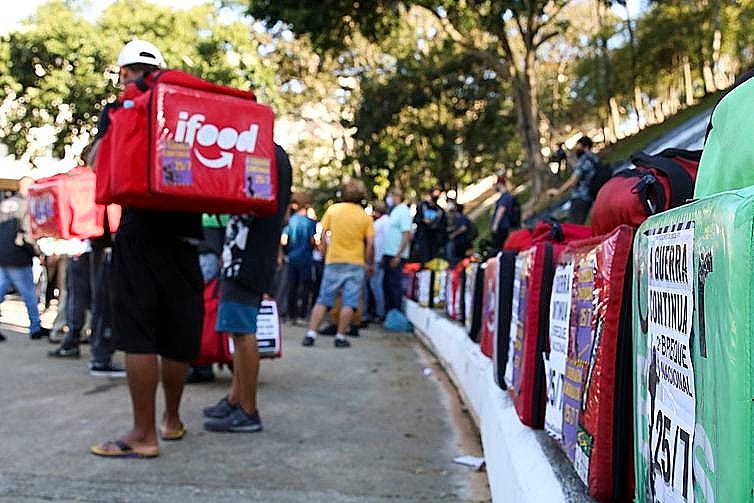
For more than a decade, Brazil’s delivery market lived exactly that: wind at its back.
Founded in 2011, iFood built a level of dominance that few digital markets ever see. In recent periods, it concentrated over 90% of market share, operating in more than 1,500 Brazilian cities, with millions of users, restaurants, and couriers connected to the same infrastructure.
The pandemic accelerated everything. Habits solidified. Consumption exploded. In 2025, even with competitors returning to the market, iFood still processed around 1.7 billion orders. The market simply had no real alternative.
Restaurants accepted high fees, tough contracts, and little flexibility — not because it was ideal, but because there was no choice.
The tide was perfect.
But no tide lasts forever.
Starting in 2025, two moves began to change the dynamics of the game. 99Food returned aggressively, backed by DiDi , with billion-real investments and a clear strategy of zero fees and heavy subsidies. Shortly after, Keeta, backed by Meituan — one of the world’s largest delivery platforms — entered Brazil promising even larger investments, starting in São Paulo and Santos.
These moves made one thing very clear: the delivery market’s barrier to entry was never technology.
A functional app, organized logistics, and enough capital to subsidize prices are already enough to create rapid impact — especially in large urban centers. In regions like Greater São Paulo, iFood remains the leader, but its local dominance is no longer absolute.
National leadership remains. Local comfort does not.
Another signal that emerges when the tide turns is where the money actually ends up.
Talking to restaurants, a pattern repeats itself: outside iFood, order volume is often lower, but net margins are frequently higher. Zero fees, subsidized promotions, and more flexible contracts completely change the end-of-month math.
This isn’t a homogeneous or universal phenomenon, but it’s enough to break a long-standing myth: that there were no viable alternatives.
When alternatives appear, loyalty stops being guaranteed — it becomes negotiated.
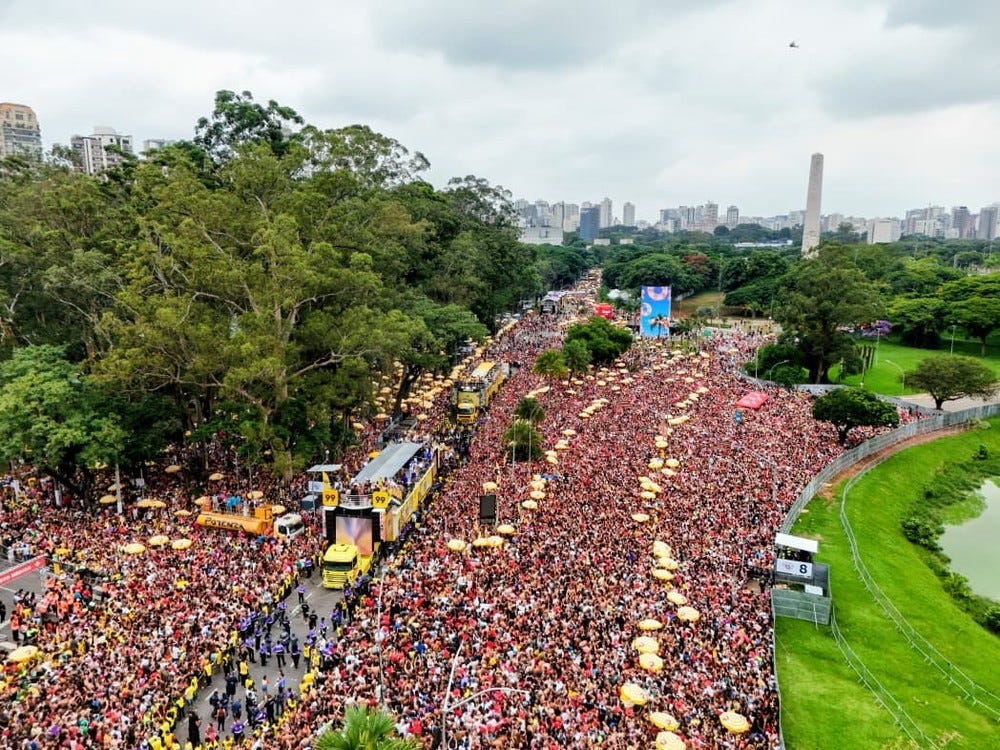
This morning, at 8 a.m., that shift became impossible to ignore.
São Paulo’s Street Carnival, historically associated with iFood, kicked off with a different protagonist. 99Food launched the block “99 Presents: Quem Pede, Pede”, bringing Ivete Sangalo to lead a São Paulo trio for the first time.
It may look like “just marketing.” But in this context, marketing is strategy made public.
When a company chooses the country’s biggest cultural stage to position itself, it’s sending a clear message: we’re here to compete.
As competition becomes more visible, another movement becomes inevitable: the constant need to reaffirm strength, growth, and leadership.
None of this is wrong. But it is symptomatic.
When the tide was perfect, nothing needed to be explained. Now, every announcement matters.
And in the middle of this dispute, there’s an immediate winner: the advertising market. One competitor forces the other to advertise, spend, and show up. The war becomes public.
Brazil’s delivery market is not collapsing. But it has clearly entered a new phase.
And perhaps the most uncomfortable question isn’t about who is losing share right now, but about how products are being built.
What iFood had to develop over more than a decade to establish its dominance is far more replicable today than it was before.
AI, automation, cloud infrastructure, APIs, outsourced logistics, programmatic marketing, and venture capital have drastically reduced execution time. What once took years can now be compressed into months.
That doesn’t mean market dominance has become easy. But it does mean the market is likely to become increasingly fragmented.
Fewer monopolies. More local battles. More pressure on product, experience — and especially leadership.
Less tolerance for improvisation or “stage-ready” mediocre executives. More need to anticipate market shifts and align teams around a clear purpose.
When the tide turns, the winner isn’t the one who grew first. It’s the one who keeps navigating when the wind changes.
Those who merely replicate what already exists — combined with price dumping — may cause short-term damage… but they don’t win the long race.
Looking at the turbulent delivery market today, one song keeps playing in my head:
🎵 “Watch the wave, watch the wave… better be careful not to get swallowed…” 🏄♂️
Because just as crises reveal who people really are, markets reveal which business models actually work.
And now, unmistakably, the wind has changed.
Need a hand with your design team?
I work with only 2–3 clients per year, helping them evolve Design Systems in Figma, Product Strategy, Community, and Marketing. If that sounds like what you need, just reply and tell me a bit about your project. Let’s talk.
Got this email from a friend?
Lucky you. Subscribe here and you’ll receive these design sparks every other Friday.
Want more between issues?
I share thoughts, rants, and experiments on LinkedIn and Xwitter (yes, I still call it that). Come say hi.
No posts
Comments
Nothing yet. Say the first thing.
Sign in to join the conversation.