
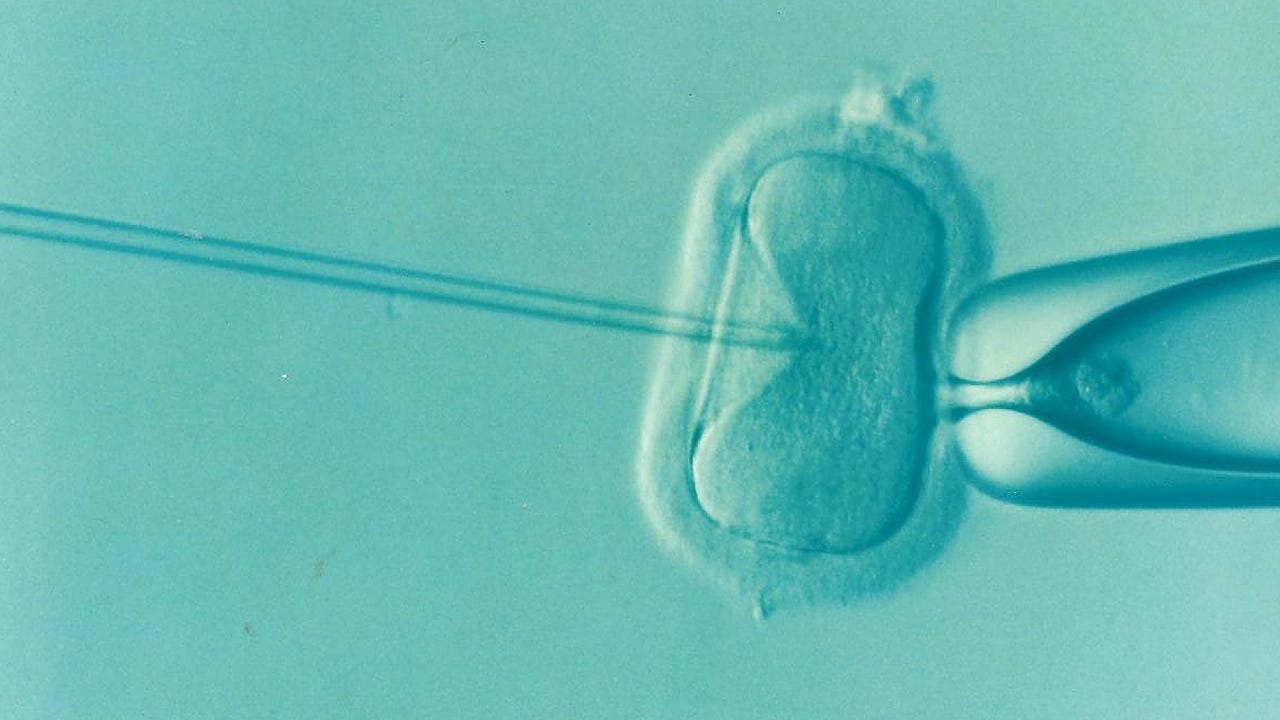
DrKontogianniIVF, CC0, via Wikimedia Commons
By Barbara A. Perry
When the price of eggs became one of the inflationary issues in the 2024 presidential race, it was the chicken variety, not those from human ovaries. Representative Alexandria Ocasio-Cortez’s recent announcement that she was freezing her eggs (personal, not store-bought) raised a torrent of questions about what we need to know about our public officials’ medical and reproductive information. Moreover, does biology require that these procreation issues remain inevitably gendered? If so, does more information, rather than less, from women empower them or restrict their personal and political choices?
AOC’s decision to preserve her reproductive options is perfectly understandable for a 36-year-old woman who is as aspiring as her male colleagues in Congress and is mentioned as a future Democratic presidential nominee. As she observed in her announcement, men don’t have to worry about that ticking biological clock and aren’t judged in the working world by its advancing time. Republican Senator Strom Thurmond, known on Capitol Hill by the mocking nickname “Sperm Thurmond,” fathered four children well into his 70s, with his second wife, who was 44 years his junior. Voters might have preferred to know the paradox of this segregationist’s fathering a child with his family’s black housekeeper, who was a teenager when young Strom impregnated her. Only after his death, at age 100, did his biracial daughter confirm that the long-time senator was indeed her father.
The procedure to harvest and preserve eggs is onerous (requiring frequent hormone injections and invasive gynecological procedures), but it is not debilitating. So why do “we the people” need to know that an officeholder is pursuing it? A less complicated though delicate procedure undertaken by men for the opposite goal of preventing pregnancy—vasectomies—is also news we don’t need to know about our politicians, despite the fact that these decisions impact the family lives of our leaders. One could even argue that by announcing her egg-freezing decision, AOC has drawn attention to the very concern she is attempting to neutralize: the prospect that pregnancy will detour a woman’s road to higher office or affect her performing its duties.
Can we imagine any male aspirants to the presidency saying they were freezing their sperm because they didn’t want the personal distraction of helping to raise a child while holding the world’s most powerful office?
For many female political leaders, egg harvesting and preservation simply hasn’t been a pertinent issue (even if it had been a normalized procedure, which didn’t occur until 2012). Hillary Clinton, Margaret Thatcher, Golda Meir, and Indira Gandhi all had adult children when they ran for or became their countries’ leaders. When she sought the presidency in 2024, Vice President Kamala Harris had two older stepchildren, who called her “Momala.” Harris was 50 years old when she first married, so childbearing was moot for her at that time in her political career. Conversely, Queen Elizabeth gave birth to her last two children well into her reign, and her older son, the future King Charles III, and daughter were teenagers. She was not the United Kingdom’s head of government, but, as head of state for a still-global empire, she maintained a full-time position and travelled widely, while nannies cared for her children before they attended boarding schools.
Japan’s incumbent prime minister, Sanae Takaichi, age 65, has three stepchildren but faced infertility when she tried to conceive children. She has noted that she wants “society to be welcoming to infertile women.” The current prime minister of Italy, Giorgia Meloni, had a 6-year-old daughter when she took office.
New Zealand’s former prime minister, Jacinda Ardern, faced the issue head-on in 2017. She made headlines in becoming, at age 37, that country’s youngest leader in more than 150 years and in answering a reporter’s question during the campaign about whether she planned to have children. She did, she said, but countered another interviewer’s implication that employers have the right to know whether prospective female employees plan to take time off to have babies.
“I decided to talk about [having a child], it was my choice…,” Ardern asserted, “but for other women it is totally unacceptable in 2017 to say that women should have to answer that question in the workplace. It is the women’s decision about when they choose to have children. It should not predetermine whether or not they are given a job or have job opportunities.” One year into her tenure as PM, she gave birth to her daughter and took a brief six-week maternity leave, during which the deputy PM substituted for her. Ardern then served as head of government for another five years.
If our most recent elderly male political leaders – Mitch McConnell, Donald Trump, and Joe Biden – are allowed to conceal their severe medical conditions while in office (to the detriment of the country), why should women feel the need to report their private reproductive choices that have little or no impact on their ability to perform public service?
In fact, AOC’s decision to publicize her egg-freezing only draws a bright line delineating a much-needed policy for all public officials — judges, presidents, members of Congress, cabinet members, military leaders, governors, mayors, and state/local law makers, as well as candidates for those jobs. The public they wish to serve has a right to know about any medical condition, physical or mental, that could significantly impact the officeholder’s ability to perform the position they hold or to which they aspire. But egg freezing is not one of them.
If women’s reproductive choices are deemed to fall into that category, then they haven’t reached the gender equity threshold required to hold the nation’s highest office. Even more starkly, can we imagine any male aspirants to the presidency saying they were freezing their sperm because they didn’t want the personal distraction of helping to raise a child while holding the world’s most powerful office?
It remains to be seen if women office-seekers who publicize their choices to have children (but delay that wish through now-available medical means) will empower themselves both personally and electorally. They might win the support of liberals who support these choices or even conservative, pro-family voters. Yet the Roman Catholic Church opposes IVF because some fertilized eggs might be destroyed. The religious right is unlikely to approve of egg-freezing candidates, but pro-lifers are an unnatural constituency for AOC, in any case.
The final irony for this publicity about women politicians’ child-bearing decisions is that it may return females to a recent time when bosses asked female job candidates if they were planning to have children. If having babies is viewed as a handicap, can only celibate, post-menopausal, infertile women – or women in their prime who have frozen their ovarian products – aim for the Oval Office?
Barbara A. Perry is the J. Wilson Newman Professor of Governance and co-chair of the Miller Center’s Presidential Oral History Program. Her new book is Reconcilable Differences: The Unlikely Political Alliance of John F. Kennedy and Eleanor Roosevelt.
Comments
Nothing yet. Say the first thing.
Sign in to join the conversation.