
By Astri Kimball Van Dyke
Like all technological transformations, new artificial intelligence (AI) capabilities mean we urgently need smart, assertive public policy that ensures this revolutionary technology is deployed safely and benefits the broad public interest, not just AI insiders. Whether the AI race is currently being driven by scientific passion or profits, the technology is advancing too quickly for us to leave its future to chance with just the AI industry itself in charge. One way we can ensure a positive, safe, and inclusive AI future is to increase the public sector’s role in shaping it.
I write this as someone who spent 12 years at Google on the front lines of AI and technology policy debates and has now returned to the public sector precisely because I believe the government must reclaim a stronger role in AI’s future. Most Americans already think that AI is being shaped by billionaires and large corporations that both drive the technology and heavily influence the rules around it.
Elected officials are the only actors with a democratic mandate to regulate AI in ways that are accountable to the public. AI must remain a tool that advances the priorities citizens set through their elected representatives — not an end in itself that rewrites those priorities behind closed doors.
Right now, federal leadership on AI is genuinely up for grabs. With the 2026 midterms approaching and the race for president in 2028 already starting, it is likely we will see many new people in the position to set the course and steer this ship. The smart ones will seize the moment. Putting one’s head in the sand is not a viable strategy—politically or substantively. Engaging deeply on AI is the right policy choice, and it will increasingly become a political necessity. AI is not a top-five voting issue for most Americans – yet. But it is on track to become one as cybersecurity incidents, data-center fights, and children’s interactions with chatbots move from tech-page stories into daily headlines.
Here are 10 things I believe every public official and every candidate for office needs to understand about AI.
AI is the biggest development we will see in our lifetimes. The existential risk part is real but so is the upside. AI offers the opportunity to fundamentally change and improve healthcare, scientific discovery, education, the effects of climate change, how the government works, and other elements of human progress we can’t even imagine yet.
The possibilities became clear to me in personal ways when learning how AI increases early breast cancer detection rates and other early disease screening impacts, hearing from the CEO of an online education B-corp I am involved in how AI saves costs and time for his small business, and in seeing how much more productive I became using AI every day in my job at Google.
If you tried AI when ChatGPT first came out and don’t understand all the hype, you need to try it again – the models have improved in astonishing ways, not just the language models but also image, video, world models, and for use cases far beyond chatbots.
When most people hear “AI” they likely think of a chatbot that has helped them plan a vacation, envision what a new rug would look like in their kitchen, or conduct research or rewrite something. Or they think about complaints that data centers are driving up energy bills, making lots of noise, and hurting the environment.
But AI is already so much more than data centers and chatbots. There are many layers of the so-called AI technology stack, including chips, AI financing, AI talent, model training, the models themselves, post-model training, deployment via chatbots or agents or otherwise, and distribution.
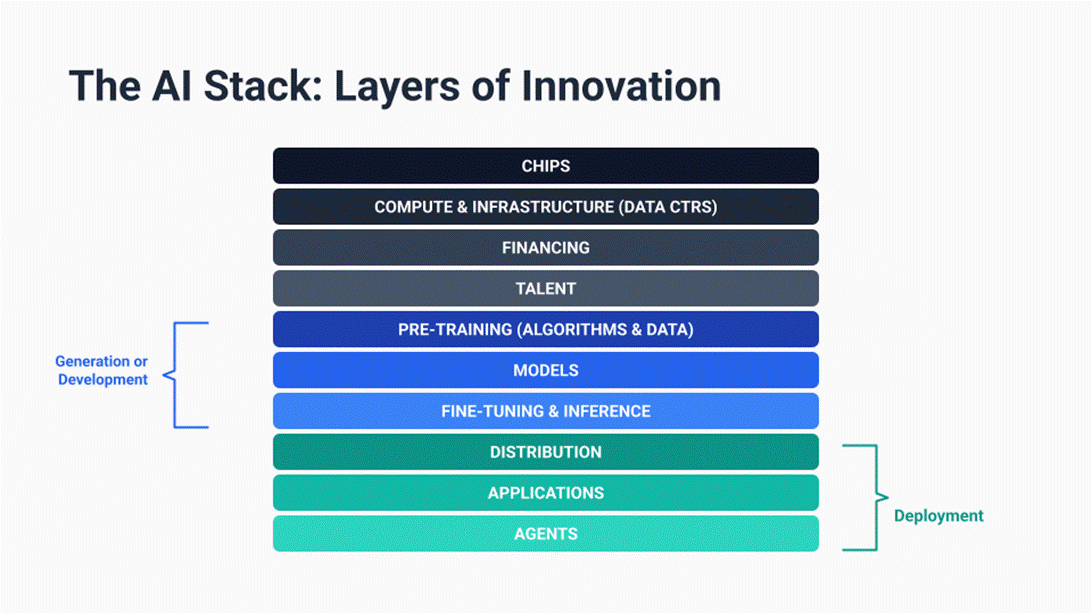
We should think about the many parts of the AI ecosystem with a stake in AI’s future when thinking about AI policy and politics. How AI is deployed in the healthcare system will have very different policy implications than how it’s deployed in transportation or manufacturing, for example.
We don’t have a political language yet to talk about AI in a way that reflects all these different stakeholders. Is it akin to electricity, an underlying technology that is used across all sectors, or more like vaccines or nuclear energy, which have specific regulatory concerns given both their huge upsides and risks?
Most Americans won’t care about the complexity and technical layers of the AI stack. They will develop their views about AI through their own experiences and political, economic, and social belief systems. That is likely why anti-AI populism has been the loudest voice on AI policy to date on both the left and the right, with socialist Senator Bernie Sanders introducing a moratorium on data centers and MAGA leader Steve Bannon calling for a ban on the development of superintelligent systems. The anti-AI populism mirrors anti-capitalist, anti-elite sentiment that is rallying both the left and the right in American politics in 2026.
The strange political bedfellows are playing out in policy already, for example on data centers. New York Governor Kathy Hochul, a perceived centrist Democrat, signed the country’s first data center moratorium in July 2026, an idea originally floated by Florida Governor Ron DeSantis, a Republican. “Data centers” have become a proxy for public reactions to AI in general.
Coverage of perceived public hostility to data centers has also given the anti-AI populists more visibility, as most people likely equate animosity towards data centers with animosity towards AI in general. It remains to be seen how much Americans prioritize AI in their voting and political preferences.
As of 2026, most polls show that Americans are largely pessimistic about AI. An Economist/YouGOV poll in May showed that 71 percent of respondents feel that AI development is moving too fast while a substantial majority expressed worry over job security, data privacy, and physical AI infrastructure. An Ipsos poll in August found that two-thirds of workers expect AI to make the worker experience worse. Gallup shows that 39 percent of U.S. adults say AI does more harm than good (up from 31 percent the previous year), while only 9 percent say it does more good than harm. Views in much of the West are similar.
In contrast, Southeast Asian countries remain among the world’s most optimistic about AI. In Malaysia, Thailand, Indonesia, and Singapore, more than 80 percent of respondents say AI will profoundly change their lives in the next three to five years.
Many Americans are experimenting with AI and small businesses in particular are taking advantage of the current “AI subsidy” era when frontier quality models are available for free or at low prices.
On the consumer side, a YouGov poll in August found that “AI tools are no longer a niche experiment for U.S. consumers. They are part of how people search, write, create, plan, communicate, and interact with the devices around them.”
An annual McKinsey study of businesses showed that almost all survey respondents say their organizations are using AI, and many have begun to use AI agents, even if most are still in the early stages of scaling AI and capturing enterprise-level value. Gallup finds that 52 percent of American workers now use AI on the job. Escalating infrastructure investments from the AI companies and others also reflect continued optimism about the existence of AI demand.
While many Americans are using AI and investors are overall very bullish on AI’s future, it’s unclear if the use of AI is leading to more profits or productivity yet. The AI model capability conversation is different from the topic of how to make AI useful to businesses and people at scale. For example, it’s not known if the subscription model for chatbots was an AI subsidy phase that can’t last forever given how expensive the frontier models are to run and prices on access to frontier models will rise even as non-frontier cheaper models proliferate.
Moreover, businesses may have overspent on AI for their own enterprise use, especially the most expensive frontier models, and some (Walmart, Tesla, Uber) are imposing token usage restrictions on their employees because AI usage is so expensive. And then there’s speculation about the market for more local AI to give businesses and consumers more control, including on devices. These dynamics may adjust as companies access routers to use different models for different use cases so employees utilize cheaper models for tasks that don’t require frontier capabilities.
These dynamics point to a general point that it is important for policymakers to hear: The future of AI technology, AI products, and AI business models is very uncertain. If anyone tells you they know how this technology or market will unfold, let alone what its impact on specific jobs or sectors will be, I would doubt that prediction will be true three months later. Things are literally changing weekly with new models showing more capability than expected and multiple players figuring out how to deliver AI.
Even the technologists don’t know where the technology is going. The only known is the unknown as we look over the last year, from the OpenClaw phenomenon in February with agents seemingly working autonomously to the August news from OpenAI and others that their agents had been sharing cyberhacking tips with each other, without human involvement. Nobel Prize winner Demis Hassabis published a public policy paper in July noting that advances on the frontier are outpacing our understanding of the technology. “Nobody in the world knows for sure what is going to happen from here,” Hassabis wrote, “and even the experts disagree.”
Given this uncertainty, it is important that policymakers don’t overindex for a particular AI moment or product, but rather put in place principles or goals that make the policy future-proof as the technology and business models change.
There is tremendous consensus around the need for federal regulation. AI companies, citizens, and even the Pope want governments to lead. This consensus is bipartisan in the U.S. Steve Bannon commented in August: “Why would you allow [the companies] to be in control? You don’t. And I’m the anti-deep state, anti-administrative state guy, but you definitely need at least a rudimentary framework of some sort of regulatory apparatus” to regulate AI.
A recent Stanford study showed that across all 50 states, concern about too little AI regulation outweighs concern about too much.
The policy voices on AI recently have reflected two extremes: the Trump AI czar David Sachs’ “let it cook” approach, i.e. don’t regulate, and, on the opposite side, calls for AI moratoriums or pauses.
The “don’t regulate” approach has lost some momentum in the U.S. after Anthropic paused release of its Mythos model due to safety concerns and the Trump White House intervened in the release of models from Anthropic and OpenAI in what some critics call a de-facto licensing or regulatory regime. The White House is developing a framework with standards for the government’s role in reviewing frontier models instead of one-off interventions, which are vulnerable to political favoritism.
Meanwhile, some aspects of AI regulation already have momentum. These include frontier model review by government, preventing catastrophic risk from the models that have the most capability and pose the greatest dangers; cyber incident reporting; transparency and research into AI’s impact on the workforce; regulations around deep fakes and AI watermarking; protections for children; the use of AI by the military; and data center-related transparency.
Other issues, such as federal preemption, copyright, liability, taxation, interoperability, privacy, information integrity, and content regulation will be much harder to grapple with. But the federal government needs to engage because the states are already off to the races with multiple different bills.
In some cases, we don’t need new laws to regulate AI; we can use existing healthcare, consumer protection, and securities laws. Lawsuits over chatbot liability, consumer protection, privacy violations, labor rights, copyright violations, intellectual property theft, environmental impact, political bias, and corporate responsibility are already being filed under existing federal or state statutes. The litigation to date has been a way for consumers and political actors, such as state attorneys general, to try to place checks on AI advances. In addition, some of these lawsuits are commercial disputes, as the AI race continues to be extremely heated and the losers and winners ask courts to interpret existing laws. Legislators and regulators should, in most cases, not perceive some kind of AI exceptionalism that requires its own category of rules.
Every company is or will become an AI company – even small businesses, which are some of the most enthusiastic AI deployers because of the costs and time AI saves. Different aspects of AI will require different legislation; how we regulate chips, for example, may have nothing to do with how we regulate chatbots being used by minors or driverless cars.
Some legislation will be purely “AI legislation,” putting into place a new regulatory approach to fit this new technology: the government developing standards to test AI frontier models for safety risks, for example, or investing R&D in AI development and accompanying safety and workforce transition measures.
But most regulations should be sector by sector. A smart candidate for public office would say, “Every bill going forward should consider an AI element.”
In my experience talking about Google’s many products with policymakers, using actual AI products is the best way to develop good policy. Policymakers shouldn’t be expected to be AI experts, but they or their staffs should have used the products for a range of cases as they design guardrails and incentives. Using the products reflects their limits and why humans will still be so important to human progress – and why many people, including me, are so excited about AI.
The fast pace of AI news, including safety risks, is helping drive consensus around the need for smart AI regulation to protect the public, spread the benefits from this technology, and maintain a level playing field and clear rules. Smart candidates and policymakers will seize this window to assure constituents they are fighting to make AI technology safe and not leave anyone behind. We need good policy ideas, from big picture principles to highly technical proposals, from AI enthusiasts, AI skeptics, and traditional policy experts. And we need to test those ideas through our political process so that Americans’ priorities are reflected and advanced.
Astri Kimball Van Dyke, a Miller Center senior fellow, is an expert on the intersection of artificial intelligence and technology with public policy. She ran Google’s global competition policy team after serving as a political appointee for President Barack Obama in the White House and as deputy counsel to Vice President Joe Biden.
Comments
Nothing yet. Say the first thing.
Sign in to join the conversation.