
Upward Growth is a health plan market advisory firm. Our weekly newsletter covers payor market strategy, regulatory shifts, and go-to-market insights for health tech vendors, investors, provider organizations, and consultancies competing in the health plan market.
🤝 Work with us on payor market strategy: Contact us
🟦 Connect with the author, Ryan Peterson, on LinkedIn.
🎧 Listen to the Upward Growth Podcast: Apple | Spotify
📰 Newsletter sponsorships: Learn More
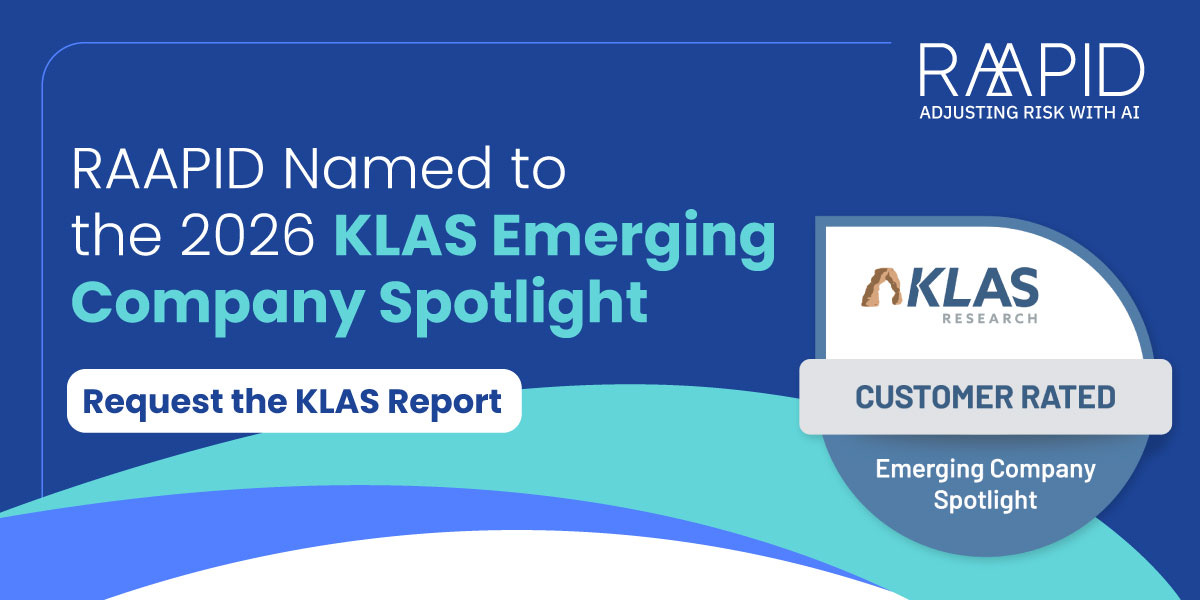
RAAPID‘s KLAS Emerging Company Spotlight is out — and every customer interviewed said they’d buy again.
KLAS interviewed RAAPID’s health plan customers for its May 2026 Emerging Company Spotlight.
The results: A+ score for “would buy again*,” an A score for “likelihood to recommend,” and standout marks for “audit defensibility and partnership responsiveness.”
Independent validation from health plans that actually use the platform.
(*Emerging Data, n=5)
Click the button to see the full ratings and customer commentary in the KLAS report:
Interested in sponsoring Upward Growth? Learn more
A quick update on the podcast side of Upward Growth. We’ve locked in several guests to record over the next few weeks, and honestly, these are convos we’ve been wanting to have for a while. The format continues to be candid reads on where the health plan market actually is, what’s shifting, and what the operators and investors close to it are seeing right now.
If you have ideas for guests worth chasing, share them with us here. We’re most interested in candid perspectives from people inside health plans, leaders navigating major market shifts (whether that's plan strategy, regulatory response, or M&A), and contrarian takes on where the market is headed. The good ideas stand out fast, and we want to hear them.
Six of the largest publicly traded health plans reported Q2 2026 earnings over the last three weeks, and taken together, the story is "plans finally got healthy." All six raised full-year 2026 guidance, most beat estimates, and while medical loss ratio (MLR) movement was uneven across the six, the numbers looked strong across the board.
And sure, that's a clear theme. But the more useful read is what the six plans committed to on those calls, because Q2 is the quarter where the language from the Q1 earnings calls turned into public commitments plans now have to live with. Disciplined pricing became raised guidance tied to a specific membership trajectory. Portfolio management became a scheduled rollout timeline at Cigna and a set of exit dates for everybody else. Medicaid margin pressure became a coordinated message to state actuaries. Each of those commitments closes down some options and opens others, and the ones that matter for CY 2027 procurement, Medicaid rate advocacy, Star Ratings positioning, and the vendor deals in your pipeline right now are the ones worth pulling out.
This is the Upward Growth quarterly read on publicly traded health plan earnings, following the Q1 edition. What follows walks from the industry-wide moves (guidance and exits) to the plan-specific ones (Cigna under a new CEO, two Medicaid MCOs pointing their language at state actuaries, three plans putting prior auth metrics on the record) to what's happening operationally inside every plan while all this is going on, and finally to the downstream effects of the exits themselves.
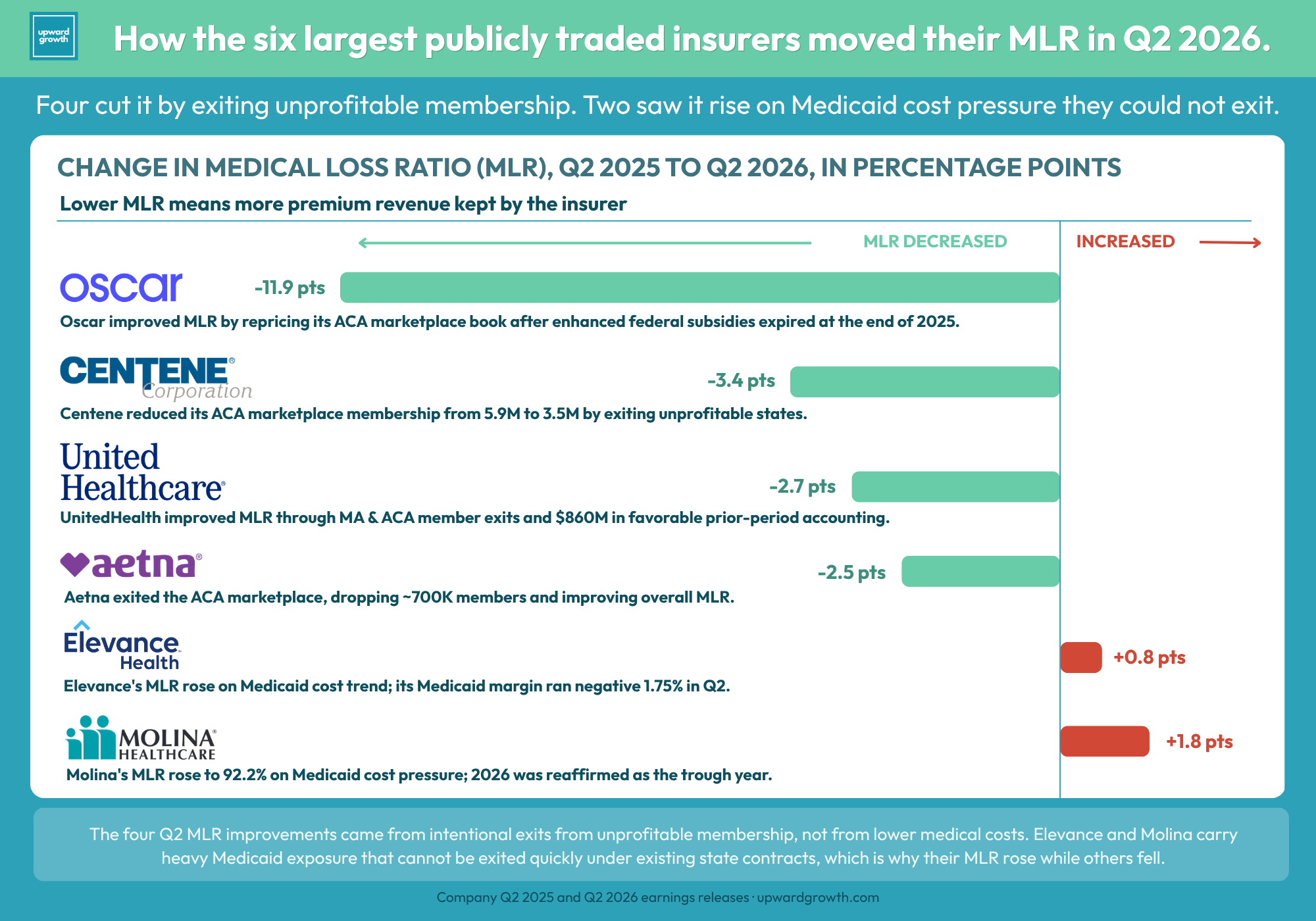
The first thing the plans committed themselves to in Q2 was continued membership loss through 2027. All six raised guidance, and every raise was defended in terms of margin discipline (fewer, more profitable members), not enrollment recovery. That framing is only defensible if the market exits continue.
Let’s discuss what each plan actually put on the record. UnitedHealth raised full-year 2026 guidance while guiding to a 500,000 individual exchange life loss and a 1.1 million Medicare Advantage life loss for the year. Centene raised full-year adjusted diluted earnings per share from greater than $3.40 to greater than $4.80 on a Medicaid membership base already down 8 to 9% year over year. Humana raised while announcing another 600,000 Medicare Advantage life exit for CY 2027. Molina raised while telling investors that 2026 marketplace guidance had swung from a $0.75 per share gain to a $0.75 per share loss and previewing a $1 billion reduction in marketplace exposure for 2027. Elevance raised while keeping Medicaid at a negative 1.75% operating margin outlook and exiting D.C. Medicaid entirely. The Blues aren’t publicly traded, but they’ve been running their own version through affiliation and consolidation for the last two years, so the shrink isn’t just a public-plan story.
Each of those raises was defensible on its own, but taken together they lock the industry into the same posture for the next eighteen months: continued exits produce margin, continued margin protects guidance, and reversing course on the exits gives back the story that justified the raise guidance. No CFO who committed to a full-year 2026 number in July can walk it back inside twelve months without material damage to the plan’s equity story.
MLR direction in Q2 wasn’t a cost management story…it was a shrinking enrollment story.
For vendors, this industry posture cuts two ways. First, on the shrinking book, per-member-per-month (PMPM) contracts signed against the pre-shrink member count were priced for a book that no longer exists. Any pitch built on retaining marginal members is now targeting the exact population the plan already decided to exit. The plan’s finance team is running that math, and the vendor economics assumed against the old book are not going to get defended by anyone inside the plan.
Conversely, the story runs the other direction for the growing book. Molina is expanding in Illinois Medicaid and was awarded Florida’s statewide Children’s Medical Services Health Plan in November 2025, expected to serve roughly 120,000 medically complex children. Humana’s Illinois Medicaid contract goes live in January 2027, and CenterWell added 130,900 senior primary care patients year to date. Cigna Healthcare’s specialty and care services line grew pre-tax adjusted earnings 22% in Q2. Vendors that can position against those specific growing segments have a live 2026 and 2027 conversation. Vendors that can only pitch across the whole book are working against the direction of travel.
And finally, the retained book itself changes the ROI story on solutions built around high-utilizer economics. The remaining membership skews healthier, more geographically concentrated, and less high-utilizer-heavy than the pre-shrink book. A pitch built on high-cost member intervention is now aimed at a population the plan has already thinned out.
Cigna’s Q2 turned the framework Brian Evanko sketched in April into scheduled operating commitments. The call was his first as CEO of The Cigna Group (he took over from David Cordani on July 1), and he used it to convert the four-variable test he laid out on the April 30 Q1 call while still incoming CEO into a set of dated moves.
The financial headline was $30.45 in adjusted earnings per share on raised guidance, a Cigna Healthcare medical care ratio of 84.5% (the best of any diversified national plan), Cigna Healthcare pre-tax adjusted earnings growth of 17%, and Evernorth Specialty and Care Services pre-tax adjusted earnings growth of 22%.
Evanko used the quarter to reinforce three portfolio decisions and preview a fourth. The Affordable Care Act (ACA) exit is running out through the rest of 2026, and Evanko treated it as settled. The eviCore strategic review is still open, and when analysts pressed on the July 30 call, Evanko kept the door closed with the same portfolio language he used in April. Signature, the rebate-free pharmacy model, is now scheduled to roll out to Cigna Healthcare’s fully insured plans in 2027 and become the standard offering across Express Scripts clients in 2028. And the Specialty and Care Services growth engine got a clearer name. Accredo, Verity, CarePath, and Shields are now running the segment, with hospital and health system solutions doing more of the growth than the pure specialty pharmacy line did a year ago.
The four-variable test (management focus, relative size and scale, standardization, automation) is showing up in each of those moves. Specialty and Care Services passes on all four variables and gets more capital and management attention. Signature is the enterprise bet on standardization and automation, and its being on schedule for the 2027 fully insured rollout is more important than the specific margin trajectory (Evanko told analysts to expect Signature margins in the 4% range, similar to legacy pharmacy benefit solutions margins). Pharmacy Benefit Services (PBS) is being reshaped underneath the Signature build: 2026 client retention above 97%, 2027 retention tracking mid-90s or higher, and new PBS business already secured for 2027 exceeding the prior two selling seasons combined. PBS is being repositioned around the Signature model while the transition costs work through the P&L.
For vendors, the Cigna procurement conversation for the rest of the year runs through two questions. First, does your solution align with the Signature architecture, or does it depend on the rebate flows Signature eliminates? And second, does it map to Cigna’s specialty and care services growth, meaning Accredo, Evernorth clinical platforms, or the hospital and health system channel? A yes on either question could mean a live conversation at Cigna, while a no on both means a longer road, because the segments that would have been buyers a year ago are the ones Evanko is either exiting or repositioning.
For investors and advisors, the eviCore review is the piece to watch. Whoever ends up with eviCore (a strategic acquirer with adjacent utilization management assets, a private equity sponsor, a recapitalized standalone) resets the comparable set for every utilization management and prior authorization asset in the market. That comp will move multiples across the category, and it will happen while CY 2027 vendor decisions at the plans running on eviCore are being finalized.

Elevance and Molina used almost identical language on their Q2 calls to describe where they think 2026 sits in the Medicaid margin cycle. On Elevance’s July 15 call, CFO Mark Kaye stated that “we continue to see 2026 as the trough year for our Medicaid margin, with improvement over time supported by better rate alignment.” A week later, on Molina’s July 22 call, CEO Joe Zubretsky stated that “we continue to believe that 2026 represents a trough year for Medicaid margins, and we remain optimistic about the 2027 rate-setting process as state actuaries take account of more recent periods of observed medical cost trend.” Two plans, in the same window, same construction, same state rate cycle. And Zubretsky named the intended audience directly.
The audience is state actuarial teams, and they are building CY 2027 Medicaid rates right now. Every state actuarial office and every consulting firm supporting one is listening to those earnings calls. Once the framing is on the record from Elevance and Molina, they both have to defend it. If Medicaid margins do not visibly improve in 2027, both CFOs are going to be answering for it on the Q2 2027 calls, and the rate-setters will remember the public framing when they build the 2028 rate deck.
The One Big Beautiful Bill Act (OBBBA) sits behind all of this. State-directed payment restrictions phase in through 2028, provider tax caps limit state financing, and Congressional Budget Office estimates put federal Medicaid outlay reductions around $1 trillion over the next decade, which I walked through last month. Plans are not waiting only on rate updates; rather, they’re waiting on state financing certainty, which runs on a longer clock than any single rate cycle.
For vendors, that changes the timing on every Medicaid deal in flight. Procurement decisions being teed up in Q3 or Q4 at Elevance, Molina, or an aligned plan are more likely to slip until state rate signals resolve, and those signals will come in state by state through late Q3 into Q4 as state fiscal years close. The plans are stalling not because they lack budget, but because their finance teams need to see what the CY 2027 rate deck looks like before they lock a vendor commitment that would show up as a cost increase inside the very trend line the plan is asking the state to reprice.
The Medicaid vendors most likely to get funded through the rest of this year are the ones showing up with a pitch about how they will reduce a plan’s administrative or care management cost per member. Vendors pitching how they will grow the plan’s revenue are aiming at a budget that is not the priority right now. That is temporary (my guess is it will shift once the CY 2027 rate signals resolve), and vendors that adjust for it will hold their footing.
Prior authorization is where the internal build narrative showed up most visibly in Q2. Three of the six plans used their earnings calls to share specific Prior Auth metrics on the record.
UnitedHealth committed to eliminating 30% of prior auth volume by year-end. Aetna committed to deciding 95% of eligible prior auths within 24 hours and 80% in real time. Elevance’s Health OS targets 80% real-time decisions on eligible cases. Cigna made no new commitment (which reads correctly given their disclosed denial rate is already below 2%). And Centene made no commitment either, which reads a little differently because their published numbers had the most room to move. Those are the same commitments the guidance raises were, just measured against a specific denial-rate number the plans have to hit.
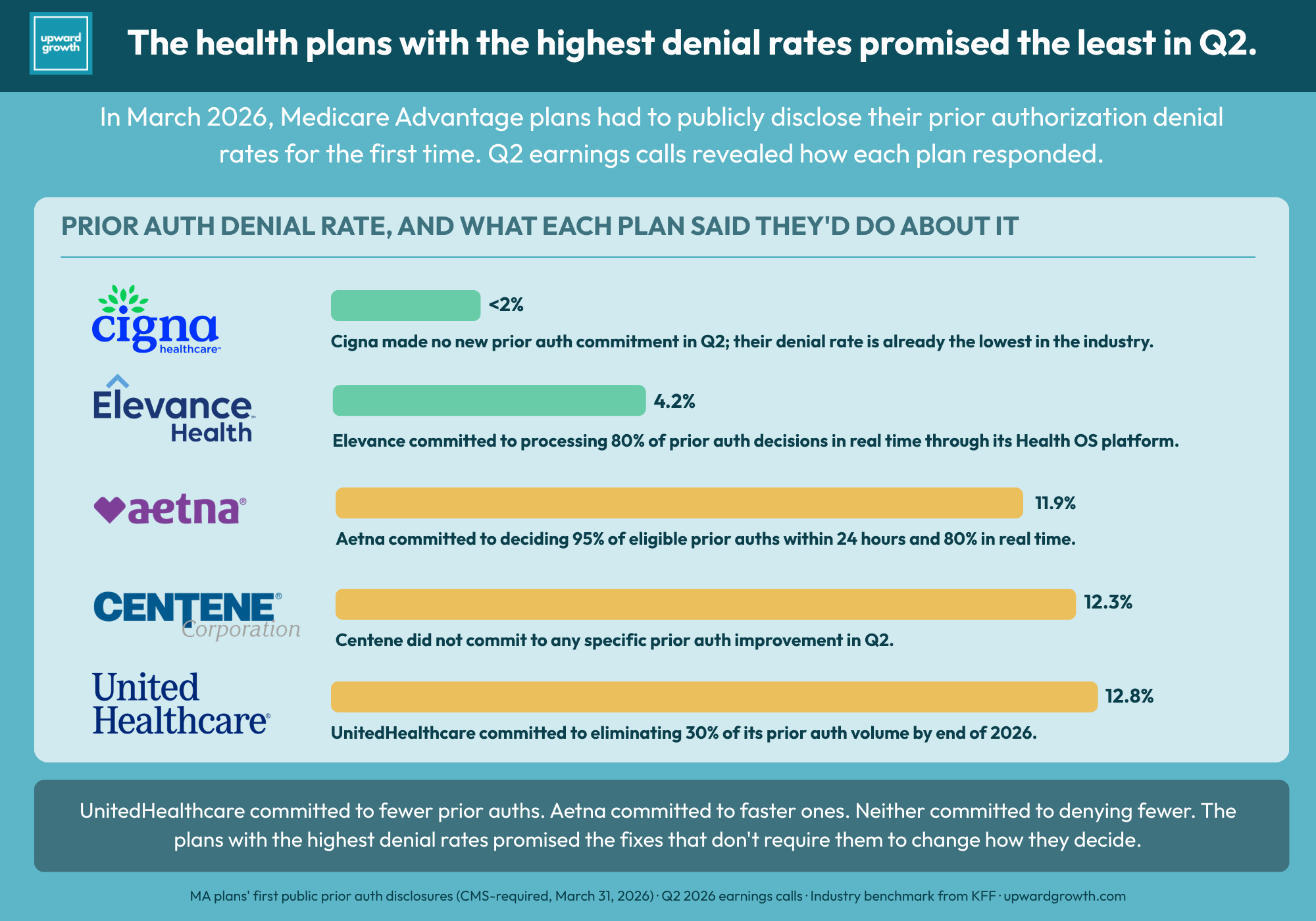
For vendors selling into any prior auth-adjacent category (utilization management, clinical decision support, provider workflow, member appeals), the negotiation is now against a stated deliverable, not an abstract build. That changes what a Q3 or Q4 pitch has to include: a credible read on whether the plan’s commitment holds on time, and a positioning of the vendor’s solution as either accelerating that commitment or filling the gap when it slips. Both positions can win a deal, but what loses is a message that ignores the commitment and assumes the plan is still in exploratory mode.
Remember, even those prior auth commitments have to run through the same Procurement, Finance, and Compliance review as every other vendor decision inside the plan right now, and that review is where the shape of Q3 and Q4 buying actually gets decided.
The commitments above are what the plans put on the record during their calls. What none of those calls really covered is the operational reality inside the plans while those commitments were being made, and that reality is the answer to why vendor deals across the market are stuck right now regardless of solution quality.
Every health tech CRO I am talking to is worried about their 2027 pipeline. The shift from 2025 to 2026 is real and specific. Through 2024 and most of 2025, plans facing a vendor decision they did not want to make or could not get through their internal process had a familiar way out. They extended the incumbent contract for one more year or deferred the decision. That decision-making (or lack thereof) worked because the internal review requirements had not yet reached the level they are at now. Vendors sat renewed with declining strategic conviction, prospective vendors sat waiting for the freeze to break, and the slow pace bought everybody another quarter.
The punt-to-next-year "strategy" is largely gone in 2026, driven by three specific pressures on plans right now: Office of Inspector General (OIG) and CMS audit defensibility, Star Ratings legal exposure, and artificial intelligence (AI) and data governance. Procurement, Finance, and Compliance are dealing with all of them at once, and every new vendor decision now runs through all three functions before it can move, regardless of what department originated it or what the solution actually does.
The first pressure is OIG and CMS audit defensibility. Elevance’s Q1 risk adjustment matter set the frame. The plan initially accrued $935 million against potential CMS liability, then ultimately paid CMS $342 million on May 27 to resolve the immediate sanctions threat. The gap between the accrual and the payment is less interesting than the reaction inside every other plan. When the Elevance matter went public in February and March, every payer compliance team pulled a defensive audit on their own historical risk adjustment submissions, and that work is still running through the industry in Q2 and Q3. Payment Year (PY) 2019 Risk Adjustment Data Validation (RADV) findings are expected in early 2027, and Kaiser Permanente’s $556 million settlement earlier this year set the ceiling for what these can look like at scale. Every procurement decision touching risk adjustment, quality, or member-level data now runs through internal review that assumes an OIG or CMS auditor will look at it later.
The second pressure is Star Ratings legal exposure, which just moved from a Clover Health matter to an industry-wide one. The May 27 ruling in Clover Insurance Company v. HHS threw out 20 measures CMS used to calculate the 2026 Star Ratings, finding them legally or procedurally improper. I wrote about why the Clover ruling was going to matter well beyond Clover itself when it came down, and Q2 confirmed it. CMS recalculated Clover’s rating using the court’s methodology, then issued a June memo saying it would voluntarily recalculate other plans’ ratings but only drop 10 of the 20 measures. Within weeks, Elevance sued CMS on July 1 claiming $115 million in lost bonus payments, SCAN Health Plan sued on July 7 claiming $125 million, and Alignment Healthcare sued on July 10 claiming $50 million. Three plans, three lawsuits, all citing the same Clover precedent. What was a settled operational discipline a year ago is now an active legal domain where Compliance and Legal have to weigh in on decisions the Stars operating team used to make on its own. The 2028 measurement year is running right now, and every vendor decision touching Stars-relevant workflows is being reviewed against the possibility that specific measures could be re-litigated between now and the 2028 ratings publication.
The third pressure is AI and data governance. Every plan is investing in AI, and the same investments powering the internal build also create governance obligations that did not exist eighteen months ago. Vendors selling AI-enabled solutions are being asked questions about training data provenance, model documentation, bias auditing, and third-party risk assessment. Data platform vendors face the same questions. Non-AI vendors are being pulled into the same conversation if their solution touches data that could feed a model somewhere else in the plan’s stack. I walked through how health plans are actually evaluating AI-enabled vendors in 2026 earlier this year, and the review requirements have only tightened since. The formal governance framework has not caught up with the review requirement, so internal teams are making case-by-case judgments, and case-by-case is always slower than a settled rule.
A vendor pitching a member engagement platform in Q3 is going to have Procurement pulling in Legal because the solution touches member data, Compliance because AI features could touch Star Ratings measurement, and Finance because the CFO who committed to guidance in July is watching every net-new spend against a shrinking book. What used to be a decision inside a single department is now a cross-functional review, and every function is understaffed for the volume of reviews landing on their desk.
Both the health plans and vendors I’m talking to are telling me deals are stalling more frequently. The buyer wants the product, but the plan can’t process the volume of new contracts moving through the system, regardless of the value and quality of the solution.
The pitches more likely to get through are the ones that arrive with the Compliance, Finance, and Legal answers already baked in, so the internal sponsor at the plan does not have to build that case themselves. Solution quality still matters, but the differentiator right now is whether the vendor has done the internal review work on the plan’s behalf.
The 5 to 7 million members losing coverage across Individual Exchange, Medicare Advantage, Medicaid, and MAPD exits are going to show up on receiving plans’ MLR before anybody is modeling them. And the Medicare Advantage share is going to show up on 2028 Star Ratings on top of it.
In urban ACA markets and metro Medicare Advantage counties, most of those transitions will have real alternatives. In the geographies and populations already most vulnerable to plan disruption, they will not. Rural Medicare Advantage counties where an exiting carrier’s plan was one of two options in market. Individual Exchange markets where the exiting carrier was the low-cost or the only preferred provider organization (PPO) option. Medicaid members caught in a plan exit who get force-assigned to a replacement without visibility into whether their specialist or their behavioral health provider is in the new network. And dual-eligible special needs plan (D-SNP) members built around a care team that no longer participates in the receiving plan. Many of the receiving plans are also cutting providers from their networks as they reprice for 2027, which makes the network-continuity story for displaced members even harder.
Two consequences fall directly on the plans that stayed in market and the vendors selling to them.
The first is adverse selection into the receiving plans. When a competitor exits, the plan absorbing the displaced membership does not get a random sample. It gets the members whose usage or geography made them uneconomical for the exiting carrier, which is the reason those members got dropped in the first place. The receiving plan now has to underwrite them at CY 2027 rates and manage them clinically against a book that was priced for a different member profile. That shows up in the receiving plan’s MLR in the second half of 2027 and gets debated on earnings calls in 2028. The plans absorbing displaced books have not yet discussed the adverse selection risk publicly, and they will not have to until those 2028 calls.
The second is the member experience data being collected right now, in Q3 and Q4 2026, for the 2028 Star Ratings measurement year, which applies specifically to Medicare Advantage plans. MA members going through a disruptive plan transition do not rate their next plan the way they rate a plan they picked in a stable market. Confusion, network mismatches, medication continuity gaps, and prior authorization disruptions all land in Consumer Assessment of Healthcare Providers and Systems (CAHPS) scores at exactly the moment the tripled CAHPS weight is redefining the Stars leaderboard. Any MA plan absorbing displaced MA members from Humana’s, UnitedHealth’s, or Cigna’s exits is going to see that land on the 2028 rating, and no CFO named it on their July call.
There is a political layer to this too. State attorneys general, CMS, and Congress are all watching the exits. If the 2027 open enrollment cycle produces public backlash over rural access, Medicaid churn, or Part D affordability, the regulatory response into 2028 gets harder for every plan that used the shrink to hit its 2026 numbers.
For MA plans absorbing displaced MA members, the pitch is direct: the 2028 Star Rating is being written in CAHPS data right now, and the tools deployed in Q3 and Q4 will show up on the rating. For plans absorbing displaced ACA or Medicaid members, the same argument works on adverse selection alone since Star Ratings doesn't apply to those books. Receiving plans in either case already know the risk is real.
Pulling the threads together, Q3 and Q4 look different from what the Q2 earnings coverage suggests.
Health plans have earnings tailwinds, and their bandwidth to close new deals is the tightest it has been in two years. The plans that overperformed against April guidance will push harder on 2027 procurement than the ones that only met it. That harder push cuts two ways: it either accelerates internal builds, which shrinks the vendor category, or accelerates vendor consolidation, which is good for the category winner and bad for the rest. Either way, shortlists that ran through five vendors a year ago are running through two or three now, and each of those has to survive the same three-function review as everything else.
Q2 also surfaced four unresolved variables that will shape CY 2027 procurement and set the 2028 outlook:
The CY 2028 Advance Notice from CMS lands in January or February 2027, and the temporary risk-model freeze that made CY 2027 workable does not extend into it.
The Medicaid recovery language Elevance and Molina committed to has to actually show up in 2027 numbers, or those CFOs will have to defend the framing on the Q2 2027 calls.
The 2028 Star Ratings measurement year is running right now, and the 2027 Stars release in early October will preview what the tripled CAHPS weight actually does to the leaderboard.
The enhanced premium tax credit (PTC) question stays open through the CY 2027 rate cycle. Restoration slows the narrowing of ACA absorption capacity that carried the 2026 shakeout. Continued absence accelerates it.
None of the four are predictable, and each one will shape the CY 2027 buying environment more than the Q2 numbers themselves did.
The Q1 public health plan earnings calls were the language quarter. Q2 was the commitment quarter. The six plans that reported over the last three weeks locked in specific numbers, timelines, and portfolio moves they now have to defend for the rest of this year and into next. Reading Q2 as a commitment quarter, rather than a recovery, is where the useful work of Q3 starts.
If you are working through what any of this means for your positioning, your messaging, or your go-to-market strategy, Upward Growth is a health plan market advisory firm that works with health tech vendors, investors, provider organizations, and management consultancies to build strategy around how health plans actually buy, operate, and make decisions. Contact us here.
Thanks for reading.
Here’s to upward growth,
Ryan Peterson
The frameworks in the weekly Upward Growth newsletter help health tech sales and marketing teams navigate payor conversations as the market continues to shift.
If your colleagues are in those conversations, they should be reading this too.
💰 Invest In Your Team with a Paid Subscription.
💡 Pro tip: Many subscribers expense Upward Growth through their company’s professional development, training, or learning budget. Here’s a one-minute email template to get your manager to approve expensing your subscription.
Comments
Nothing yet. Say the first thing.
Sign in to join the conversation.