
Upward Growth is a health plan market advisory firm. Our weekly newsletter covers payor market strategy, regulatory shifts, and go-to-market insights for health tech vendors, investors, provider organizations, and consultancies competing in the health plan market.
🤝 Work with us on payor market strategy: Contact us
🟦 Connect with the author, Ryan Peterson, on LinkedIn.
🎧 Listen to the Upward Growth Podcast: Apple | Spotify
📰 Newsletter sponsorships: Learn More
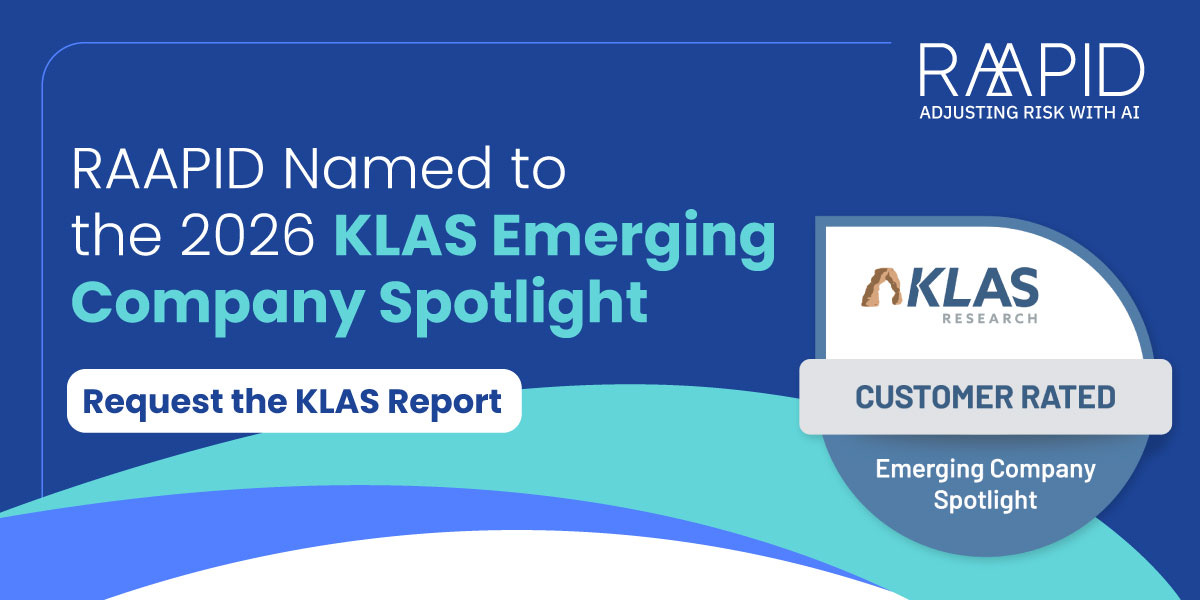
RAAPID‘s KLAS Emerging Company Spotlight is out — and every customer interviewed said they’d buy again.
KLAS interviewed RAAPID’s health plan customers for its May 2026 Emerging Company Spotlight.
The results: A+ score for “would buy again*,” an A score for likelihood to recommend, and standout marks for audit defensibility and partnership responsiveness.
Independent validation from health plans that actually use the platform.
(*Emerging Data, n=5)
Click the button to see the full ratings and customer commentary in the KLAS report:
Interested in sponsoring Upward Growth? Learn more
I snuck up to Big Bear recently for a couple of days. Most SoCal folks know it as the local ski spot, but in summer it turns into a different playground: hiking trails, mountain biking, and a few lakes to poke around on. Getting away and immersing in something different is how I stay fresh, open, and curious, and that’s the same mindset I try to bring back to the work.
And that mindset is what this week’s article calls for. On the surface, it looks like a piece about GLP-1s, but the real work is trying to read the tea leaves on what CMS is thinking, and where the next round of programs aimed at curtailing federal cost while improving clinical outcomes is heading. GLP-1 through the Bridge Program this week. ACCESS the other week, and its companion podcast episode too. Every one of these programs is a data point in the same larger picture.
And to be direct, a few readers and a client have been pinging me about Bridge since the ACCESS piece ran, asking whether I’d walk through it the same way. Most of the folks I talk to are having a harder time than usual keeping all these new CMS specialty coverage programs straight (I do not blame them...). Such Center for Medicare and Medicaid Innovation (CMMI) models like ACCESS, The Better Approaches to Lifestyle and Nutrition for Comprehensive hEalth (BALANCE) Model, and the standalone CMS demonstrations like Bridge that sit alongside them. So this week we'll discuss Bridge, why its ripple effects show up across every line of business you sell into, and what its design signals about how CMS structures the next high-cost specialty category.
The Medicare Glucagon-Like Peptide-1 (GLP-1) Bridge Program launched July 1. Its design is the reference architecture for how the federal government will structure coverage for the next high-cost specialty drug category. If you sell to health plans in any category, that design is now inside your 2027 pipeline.
Two key things to know as we get started.
First, GLP-1 coverage has been talked about as one story for two years, but really, that story is splitting. Five lines of business are each making a different 2027 coverage call on GLP-1, on different timelines, and the medical trend impact is a line item in nearly all plans’ 2027 pricing this cycle. That shapes what plans are willing to fund across the rest of your product categories, obesity-adjacent or not.
Second, Bridge's design will not stay inside GLP-1. The demonstration runs on a short runway, prior auth is retrospective, a central processor operates outside plan risk, and BALANCE, the permanent structure that was supposed to replace it, sits indefinitely delayed for Part D. That's CMS's template for how to structure federal coverage for a high-cost specialty category when the permanent framework isn't ready. Cell and gene therapy access is next. Cardiovascular specialty drugs after that. How Bridge plays out through Q4 tells you how CMS will structure the coverage decision on your buyer's next category.
But first, let’s dive into what Bridge actually is.
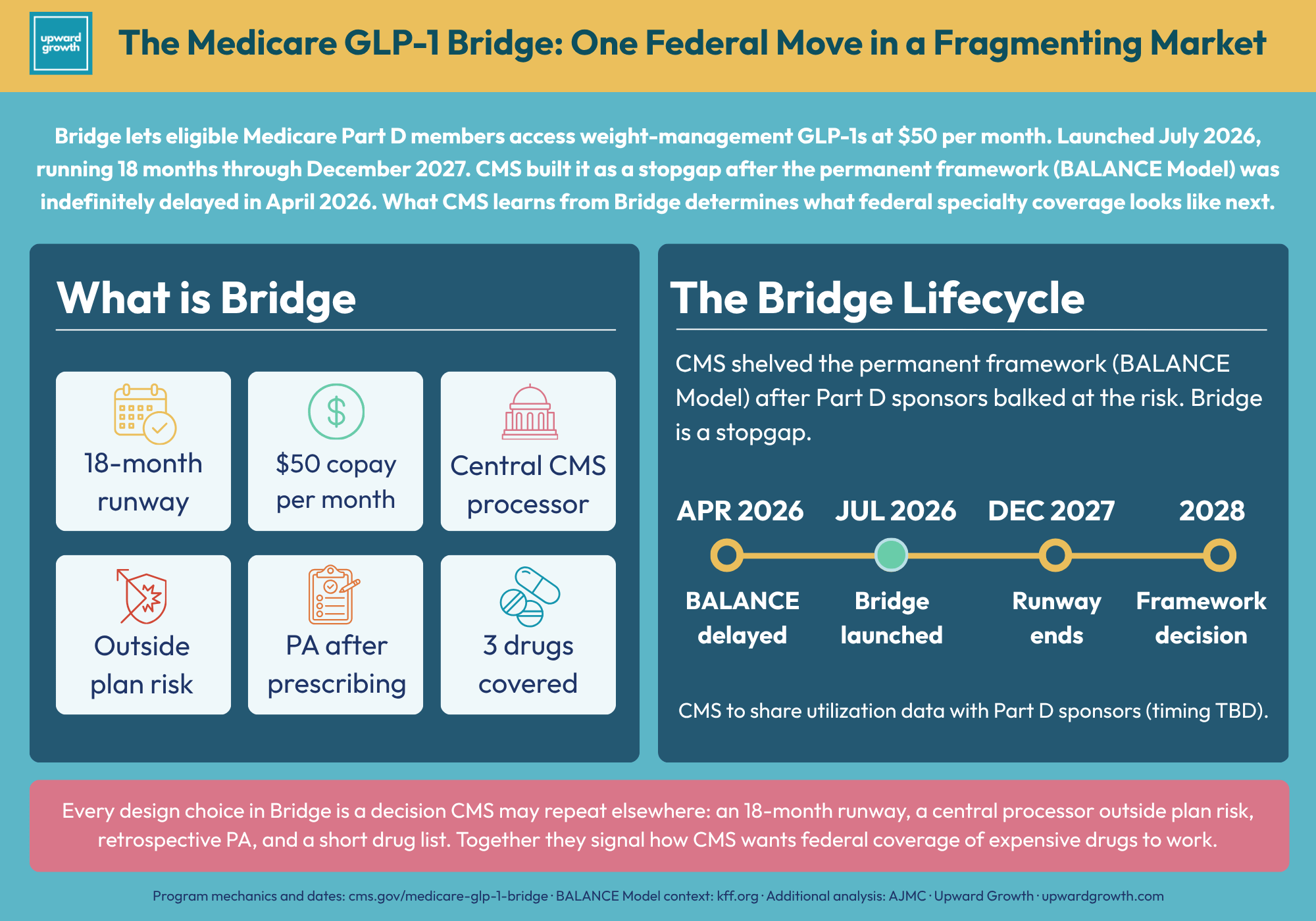
Bridge is a temporary demonstration that gives eligible Medicare Part D beneficiaries access to weight-management GLP-1s at a flat $50 monthly copay. It runs July 1, 2026 through December 31, 2027, and it covers Wegovy (all formulations), Zepbound (KwikPen formulation only), and Foundayo (Eli Lilly’s oral orforglipron, FDA-approved April 1, 2026).
Bridge operates outside standard Part D coverage and payment flow, which means Part D plan sponsors do not carry risk for weight-management GLP-1s dispensed under Bridge. CMS uses a single central processor to handle prior authorization, claims adjudication, and pharmacy reimbursement. Providers submit retrospective prior auth requests after prescribing, and beneficiaries do not opt in. The CMS guidance also commits CMS to sharing utilization data with Part D sponsors ahead of the permanent implementation, whenever that lands.
Bridge was originally announced in December 2025 as a six-month bridge to the BALANCE Model. In May 2026, CMS indefinitely delayed the Part D portion of BALANCE and tripled the Bridge runway to eighteen months. The Medicaid portion of BALANCE remains active, with states able to opt in from May 2026 onward. What CMS is buying with the extended runway is utilization and cost data on real beneficiaries before committing to BALANCE in Part D.
Eli Lilly’s executive team has projected roughly 20 million Medicare beneficiaries could meet the Bridge clinical criteria of a Body Mass Index (BMI) of 35 or greater, or 30 or greater with a qualifying comorbidity. AJMC modeling puts the real-world reach far below that. Three things create the gap: the retrospective prior auth design, the requirement to document BMI at the time of therapy initiation (a paperwork burden for beneficiaries who started GLP-1 therapy years ago for a different indication), and the exclusion of Private Fee-for-Service (PFFS) plans, PACE, and several other niche MA plan types from participation."
Bridge and the ACCESS Model are both CMS efforts to reshape coverage for chronic and specialty conditions, but they operate at very different scopes and time horizons. ACCESS is a CMMI model, a durable framework built inside traditional Medicare fee-for-service, aimed at aligning outcome-based accountability across chronic conditions over the next decade. Bridge is a CMS payment demonstration outside the CMMI model structure, aimed at one drug class for one indication, on an eighteen-month runway. ACCESS points to where CMMI wants chronic care payment to go long-term. Bridge is the interim tactical solution while BALANCE sits indefinitely delayed for Part D. The deeper read on ACCESS and the outcome-based framework is in the ACCESS article and on the podcast episode.
Bridge’s design is CMS’s template for structuring federal coverage of a high-cost specialty drug category when the permanent framework isn’t ready. GLP-1 is just where CMS is running it first.
Bridge's design is CMS's template for structuring federal coverage of a high-cost specialty drug category when the permanent framework isn't ready. GLP-1 is just where CMS is running it first. Cell and gene therapy access is the next category CMS applies this to. Cardiovascular specialty drugs after that. If your product or your portfolio touches either of those categories, how the Bridge rollout plays out through Q4 2026 is the leading indicator for how CMS will structure the coverage decision that lands on your buyer’s desk next.
That covers what CMS did. The rest of the market did something too, and it's different in every line of business. Let’s take a look.
Something worth naming before the walkthrough. Bridge itself is a Medicare-only program. But the pressure that produced Bridge (rising GLP-1 spend, coverage decisions plans and employers can’t sustain at current utilization) is showing up in every line of business, and each buyer segment is responding on its own timeline against its own math.
On the Medicare side, Bridge itself just changed the equation. MA plans had one indication lifted off their Part D risk sheet, and standalone PDPs got a new central-processing pipe with no relief on the member navigation problem it creates. Outside of Medicare, the pressure is showing up in different forms. State Medicaid programs closed their budgets against a spend line that was doubling year over year, and the elimination cycle isn’t over. Self-insured employers are locking their 2027 plan designs mid-August, working from consulting firm guidance that has pulled back over the last twelve months. ACA health plans filed rate increases in mid-summer that averaged 14%, with GLP-1s named as one of the drivers.
That’s why the aggregate story from the last two years no longer works. There are five different 2027 GLP-1 answers depending on who your buyer is, and where each of them nets out also tells you something about what they’ll fund from vendors across your other product categories this cycle.
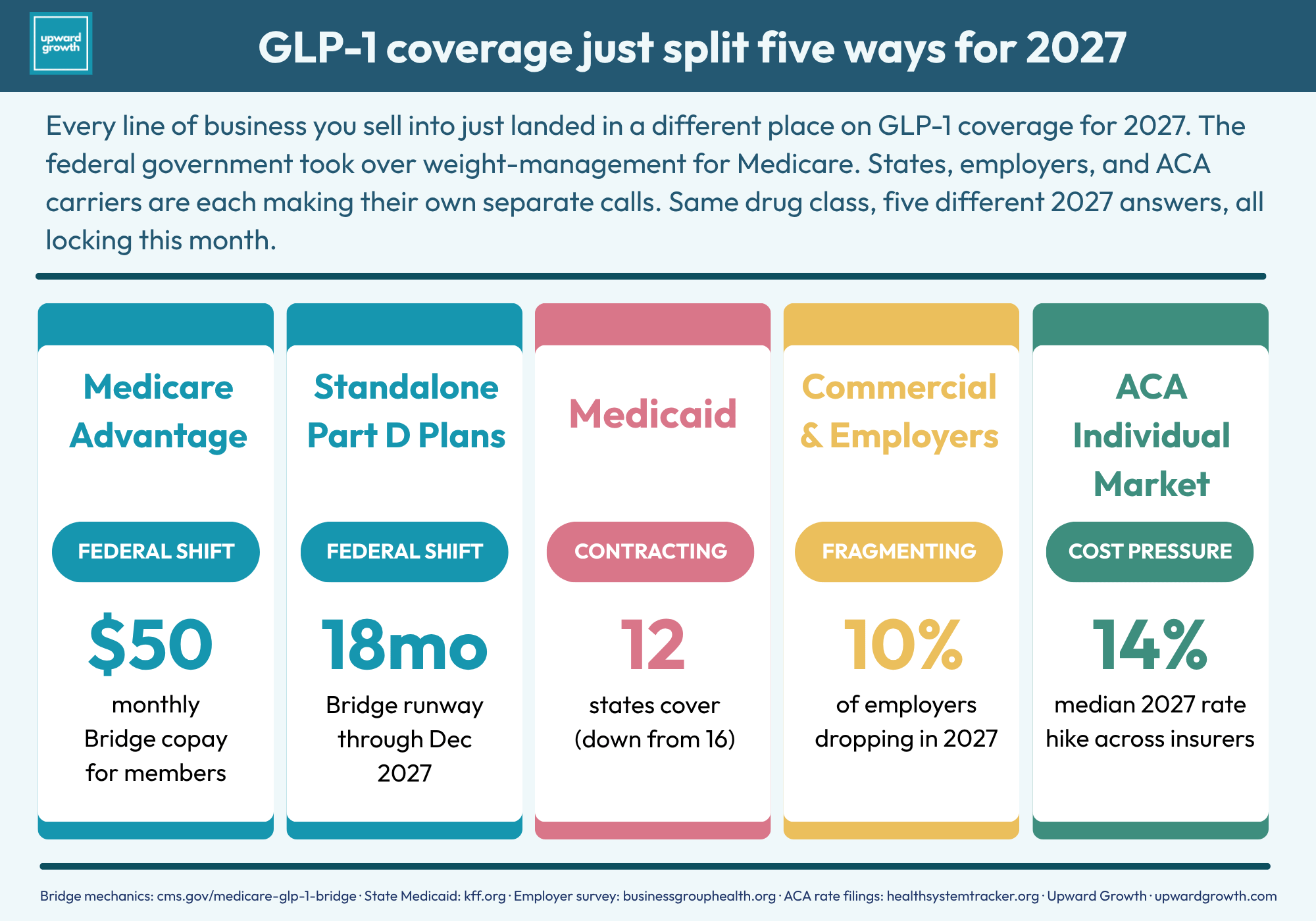
Bridge changes the MA bid math for 2027 by taking one indication off the plan’s Part D risk sheet. MA plans that include prescription drug coverage no longer have to price the weight-management indication into their 2027 bids. They still price GLP-1s for the approved non-weight indications like diabetes and cardiovascular risk reduction, but the weight-management piece shifted to CMS on July 1. The first implication is that member education about Bridge eligibility becomes a benefit differentiator. A plan that helps members navigate intake looks better on member experience than one that doesn’t. The second is that Q2 2026 earnings language on specialty pharmacy trend is mixed across the largest MA health plans. UnitedHealth’s Q2 call cited GLP-1s as part of a continued elevated commercial pharmacy trend. Humana’s Q2 call described pharmacy medical cost trends as “very elevated” without isolating GLP-1s. If you sell to MA plans in any category (care management, risk adjustment, quality measurement, member engagement, PBM tech), what those plans say about pharmacy trend across the next two earnings cycles is what your buyer will point to when justifying or cutting vendor budgets.
PDPs don't hold the medical relationship, which shapes the Bridge angle here. Standalone PDPs serving dual-eligible populations need workflow for identifying who qualifies for Bridge versus who's covered through their existing Part D plan for other indications, because dual-eligibles enrolled in eligible plan types can participate but the qualifying rules are more complex than for the average MA-PD beneficiary. Vendors with PBM technology, member engagement platforms, or Part D workflow tools have a new addressable use case that did not exist before July 1, regardless of whether their product touches obesity at all.
Twelve state Medicaid programs cover GLP-1s for obesity treatment under fee-for-service as of August 2026, down from thirteen at the start of the year and sixteen the year before, and the elimination list is not one-off. Four states dropped coverage effective January 1, 2026 (California, New Hampshire, Pennsylvania, South Carolina), Massachusetts followed with a cut effective July 1, 2026, and Michigan and Virginia tightened eligibility to morbid-obesity thresholds. Pennsylvania Medicaid's GLP-1 spending grew from $233 million in 2022 to $1.3 billion in 2025, and the state projected $836 million in savings from elimination. The cost pressure driving that decision does not reverse in twelve months. For vendors selling to state Medicaid MCOs, the read-through is direct. States cutting GLP-1 spend are running the tightest 2027 rate cycles for their MCO contracts, which squeezes what those MCOs will fund from vendors across care management, risk adjustment, quality measurement, and behavioral health.
Fully insured commercial plans have already made their coverage calls (Blue Cross Blue Shield of Massachusetts, BCBS Michigan, and Harvard Pilgrim all discontinued weight-loss GLP-1 coverage effective 2026). Self-insured employers are still locking their 2027 designs, with mid-August the pressure point. The Business Group on Health 2026 survey of 105 large employers found 67% currently cover GLP-1s for weight management, but only 72% of covering employers intend to maintain in 2027 and 10% expect to drop. A Willis Towers Watson June 2026 pulse survey confirmed the direction (66% cover, 12% likely to discontinue for 2027). The Pharmaceutical Strategies Group 2026 Trends in Drug Benefit Design report, covering 237 benefits leaders, found 49% of payors not currently covering GLP-1s for obesity would not cover at any price, driven in part by discontinuation rates (nearly two-thirds of non-diabetes users discontinue within twelve months). Cigna’s Q2 call meanwhile cited decelerating GLP-1 prescription growth in the employer book. Three independent surveys and a payor earnings call are telling the same story: employers and commercial plans are rebalancing what specialty pharmacy categories they will fund. For vendors selling anything into self-funded employers, how the account handled GLP-1 coverage for 2027 tells you where the rest of their 2027 specialty spend is going.
ACA health plans are pricing GLP-1 exposure into 2027 rate filings alongside broader medical trend running double digits in most states. Peterson-KFF Health System Tracker analysis of 77 insurers across 16 states plus DC found a median 2027 rate increase of 14%, with a range of 1% to 52%. GLP-1s are named in most filings as one of the drivers, alongside utilization, coding intensity, and Independent Dispute Resolution costs. Employee Benefit Research Institute analysis published by the Blue Cross Blue Shield Association puts the GLP-1 add-on to employer premiums at up to 14%, even with tight clinical eligibility. That premium pressure is compressing what ACA plans can fund in 2027 across their product categories, not just obesity-adjacent.
What that means for your pipeline is the harder question, and it doesn’t sort by product category.
The pitch that worked at the start of the year is losing meetings now. Plans, employers, and state Medicaid programs have made their 2027 coverage calls on GLP-1, and they didn’t all land in the same place.
The decision patterns are worth naming, because they will repeat for the next high-cost specialty category. Any vendor selling into plans should recognize them.
Pattern one: the plan dropped coverage. Blue Cross Blue Shield of Massachusetts. Pennsylvania Medicaid. The employers on the discontinuation list. Once a plan or employer publicly ends coverage in a high-cost category, the political and budget cost of reversing that decision is prohibitive for at least two cycles. Track the plans that dropped GLP-1 coverage in 2026, because the ones cutting now are the ones that will cut on the next high-cost category you pitch them three years from now.
Pattern two: the account covers but is drowning in management overhead. Most plans that still cover GLP-1s are managing them with prior auth, biometric eligibility validation, weight-management program requirements, and dollar caps around $3,000 per member per year. It’s also the largest cohort by members. The buyer at these accounts measures vendor pitches against prior auth reduction, medical loss ratio impact, cost-per-member outcomes, and discontinuation catch rates. The pitch that works here reduces management overhead per member covered. The pitch that stalls promises to help serve more members. Care management vendors selling into oncology and specialty pharmacy vendors selling into rare disease run into the same buyer pattern.
Pattern three: the account is defending its coverage internally. Some regional plans and a shrinking cohort of employers are holding GLP-1 coverage against internal pressure to cut. The buyer at these accounts has moved past clinical merit and is building the internal ROI case to defend the coverage decision to a CFO looking at the same 14% premium math the Employee Benefit Research Institute cited. What sells here is real outcomes evidence: adherence data, weight-regain prevention, long-term ROI. Enrollment and engagement metrics won’t get the CFO to renew.
Pattern four: the workflow layer just changed. Bridge central processing means pharmacies and providers now handle GLP-1 workflow through a different pipe than standard Part D. That’s a workflow enablement sale for vendors with Part D infrastructure, prior auth support tools, medication therapy management platforms, or provider workflow tooling. Each time CMS introduces a new demonstration structure (Bridge now, cell and gene therapy access next), the operational workflow changes before the coverage rules settle. Infrastructure vendors get a real opening while the demonstration is running, and it closes fast once CMS finalizes the permanent structure.
These patterns show up in oncology, rare disease, and cell and gene therapy, not just obesity-adjacent categories. GLP-1 is the clearest example of all four hitting at once, which is what makes it useful for reading how your own category might be affected.
We've covered what Bridge actually is and why its design is the reference architecture for the next high-cost specialty category, how GLP-1 coverage splits across the five lines of business above, and the buyer decision patterns visible in the split. Below is the tactical layer underneath all of it: the discovery questions that tell you which pattern each account is in, the disqualification signals worth acting on early, the messaging shifts by pattern, and the fall enrollment watchlist that tells you whether Bridge's design becomes the template for the next high-cost category or stays a one-off.
Paid subscribers get this, plus 50+ frameworks, scripts, and deep dives built for health tech teams selling to health plans. One qualified conversation from these frameworks is worth more than a decade of subscriptions.
🔓 Upgrade to a paid subscription to keep reading.
Comments
Nothing yet. Say the first thing.
Sign in to join the conversation.