
There are those, who believing in deterministic materialism, cling to Darwin’s theory of chemical and biological evolution as if it were a life raft, kicking out into the cold any who counter them, such as, say, religious nutcases.
There’s a problem: The random mutations that drive evolution cannot explain the higher levels at which humans operate. Unlike animals, we have the ability to reason and to hold values. Evolution lacks explanations for how the foundations of chemistry and biology — physics and mathematics — came into existence.
To visualize the problem, let’s stack levels of knowledge that define the world as we understand it. Each higher level is dependent on all other ones below it. We cannot have physics, for example, without mathematics; we cannot have values without a mind that can reason.
? ? ?
------------------
Values
------------------
Mind-Reason
==================
Biology
------------------
Chemistry
------------------
Physics
------------------
Mathematics
------------------
? ? ?
Question marks at the top and bottom of the stack meant that we don’t know what undergirds Mathematics, nor what lies above Values. π is π, and no number of parallel universes can deviate from 3.141...
Evolution can explain some developments of biology and chemistry; both contain elements that change over time. Physics and mathematics, on the other hand, are unchanging, despite the ardent efforts of intersectionalists.
At the other extreme, material determinists attempt to extend evolution to areas like psychology, anthropology, and even astronomy in their attempt to explain the origin of our minds, reasoning, and values. This is what’s at work when someone states, “It’s due to evolution” — they’re hiding that they have no explanation. It’s the god-of-the-gaps for the ungod crowd.
Why we have minds that reasons and act on values — rather than minds like animals that only react, without thinking through future consequences — is a puzzle to be solved. These are the possibilities from which we choose:
Choice A. As humans evolved from animals, we co-evolved higher-order minds and then developed value systems based on our interactions with others.
Choice B. A supreme external to the universe, such as the Jewish God Yhwh, who created humans separately from animals, and then injected his image into them, providing their minds with reasoning and values.
Choice C. Some other mechanism, one we have not yet uncovered.
When it comes to A. and B., both sides have their hard-core-ists. Material determinists go so far as stating categorically that we have no free will; me, in writing this article, for instance, was pre-determined by chemicals interacting in my brain biology to put fingers to keyboard and produce this text. I could not choose to not do this, according to material determinists. This is the same thought process is used by those who consider criminals victims.
At the other end are hardcore creationists who consider no explanation beyond a six-day creation starting on October 23, 4004 BC [source].
Both sides, I argue, are insecure in their positioning. In both camps, nothing is more likely to generate a shunning of others than to admit the g- and e-words, respectively.
I had to chuckle the other day when I read the scientism claim, made in earnest, that science has proved determinism is true [source]. Allowing free will into the tent of the determinist camp would mean that science cannot explain everything — an anathema!
Creationists can’t go beyond young-earth creationism, because that allows the possibility of evolution being true, in how long-term changes were wrought.
The problem for science is that cannot study what it cannot study. The land beyond science is called metaphysics. We can admit that such a land exists (philosophy); or we can co-opt it by turning the metaphysical into the physical (scientism); or we can ignore it exists (materialism).
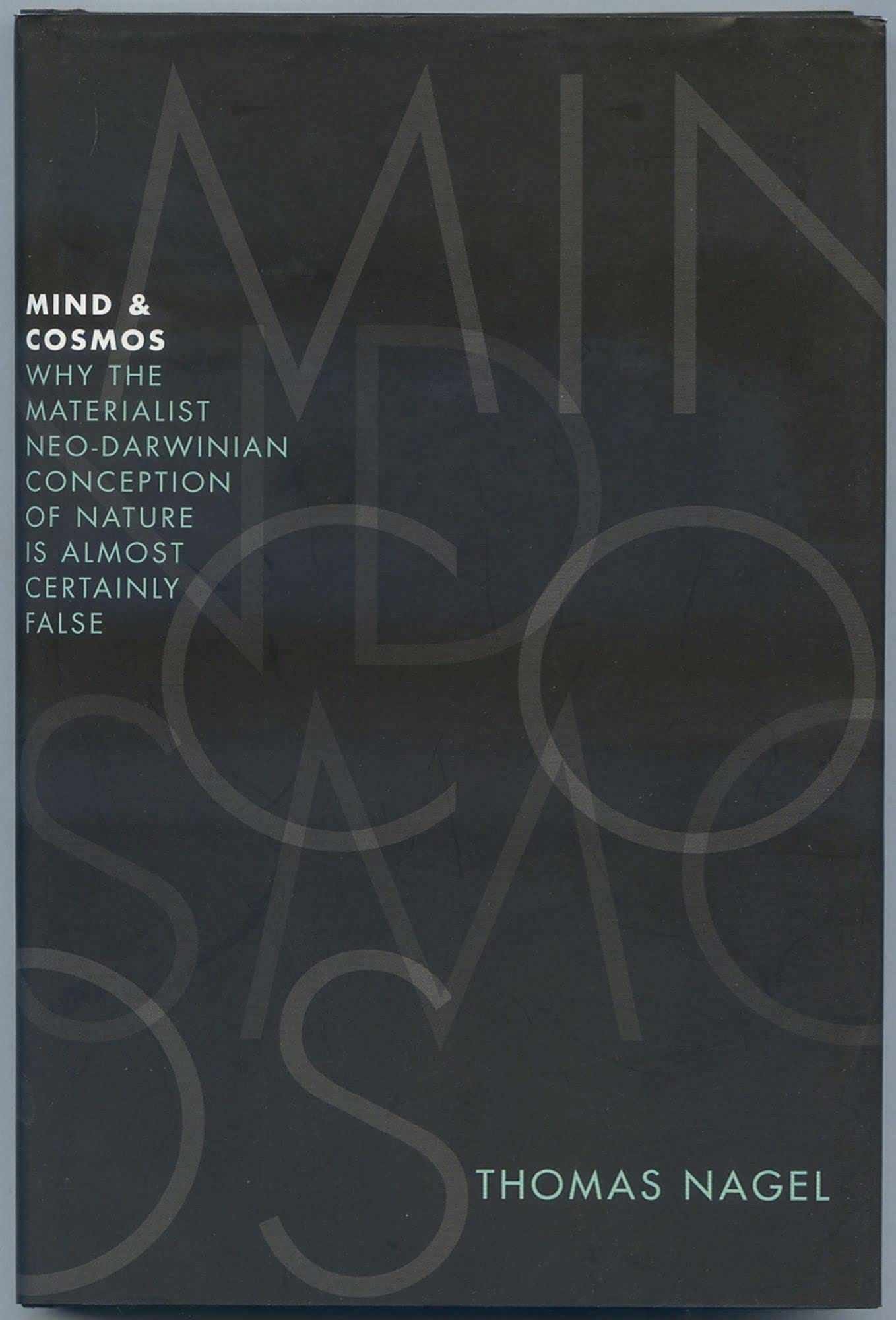
Mind & Cosmos book written by Thomas Nagel
Philosopher and lawyer Thomas Nagel confronts these topics in Mind & Cosmos. The problem he tackles is in asking how evolution could have developed a human mind that reasons and has value preferences.
He presents the problem using his legal mind; he debates various answers with his philosophical mind. He is an atheist, yet he includes the intelligent designer option, albeit distastefully, for completeness.
How did we arrived at a reasoning mind? He presents too many options for me to list here.
How did we establish values? He zeros in on a simple use-case: Pleasure and pain. He defines values as caring about ourselves and others, and then argues that we developed values, because we discovered the positive aspects of pleasure (such as giving a present to someone) and negative aspects of pain (such as being rejected by a once-trusted friend).
He writes, “I would like to extend the boundaries of what is not regarded as unthinkable, in light of how little we really understand about the world. It would be an advance if the secular theoretical establishment, and the contemporary enlightened culture which it dominates, could wean itself of the materialism and Darwinism of the gaps.”
He grasps the state of the Western world, where some have the arrogance to stand atop civilization confidently knowing all that is knowable, and that variations to what they know are unthinkable — not just in science, but in politics and religion as well.
- - -
I recommend that you read this book having some background in philosophy or theology. The pages cover concepts like epistemology [limits of knowledge] and teleology [purpose]. Indeed, it took me some time to get through the 144 small-format pages, as I had to pause every so often to take in what he had just presented, and then to reread the last section. Should you begin reading this book, I advise that you begin with Chapter 6, Conclusion -- just two pages -- as your introduction to reading this work.
Mind and Cosmos: Why the Materialist Neo-Darwinian Conception of Nature Is Almost Certainly False
by Thomas Nagel$35.95
144 pages, hardcover
Published 2012 by Oxford University Press
ISBN 9780199919758
Comments
Nothing yet. Say the first thing.
Sign in to join the conversation.