
Substack, on which this blog runs, lets you support me and WorldCAD Access through annual subscriptions. If you want to make a one-time contribution, then I’ve set up some non-subscription alternatives:
Buy me a coffee -- https://buymeacoffee.com/grabowskif
In Canada -- eTransfer to grabowski@telus.net
Speaking of support, thank you! to
* Chris Huntley
Engineers built the Mac’s foundation. Apple forgot. I expect nothing less.
- Agnes Broad (via Twitter)
The Mac AEC story can be extended to MCAD software products. Pro/Engineer, SolidWorks, SolidEdge, etc. are all Windows-native products. Shapr3D-like products supporting the Mac platform came much later.
Sometimes I wonder about this issue: Why is it that the software companies are reluctant to develop on the Mac? I think part of this could be the continuous disruptive changes from Apple during the PowerPC -> Intel -> Apple Silicon transitions.
I remember when I was at Vectorworks, we always dreaded about the possibility of finding breakages after a major release from Apple. The Mac platform has definitely become solid and stable in recent years, but still requires a lot of testing before/after Apple’s yearly release, compared to Windows major releases -- which mostly just works and breakages are minimal.
The other issue is to find Mac developers in the market: There are fewer Mac developers than the number of Windows developers. Mac development is, in my mind, an acquired taste; once you know how to do it, you might end up loving it.
-Biplab Sarkar, ex-CEO of Vectorworks, Inc.
The editor replies: One alternative for Mac users is to operate CAD systems that run in Web browsers, like Onshape, or else in virtual machines, like Parallels.
Qonic is a newly developed BIM tool with extraordinary features. It is available for Windows and Mac (IOS and Android as well).
- D. C. B.
The editor replies: It’s good to let readers know that Qonic works on multiple platforms, as it is Web-based. It launched four years ago at community.qonic.com.
Publisher David Levin ran an abridged version of Anthony Frausto-Robledo’s article, translated into Russian, at https://isicad.ru/ru/articles.php?article_num=23460.
One reason there are proprietary formats: $. We couldn’t ever get OpenRFA off the ground. We couldn’t even get industry standards on which data fields should be used for which components. There’s so much that needs to be done for BIM collaboration to work.
- Dave Edwards
The editor replies: OpenRFA specifies parameters and collections for Revit RFA family files. You can learn more about it through app.opendefinery.com/collection/10794.
Just a reminder: Rhino has its own geometry kernel. We provide open-source libraries for reading and writing 3DM files. The libraries are completely free, including developer support. The libraries are available for most operating systems.
Also, Rhino reads and writes dozens of 2D and 3D files formats, including many of those supported by OpenDesign — with more on the way as OpenDesign adds more support.
All of the supported formats are included with Rhino at no extra charge.
- Robert McNeel
The editor replies: Rhino is a 3D modelling program that’s kept its price at $995 since, like, forever, and — as a bonus — is a permanent license. Learn more at www.rhino3d.com.
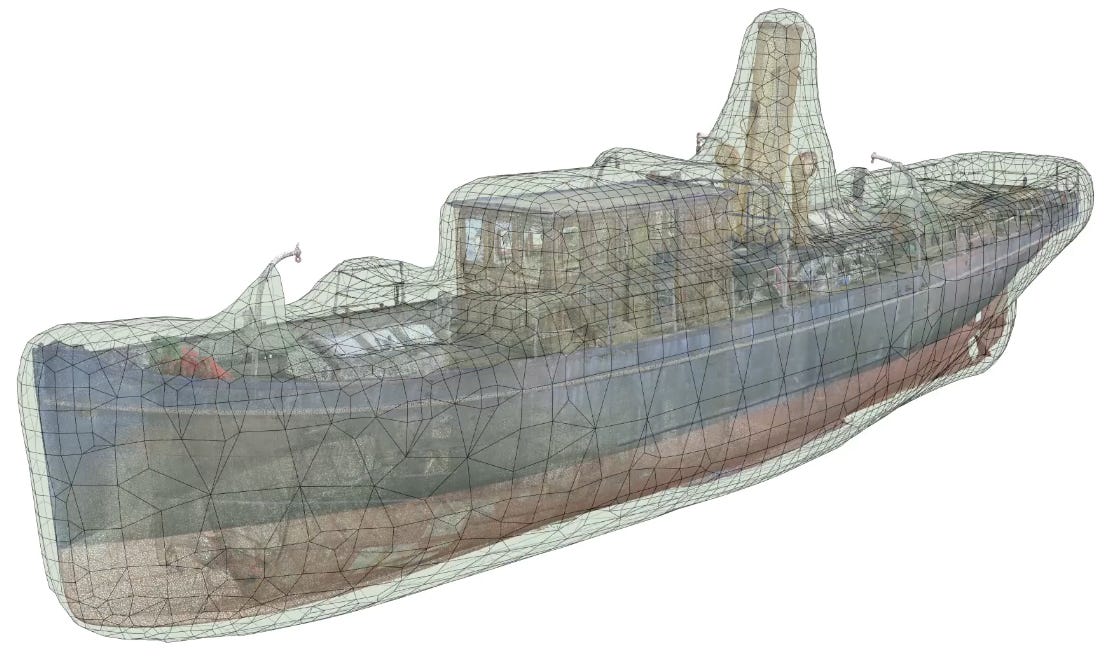
3D scanned model of a boat being shrinkwrapped by Rhino
Please get some sub-editing, even if it’s by AI. The constant (every sentence) parenthetic (as in not essential to the current sentence) statements make it (nearly) impossible to read (it is).
- Ian End
The editor replies: The great thing about having your own blog is that you can use any writing style you want. Freedom through the press!
As for the Note A1, it appears to me to be case of hardware being ready far before the software was. Since I wrote this review, TCL has shipped software updates every two weeks. The most important arrived last week to add Google Play store, so that we can now install just about any app we want.
I was interested in the comments made by Mark about the lack of AI in civil engineering design applications. Towards the end of April, we are launching the latest version of Corridor EZ, a Civil 3D application which automates road design.
Whilst AI has been present in Corridor EZ since 2020, the new release sees the emergence of dedicated AI assistants in the software. The AI assistants help civil engineers overcome the complexity and nested layers of commands inherent in civil engineering software. As a result, designs can be both generated and optimized via textual conversations with the AI assistant.
Given the shortage of civil engineers in North America and around the world, I don’t think that AI will be replacing civil engineers any time soon. Rather, the introduction of AI will free them from the constraints that civil design software has burdened them with.
- Andrew English
The editor replies: The software is of interest to me as my degree is in Civil Engineering, and I specialized in transportation planning — albeit 45 years ago. Corridor EZ and other civil-related software matches Australian standards, and can be found at civilsitedesign.com.au.
Mark Burhop attended Hannover Messe 2026 in Germany and reported on what he saw on his blog at burhop.substack.com.

Mark Burhop live on the scene from Hanover, Germany
So reminiscent of two bellwether shows I attended:
Siggraph 2014 was all about 3D tv, and how it was ready to become the giant new market.
A/E/C Systems 2000 was over-the-top around Internet and CAD. (One of the suitcases I came home with was filled just with booth trinkets.)
In one, 3D tv, the market never materialized. In the other, the Internet became an optional extra, not the center focus for CAD.
I think that AI will become an optional extra, kind of like collaboration has become in CAD. Even then, AI will be shown to be clever coding, and won’t exhibit actual intelligence. In all three cases, there too many venture funds paid for too much marketing.
- Ralph Grabowski
Mark Burhop replies: This is a good example. Personally, I loved seeing the NCAA Football championship around 2008 in 3D at the theater, but I remember walking out hearing all kinds of complaints.
What was the “Industrial Metaverse” back in this time was the same way. I’m still waiting for my unique 3D avatar that we will all have, according to Gartner, by 2011.
The young folks doing AI in manufacturing haven’t been though these sessions of “irrational exuberance”, and the marketing folks never change. Having said that, I still think AI will have a bigger impact on CAD than the Internet.
I had a pet peeve using CADD software of any kind. The biggest issue I had was to design and draft the way the software was designed to work. I often spent more time working around the software limits than working on the project itself.
Back in the day, I would get a drawing in from someone using a different software and would spend several hours converting it to the CADD software I was using. Often losing some important parts of the drawing or coming in FUBAR’ed. Just some observations.
- Hawkeye
The editor replies: There certainly are incompatibilities between CAD systems, although not as severe as in the 1980s-2000s when exchanging files between different systems was inconceivable. Easy networking and the Internet changed that, and efforts like open DWG, STEP, and IFCs helped greatly.
That said, I’ve mostly used CAD to solve geometric problems, rarely for design.
Comments
Nothing yet. Say the first thing.
Sign in to join the conversation.