
AI headlines make it sound like companies are either “AI-first” or already obsolete.
The data tells a very different story.
Yes, AI is delivering real, measurable value.
But no, most organizations are far from mastering it.
The opportunity right now isn’t to become more technical.
It’s to understand where AI actually works, where it’s overstated, and how you can use it without losing your human advantage.
Where AI Is Already Paying Off
Let’s start with reality, not hype.
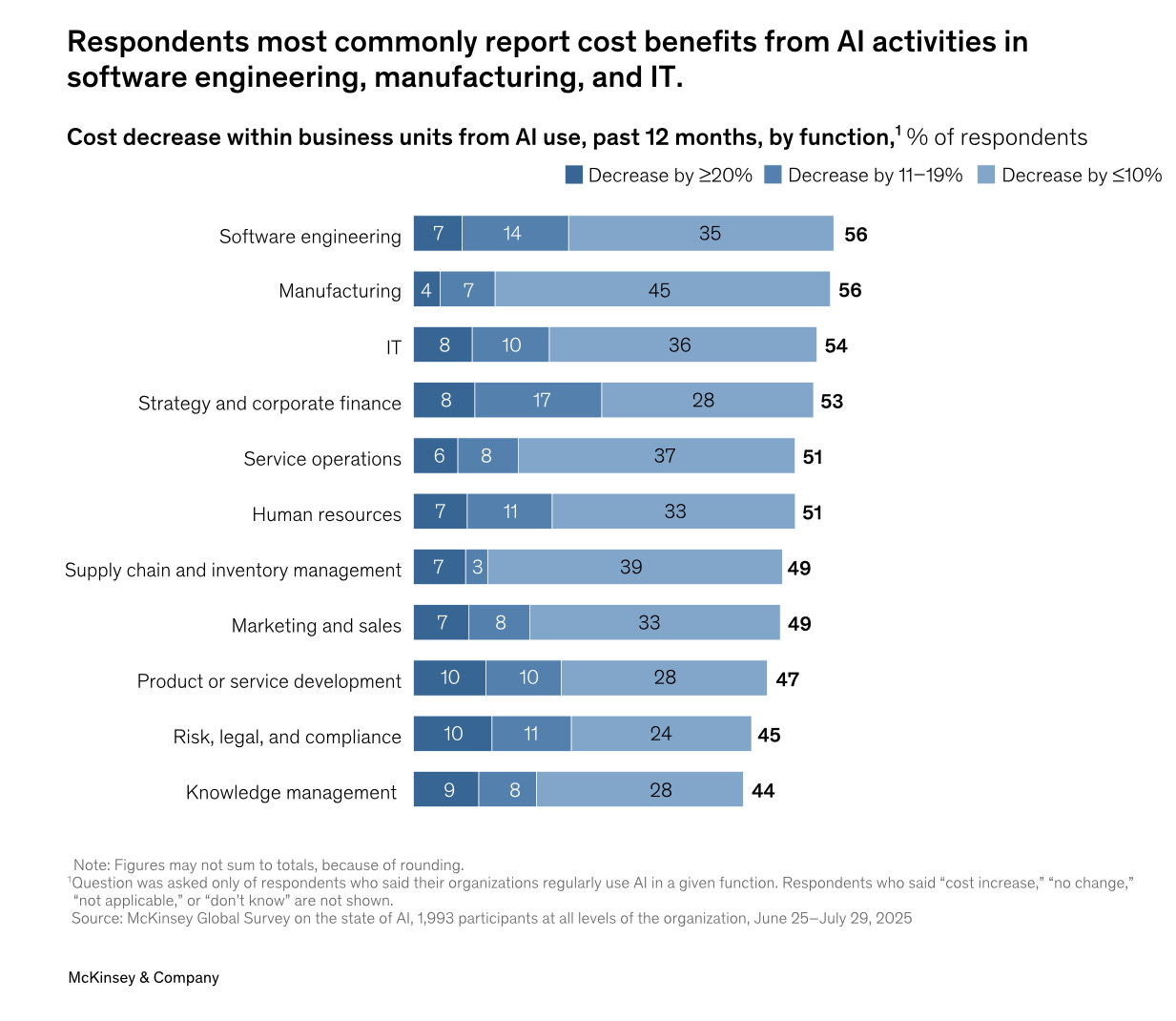
This chart shows where organizations report actual cost reductions from AI over the past 12 months.
The biggest winners:
Software engineering
Manufacturing
IT
Strategy and corporate finance
In all of these areas, roughly half of respondents report cost reductions, with some seeing decreases of 20% or more.
That matters for one simple reason:
AI is not a future promise anymore.
It’s already changing budgets.
What’s really happening behind the numbers
AI is quietly absorbing work that used to require:
Large teams
Long cycles
Repetitive human effort
Examples you already recognize:
Code suggestions and debugging support
Forecasting and financial modeling drafts
Process optimization in manufacturing
Internal IT support and monitoring
This is not about replacing humans.
It’s about removing friction.
AI does the heavy lifting.
Humans decide what matters.
But Here’s the Part Nobody Talks About
Now look at this chart:
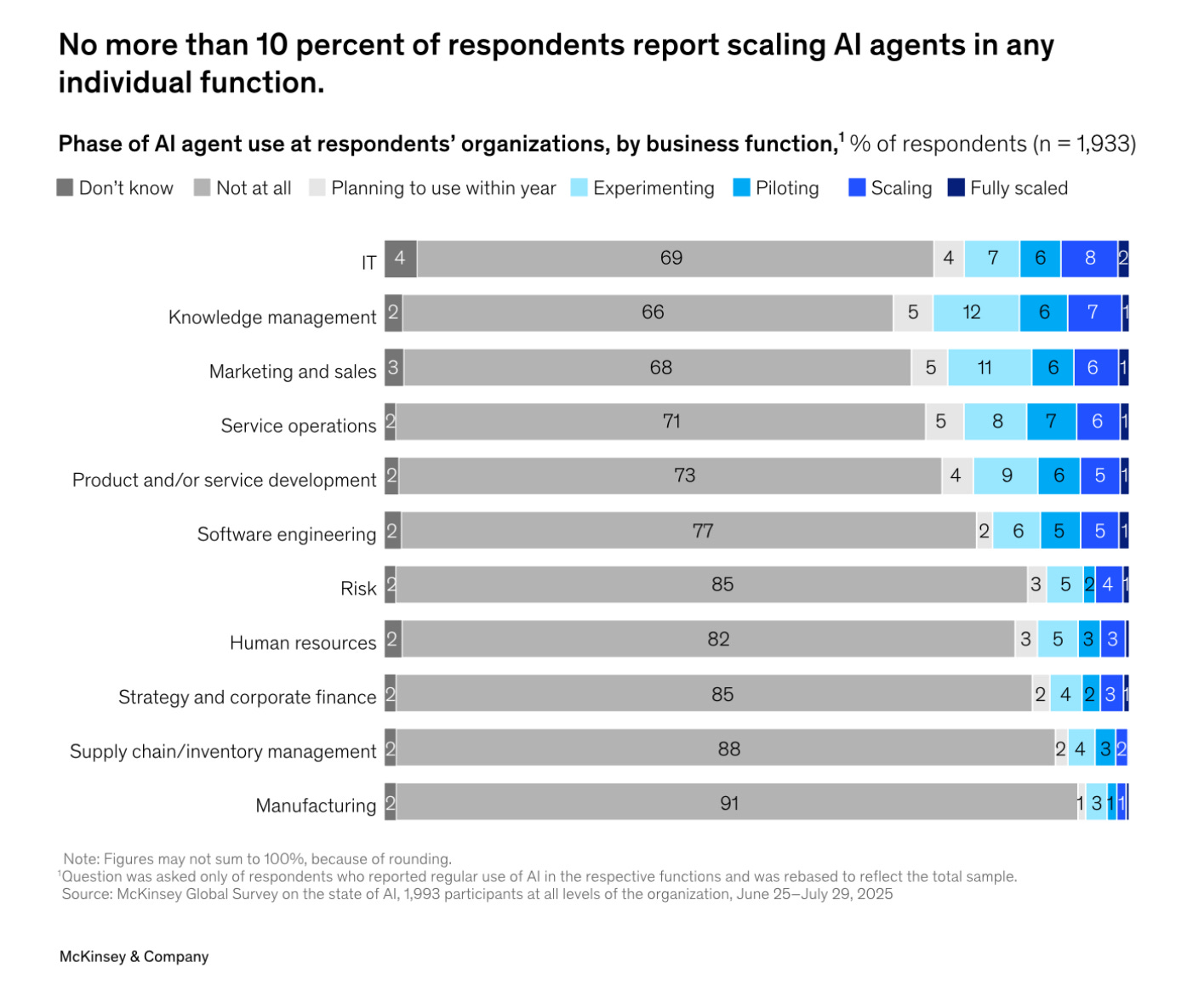
Despite all these cost savings, fewer than 10% of organizations report fully scaling AI agents in any function.
Let that sink in.
AI works.
AI saves money.
And yet almost no one has operationalized it at scale.
Most organizations are stuck in:
Experimenting
Piloting
Small, disconnected use cases
Why?
Because scaling AI is not a technical problem.
It’s a human one.
Why AI Stalls After the Pilot Phase
AI adoption breaks down at the same place every time:
Judgment.
AI can generate options.
AI can optimize known processes.
AI can summarize, draft, predict, and suggest.
But AI cannot:
Decide trade-offs
Set priorities under uncertainty
Align decisions with values
Own consequences
That’s why McKinsey’s leadership has been explicit: the skills AI cannot replicate are the ones that matter most as adoption increases.
Aspiration.
Judgment.
Creativity.
Those are not technical capabilities.
They are human ones.
How to Use AI Without Becoming Replaceable
Here’s the practical rule that actually works:
Use AI to reduce effort, not responsibility.
AI should handle:
First drafts
Pattern recognition
Research synthesis
Routine decision support
You should handle:
Direction
Context
Final judgment
Ethical and strategic choices
If you outsource thinking, you weaken your value.
If you outsource execution, you multiply it.
Why This Is a Career Advantage (Not a Threat)
Most professionals are doing one of two things:
Ignoring AI completely
Letting AI think for them
Both are mistakes.
The people who win will sit in the middle:
Fluent enough to use AI daily
Critical enough to challenge its output
Confident enough to decide without it
This is why AI adoption increases the value of strong human skills instead of replacing them.
AI scales competence.
It does not create wisdom.
The Real Opportunity Right Now
The charts in this article tell a simple story:
AI is already delivering cost and productivity gains
Very few organizations have figured out how to scale it
The bottleneck is not technology — it’s leadership and judgment
That’s where your leverage is.
Not in becoming more technical.
But in becoming better at thinking, deciding, and owning outcomes in an AI-assisted world.
Sources
McKinsey Global Survey on the State of AI (QuantumBlack)
https://www.mckinsey.com/capabilities/quantumblack/our-insights/the-state-of-aiMcKinsey CEO on the human skills AI models can’t do (Business Insider)
https://www.businessinsider.com/mckinsey-boss-shares-human-skills-ai-models-cant-do-2026-1
No posts
Comments
Nothing yet. Say the first thing.
Sign in to join the conversation.