
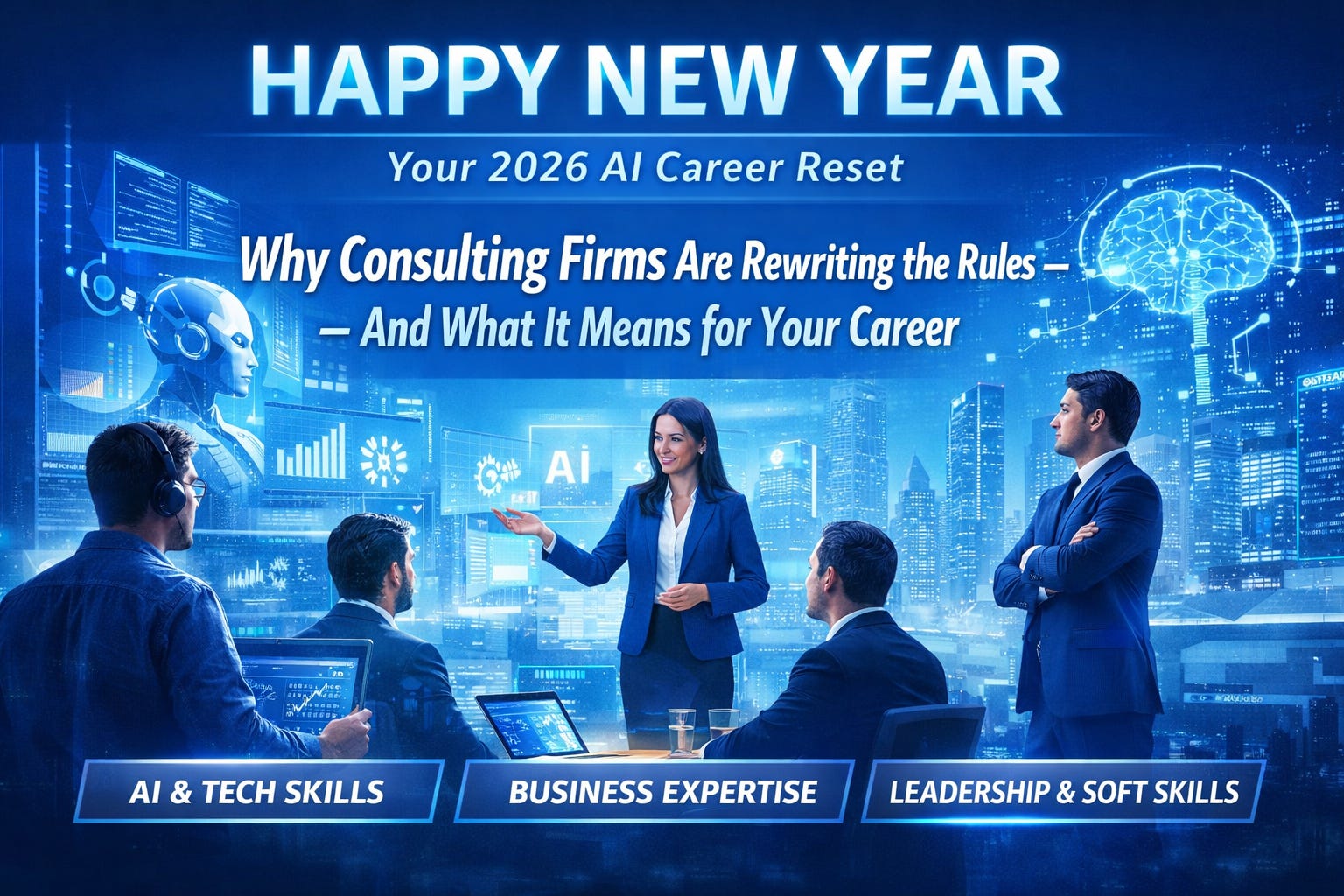
Why consulting firms are rewriting the rules and what it means for your career in 2026
Happy New Year.
If you are planning your next career move, this is the moment to recalibrate. AI is no longer a future trend. In 2026, it is the baseline expectation — especially in consulting, tech, and leadership roles.
1. The consulting model is fundamentally changing
Top consulting firms such as McKinsey & Company, Boston Consulting Group, PwC, EY, Deloitte, and Accenture are moving away from classic advisory work.
Instead of slide decks and short-term strategy projects, they are now delivering:
Multi-year AI-driven transformations
Implementation and ownership of tools
Long-term operational impact
This shift is forcing the biggest talent overhaul consulting has ever seen.
2. What “AI-ready” really means in 2026
By 2026, firms are no longer choosing between:
traditional consultants
pure engineers
They are hiring hybrid profiles.
The most valuable professionals are those who can:
understand business problems
work confidently with AI tools and data
translate technical output into business decisions
At McKinsey, these profiles are described as “5Xers”: people who are deep in one area, but effective across several others.
This is not about becoming a full-time engineer. It is about becoming adaptable, credible, and useful in AI-enabled environments.
3. Engineers are in demand — but most roles are not engineering roles
Yes, hiring for AI engineers, data scientists, and software developers is accelerating.
But here is the critical reality for 2026 careers:
Most AI work does not require deep model-building expertise.
Many organizations still struggle with:
data governance
AI readiness
integration into business processes
adoption and change management
That is why generalists with strong AI literacy and business understanding remain essential — especially in consulting and leadership roles.
4. Upskilling is replacing mass hiring
There are not enough AI experts on the market. Consulting firms know this.
As a result, they are:
upskilling tens of thousands of existing employees
launching internal AI academies
certifying staff in applied AI, AI governance, and AI compliance
In 2026, career advantage will not come from having studied AI early.
It will come from:
learning fast
applying AI pragmatically
turning AI capabilities into measurable business value
5. Soft skills are becoming more important, not less
As AI takes over analytical and repetitive tasks, human skills are gaining value.
Consulting leaders consistently highlight:
judgment and critical thinking
communication and influence
stakeholder management
learning agility
emotional intelligence
AI can analyze data.
It cannot build trust, align stakeholders, or lead transformation.
Those skills will differentiate careers in 2026.
6. What this means for your career planning this year
As you start the new year, ask yourself:
Can I explain AI concepts to non-technical stakeholders?
Can I connect AI use cases to real business outcomes?
Can I learn new tools quickly without waiting for formal training?
Can I lead teams through AI-driven change?
If your answer is “not yet,” that is not a weakness.
It is your biggest opportunity for 2026.
7. The smartest career strategy for 2026
Do not aim to become:
a pure coder
a pure strategist
an AI theorist
Aim to become:
the person who makes AI usable, understandable, and valuable.
That is who consulting firms are investing in.
That is who gets promoted.
That is who stays relevant as roles evolve.
Source: https://www.businessinsider.com/how-ai-is-changing-consulting-talent-at-mckinsey-pwc-deloitte-2025-12
No posts
Comments
Nothing yet. Say the first thing.
Sign in to join the conversation.