
Hey all! Nicholas from the Unusual Whales team, here!
In this issue, we’re bringing to you a banger write-up by our own Dan Wagner covering the potential of the Unusual Whales Earnings Vol Scan Skill. The general concept revolves around shorting earnings volatility in a risk-defined way.
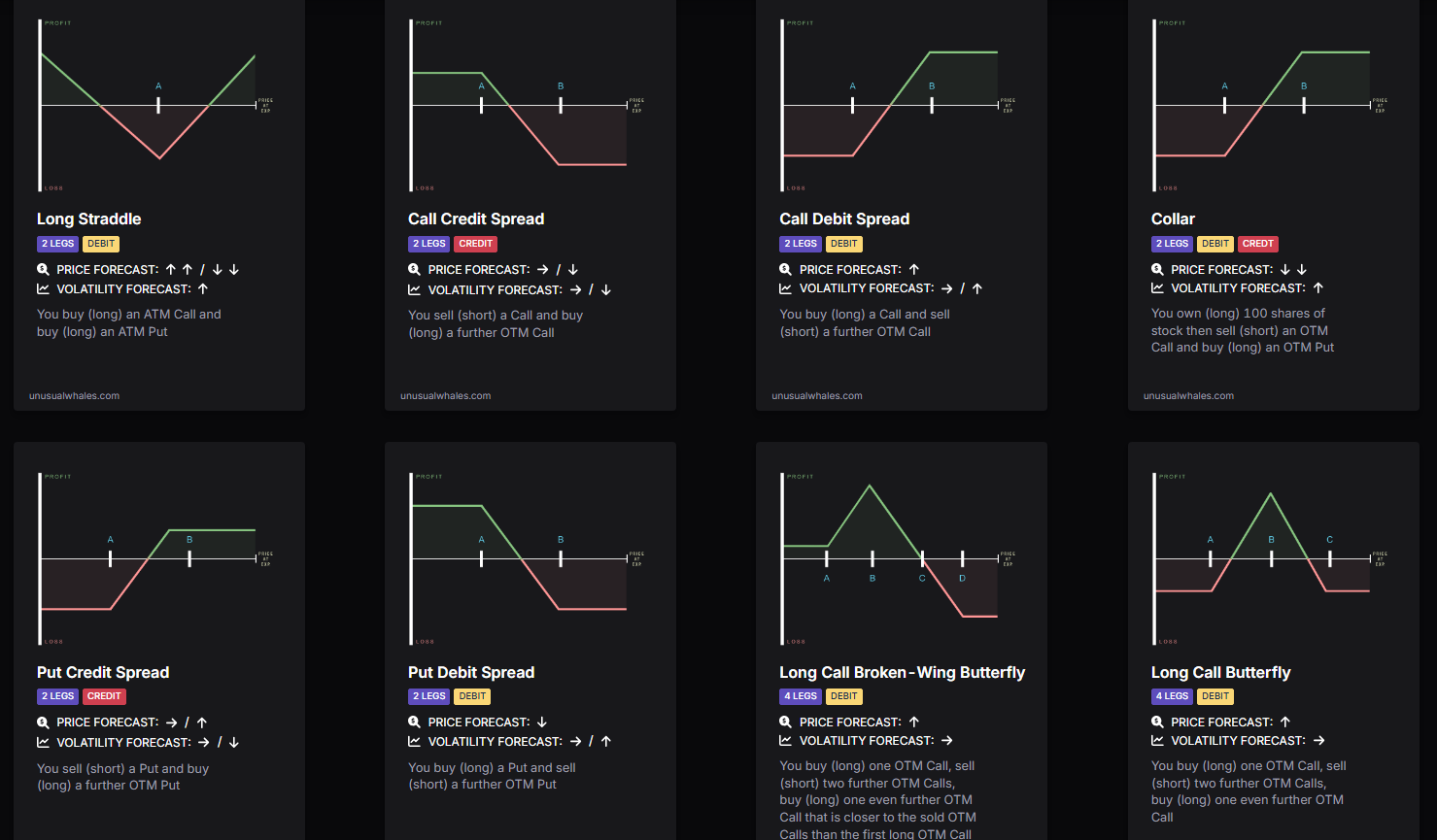
While myriad options strategies exist, this concept lies in utilizing calendar spreads, versus the popular short straddle. Using an AI Assistant alongside the Unusual Whales API and Earnings Vol Scan Skill, Dan outlines how this risk-defined strategy works, and walks us through how to set it up in just a few short, easy-to-follow steps, so check it out below!
Options that span an earnings date systematically price in bigger move than what is usually realized, and sellers of that event risk get paid the difference. This is known as the earnings variance risk premium, and this Skill hands your AI assistant a ready-to-run scanner that finds calendar spread setups to capture that risk premium with a defined, known-in-advance max loss. Copy the prompt below then paste it to your AI assistant to learn the method and generate trade ideas in a single session or review the Skill yourself here:
https://unusualwhales.com/skills/uw-earnings-vol-scan-skill.md
The Unusual Whales team created this Skill to identify interesting opportunities to short earnings volatility in a risk-defined way: “https://unusualwhales.com/skills/uw-earnings-vol-scan-skill.md”. The Skill file is long (2000+ lines), so make sure you access the entire file! Read the Skill (store a local copy if possible) then interactively work through these steps with me: (1) provide a short summary explaining why this strategy might have a durable edge, (2) concisely explain the filtering techniques it uses with as little jargon as possible, then (3) stand up and run the scanner the Skill provides, confirm its selftest passes, then review the returned trade ideas with me.
Earnings announcements are known catalysts on a known date as management releases new information to the market.
Since these announcements typically occur during illiquid post-market or pre-market sessions, the price of the underlying stock has a lot of potential to “gap” or “jump”. Options expiring right after the report price in an expected move, and on average the move that realizes is smaller than the move that was implied. This difference is the earnings variance risk premium, which is what the Skill is designed to harvest.
The earnings variance risk premium is not a fringe idea.
It is widely documented in professional options literature:
Positional Option Trading (2020) by Euan Sinclair (Chapter 5, “Finding Trades with Positive Expected Value”)
Trading Volatility (2014) by Colin Bennett (Chapter 6 Section 4, “Trading Earnings Announcements / Jumps”)
The Volatility Edge in Options Trading (2008) by Jeff Augen (Chapter 7, “Trading the Earnings Cycle”)
A long option acts like portfolio insurance, and insurance pricing must make sellers money on average (or else no one would sell insurance):
Long the stock? Buy Puts to cap your downside risk at the strike price minus the contract price.
Short the stock? Buy Calls to cap your upside risk at the strike price minus the contract price.
Options are priced right most of the time; I have (somewhat jokingly but not really) heard the options market referred to as “the smart guy Olympics”.
But around earnings, market participants looking for protection bid up the price of options, and sellers willing to take that risk are paid the average difference between the expected move and the realized move.
The obvious way to capture any variance risk premium (earnings or not) is with a short straddle; selling both the at-the-money Call and the at-the-money Put.
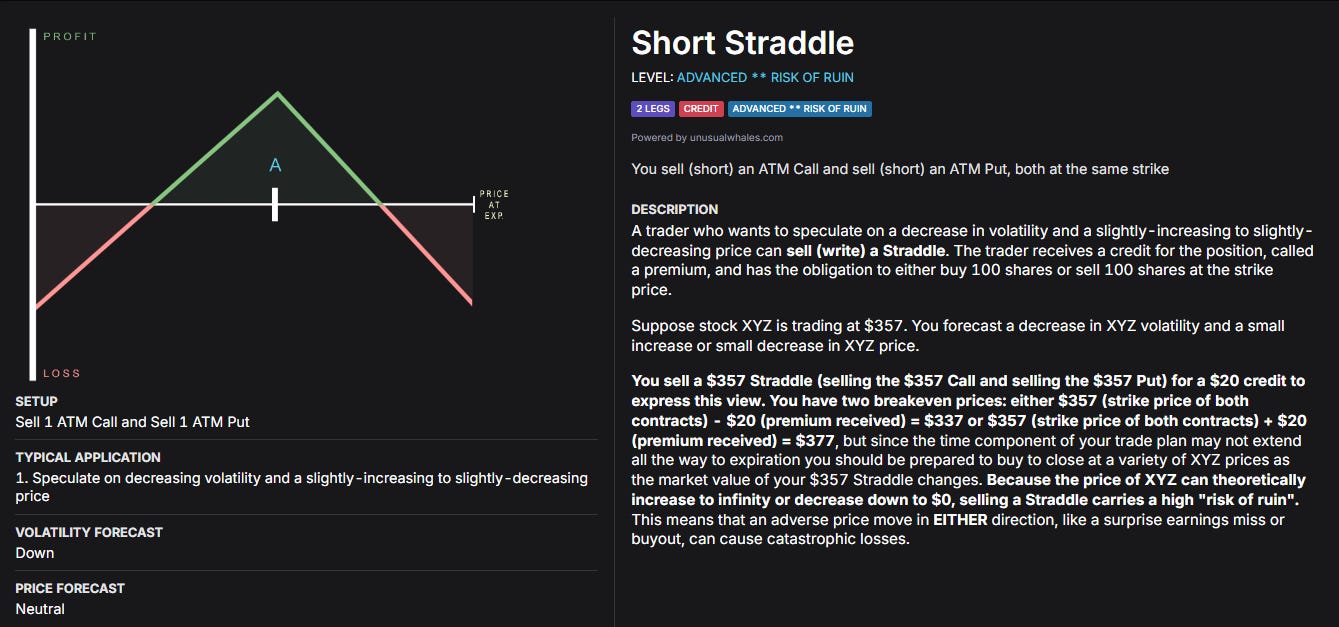
Selling straddles works, but the risk is theoretically undefined as a large price gap can cause a catastrophic loss. (You can learn more about the short straddle structure here: https://unusualwhales.com/option-strategies/short-straddle.)
This Skill uses a long calendar spread as well, which comes with tradeoffs:
Positive: long calendar spreads (sell the front expiry, buy the back expiry) have a max loss of the debit paid to enter the trade
Negative: long calendar spreads are not a perfect bet on implied volatility, they are a bet that the elevated implied move does not materialize and that the term structure normalizes after the report
Remember that “defined risk” is not “low risk”; if the stock price moves sharply away from your strike, you will lose money.
CHWY reported earnings before the open on June 10, 2026. Late on June 9 the stock sat at 20.58, and the market was pricing a large one-day move of roughly 13%. Obviously that “fear” was concentrated in the closest expiry, which was June 12, 2026.
Here is the term-structure inversion the scanner hunts, in one real quote:
Sell the 06/12/2026 22.5 Call: implied vol at 168%, collect 0.56
Buy the 07/17/2026 22.5 Call: implied vol near 69%, pay 1.16
Net debit per calendar spread: 0.60 ($60 before transaction and exchange fees), which is the max loss
What actually happened is the whole argument for this structure.
The CHWY price fell after earnings and moved away from the strike, the direction this position least wanted. However, the collapse in the short-dated Call’s premium was significant enough that the full structure could be closed for 0.62, marginally above the entry cost and enough to cover the round-trip transaction costs for a scratch. The maximum loss would hurt, but it will never be more than the cost of the position (plus fees).
Two practical notes on the strike choice. First, astute readers are likely asking, “Why the 22.5 strike instead of the 20 strike, which was closer to (but below) the spot price at the time?” The answer lies in real-world execution.
The 22.5 strike had significantly tighter bid-ask spreads, which is important for a two-leg structure that has to cross the spread 4 times over its life. Market quality can matter more than centering the strikes perfectly, especially in names with fewer strikes and lower volume.
Second, the tradeoff created by the 22.5 strike choice. Shifting strikes further above the spot price introduces a bullish directional lean. Selecting the at-the-money strike does a better job isolating the volatility target of this trade since vega is highest at-the-money.
The Skill calls the Unusual Whales API, so you need API access to run step 3 of the prompt.
If you have not subscribed yet, you can start with an API trial subscription here:
https://unusualwhales.com/pricing?product=api
As of July 19 2026, the first 7 days of trial subscriptions are free, and you can cancel anytime during that window without paying a cent.
You will need to register a credit card to start the trial subscription, and if you do not cancel before the trial ends, it will convert into the paid trial plan at $50 per week.
Make sure you have your API key ready, since the Skill needs it to successfully fetch data from the Unusual Whales API.
Send the prompt to your AI assistant, ask questions at each step, and you will walk away with two things: (1) a working understanding of the earnings variance risk premium and (2) a trade idea generator running on your own key.
The filter thresholds in this Skill were derived from a backtest published on the Volatility Vibes YouTube channel here:
The presenter packs a lot of valuable insight into a 19 minute video, and it is well worth a view.
As with any single published backtest, validate the logic against your own assessment and data before committing capital to any strategy.
Educational content, not investment advice. The scanner surfaces ideas to research, not recommendations. Options carry risk, including the loss of the full premium paid.
NOTE: This post is not financial advice. The stock market is risky, and any trade or investment is expected to have some, or total, loss. Please do research before any trade. Do not use this information for investment decisions. Check terms on site for full terms. Agree to terms before considering this information.
Comments
Nothing yet. Say the first thing.
Sign in to join the conversation.