
Everything you see in Die Hard 2 the airport, the planes, the snow is fake. The chaos making it was completely real. This week’s guest, Jorma Taccone (The Lonely Island), breaks it down with us.
Die Hard director John McTiernan was unavailable for a sequel because he was already committed to The Hunt for Red October. So Fox went looking for a new director and landed on Renny Harlin, a Finnish filmmaker whose dailies from The Adventures of Ford Fairlane impressed the studio so much that they hired him without much second guessing. Probably a great stroke of luck for Renny, who avoided going to “director jail” after Ford Fairlane flopped at the box office. Now, was Renny the right choice? You can’t really tell, since Fox brought McTiernan back for Die Hard with a Vengeance in 1995, which is often viewed as the best sequel of the bunch.
Thanks for reading Before You Watch! This post is public so feel free to share it.
Bruce Willis and Renny Harlin had two disagreements while making Die Hard 2. Both came down to the same underlying tension: Willis had just become a movie star, and he wasn’t sure John McClane was the right vehicle for where he wanted to go.
The first disagreement was about tone. Willis wanted to strip the humor out entirely to play McClane as a serious dramatic action hero, no quips, no one-liners, no jokes in the face of catastrophe. Harlin pushed back hard. His argument was that the humor wasn’t decoration; it was the reason audiences connected to the character. When Willis said the one-liners were inappropriate with lives on the line, Harlin’s response was direct: This is a movie.
It escalated to a three-way meeting between Willis, Harlin, and producer Joel Silver. The compromise they landed on: Willis could deliver every line his way, as many times as he wanted. But he also had to give Harlin at least one humorous take. Harlin would then choose. The version in the film is Harlin’s version.
The second disagreement was about Holly. Harlin believed the emotional spine of the sequel was McClane’s wife being on one of the circling planes that his entire drive came from trying to save her specifically, not airports in the abstract or passengers in general. Willis was less convinced. Harlin kept telling him: It’s about the wife. That’s why when they finally get together at the end and they hug, that’s it.
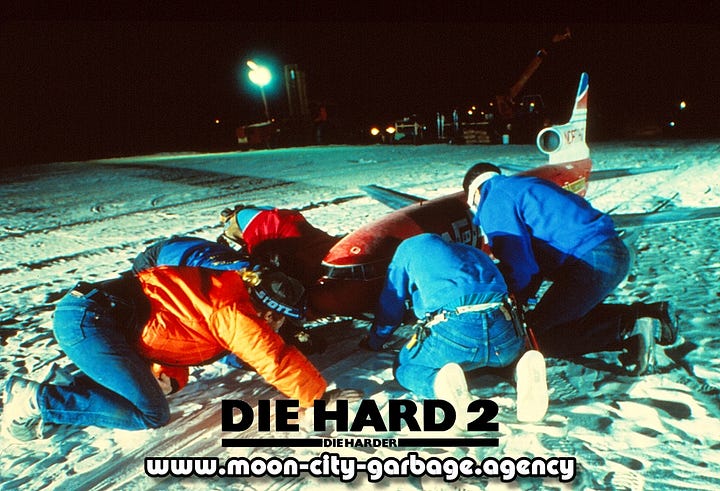
Die Hard 2 is set at Washington Dulles International Airport, but it was filmed in Stapleton International Airport in Denver, and they only allowed them to shoot there on a limited schedule and only on the condition that no planes or airline logos appear, since the script wasn’t really a positive view of airport staff or even plane safety.
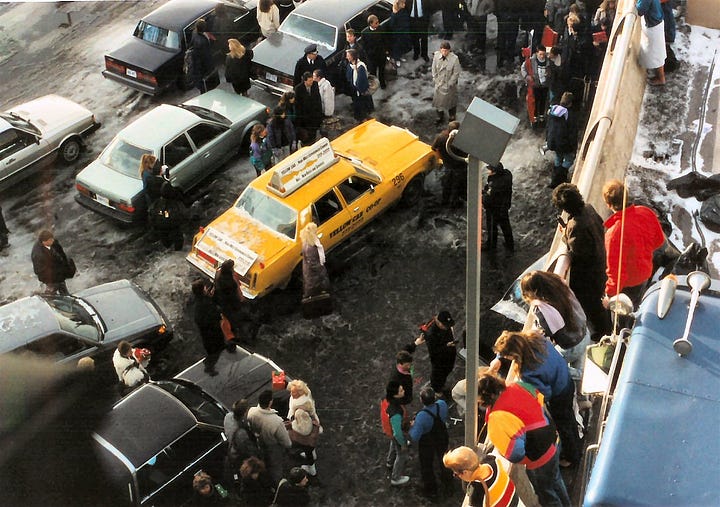

To fill the gaps, Fox built a fake airport on three soundstages, which included an air traffic control tower, a police station, an annex with a moving sidewalk, and even plane interiors. The luggage conveyor room was built in a downtown warehouse. The "basement" and tunnel sequences were filmed at the Harbor Generating Plant in Wilmington and the Jensen Filtration Plant in Granada Hills.
But that’s not all. When rain destroyed the snow conditions at Moses Lake, Washington, production moved again, this time to Alpena County Airport in Michigan.
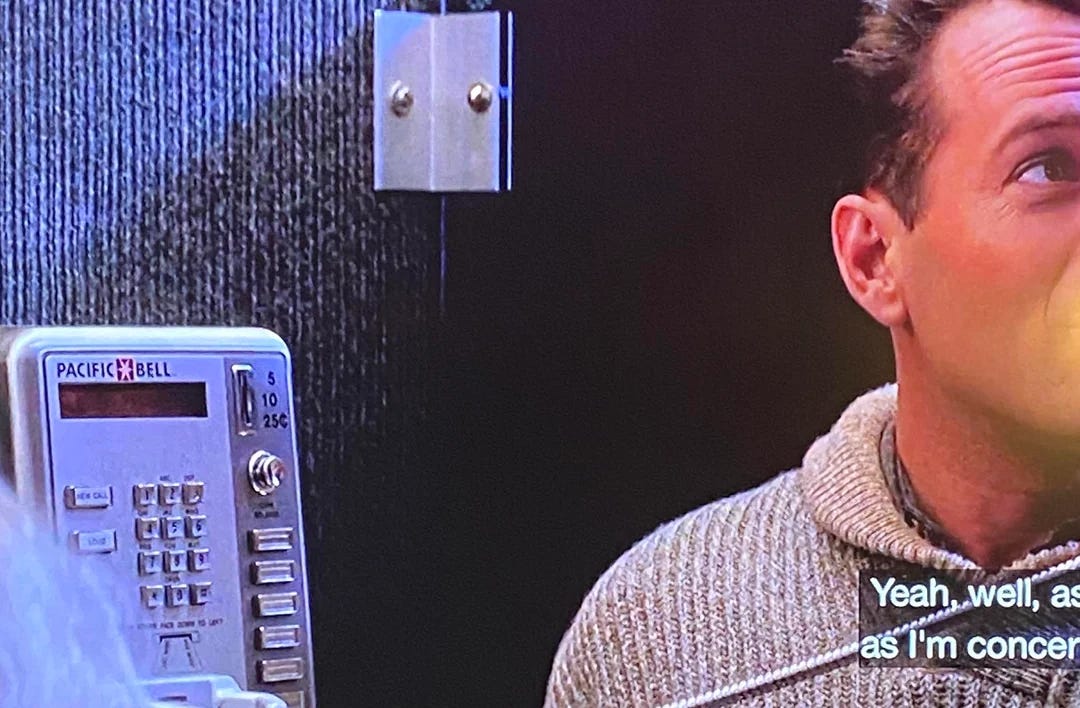
Which is probably why a pay phone in Dulles had a Pacific Bell logo. It was hard to keep track of exactly where they were on any given day.
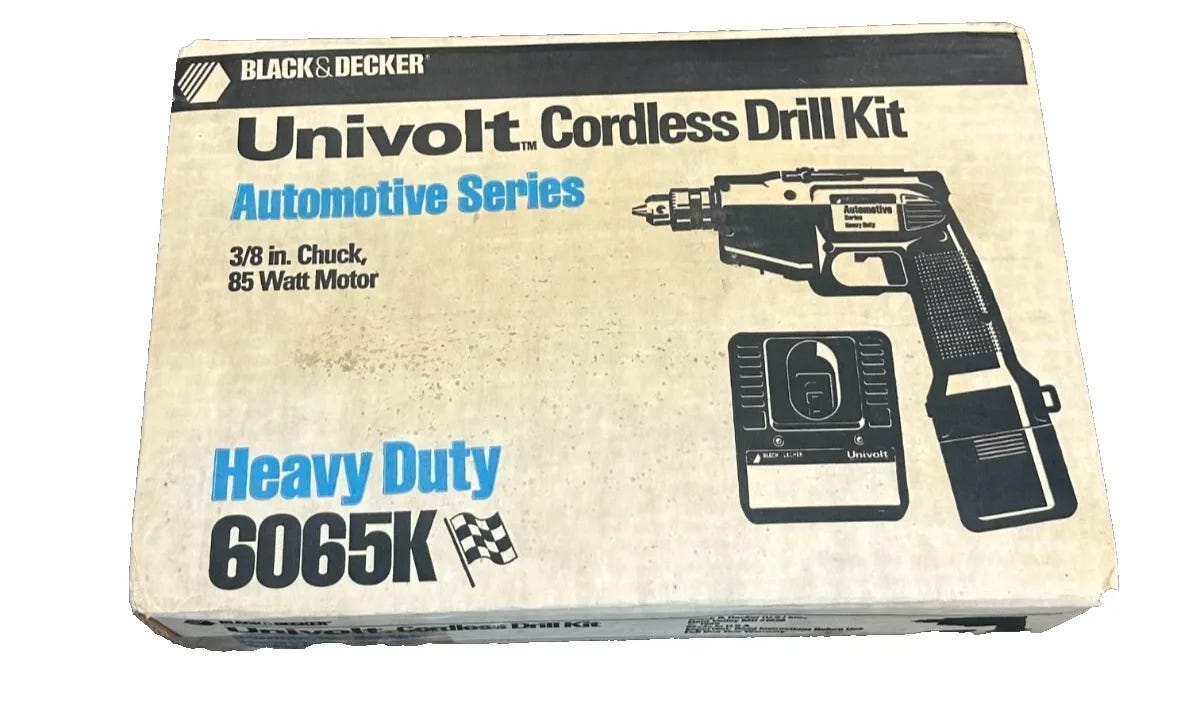
Fox had a product placement deal with Black & Decker. The company paid $20,000 to feature the Univolt cordless drill in a scene where McClane removes a vent grill. They even built a full marketing campaign around it. Three days before the film's release, Black and Decker learned Harlin had cut the scene entirely. Black & Decker sued Fox for $150,000 in damages. Fox settled for an undisclosed amount. It’s the first and only time a studio was sued for failed product placement.
Die Hard 2 is the bloodiest film in the franchise, and the MPAA rated it NC-17. Which forced Harlin to go back in and lessen the gore in these 3 spots
The Icicle Kill: A mercenary stabs a mechanic straight through the eye.
Plane Turbine: John McClane tosses a baddie into a 747 jet engine.
Plane Crash: The original passenger crash was slightly more graphic.
Oddly NC-17 was being doled out alot at the time as films like American Pie, Braveheart, Casino, Scary Movie 2, Scream, Total Recall and even South Park all originally recieved NC-17’s on their first attempt thru the MPAA
Yes, that IS John Leguizamo as Burke, one of Colonel Stuart's soldiers. According to Leguizamo's autobiography, the part was supposed to be larger, but once the production measured the height difference between him and Willis 6½", Willis is 6'0"), the role shrank, and his one line was dubbed over. Producer Joel Silver made it up to him with a bigger part in Executive Decision six years later, which could have been a total coincidence.
Almost every airplane you see in Die Hard 2 is either a scale model, a matte painting, or a forced-perspective miniature. The reason: parking a real commercial jet for a night shoot cost $40,000 per plane and that’s before crew, lighting, and permits. ILM’s matte department supervisor Bruce Walters estimated the real-planes approach would have run $250,000 or more for a single shot. So they didn’t do it.
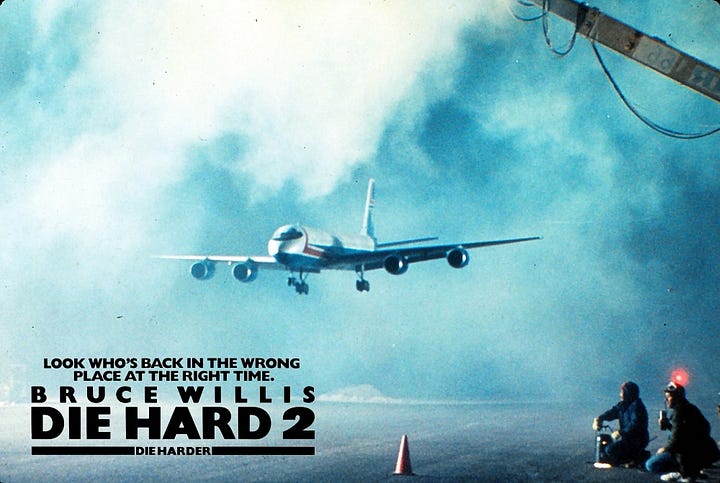

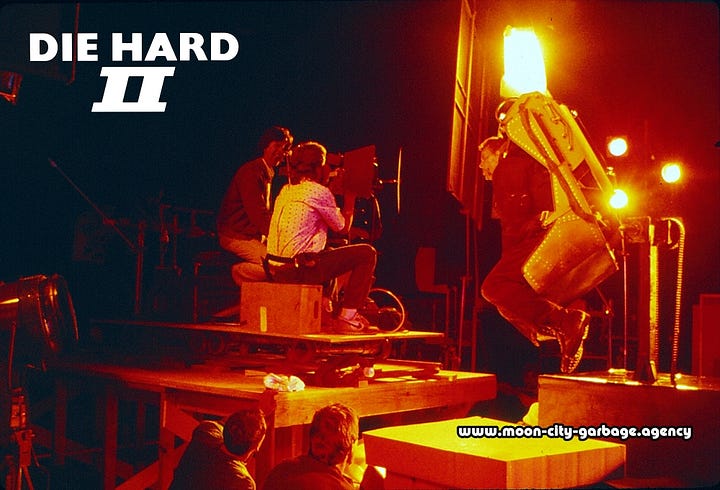
“Miniature” is a relative term: the smallest plane used was a C-130 with a 14-foot wingspan. The largest was a 747 model with a 20-foot wingspan and a 24-foot fuselage.
To simulate snow kicking up when a plane's wheels touched down, the effects team hid a fire extinguisher inside the landing gear bay of the model and wired its trigger to a radio-controlled solenoid. The moment the wheels made contact, a stagehand would fire the extinguisher and CO2 would blow out of the wheel wells standing in for snow. See all the pictures here
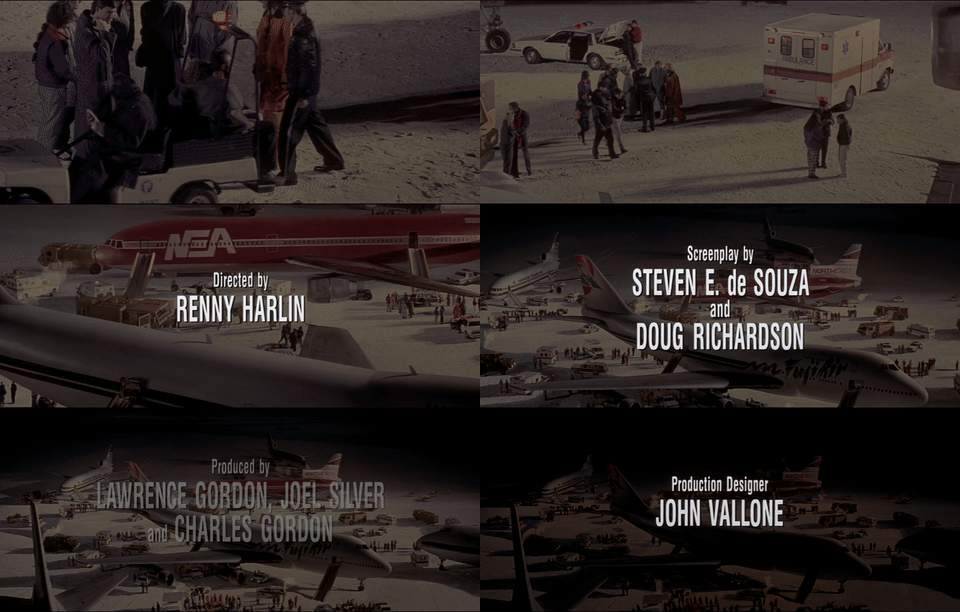
The final shot of the film a slow pullback across the airport tarmac as the camera rises above it all is a painting. ILM’s matte artist Yusei Uesugi spent five weeks painting it by hand: a canvas thirteen feet wide and five feet tall.
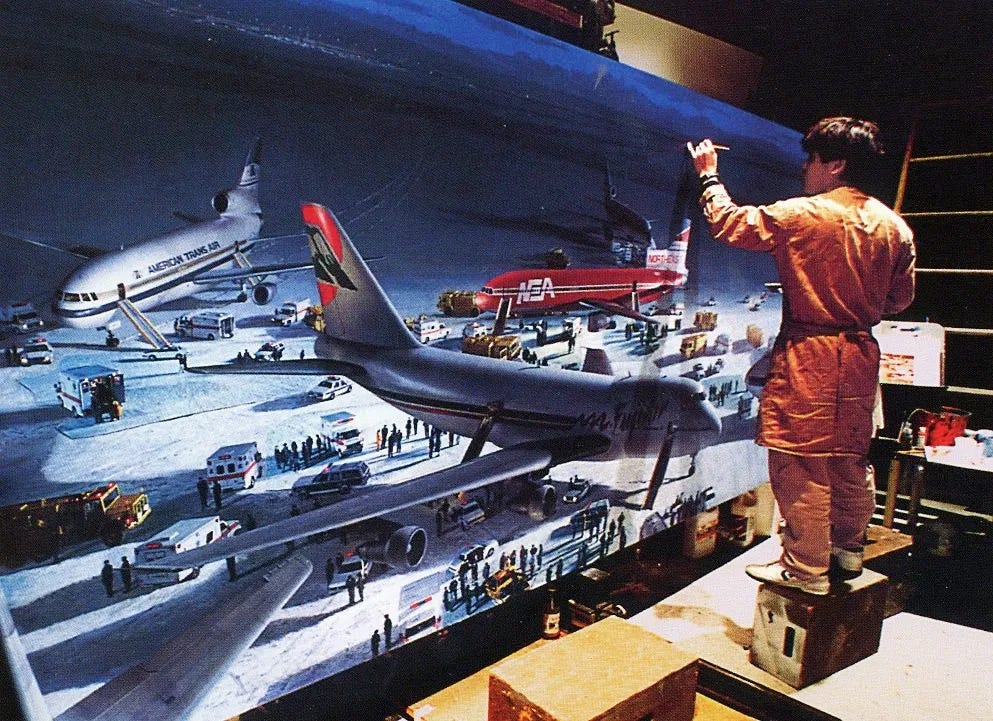
The painting was then photographed in five telescoping sections using ILM’s Automatte camera and assembled digitally in Photoshop which had only just been invented. John Knoll, one of Photoshop’s co-creators, was working in ILM’s camera department at the time and the software was still being developed. The computer the team used had an 80 or 160MB hard drive. It couldn’t hold a single full digital painting, which is why Uesugi painted it on canvas first and the digital work was used to blend and composite the photographed sections.
The original canvas still hangs in ILM’s San Francisco offices.
The 747 crash at the end of Die Hard 2 is not one explosion. It’s three carefully timed charges placed inside the model with specific delays between them. Getting that timing right took two attempts and two completely separate model aircraft.
The first take was shot with four cameras simultaneously. It still didn’t work. The pyrotechnic delays that had been calculated turned out to be too short. The plane simply disintegrated all at once, too fast for the sequence and nothing usable showed up on camera.
They built a second 747 model. This time they increased the delay between charges and it worked, filming at 360 frames per second stretched it to fifteen times its real time duration.

The villian is Die Hard is General Esperanza, the dictator of Val Verde, a fictional Latin American country that also appears in Commando (1985). Both films were written by Steven E. de Souza and produced by Joel Silver. De Souza has teased that even the original Predator might have taken place in Val Verde.
De Souza invented it specifically to avoid diplomatic friction with any real nation but it’s myth has grown. A full Wiki gives you the history by decades.
The Republic of Val Verde splintered off of Guatemala in 1970 during the Guatemalan Civil War. The territory seized from Guatemala included all the land North of The Northern Transversal Strip which was officially created during the Guatemalan government of General Carlos Arana Osorio in 1970. It is known today as the Guatemalan Department of Petén and is geographically the northernmost department of Guatemala, as well as the largest by area — at 35,854 km2 (13,843 sq mi) it accounts for about one third of Guatemala.
When TBS aired Die Hard 2 they replaced Mclanes famous line with "Yippee-ki-yay, Mr. Falcon," which was Esperanza's codename from earlier in the film. Yeah it was dumb but its glorious.
Die Hard crossed $100 million domestically in 41 days and ultimately outgrossed the original and launched a 5 part franchise, for better or worse.
Bruce Willis earned $5 million for the original Die Hard, a salary that shocked Hollywood at the time. For the sequel, he received $7.5 million. By Die Hard with a Vengeance it was $15 million, and for Live Free or Die Hard and A Good Day to Die Hard he made $25 million each.
Every action sequel that came after borrowed something from Die Hard 2, the bigger stakes, the larger playing field, the hero who complains the whole time. Most of them forgot the part that actually matters: he's not saving the world. He's saving his wife.
Are you following us on Facebook?
Want Paul to sign and personalize a book just for you? It can happen

No posts
Comments
Nothing yet. Say the first thing.
Sign in to join the conversation.