
Spielberg’s own childhood memory of being awakened by his father to watch the Leonid meteor shower shaped his sense that the night sky was romantic rather than threatening. Spielberg told Women’s World in 2024 that his early experience helped him imagine aliens as peaceful visitors rather than invaders. Which was an idea he’s been chasing for decades.
Steven Spielberg’s Close Encounters of the Third Kind grew out of his teenage film Firelight. It had a runtime of two hours and fifteen minutes and was made for $500 (according to Spielberg, it made $501). Only three minutes and forty seconds of footage have ever been released. Spielberg himself called it "one of the five worst films ever made."
Firelight evolved into a more paranoid concept called Watch the Skies which then became Close Encounters of the Third Kind.
Richard Dreyfuss actively lobbied for the part of Roy teasing Spielberg about rival actors and passionately making his plea. Spielberg has confirmed that he initially had many other actors in mind and that Dreyfuss’s wasn’t the right type. Eventually he came around and according to Speilberg it was truly based on a real process of considering alternatives rather than Dreyfuss’ bullying.
One of those alternatives, STEVE MCQUEEN who loved the script but would not play Roy because the part required him to cry; McQueen also insisted Spielberg should not cut that emotional beat, because it had made him cry while reading it.
For Ronnie Neary, Spielberg has said he cast Teri Garr after seeing her in a coffee commercial and recognizing that she could communicate humor and mounting panic at the same time.
Spielberg later came to believe that the finished product shortchanged Garr. He regretted presenting her as too shrill and too much the story’s “bad guy,” and in 2005 he said that, as a father, he would no longer end the movie with Roy leaving his family to join the mothership.
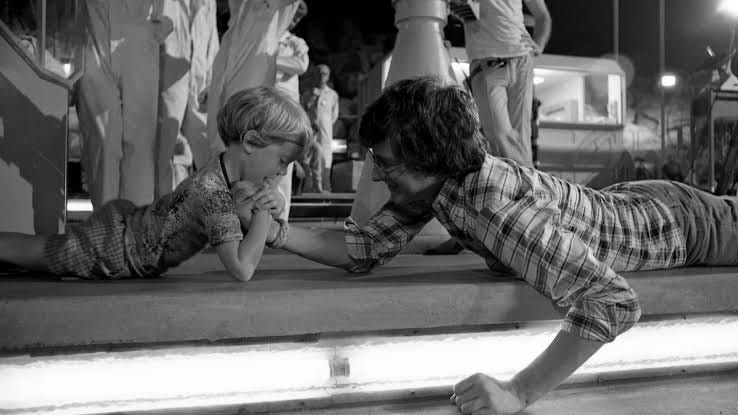
Cary Guffey’s performance as Barry is probably the best examples of Spielberg’s child direction methods. Spielberg admitted he manipulated Cary’s sense of wonder by employing many different techniques like unwrapping a present above his eyeline, using a clown and costumed gorilla off camera to make him laugh as though he was reacting to aliens. Apparently Guffey was so efficient that Spielberg had a shirt made reading “One-Take Cary.”
“I didn’t like my work. And it took a long time to recontact that feeling in me of why I made the film. ... I didn’t do it because it was a Spielberg movie, because they didn’t exist as such yet, or because it was a great role. I did it because I knew they would show that film in the Museum of Modern Art in the year 2030, that...this movie would be potentially the most important film ever made, and I wanted desperately to be a part of that experience.” - Richard Dreyfuss
Alien movement posed another technical problem. Spielberg wanted beings that glided rather than walked, and one abandoned test involved an orangutan in a specially built gray suit and roller skates; when that failed, many of the small aliens in the finished film were portrayed by local Mobile elementary-school girls in suits and masks, heavily backlit to turn performance into silhouette.
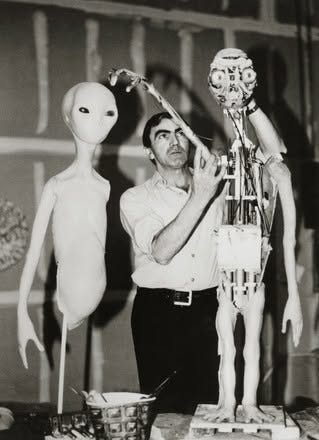
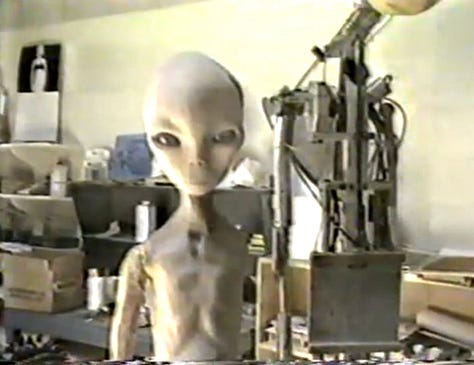
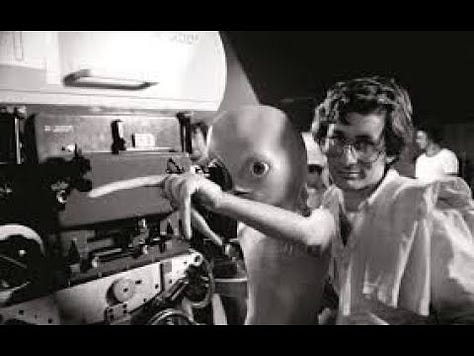
Carlo Rambaldi’s articulated alien puppet for the farewell exchange with Lacombe remains one of the film’s most important designs. Spielberg’s nickname for the puppet was “Puck,” it was built from steel, aluminum, and fiberglass, operated by seven puppeteers, and partly based on Cary Guffey’s facial expressions. Spielberg loved Puck and people remember him asking what would happen if “this little guy didn’t get back on the mothership.” which was the spark that led to E.T.
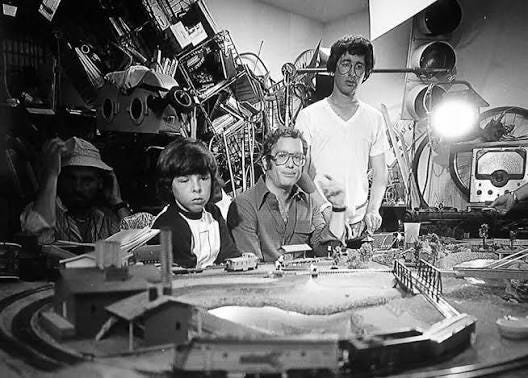
There are 3 distinct versions of Close Encounters, the 1977 Theatrical, the 1980 Special Edition, and the 1998 Director’s Cut. Speilberg’s continous tinkering is rare and most likely due to a rushed post production and test screening process. Which was all due to Columbia’s financial troubles.
Spielberg had hoped for a summer 1978 release so he could finish editing and effects work more comfortably, but Columbia insisted on a November 1977 opening because of their studio’s cash problems. Which led to abrupt cuts in the run time of the film to get it to a place where the film could turn over quick enough in theaters to make more money. However even with 7 minutes taken out, Speilberg didn’t hit that mark for exhibitors.
Theatrical (135 Mins) Compared to the other versions, the theatrical version leans into the dark humor of watching Dreyfuss unraveling in the second act. There are also added scenes that show Dreyfuss at work. In the finale, we don't see what happens to Dreyfuss into the spaceship. It also replaces composer John Williams' credit music score with an assembly of other pieces.
Special Edition (132 Mins) Spielberg was offered a new budget by Columbia Pictures to add new scenes in exchange for delivering a re-release. He tightened the pacing by trimming several character-driven scenes (like Roy's blowouts with his family). It added the discovery of the lost Cotopaxi ship in the Gobi Desert. It also includes the highly debated sequence of Roy actually traveling inside the massive mothership and restored John Williams' intended credit sequence score.
Director's Cut (137 mins) This is largely considered the "definitive" version. Spielberg assembled his favorite elements from both previous versions to create a fuller picture of the Nery family. He also removed the inside spaceship scenes as well as some forced product placements and tightened up scenes that he added for the special edition.
According to Mental Floss, Spielberg and Lucas exchanged 2.5 percent of their respective films’ profits in 1977, and because Star Wars dramatically outperformed Close Encounters, Spielberg’s portion of Lucas’s film became enormously lucrative.
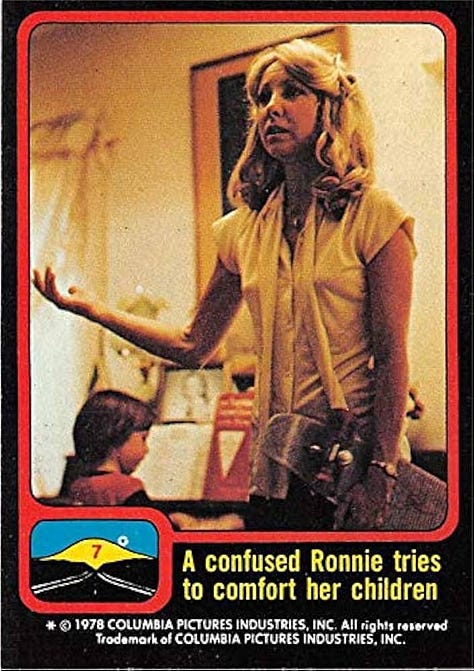

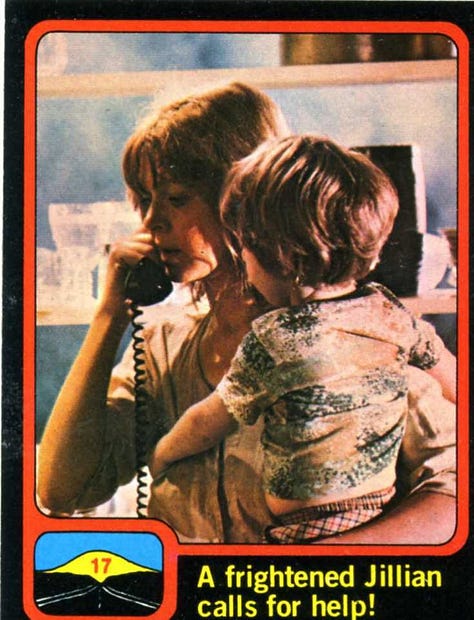


In 1978, Topps released a set of trading cards but in the 66 card set but none of them feature Roy Neary (Richard Dreyfuss) or François Truffaut (Claude Lacombe) because Topps did not secure the rights to feature their likeness. Instead, the card set focused on supporting characters and alien imagery.
Producer Julia Phillips was fired from the production, and later wrote bitterly about Spielberg in her memoir, You’ll Never Eat Lunch in this Town Again, she attributed her worsening emotional state and cocaine use partly to the stress of working with him.
On His Ego: When describing looking at a new property, Phillips remarks to Spielberg, “with a little work this place could house your ego.”
On His Ruthlessness: She famously dubbed him “the ultimate writer-fucker,” referring to the director’s tendency to minimize or alter the original writers’ contributions to claim creative control.
Quoting David Geffen: (Spielberg is) “selfish, self-centered, egomaniacal, and worst of all—greedy.” Phillips notes this was “a pretty good description.
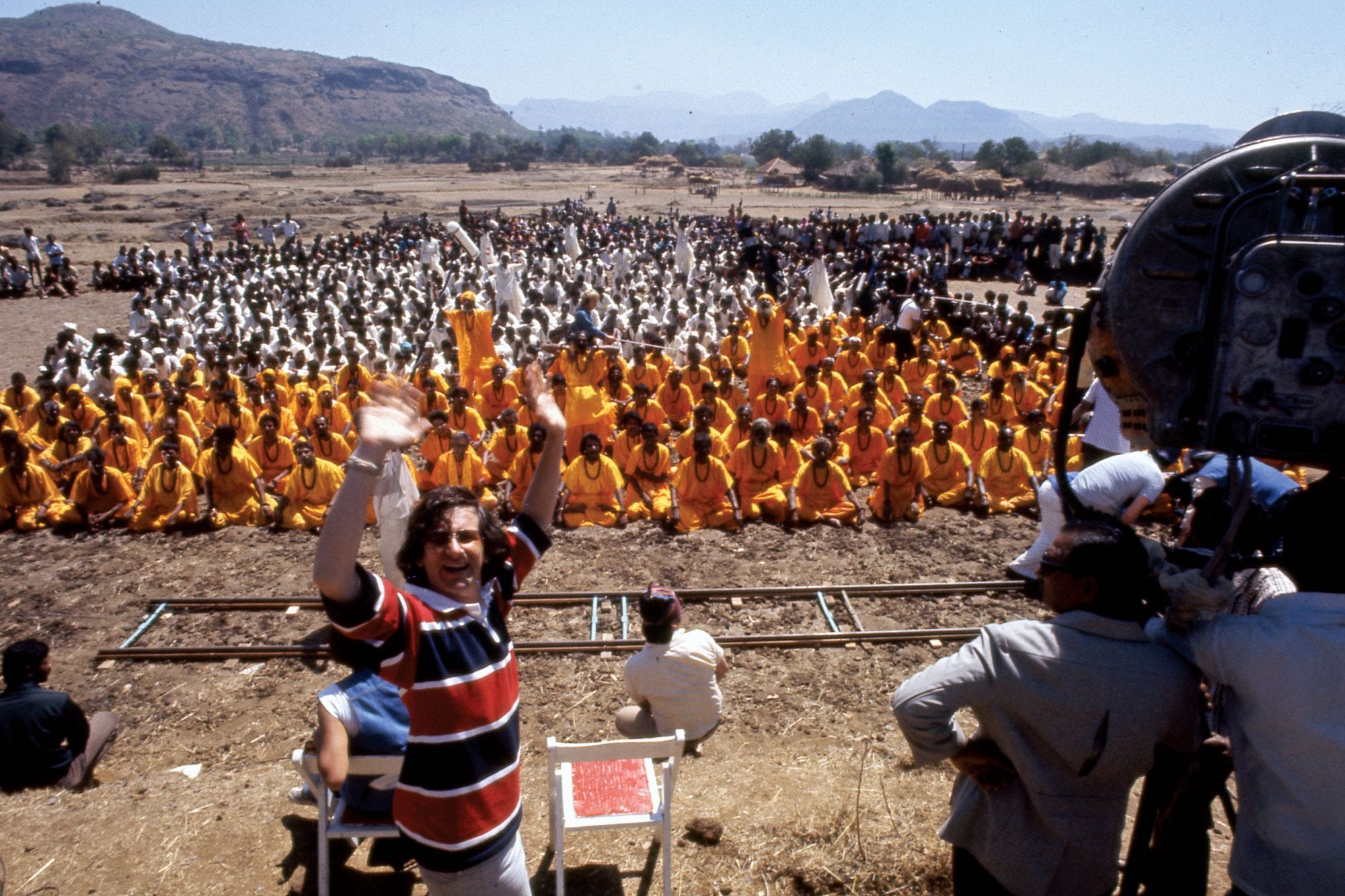
Truffaut offered his own drier observation about filmmaking culture, saying that one thing he discovered while acting in front of the camera was that “everybody says many nasty things behind the director’s back.”
Even Speilberg’s DP, Vilmos Zsigmond recalled that Spielberg watched one or two movies almost every night during production and came back the next day with new ideas, sketches, and demands. Veteran gaffer Earl Gilbert eventually joked that if Spielberg would stop watching those “f***ing movies” every night, the production might get back on schedule.
Now while there might have been tension on set you can’t deny the end result. Close Encounters changed what big-scale alien movie could feel like and started a tonal shift that influenced later filmmakers to not have aliens invade but co-exist. A kinder, gentler Sci Fi film that was more curious than confrontational.
Paul is live in Los Angeles on 6/26 @ Largo

Are you following us on Facebook?
Want Paul to sign and personalize a book just for you? It can happen

No posts
Comments
Nothing yet. Say the first thing.
Sign in to join the conversation.