
We usually notice that someone has reached capacity when their distress becomes impossible to ignore.
Your kid cries, yells, runs, hits, freezes, refuses, or stops speaking.
You snap, shut down, go blank, or become unable to tolerate one more question.
Those are all clues.
They just tend to arrive later.
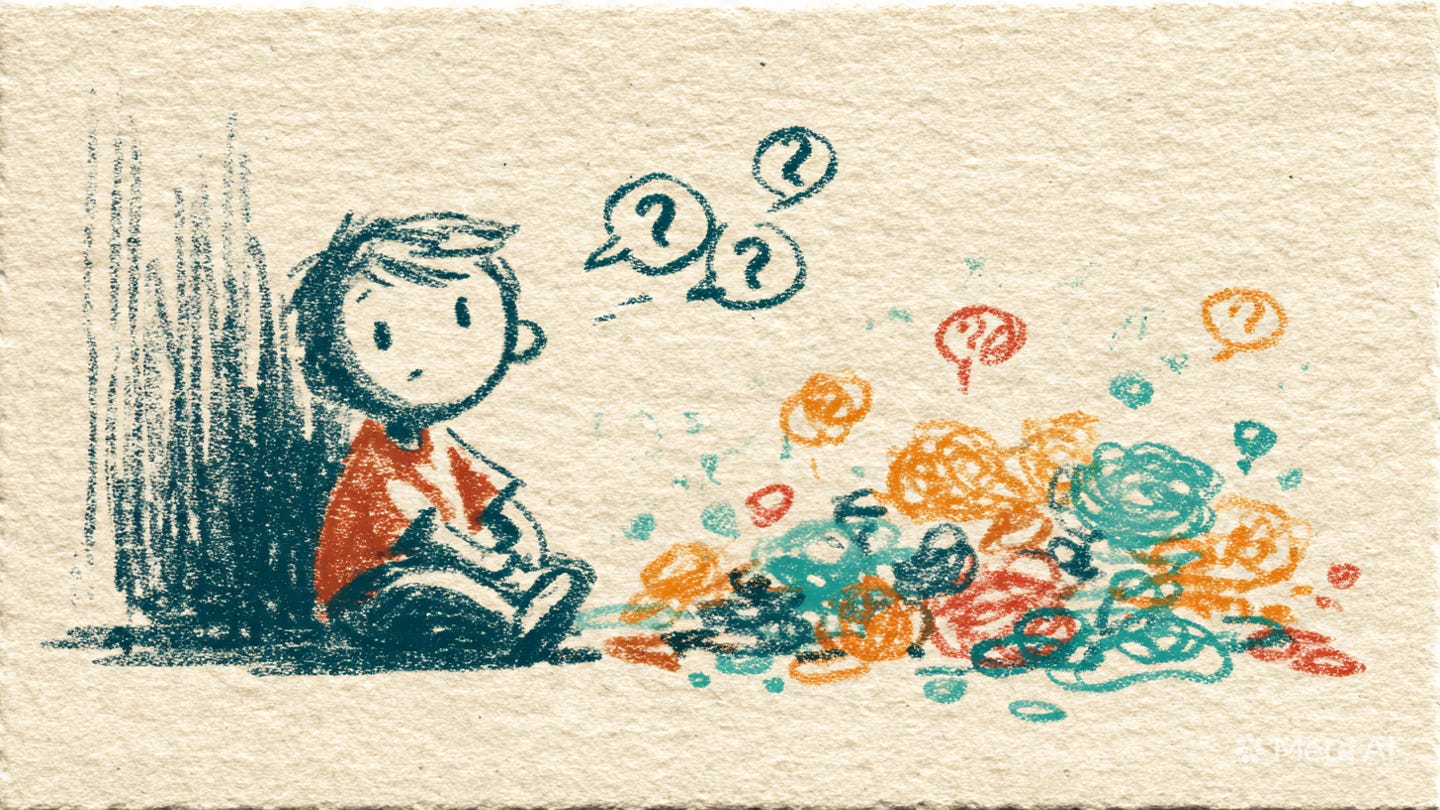
The earlier clues are often quieter.
My kid starts asking the same question over and over.
The other one becomes louder, faster, or much sillier.
And the third kid begins controlling the play because predictability suddenly feels necessary.
They reject every choice, cling to you, hide under the furniture, chew their shirt, pace, or complain that their stomach hurts.
Or they stop talking.
Or they become unusually agreeable.
That last one is harder to catch.
We are taught to read compliance as regulation.
But a quiet, pleasant, cooperative kid is not automatically a regulated kid.
Sometimes a child becomes easier for everyone else to manage because they have stopped communicating what the experience is costing them.
Adults do this too.
You may keep smiling, answering, working, parenting, or participating while your internal access steadily drops.
You are still functioning, so you do not count the earlier clues.
I did this for a long time.
I treated the crash like the first clue that I had done too much.
It was not.
The crash was the last clue.
Before the crash, my nervous system had already been leaving clues.
Basic decisions were harder.
Noise felt sharper.
I needed more bathroom breaks.
I could still complete the appointment or clean the kitchen, so I told myself I was fine.
I was not fine.
I was still moving.
Those are not the same thing.
Continue Growing With Unmasked
Unmasked Parenting is for families who are tired of being told to look only at behavior while ignoring the nervous system, the environment, and the cost of appearing fine.
Free subscribers receive new articles and practical resources that help you understand what may be happening beneath the surface.
Paid subscribers support the continued creation of this work and receive access to deeper tools, guides, and resources designed to help you build sustainable access for yourself and your kids.
Subscribe to continue exploring parenting through curiosity, connection, and neurodivergent affirmation.
The remainder of this article is for paid subscribers.
Comments
Nothing yet. Say the first thing.
Sign in to join the conversation.