
For years, I worked crazy long hours building my marketing agency.
I had a team. I had clients. From the outside, it looked like things were working. From the inside, I was wearing every hat at once: managing clients, doing the actual work, overseeing my people, hunting for new business—all of it, every day, without a real system holding any of it together. I couldn’t find a good project manager. I never learned to delegate properly. I didn’t create the right systems. I just kept adding more to my plate and telling myself this was temporary. Just until things stabilized. Just until the next client. Just until.
And underneath all of it, there was a fear so constant I’d stopped feeling it.
If I slow down, I will lose everything I’ve built.
So I didn’t slow down. I worked longer. I checked off more to-do’s. I skipped vacations. I said no to people I loved. I told myself it was fine.
Here’s what was also happening at the same time.
My health was not where it should have been. My marriage had moved to the back burner. I stopped seeing my friends. We were all busy. The parts of my life that made me feel like a full human being were slowly disappearing.
Two fears. Running at the same time. In opposite directions.
Fear of stopping. Fear of not stopping.
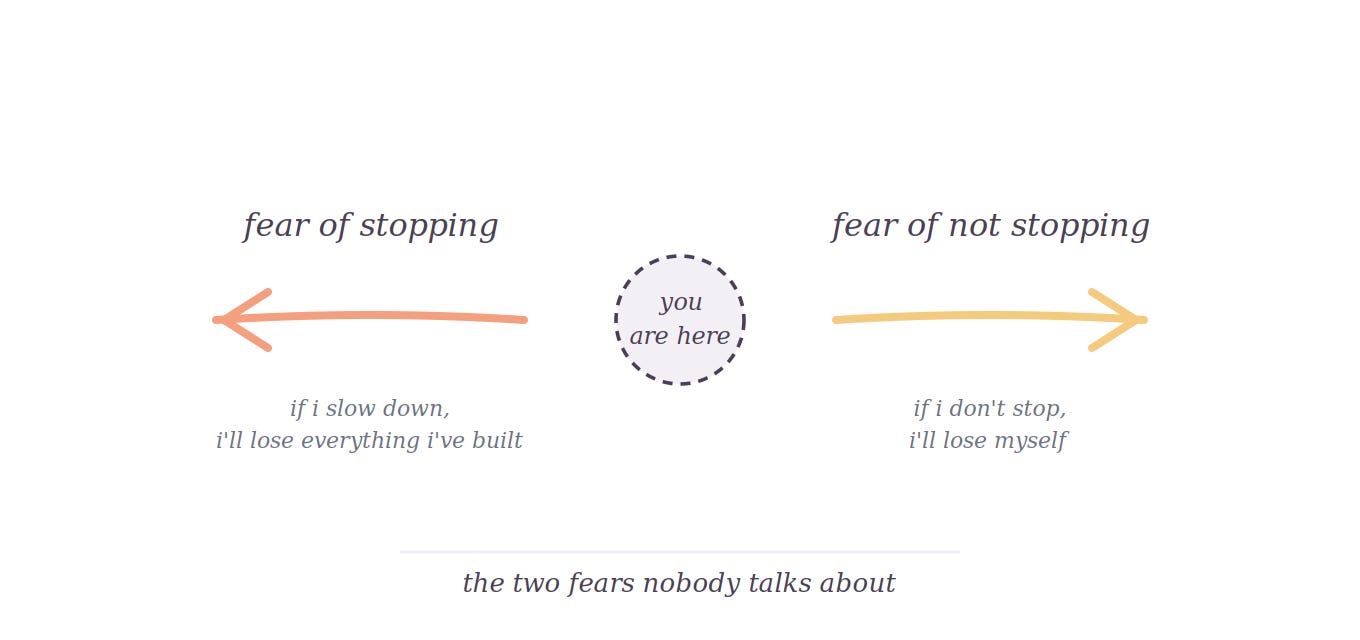
This is the Default Path at its most brutal. It doesn’t just steal your time. It makes you feel like you have to choose between your ambition and your life. And most of us, conditioned as we are to keep going, keep choosing ambition. Speed. More. Over and over. Until something forces us to look up.
For me, that moment came in the Sea of Cortez. Where I decided to replace boredom from no WiFi with learning to kiteboard. And in that moment of stillness, I asked myself a different question. What if there’s another way?
Why Your Brain Won’t Let You Stop
I want to tell you something that changed how I understood all of this. It won’t make the fear go away but it explains why the fear is so loud.
Nobel laureate Daniel Kahneman spent his career studying how human beings make decisions. His most important discovery is both simple and humbling: we feel the pain of losing something roughly twice as intensely as the pleasure of gaining something equivalent.
We are not rational. We are loss-averse.
Your brain was shaped by millions of years of survival. Losing your food supply meant starvation. Missing a new berry patch just meant hunger. The brain adapted to weight loss far more heavily than gain. It built a threat-detection system designed to keep you alive in the wilderness.
The problem is that this same system is now running in your open-plan office. And it cannot tell the difference between a woolly mammoth and an unread email.
Slowing down feels like losing. So the alarm goes off. And you start running. Because you’re wired that way.
I learned this in my body, not a book, one afternoon in Baja.
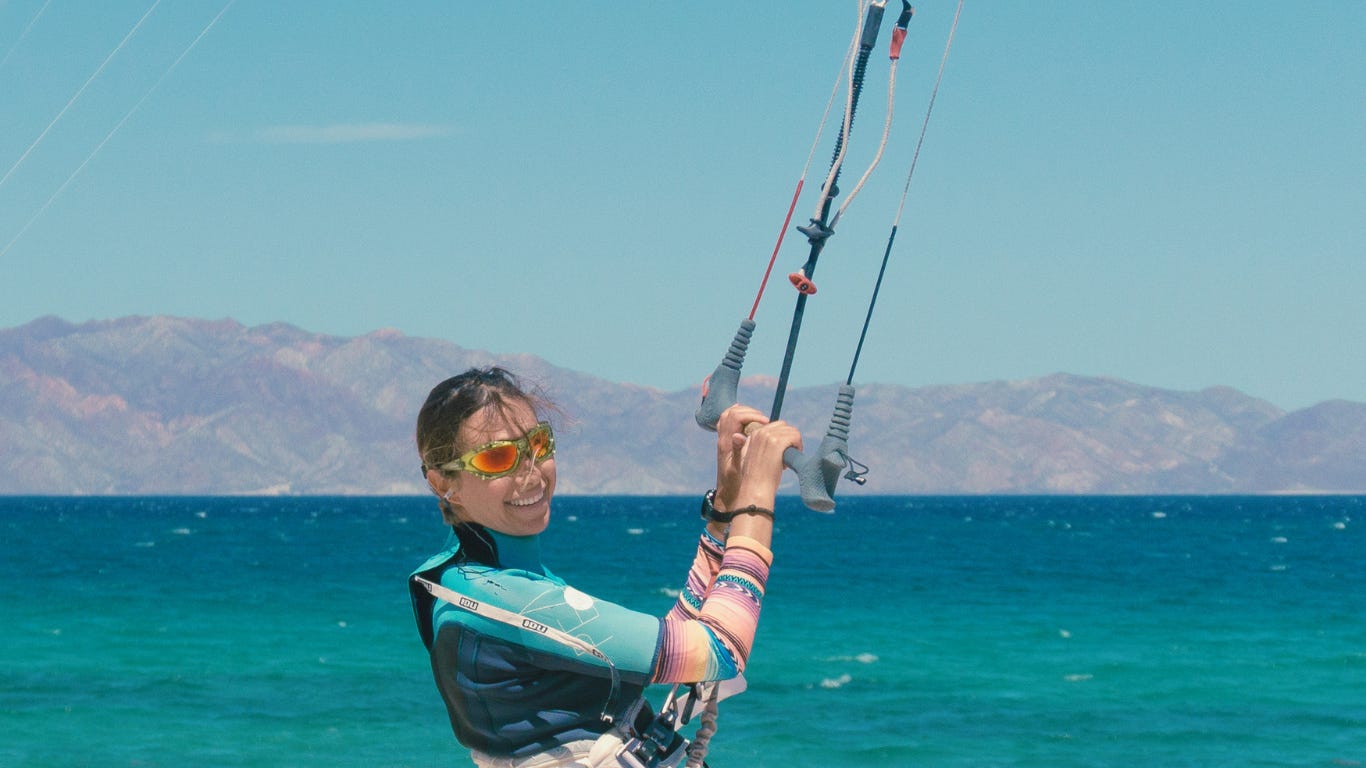
I was kite surfing. The water was unusually calm, just a few ripples on the surface. I was alone out there, practicing my turns. Then I saw it.
Big. Dark. Following me through the water.
Shark.
I panicked. I turned. It turned with me. I crashed my kite into the water, heart slamming, waiting for the attack that never came. When I relaunched and looked down again I finally understood. The shark was the shadow of my own kite. The water was too calm to hide it. I had been fleeing my own shadow.
I laughed until my ribs hurt, alone in the middle of the bay.
Your brain does this all the time. The colleague who might get ahead. The client you might lose. The edge you might dull if you take your foot off the gas for five minutes. These threats feel real. They have mass and teeth and terrible intentions.
Look again. Most of them are shadows.
What I Finally Saw
Standing in the Sea of Cortez that afternoon, something landed for me that I hadn’t been able to see from my kitchen table at midnight.
The first fear — if I slow down, I’ll lose everything — was a projection. A story about the future.
The second fear — if I don’t slow down, I’ll lose myself — was already happening. Had been happening for years. Without anyone announcing it. Without me noticing it.
My health. My marriage. My friendships. The sense of who I was when I wasn’t working.
One fear lived in the future. The other was living in the present. And I had been so focused on protecting against the first one that I couldn’t see the second one was already underway.
That was when I started asking a different question. Not how do I protect what I’ve built but is this actually the dream? Or is there another way to do this where work feeds life instead of the other way around?
There is. That’s why this Unhustle letter exists and why I wrote a book.
The Unhustle Experiment
This week, I want you to do one thing. It takes five minutes. You’ll want to do it in your head. Please don’t. Write it down.
Finish these two sentences:
If I slow down, I’m afraid I’ll lose...
If I don’t slow down, I’m already losing...
Notice the tenses. The first fear lives in the future. The second is happening now.
Most people discover the second column has been filling up for years — the health, the relationships, the parts of themselves that exist outside work — while the first column remains largely hypothetical.
You don’t have to solve anything today. Just be honest about what’s actually true. That honesty is where the desire path starts.
If this resonated, forward it to one person who needs to read it. That's how this letter grows.
This Week’s Question
Which fear is louder for you right now?
The fear of what you might lose if you slow down. Or the fear of what you’re already losing because you haven’t.
Hit reply. I read every email. Every single one. Or leave a comment below. Have you had these fears?
— Milena
Writing from Baja California Sur, where the WiFi is weak and the thinking runs deep.
The Unhustle Letter goes out every Sunday. Forward it to someone running on two fears. → unhustle.com · Work with me · Join the book waitlist
Comments
Nothing yet. Say the first thing.
Sign in to join the conversation.