
Hello friends, and happy April—we are still getting snow and frosts in NH.
Like so many others, I loved Virginia Evans’ debut novel The Correspondent—one of my favorites of 2025. I’ve also been astounded by its runaway success. I’ve been a fan of novels in letters since I was a tween, but also had the sense that for most readers, they’re a little too quiet, a little too old-fashioned.
The epistolary novel is indeed an old-fashioned form (Mary Shelley’s Frankenstein, for example), and yet somehow it keeps on going, even in our fragmented 21st century. And there’s a bonus for 21st-century readers and our short attention spans: most of today’s epistolary novels are short.
If you loved The Correspondent and want to dig in to another novel in letters, here are some suggestions. Let me know if you’ve read any of these, or have others to add!
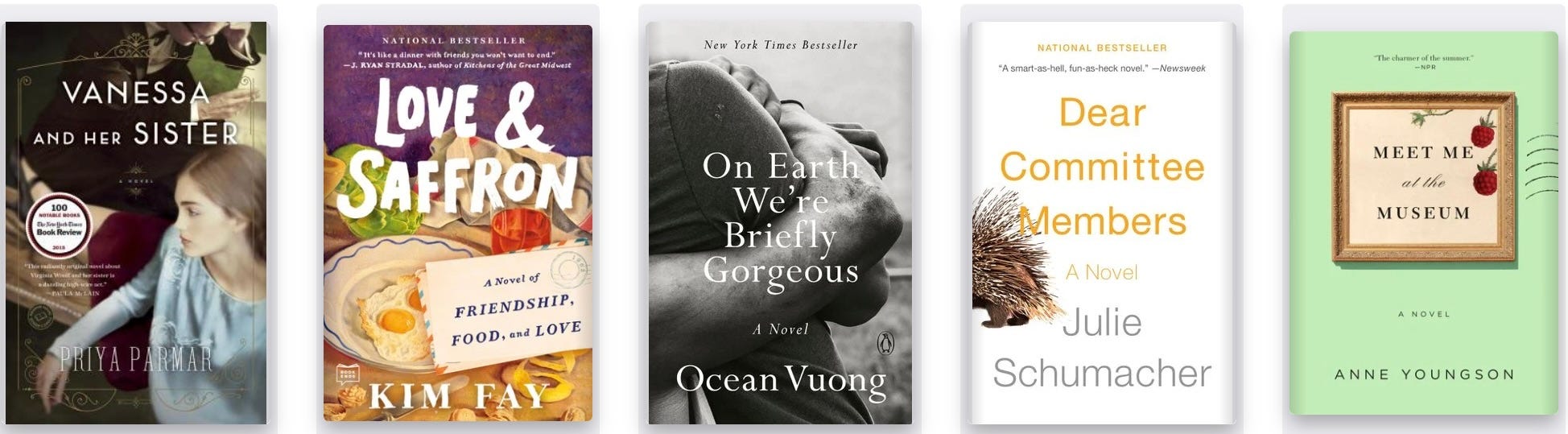
Love and Saffron, Kim Fay (2022)
The story of an unlikely friendship between the 59-year-old Imogen, a regional food writer in Washington state, and Joan Bergstrom, a Los Angeles reporter in her late 20s who’s starting to write about food and cooking. Love and Saffron is set in the ‘60s, and as the women share food notes, they grow closer. Each is changed by the other over the years of their correspondence.
Meet Me At the Museum, Anne Youngson (2018)
Meet Me at the Museum records the unlikely correspondence between Tina, a late-middle-aged English farm wife, and Anders, a widowed curator at a museum in Denmark. Their letters begin with a query from Tina about the Tollund Man, a Bronze-age man preserved thousands of years ago in the bog, and eventually turn into a moving friendship, and maybe more, that allows both of them to change and grow. Tender.
On Earth We’re Briefly Gorgeous, Ocean Vuong (2019)
Poet Ocean Vuong’s autobiographical debut novel is in the form of a long letter from the young man Little Dog to his mother, musing about his family’s immigrant life in Connecticut, the trauma of the Vietnam War, his wayward youth and coming to terms with his sexuality. It’s short, more novella than novel, and more meditative than forward moving, but beautiful in its language and evocations of Little Dog’s life.
Vanessa and her Sister, Priya Parmur (2014)
Vanessa and her Sister is in the form of Vanessa Bell’s (fictional) diary. It opens in 1905: Vanessa Stephen, in her early 20s, is trying to manage a household full of not-quite-grown siblings, especially the fragile Virginia, and to figure out her role in the emerging group of talkative and braggy young intellectuals who gathered at their house, and began to call themselves the Bloomsbury Group. The novel is a little hard on the young Virginia Woolf, but that feels true to what Vanessa might have felt. There are also echoes of EM Forster’s characters Margaret and Helen Schlegel from Howard’s End. (Forster likely based the Schlegel sisters on Virginia and Vanessa.)
Dear Committee Members, Julie Schumacher (2014)
The comic Dear Committee Members puts a campus novel into novel-in-letters form. The beleaguered Jason Fitger, an English prof at a middling Midwestern college has to write endless letters of recommendation for his students. Meanwhile, his department’s budget is getting cut dramatically, while non-humanities departments like economics are enjoying bigger budgets, etc. If you liked Richard Russo’s academic satire Straight Man, or the Netflix comedy “The Chair” (with Sandra Oh and Jay Duplass, very funny), then Dear Committee Members is for you.
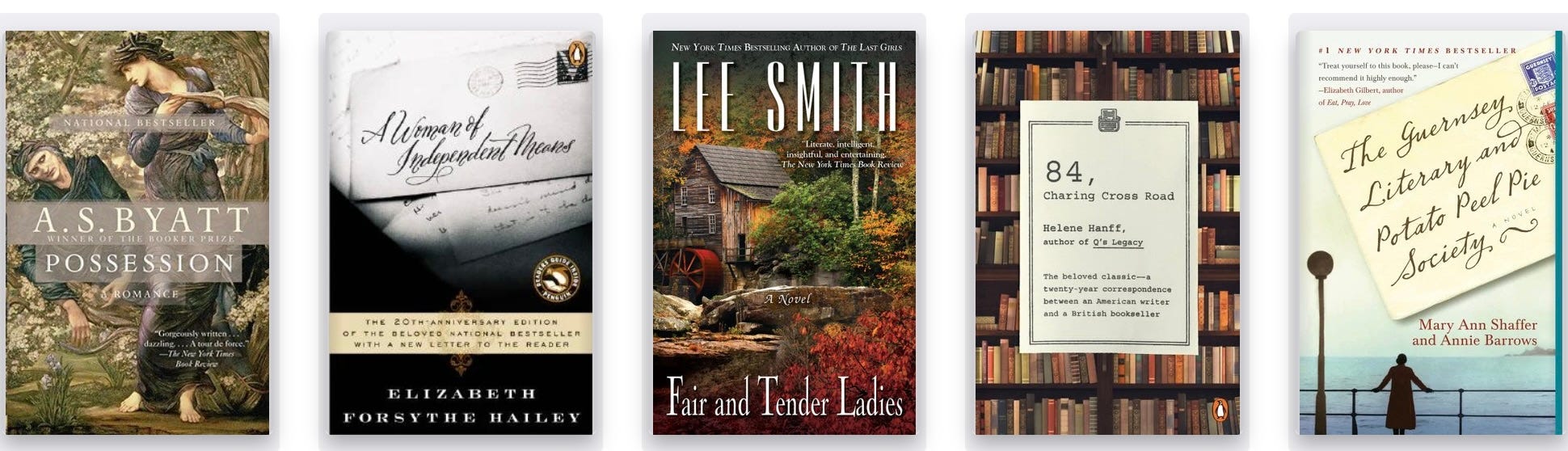
The Guernsey Literary and Potato Peel Pie Society, Mary Anne Shaffer, Annie Barrows (2007)
Did every book club in the early 2000s read this novel? Possibly. TGLPPS is a postwar story following writer Juliet Ashton (who seems loosely based on Jan Struther, the London Times columnist and author of Mrs. Miniver). Juliet is at loose ends, searching for her next book topic. She stumbles onto the story of the Guernsey Islanders and how they survived Nazi occupation. It’s a friendship story, a love story, and a coming-of-early-middle-age story, and it includes letters not just from Juliet but also from a mix of voices—her stalwart editor, her best friend, an array of Guernsey residents. TGLPPS also has a bittersweet origin and publication story: In her sixties, librarian and editor Mary Ann Shaffer was finally writing the novel she’d wanted to write for many years, when she was diagnosed with cancer. Her niece, children’s author Annie Barrows, finished the novel, and it was published a few months after Shaffer died.
Possession, A.S. Byatt (1990)
This is cheating a little, since Possession is partly epistolary, and partly a third-person narrative. But the letters, poems, diary entries, and other documents (all invented by Byatt) between two Victorian poets are what make the novel so immersive. In my memory of the book, the story of the two 20th-C. scholars as they research these documents and come to startling conclusions, is satisfying, but it’s the 19th-C. love story that’s most compelling.
Fair and Tender Ladies, Lee Smith (1988)
Oh, how I loved this novel, the way it followed main character Ivy Rowe for most of her life, through her letters from childhood on through old age, and gave such a wonderfully particular sense of her character, and life in the Appalachian/Blue Ridge Mountain town of Sugar Fork, VA. There’s a lot of dialect in these letters, so it may not be for everyone.
A Woman of Independent Means, Elizabeth Forsythe Hailey (1978)
Like Smith’s Fair and Tender Ladies, A Woman of Independent Means follows Bess Steed Garner through her letters, which stretch from from age 10, at the beginning of the 20th century, to the end of her life, in the ‘70s. And like Fair and Tender Ladies, it is a Southern novel: Bess is a Texan, a Dallas lady. I read this around age 13 and loved it enough to reread it every few years for a while, enjoying Bess (like someone’s bossy, charismatic grandmother) and the way she engineered her independent means in a time when that was rarely possible.
In checking A Woman of Independent Means’ names and dates, I came across Anne Tyler’s 1978 review in the NY Times. Here’s a quote:
“At a few points, this book is no fun at all to read. Why would we want to add this interfering, grasping, possessive person to our list of acquaintances? But slowly, she wins us over. Some of her more audacious offenses begin to make us laugh; her tragedies are more moving than we would have expected.”
84, Charing Cross Road, Helene Hanff (1970)
84, Charing Cross Road reads like a novel (or novella; it’s short), but this is a collection of real letters between New York City writer Helene Hanff and Frank Doel, a used-book dealer in London (along with letters to and from Doel’s coworkers at the bookstore). The letters run for 20 years, beginning in 1949. It’s an unlikely-friendship story, or maybe a platonic love story. My only quibble is that it ends abruptly.
Maria Semple’s Where’d You Go, Bernadette, which makes use of emails and other documents, as Bernadette’s tween daughter tries to figure out where her mother has run away to.
Taylor Jenkins Reid’s Daisy Jones and the Six, which uses (fictional) interview transcripts, like a VH-1 documentary, to bring to life a Fleetwood Mac-style band and its Stevie Nicks-like songwriter and sometime frontwoman.
Helen Fielding’s Bridget Jones’ Diary. The title says it all. Very much of its time, but still very funny.
Beth O’Leary’s The Flatshare. A rom-com; two roommates, Tiffy and Leon, never see each other because one works the night shift, so they leave notes for one another. It’s partially epistolary, partially a more standard narrative. (I’ve only just started listening to this one).
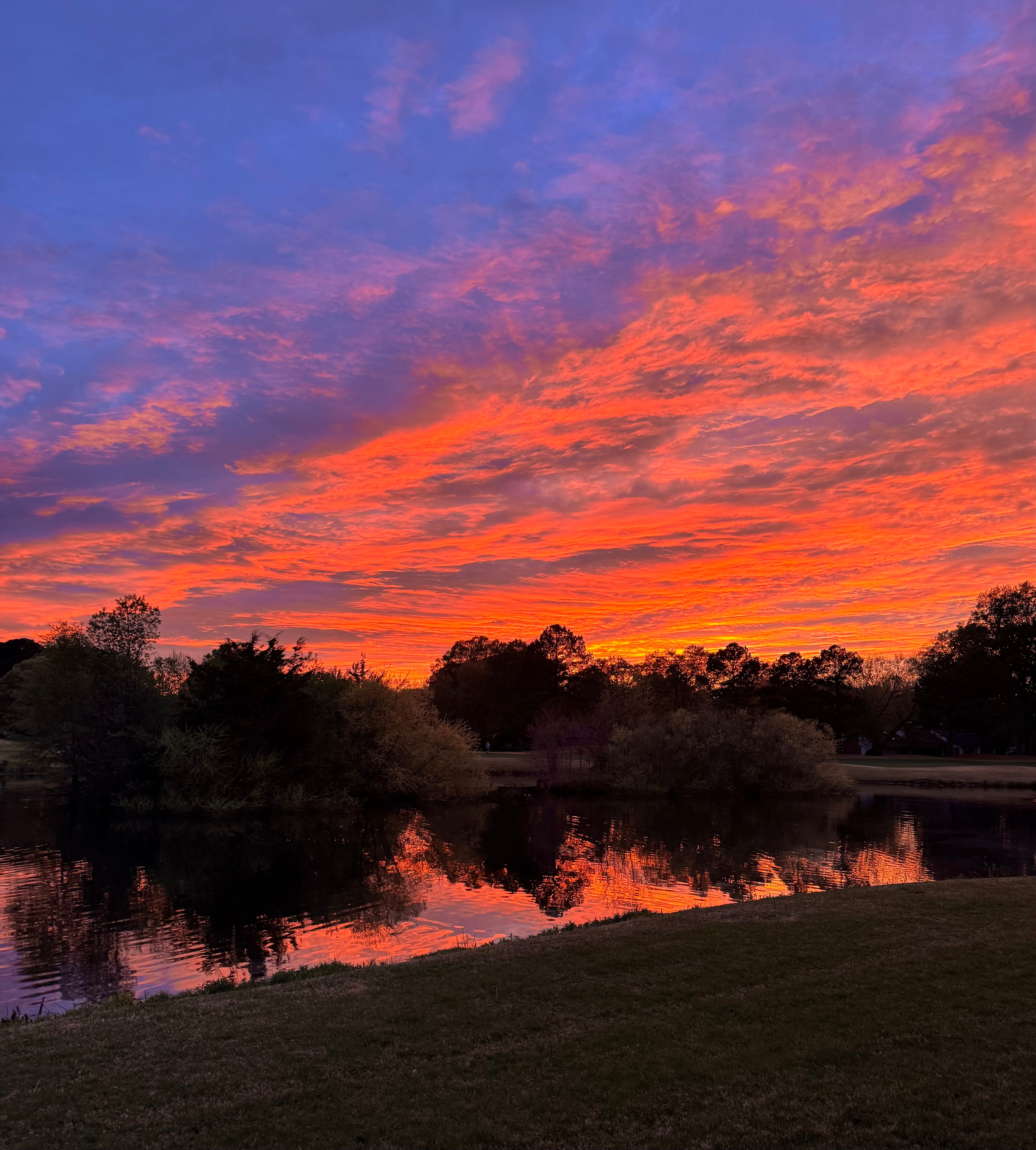
Until next time! I’ll leave you with this sunset from behind my mom’s house in Virginia, where I was visiting last week.
Comments
Nothing yet. Say the first thing.
Sign in to join the conversation.