
Hi friends,
And suddenly it’s mid-August, the end of summer around the corner. In New Hampshire, we’re in peak tomato and corn season, and the kitchen counters are covered with tomatoes, despite the blighty look of my tomato plants. So for the moment, it’s still summer, which means more summer reading, under a tree or at the beach. Today I have a few more books to recommend and some summer-reading favorites, all sagas, from summers past. (I’ll link to Summer Reading Part One, my post from earlier this summer, below.)
Let me know what you’re reading this summer!
Whistler, Ann Patchett
Ann Patchett’s latest is one of the books I avoided earlier this summer, simply because it’s one of the year’s biggest books, as in biggest-selling. But as a Patchett fan, I succumbed, and can say that Whistler will be one of my favorites this year. In Whistler, a long-estranged pair—a stepdaughter and stepdad—reunite after 40 years apart. Daphne is a 50ish English teacher at a Manhattan girls’ school, and her much older husband Jonathan is a retired hospital administrator. They encounter Eddie, Daphne’s long-lost stepfather, on a visit to the Met Museum. As Daphne and Eddie get to know each other again, the novel moves between the present day and the traumatic incident that drove them apart.
It’s a quiet novel with a lot of charm, and it seems like Patchett really enjoyed writing the New York City setting—this novel’s New York is like Laurie Colwin’s or Nora Ephron’s New York—though at heart Whistler is a fractured-family story. Also, the horse on the cover (Whistler is his name) is both incidental and integral to the story, but this is not a book about a horse. If you’re already an Ann Patchett fan, Whistler has hints of both Commonwealth and The Dutch House.
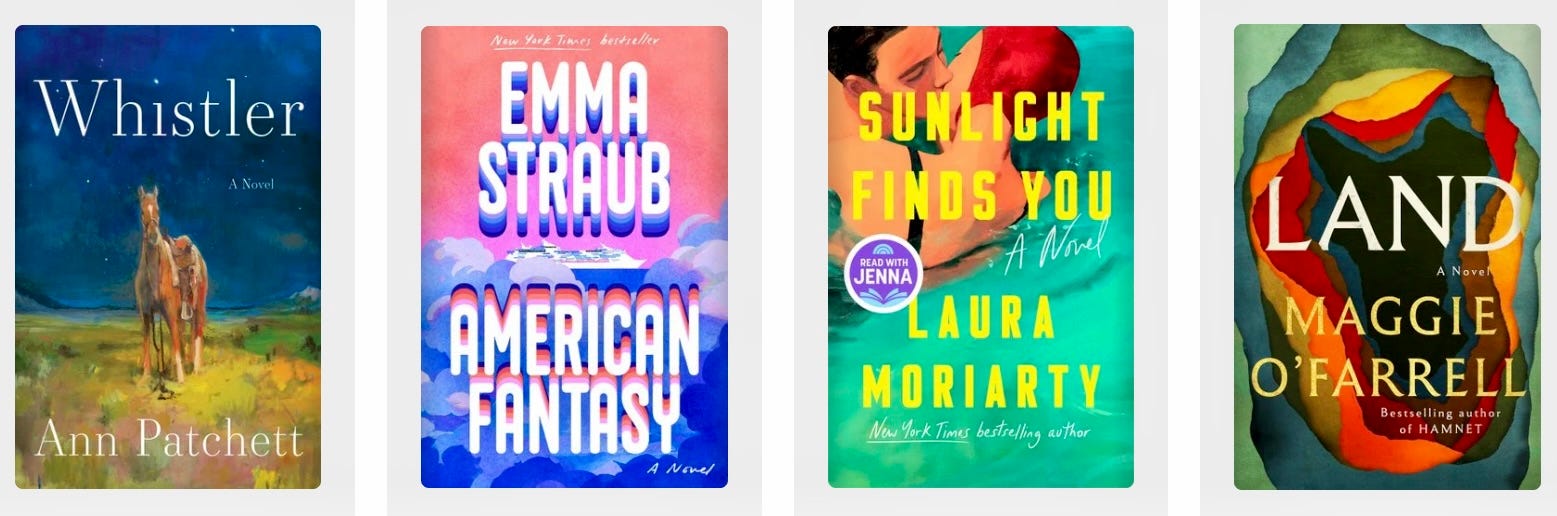
American Fantasy, Emma Straub
As my friend Tabitha pointed out, both American Fantasy and Whistler feature 50-something main characters, though American Fantasy’s Annie is feeling her age, her menopausal symptoms, etc. much more so than Whistler’s Daphne, who’s a little disembodied. Whistler’s Daphne is never going to tell us much about her hot flashes.
American Fantasy follows three characters through a four-day cruise for the middle-aged fans of Boy Talk, a ‘90s boy band. Annie is recently divorced, and solo because her sister, whose idea the cruise was, broke her leg; Keith is the saddest member of Boy Talk, in the middle of his own midlife crisis; and Sarah is a 30-year-old event producer who has to wrangle Boy Talk and the fans through a series of performances, games, and parties. Straub does a beautiful job inhabiting Annie and Keith, and keeping the reader wondering whether the two will somehow end up together. The third character, Sarah, fills in some of the details about the cruise, but at times it felt like she was added to keep the novel from being categorized as a rom-com or romance. If you haven’t read any Emma Straub, I’d suggest starting with her previous novel, This Time Tomorrow, another midlife coming-of-age tale, and a gentle time-travel story.
Sunlight Finds You, Laura Moriarty
Laura Moriarty’s Sunlight Finds You is a slow-burn love story and family story, wrapped in the tensions and mores of Cold War-era Florida. As the novel opens, it’s 1947. Teenage Nora and her family have moved to St. Petersburg from small-town Missouri for a fresh start after the death of Nora’s mother. Soon Nora connects with Leonard, a shy, intellectual swimmer from a prosperous, snobby family. When Leonard’s parents catch Nora and Leonard being reckless, Leonard’s mother coerces Nora into promising not to have anything to do with Leonard. Leonard, not understanding Nora’s decision, enlists in the Army just before the Korean War breaks out. Forbibben from seeing Leonard, Nora makes a decision with life-changing consequences, and both Nora and Leonard take actions that seem like they can’t be undone.
At more than 450 pages, Sunlight Finds You feels saga-like, spanning almost two decades, though the main action takes place over only a few years. It’s a novel to sink in to rather than race through, its plot secondary to its characters. The book is especially strong in its depiction of life for Florida transplants after World War II; the era’s rigid social expectations are key to the story. I wish the novel had spent more time with the older Nora, but still, Sunlight Finds You offers a layered coming-of-age story.
Land, Maggie O’Farrell
Land should be a perfect summer novel for a reader like me: a long family saga set in Ireland in the decades after the Great Famine. Land offers the story of Tomás and Phina and their children, Liam, Enda, Rose, and Eugene. Tomás is a mapmaker who works for the British; he’s a skilled draftsman and surveyor, who also translates for the British. The novel layers in Irish folklore and mythology with the deep-time story of a sacred well and its land. There’s also a brave family dog, Bran, who gets his own history.
O’Farrell evokes these characters and their landscape so beautifully, but she also puts the family through repeated tragedy and heartbreak, as there surely would have been soon after the Great Famine, but so much so that the novel can be hard to read at times.
Every summer I hunt for the perfect summer book. My definition of perfect summer book leans towards doorstopper—books that you sink into and live with for a while. Here are six of my favorite summer reads from the past ten years or so, all of them family sagas or friendship stories.
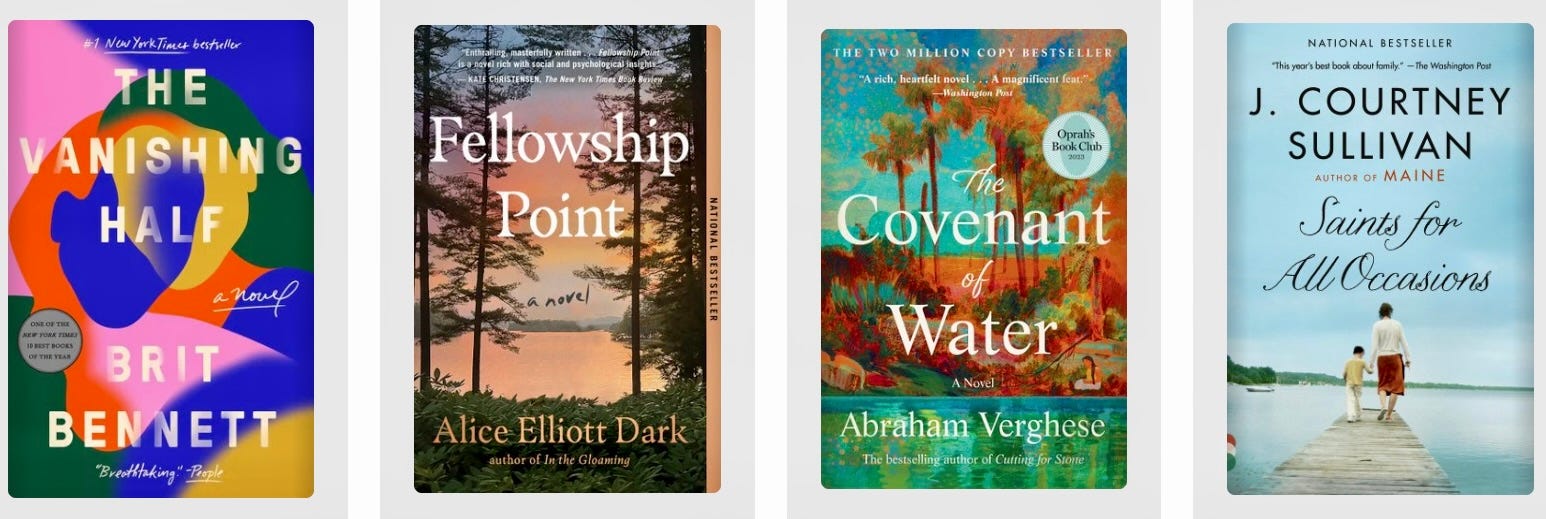
The Vanishing Half, Brit Bennett (2020)
An absorbing family saga following twin sisters Desiree and Stella, and, eventually, their daughters. Desiree and Stella grow up in a small (fictional) Louisiana town where everyone is a light-skinned African American. The novel traces the two sisters’ diverging paths, following them, and later their daughters, over the next fifty years. The Vanishing Half brings these characters to life, while at the same time offering a suspenseful, sprawling plot that examines the effect of racism and colorism on all its characters.
Fellowship Point, Alice Elliott Dark (2022)
Fellowship Point follows two lifelong friends, Agnes and Polly, through their lives in Philadelphia and summers at Fellowship Point, their small colony in Maine, founded by their Quaker great-grandfathers. Agnes, never married and prickly, is at the heart of the novel, and Polly more of a supporting character, although Polly gets her own point-of-view sections too. The novel covers most of their lives, but the present story takes place in 2000, and concerns Agnes’ attempt to protect their colony from predatory developers. It’s a big novel, 19th-century-novel-ish in some ways, and it’s a novel about friendship, a rare thing. A perfect summer read for me.
Saints for All Occasions, J. Courtney Sullivan (2017)
An Irish-American family gathers for a family funeral; the novel follows two storylines, one from the present—the days leading up to the funeral, from the perspectives of various family members, as they try to figure out what led to the unexpected death—and one from the past—two sisters emigrate from Ireland to Boston, and eventually go through a major falling-out. This is Colm Toíbín territory, but more straightforward. I admire Saints for All Occasions’ storytelling, suspense sympathetic characters, and restrained style.
The Covenant of Water, Abraham Verghese (2023)
A multi-generational family saga set in South India, spanning most of the 20th century. Verghese manages a large cast of characters and a multi-pronged 19th-century-novel-esque plot, but still, his characters are beautifully developed, with such tender interiority, and his writing so evocative, that I wanted this very, very long novel to keep going. Verghese is also a doctor, and this shows—medical issues are integral to the plot, though it’s not a medical drama, per se. The novel also draws attention to class and gender issues, the depredations of colonialism, and the consolations and restrictions of religion.
Tomorrow and Tomorrow and Tomorrow, Gabrielle Zevin (2022)
Like Fellowship Point, Tomorrow and Tomorrow and Tomorrow is a novel about friendship and its power, and how it affects our lives. Sam and Sadie are two video gamers who first become friends in childhood. TTT follows Sadie and Sam through three decades of friendship as they form a little company together, build video games, and go through A LOT of ups and downs. Immersive, beautiful, and long; also a little 19th-century-ish in its omniscient narration and length. (Note: You don’t have to be interested in gaming to like this novel. I have no interest whatsoever in video games.)
The Past, Tessa Hadley (2016)
The Past unfolds over a few weeks as four grown siblings gather at their old country house, originally the home of their grandparents. Plenty of family dynamics here:, with three fractious sisters, all perceiving themselves as failures of a sort, and their brother Roland, who arrives with his cool foreign wife and teenage son. The novel’s present alternates with the past, dropping back to the late ‘60s, when the siblings’ mother leaves her philandering, jackass husband and returns to her parents’ house with her little children. It’s a quiet but intense novel, with some wonderful character studies, and evocative descriptions of the house, the overgrown wilderness around it, and nearby towns.

Comments
Nothing yet. Say the first thing.
Sign in to join the conversation.