
“There are so many ways to be a writer. Find your way and don’t let anybody diss it.” — Jennifer Louden
Hi friends, I’m in the middle of revising my novel, so today I’m sharing a piece from 2024, one of my favorites from my occasional Midlife Author interviews. This Q and A is with the delightful Jennifer Louden. For the writers out there who need a little encouragement, and anyone seeking a midlife pivot, this one’s for you!
I’ve been following Jennifer Louden’s career for decades—in the ‘90s, my sister gave me a copy of The Woman’s Comfort Book, which was in fact a comfort to me as a young woman. And I was so happy to find her Substack It’s Not too Late.
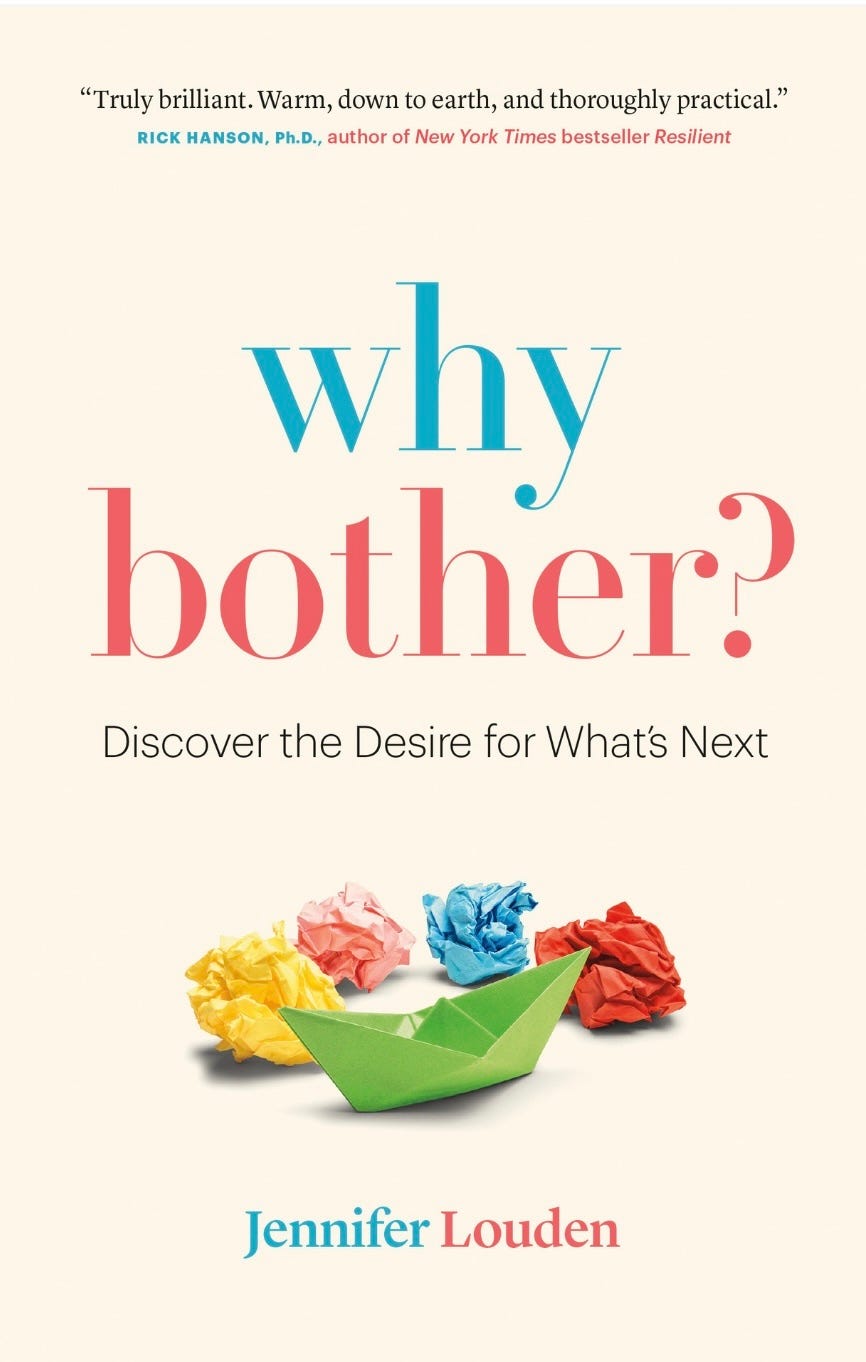
Here’s a little more background: Jennifer Louden is a personal growth pioneer who helped launch the concept of self-care with her first bestseller, The Woman’s Comfort Book (1992). Since then, she’s written eight books, including The Woman’s Retreat Book and The Life Organizer, with close to a million copies sold. Her latest book is Why Bother? Discover the Desire for What’s Next.
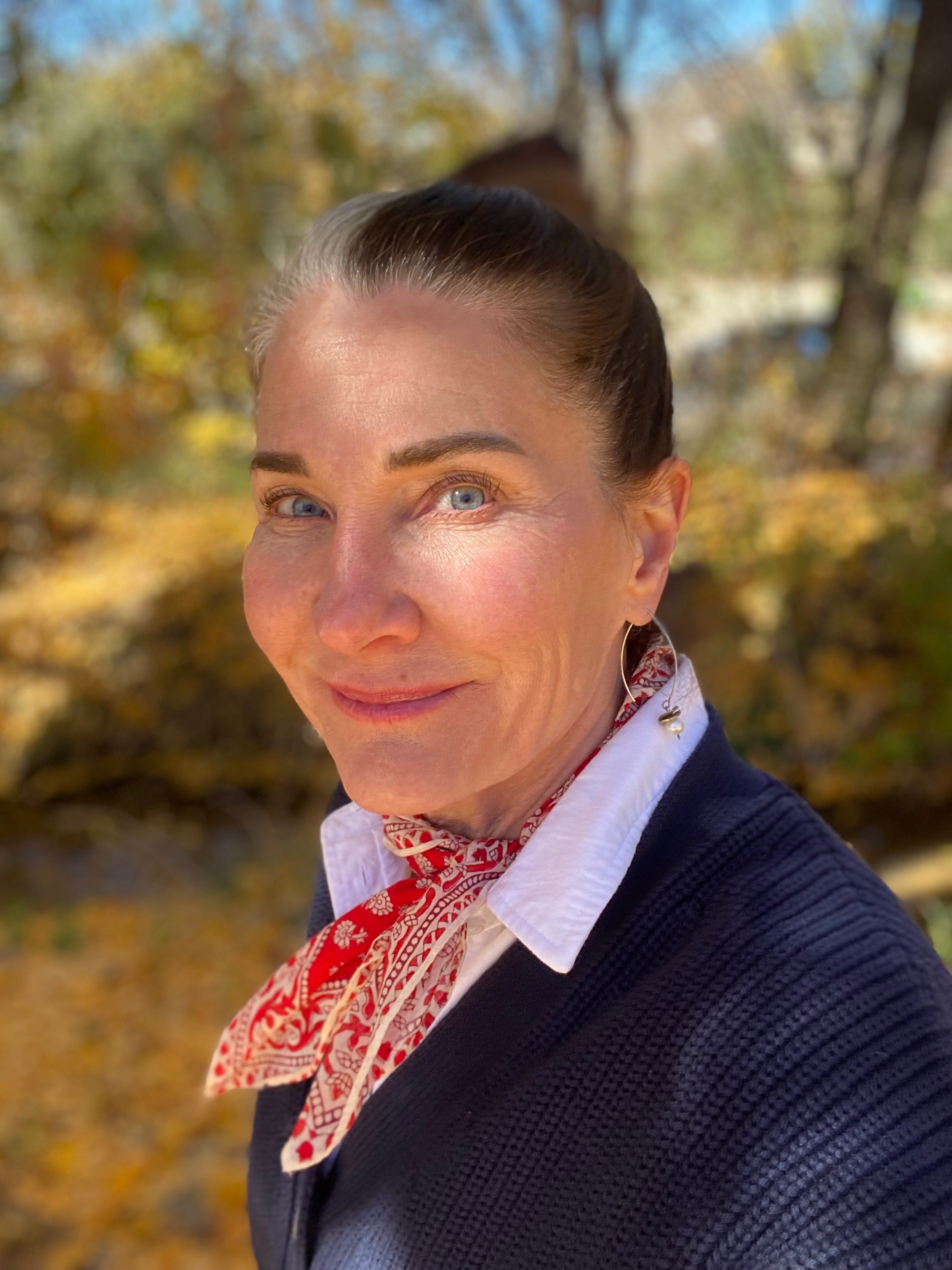
Jen has spoken around the U.S., Canada, and Europe, wrote a column for Martha Stewart magazine, and been profiled or quoted in dozens of major magazines, and in two of Brené Brown’s books. and appeared on hundreds of podcasts, TV, and radio shows..
Jen hosts the podcast Create out Loud from her home in Boulder County, CO, where she lives with her husband Bob and their two dogs, Stuart and Willa. She’s a mom of two fully launched adults and a passionate climate activist.
Hi Jen! So you’ve written nonfiction for many years, starting with The Woman’s Comfort Book. Where were the first glimmers of that book?
Yes, The Woman’s Comfort Book was my first book. Here’s the story of that book’s conception as I recounted it in my last book, Why Bother?
It’s the late summer of 1987. I’m twenty-five. I’ve been out of film school for a year and a few months. My entire reason for being is to make it as a very successful screenwriter, preferably before the year is over.
I have a halfway decent agent, I’ve had a handful of meetings with development executives, and I’m working on a new screenplay. By all rights, I should be hopeful. Only I’m not. I’m depressed, I’m drinking too much red wine , and I’m stuck.
I sit at my kitchen table in a tiny rented guesthouse, staring at my computer screen, rewriting the same four or five pages. My memory of those hot smoggy months is of a blinking cursor, three young women characters who refused to come alive, and then, at some point, an inner voice whispering I needed to try something else . I remember the warm appeal as I considered giving up the fight to be a writer and then my icy horror. I needed to become a successful writer. A Somebody. And quickly.
The inner voice didn’t go away. In fact, it got louder as it tried to get my attention. In my favorite bookstore, it would insist I look for Help Wanted signs. Driving by the garden store, it would nag me about how much I loved gardening; why not explore that interest? The voice kept nattering and prodding.
The leaden weight of trying so hard to become somebody, to prove I was special, floated off me. For the first time since I had moved to L.A. six years before to “make it” in the film business, I was okay.
The voice began to editorialize: “You need to be kinder to yourself. You need to quit writing.” This advice made me want to find an exorcist. It was one thing to suggest another job to make some money, but it was quite another thing to ask me to quit writing. If I gave up my dream, I was certain I would die. Die as in I couldn’t see anything else for me beyond writing and selling this screenplay. The world was flat and I would fall off. I had to become a successful screenwriter.
For whatever reason, I decided to take a break. Standing by the kitchen counter, I surrendered being a writer. I’ve tried to understand for thirty-plus years what happened next. Free fall is the best I’ve come up with, only it wasn’t frightening.
I was lightness itself, falling and rising at the same time. The leaden weight of trying so hard to become somebody, to prove I was special, floated off me. For the first time since I had moved to L.A. six years before to “make it” in the film business, I was okay. Simply okay.
After maybe two minutes or maybe half an hour, I heard a voice clearly say, “The Woman’s Comfort Book.” I turned to see if my landlord, who lived right above me, had stuck her head in my apartment and spoken. But there was no one there.
It took me several years to write the book proposal and my first effort was godawful. Everybody turned it down, but the woman who became my editor at Harper saw something in the idea, gave me great notes, and eventually bought it. I’m forever grateful.
So the act of taking a break, that moment of lightness, allowed a new dream to enter. What about your more recent turn towards novel writing? Why, or how, did fiction start calling to you more insistently?
After my strange new personal-growth career was born, the storyteller in me was restless and begging for attention. I kept writing fiction here and there, in spurts. I have two first-draft novels in the drawer and a memoir. Writing stories was such a recurring strong desire for me that around 2001, I moved my family away from our lovely life in Santa Barbara to the Pacific Northwest where we could live more cheaply, so I could write fiction.
But while I wrote a first draft of a novel that showed real promise, I never rewrote it. I kept going back to my nonfiction writing, partially to make money but also I think I was afraid I couldn’t write fiction, that I wasn’t talented or smart enough. The novel I’m writing now represents fulfilling that long-held desire and disbelieving those old stories.
What do you know now as a writer that you wish you’d known starting out?
It’s not about talent! It’s about learning and studying and rewriting.
That I work best with a writing coach helping me develop the story as I write.
It’s okay if writing is hard, if you don’t find a flow state very often or at all. That doesn’t mean you aren’t a real writer or can’t make this work.
I get to choose where I put my attention. Writing can be exactly like a meditation practice; I can return my mind to my story again and again and again.
There are so many ways to be a writer. Find your way and don’t let anybody diss it.
Get comfortable with never being finished until the book goes to print. Let go of needing to be done, forget being tidy, and forget about putting all the jigsaw puzzle pieces neatly back in the box: there will always be a few missing pieces.
Can you share a challenge you’ve faced with writing or publishing?
Publishing, so many! Here’s one: I sold a book in early 2001 and couldn’t write it. It was a great idea, but it wasn’t coming. Pure panic. Then my editor left Random House and the editor who acquired me told me she didn’t like my idea, and she didn’t like my writing. Still stings to remember that conversation.
Writing challenges are an everyday occurrence for me. Staying in the chair is challenging. Piecing together my plot. Wanting to get my first draft finished so I can rewrite, which ironically is now my favorite thing to do—challenging. I want to get on with fixing things (see advice above, forget being tidy). Moving characters around the room messes with me every day. Finding accurate original ways to describe things like the leaves rustling in the trees. I could go on. Basically: writing is challenging!
Ask yourself: “Is it difficult to call myself a writer and if so, why?” We have so much cultural baggage around writing …. and we still hold stuffy ideas about who gets to call themselves a writer. Peer at what you believe, question it.
Can you share your advice for someone who’s just getting started with writing, or who thinks it’s too late? Or someone who wants to try something quite different?
If writing is your jam or you think it might be, you can figure out how to make it work. This is very doable! It helps to toss out any myths and stories you hold about writing.
One of the prompts I liked to give my coaching clients: “What rules and stories about writing do I need to throw out to write today?” Jot down a quick list. See the bars of your mental prison and then behold: the door is open.
Another way to explore what might be in your way is to ask, “Is it difficult to call myself a writer and if so, why?” We have so much cultural baggage around writing that goes back to literacy and writing skills as indicator of class and privilege, and we still hold stuffy ideas about who gets to call themselves a writer. Peer at what you believe, question it.
All of this applies to pivoting too. I’ll be damned if I’m going to put myself in a box, or let anybody else put me in a box, about what I can write. Who gets to decide for me? Nobody can stop me from writing what I’m interested in. And FYI: Readers don’t care about boxes; they care about writing and books that move them or inform them or turn them on or make them laugh out loud. Write for your reader!
And speaking of pivoting, tell us about your novel.
When I read Harry Potter all those years ago, I kept thinking, “Why do the kids get to go to Hogwarts, I want to go!” I’m writing a contemporary fantasy about a magical school for older women where the women learn magic to buy humanity time from the climate crisis. It’s a mother-daughter story, it’s about desires that never leave you, and it’s about older women’s unique power. My main character Thea believes very strongly that it’s too late for her to have what she’s always wanted—magic—but is it?
What makes a midlife writer a stronger writer?
I’m so much more aware that writing, like many endeavors in life, is a mind game*. I know I can succeed at mind games. I’ve meditated for decades. I’ve helped my parents through the end of their lives. I fell in love at 45 after an unwanted divorce. I became a runner at almost 54. Mind games are something I understand.
I’m fond of saying to writers I work with: “Just stay in the room five more minutes.” That’s a mind-game practice.
*By mind game, I mean how I think about the process, how I get myself to show up, how I work with all the challenges I named above. And by success, I mean finish and rewrite a novel I’m proud of and other women find empowering and exciting to read.
And last, tell us about some books that you think deserve more attention.
Zorrie by Laird Hunt. Time’s Mouth by Edan Lepucki. The Colony by Audrey Magee. The Narrowboat Summer by Anne Youngson. There, now you can see what a wide reader I am.

Thanks to Jen Louden for this clear-eyed interview!
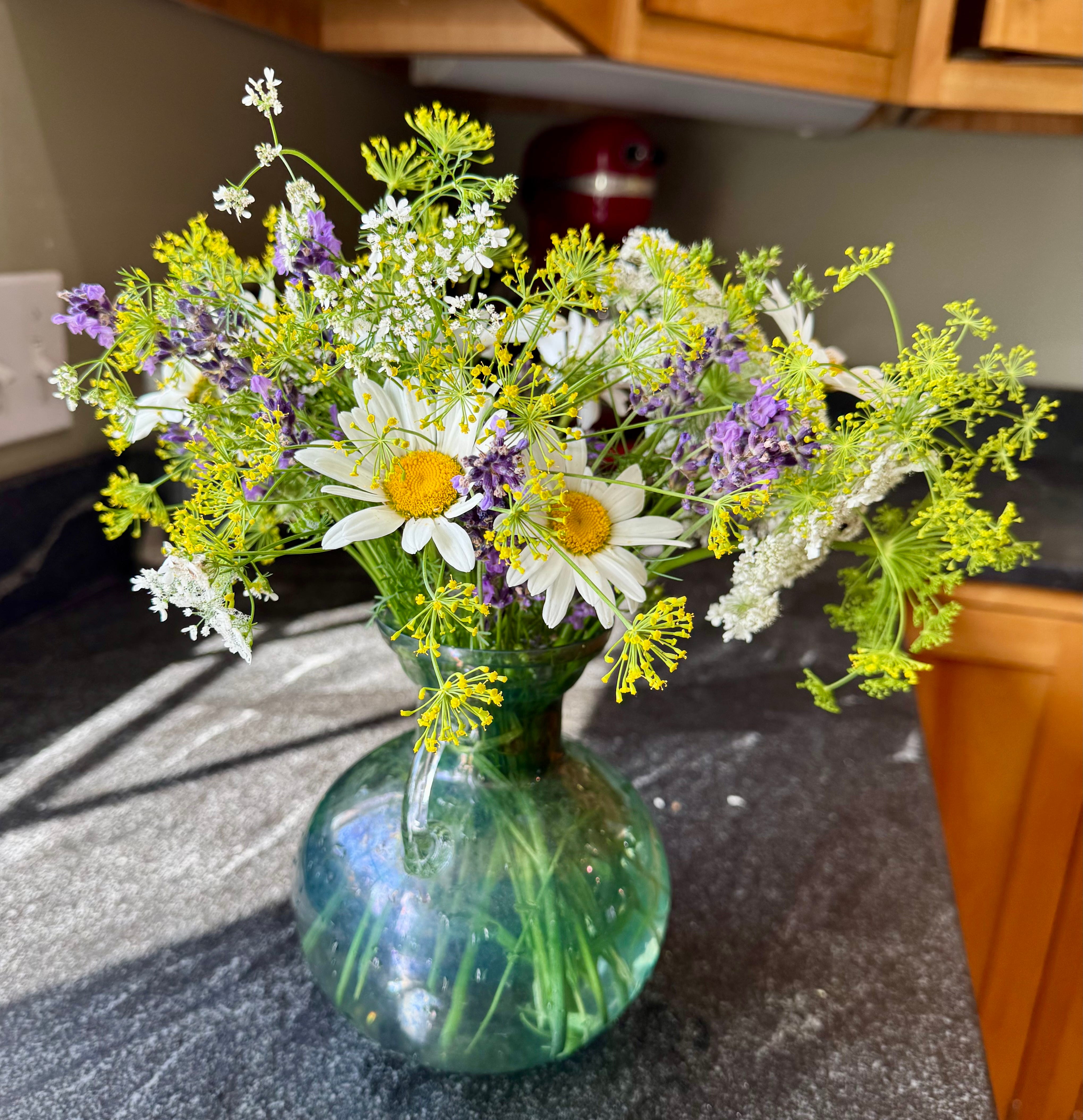
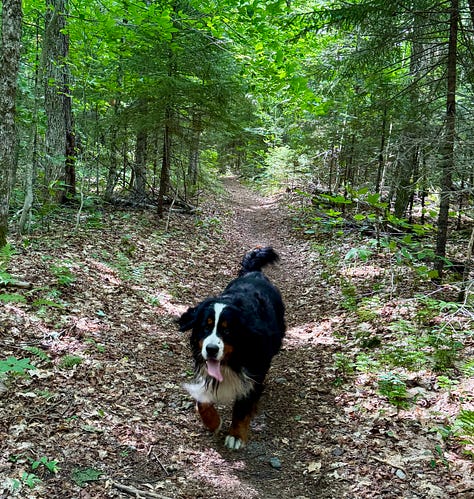
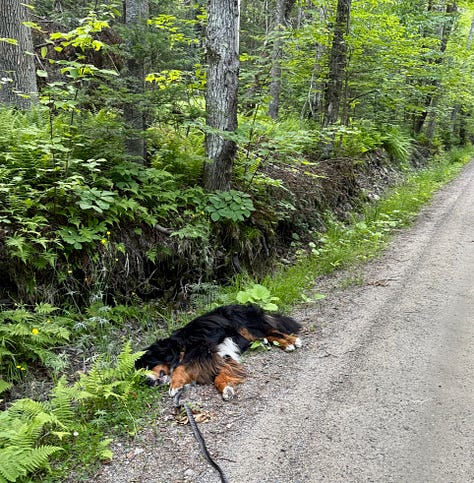
Until next time! I’ll leave you with an odd arrangement I made out of dill, lavender, cilantro, wild carrot, and daisies, and some pics of Otto on the trail and being a baby.

Comments
Nothing yet. Say the first thing.
Sign in to join the conversation.