
Disclaimer: Not financial advice, please DYODD.
It is a quiet giant behind America’s financial plumbing, and the No.1 for many things:
Runs the largest POS (point-of-sale) ecosystem for SMB.
Processes the most Zelle transactions.
Owns the largest PINless debit card network.
Powers core banking systems for 40%+ banks and credit unions.
The stock has dropped ~70% since Jan 2025 due to self-inflicted issues, the “AI will eat software and payments” narrative, and a “kitchen sink” quarter that spooked the market, leaving it at its lowest valuation since the GFC.
That’s where the opportunity begins.
That enters Fiserv FISV 0.00%↑
Fiserv has 2 business segments.
In Core Banking, Fiserve holds the #1 market share among U.S. banks and credit unions, with high switching costs and a sticky, long-term client relationship.
In ancillary services, Fiserv leads in Zelle, debit, and credit card processing, supplemented by its unique STAR/Accel network, a critical asset under Regulation II (Durbin amendment).
In Merchant Acquiring, Clover is the #1 POS ecosystem for SMBs, and Carat is a top-5 contender in the enterprise.
Today at $63/share ($34Bn market cap), Fiserv trades at 7x adjusted P/E ($4.9Bn LTM adjusted net income) and 8.5x EV/EBIT ($61Bn EV, $7.2B LTM adj. EBIT). Even on GAAP earnings, which understate its true earning power (will discuss later), it sits at ~10x P/E.
Peers across the core banking and merchant-acquiring verticals typically command P/E multiples of 15x to 25x (will discuss in detail).
Since Jan 2025, the stock has fallen ~70%, while SPY is up 20%+, its 2 core banking peers are down 10% to 40%, and its merchant acquiring peer is down 34%. The sector underperforms the overall market, and Fiserv underperforms its sector peers.
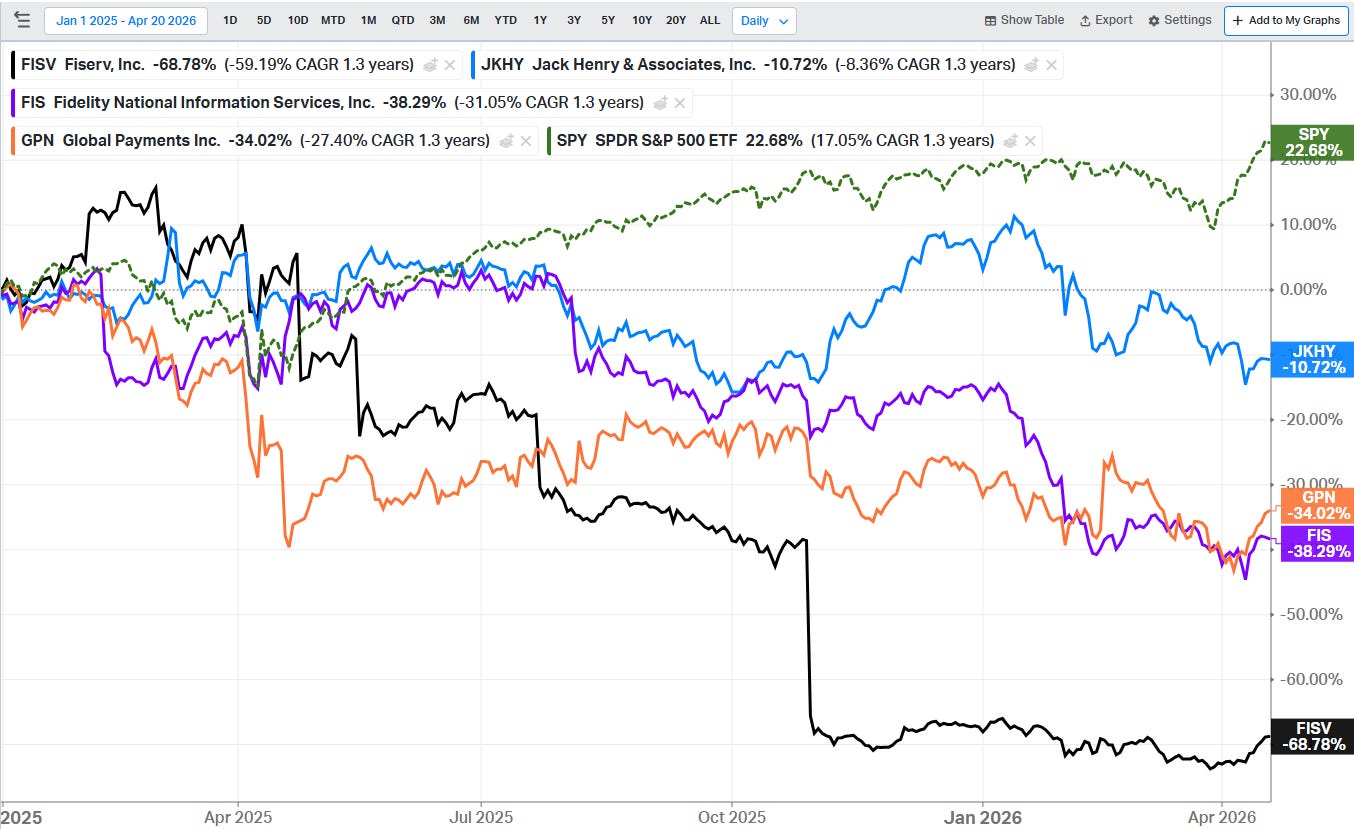
A business with Fiserv’s unparalleled scale, market dominance, and structural moats trades at this level while the major index is near its ATH, usually indicating a rapid structural decline.
isn’t without merit.
Fiserv’s core banking has a net loss of ~100 credit union clients in 2025. Satisfaction scores remain among the lowest tier in the latest ABA survey.
It acknowledged that a portion of prior growth came from a one-time boost in its Argentina business that won’t repeat. Meanwhile, years of under-investment have eroded some core capabilities in pursuit of short-term margins.
This analysis does not ignore these challenges. Instead, it examines both sides: acknowledging the legitimate reasons for the market’s skepticism while laying out a bull case that sits beneath the concerning headlines.
Industry Overview
Core Banking
Merchant Acquiring
Valuation Take #I - Napkin Math Style
Key Assets Walkthrough
70% off ATH and 3Q25 Bloodbath
“One Fiserv” Strategic Reset
Thesis Recap
Position and Execution Strategy
Core Banking System is a “back-office” platform for financial institutions. It handles deposits, loans, account mgt, data, general ledger, etc.
At its heart is the core engine (the ledger, accounts, deposits/loans), which connects via API/middleware to customer-facing Channels (mobile app, online banking, ATMs, call centers, etc). It also powers Ancillary Services - payments (ACH, Zelle), card processing (debit/credit), connection to card networks (Visa/Master, STAR/Accel), risk management, and reporting.
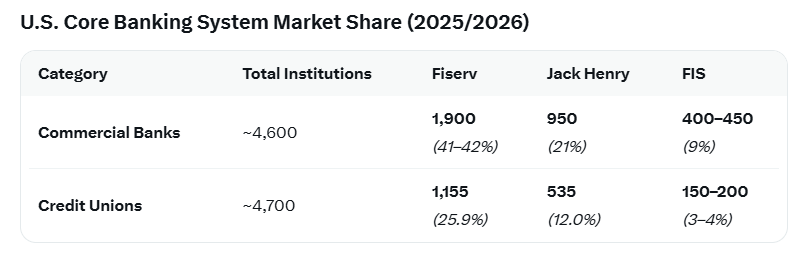
Fiserv, FIS, and Jack Henry, known as the Big Three, serve 70%+ of banks and ~50% of credit unions.
Fiserv has the largest overall market share, from small banks to large institutions. It offers the most comprehensive solution.
Jack Henry specializes in small community banks and credit unions, known for high client retention and strong service quality.
FIS is the strongest among mid-sized to large banks.
Prior to the 1960s, banks relied on paper-based processes. The first computerized core systems emerged in the late 1960s. Industry-wide adoption occurred from the late 1970s to the 1990s, when the Big Three were founded (FIS in 1968, Jack Henry in 1976, and Fiserv in 1984).
The Big Three consolidated their dominance through aggressive M&A in the 2000s and 2010s, and the industry has shifted toward cloud-native platforms and modern digital architectures since the mid-2010s.
Despite pressure from fintech disruptors, the Big Three have defended their market positions, and the top 3 FinTech core banking providers (Mambu, ThoughtMachine, and nCino) have a total combined market share of < 5%.
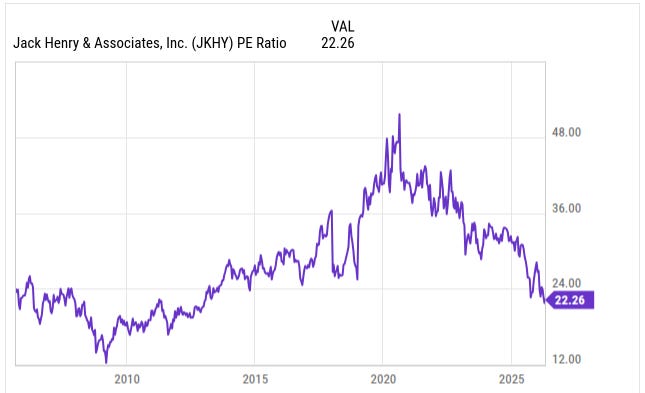
The high switching costs and deeply sticky, long-term client relationships inherent to core banking systems have allowed Fiserv, FIS, and Jack Henry to maintain dominance while steadily modernizing their platforms. It reflected in its valuation, using Jack Henry (a pure core banking play) as an example, its average P/E at mid-20x.
Merchant acquiring enables businesses (a.k.a. merchants) to accept electronic payments (credit, debit, and digital wallet).
An acquirer acts as the middleman: it connects the merchant with the customer’s issuing bank and the card networks (Visa, Mastercard, etc.) to authorize, process, and settle transactions.
Merchant acquiring started in the 1950s–60s as a paper-heavy, bank-dominated business. Electronic adoption took off in the 1980s–90s with POS terminals, followed by consolidation in the 2000s–2010s through big M&A deals (First Data, TSYS, Worldpay, etc). Over the past decade, the industry has rapidly shifted toward e-commerce and cloud-based POS systems.
Today, the market is split between traditional players (Fiserv, Global Payments), large banks (JPM, BAC, Wells Fargo), and fintech disruptors (Square, Adyen, Stripe, PayPal).
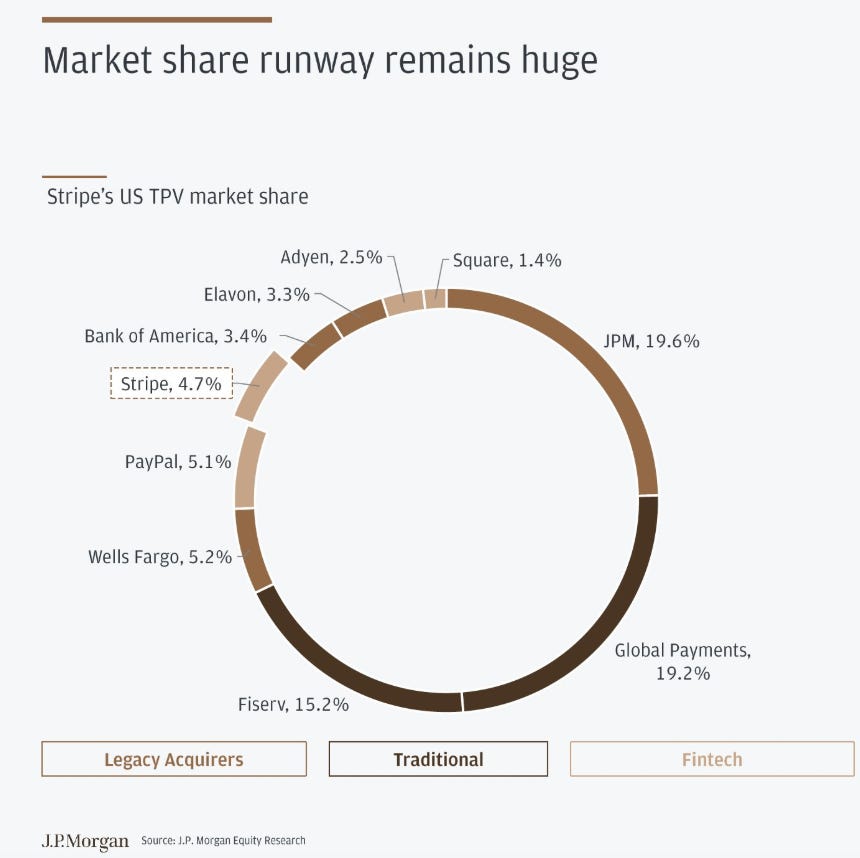
The Big Three dominate: JPMorgan Paymentech (20%), Global Payments (19%, including Worldpay), and Fiserv (15%).
Unlike core banking, fintech disruptors have made real inroads here. PayPal, Square, Adyen, and Stripe together hold ~20% market share, and keep growing, driving down multiples for traditional players.
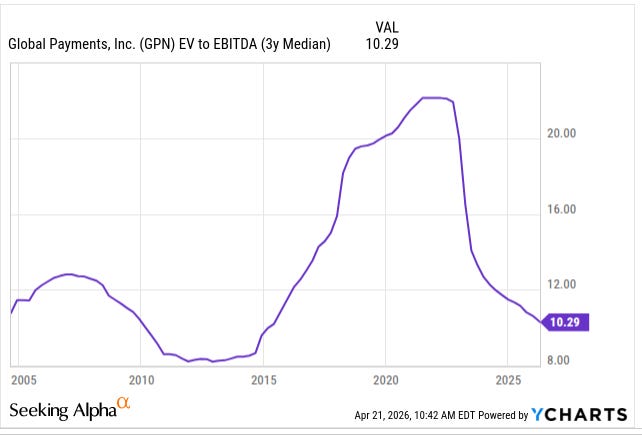
Global Payments ($GPN) is a great peer to understand how the market values merchant acquirers. Its merchant business has long been the largest and highest-margin segment, followed by the lower-margin (but still lucrative) Issuer business. Historically, GPN has traded in the 10x-20x P/E range and has been declining since 2021/22, currently at ~10x.
We will dive into each segment later, but for a napkin-math valuation, think of Fiserv as 2 separate $10Bn revenue businesses:
acquiring (Merchant): 30-35% operating margin.
Core Banking (Financial): 40-45% operating margin (1000 bps higher)
Comments
Nothing yet. Say the first thing.
Sign in to join the conversation.